

The Blues & Billie Armstrong
A Novel by Roy Dufrain, Jr
(40) ROY DUFRAIN JR | Substack
My college housemate has published his first novel, The Blues and Billie Armstrong, on his Substack. Check it out below – it is damn good, man.
The Blues & Billie Armstrong
THE BIG ANNOUNCEMENT
Jun 25, 2025
Fifty years ago I was a small town golden boy with a scholarship to a private university and the dream of becoming a novelist.
Forty years ago I was an unemployed college dropout, a speed freak, dive-bar pool shark, drug dealer and philanderer. Thirty years ago I was a newly married, newly clean newspaperman and stepfather. Twenty years ago I was owner, editor and publisher of four regional magazines. Ten years ago I was a recent college graduate enrolled in Stanford University’s online novel writing program.
Ten days ago I finished my novel…


The Blues & Billie Armstrong tells the story of Archer King, as a motherless boy puzzling out what it means to be a man, and as a man in his fifties with perhaps one last chance to live up to his own code.
Young Archer is thirteen years old in the midst of the historic upheavals of 1970 America. After his mother’s apparent suicide, his father remarries and he gains a stepsister, the barefoot, braless and hand-on-hip seventeen-year-old, Billie Armstrong, whose big personality and radical politics open Archer’s eyes to new ideas (and feelings) but don’t go over too well in the small town of Lupo Yoma, especially with Archer’s hero, local baseball legend Hank Timmons, home on leave before shipping out to Vietnam.
When they discover a cache of old blues records and love letters, Archer and Billie team up in a quest to learn the truth about his mother’s secret affair and its connection to her death. But their investigation is sidetracked when the friction between Billie and Hank explodes into flames.
Older Archer is a prize-winning, hard-drinking San Francisco newspaper columnist renowned as a fearless truth-teller. At the height of his success, Billie is captured after decades on the run from a murder charge. Archer can clear her name only by revealing the secrets he’s kept hidden for forty years. Secrets that will risk his career, his financial wellbeing, his personal brand, his very identity…and ultimately his freedom.
The book is generously salted with references to music, pop culture, baseball and American history. Howlin’ Wolf, Dave Brubeck, Country Joe and the Fish. Cronkite, body bags and Tricky Dick Nixon. I Dream of Jeanie, quadraphonic sound and halter-tops. Women’s lib, Kent State, the occupation of Alcatraz. And eighth-grade dances, the Batmobile and Little League rivalries.
It’s a coming-of-age / redemption story with a little mystery and suspense, a dash of unconventional romance, and some unexpected turns. Archer King is naive, witty, self-deprecating and philosophical, but also willful, jaded and self-destructive. He’s haunted by the huge impacts of two women in his youth—his mother and her mysterious death and love affair, and the one-and-only Billie Armstrong, who crashes in and out of his young life like a psychedelic wrecking ball, then turns up years later to do it all over again.
First Chapter: INTRO: THE PERSISTENCE >
- Title Illustration Design by Roy Dufrain Jr
- Background Fractal Art by Blair Gibb at blair-gibb.pixels.com
- Window Frame Rendering: extremal at iStock.com
The Year of Twelve Songs, Pt 12
Fire and Dreams
Jan 29, 2025
This Month’s Song: Fire and Dreams
If I were making an album out of The Year of Twelve Songs, Fire and Dreams would be the title cut. It’s also my latest song, and only a few people have heard it at all before this posting. And they heard an earlier, definitely unfinished version. That was a couple years ago, and the song has evolved quite a bit since then. It’s weird how that happens, but it does.
My messy cockpit. The Alabama sunrise out my window. Tools.
Performance & Production
Over the course of the project, I’ve tried a number of different approaches, and I think this one feels the best for me. I recorded the main guitar part solo (no vocal) to keep my mechanics clean as possible. Once I got a decent take down, I did three takes of the vocals, three takes of the lead guitar and three takes on harmonica. Then I edited out the bad, kept the good, swapped in pieces, mix and match. Like, if I like the vocals on take 1 except for the third chorus, I’ll use the third chorus from take 2 or something. Etcetera. Seems like I get the best results from this workflow. Your mileage may vary.
Lyrics
FIRE AND DREAMS
I wrote these songs in smalltown barrooms
Cheap motels and broke down cars
On paper napkins and envelopes
Dear John letters and sticky notes
With open chords and easy changes
On old guitars in standard tune
That’s all I know, and all I need
To tell these tales of fire and dreams
Fire and dreams, wind and wonder
Fire and dreams, smoke and fear
Hope and ashes, love like thunder
Fire and dreams, rain and tears
I specialize in sad and lonesome
Minor keys, major confessions
I know the words and the melody
To ease the pain of heartache past
So listen close, these are the hits
You’ve never heard but know so well
Raise a glass and raise your voice
Sing with me of fire and dreams
Sing your sins and ragged scars
Sing your peace and sing your screams
Sing the lies that tell your truth
Sing your heart through fire and dreams, fire and dreams
Fire and dreams, wind and wonder
Fire and dreams, smoke and fear
Hope and ashes, love like thunder
Fire and dreams, rain and tears
INSTRUMENTAL BRIDGE
Fire and dreams, wind and wonder
Fire and dreams, smoke and fear
Hope and ashes, love like thunder
Fire and dreams, rain and tears
Fire and dreams, rain and tears
… ……………… rain and tears
Gear & Software
Guitar: Taylor American Dream AD11e Grand Theater
Harmonica: East Top Lucky 13, key of C
Plug-ins: Waves CLA Vocals; Waves Abbey Road Studio 3
Hardware: MacBook Air 2020, with AOC 27-inch auxiliary monitor.
Focus rite Scarlett 2i2 Audio Interface
Beyerdynamic DT900 Proxy Open-back Headphones
PreSonus E5 Studio Monitors
PreSonus M7 Cardioid Condenser Microphone
Thanks for listening!
This is the last month of The Year of Twelve Songs. I posted the first song on January 31, 2024, so I’m happily amazed to say I finished the project within the time I gave myself. I learned an awful lot and had a lot of fun along the way. And now, on to the next thing, whatever that is! Thanks again and again and again to those of you who bothered to listen, like, comment or especially subscribe!
Sting-Rays, Stratocasters, Beatle Boots and Destiny
Or how I won a footrace against a dog named Pig Pen
The Year of Twelve Songs, Pt 11
The Year of Twelve Songs, Pt 10
The Year of Twelve Songs, Pt 9
The Year of Twelve Songs, Pt 8
The Year of Twelve Songs, Pt 7
The Year of Twelve Songs, Pt 6
The Year of Twelve Songs, Pt 5
The Year of Twelve Songs, Pt 4
The Year of Twelve Songs, Pt 3
The Year of Twelve Songs, Pt 2
Some words I liked a lot this year.
One fan’s thoughts on the current state of the game
Or how I won a footrace against a dog named Pig Pen
Jun 17, 2023 •
We saw 9.5 of the 10 Best Pic Nominees
Is Hitting a Baseball Really the Hardest Thing to do in Sports?
Two guys in recliners share their wisdom
Why he was a hero whether we agreed with him or not
December 2021
How John Lennon validated my self-belief
A Live Reading of an Excerpt from my Novel
A Young Man’s Journey Toward Meaning
Sting-Rays, Stratocasters, Beatle Boots and Destiny
A live reading in San Francisco
A tip of the hat to Stan and Willie
Me & the Godfather down in Fuzzy town
A personal tribute marking the 2020 death of a unique voice in American music
A Walk Through Hell With A Friend
A special bond forged in the worst of times
The Blues & Billie Armstrong 2
UNEASY LISTENING
Jul 02, 2025
The Blues & Billie Armstrong 1
INTRO: THE PERSISTENCE OF TRUTH
Photo by Pavel Mikhailov at iStock.com
Perhaps you’ve seen the video of my arrest.
I was told it went semi-viral, another disease upon the disease that already is the internet. Friday night I was celebrated for receiving the Pulitzer Prize for Commentary. A lavish banquet was held in my honor in the Gold Room at San Francisco’s Fairmont Hotel. Saturday night—or rather, early Sunday morning—I was handcuffed by a police officer and digitally immortalized by some pixel headed tourist kid with a smartphone and a sideways Dodgers cap.
The video appears above the clever title: Prize-winning Writer Dovi’d and Toke’d. The footage opens with a wide shot of my 2010 Cadillac CTS, run aground, cockeyed and high-centered on the concrete island in the middle of Lincoln Way—mere blocks from my home. I stumble out of the car, leaving the door flapped open. On the Bose stereo, Howlin’ Wolf is growling out Moaning’ at Midnight.
A dashboard warning bell dings out of time. Red and blue lights spin and strobe in the night. You hear a quick woo-hoo from a siren. The picture jiggles as the camera zooms in, the officer walks into the frame, asks if I’m alright, sweeps the beam of his flashlight across the interior of the Cadillac. The camera can’t see into the car, but I can tell the cop is curious about the mess on the passenger seat vintage ladies hatbox, the lid tossed aside, old letters and yellowed newspaper clippings spilled onto the seat and floorboard. No hat in sight.
It’s long after midnight, but I say, “Good evening, officer.” I lean on the Caddy, the picture of casual debauchery.
“License and registration,” he says. I pull my wallet out of my back pocket and fumble it to the ground, then manage to pick it up and hand it to the officer with a hapless shrug. Asserting my rights, I slur out a refusal to take the field sobriety test. The cop nods, unperturbed. My chest expands as if I’ve scored a minor victory. He’s not impressed. “Mr King, I’m placing you under arrest for driving under the influence. Please turn around and place your hands behind your back.”
I begin to sputter bitterly. “God damn her,” I say. “They said she was dead. Now she shows up out of nowhere after all these years… like a fucking ghost? God damn Billie Armstrong.” My arms stretch out as if I’m being unjustly martyred. The cop calmly spins me around and tries to gather my hands but I yank loose and start firing punches at the hood of my own car. A solid combination, a right and left jab followed by a hard overhand right that shoots pain throughout my body like I’ve been tased.
The cop tries again to corral my hands, but I whip around and take a wild swing in his direction. Fortunately, I miss by a mile, lose my balance, and down I go, ass-first, tailbone smack against the curb. I’m lying on the pavement for a ten-count, and he just shakes his head, helps me to my feet and snaps the cuffs on. He shoves me to the patrol car, stuffs me into the back and slams the door.
You see my face through the window, the whirling lights bouncing off the glass, my mouth in a holler. My voice now distant and faint and the tone shifted to righteous self recrimination. You only hear snatches of my crazed lament—some garbled nonsense about “the persistence of truth.”
Meanwhile, Howlin’ Wolf is still moaning the blues in my Cadillac.
Previously in The Blues & Billie Armstrong…
You see my face through the window, the whirling lights bouncing off the glass, my mouth in a holler. My voice now distant and faint and the tone shifted to righteous self recrimination. You only hear snatches of my lament—some garbled nonsense about “the persistence of truth.” Meanwhile, Howlin’ Wolf is still moaning the blues in my Cadillac.
The first time I heard the blues was a gray rainy Wednesday in September of 1969.
I was sitting with my mother in our house on Fourth Street. I was twelve years old, almost thirteen; she was thirty-two and quite dead.
This was up in Lupo Yoma City, a small-minded town next to a big muddy lake in the hills of Northern California. Earlier that day I’d walked out the front door under a clear sky. I was halfway across the lawn when my mother hollered, “Your lunch!” I ran back and she handed me the brown paper bag, the top folded over twice with a sharp straight crease and my name printed neatly with black felt pen on both sides. She wore a sundress with blue flowers on a white background, and I didn’t think to tell her how pretty she looked.
That afternoon the sky crowded up with gray-bellied clouds and it began to rain. At school we were kept inside watching a movie about Dr. Leakey digging skeletons out of the ground in Africa. After the final bell I took the bus to Fourth and Main and ran the last block home through the downpour. I stopped on the covered porch and wiped my sneakers on the welcome mat so I wouldn’t get yelled at for leaving wet footprints on the floor.
Inside, the house was full of the empty hush that brings background noises into the foreground—the loud tick of the second hand on the grandfather clock, the refrigerator hum leaking in from the kitchen, the rain stammering against the roof. And something unfamiliar, a rhythmic scratching I couldn’t identify but followed back toward my mother’s room—not the room where my parents slept, but the one she called the “dayroom,” where she kept the art deco vanity with the big round mirror, the typewriter on the yard sale desk, the Singer sewing machine, and the twin rollaway bed where she suffered through her migraines.
The door was open.
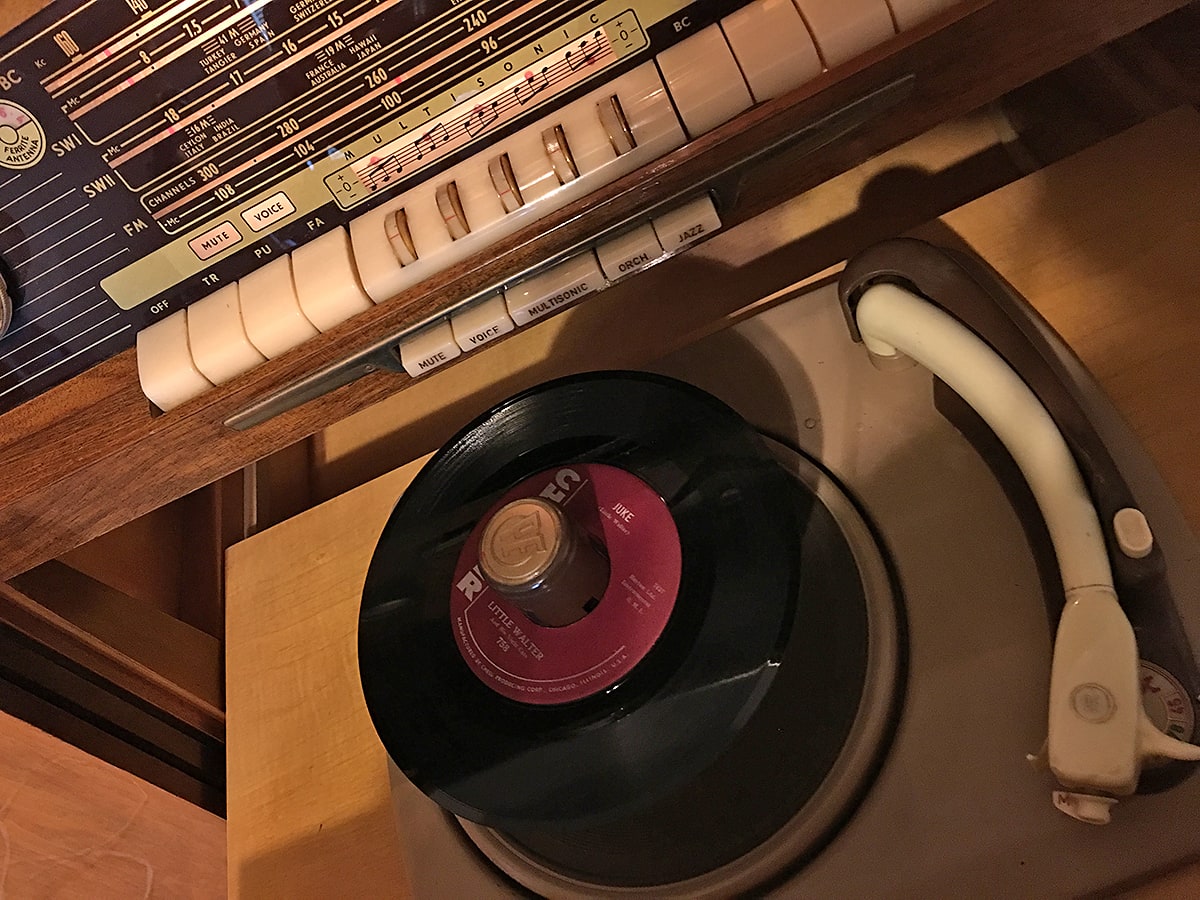
The scratching sound came from the Grundig Majestic hi-fi, which I’d almost forgotten was in there. As far as I knew it hadn’t been used in a couple years, since the day I helped my father move it out of the living room to make way for his brand new Magnavox Astro-Sonic Stereo Console, which he enjoyed showing off to guests, always finding an opening for the same hokey line—that he was serving “Sinatra and Seagram’s.”
The old Grundig’s auto-changer didn’t always work properly, and now the phonograph needle was stuck in that blank moat at the end of a record, scratching back and forth.
My mother lay on the rollaway bed, on her back in the sundress, on top of a pale green chenille bedspread. I thought she’d fallen asleep listening to the hi-fi, but on the nightstand the lamp was left on and a half-gone fifth of vodka stood uncapped in a small circle of dusty light next to an empty highball glass and a huddle of drugstore pill bottles.
My mother had a warm brown complexion that showed her Mexican-Irish blood, but now her face was drained and bluish gray. Mascara ran in river stains down her cheeks. There was no sound of her breath. Her chest and stomach did not rise and fall. Her head drooped to one side and a trail of vomit ran from the corner of her mouth onto her neck, the smell of it tainting the air.
I didn’t want to scream or cry. I wanted to show grace under pressure, courage under fire. I tried to think of a movie, a book or a TV show with a reassuring synopsis—faint-hearted kid finds dead mother’s body, reacts with perfect composure, proves manhood.
I found my way to the kitchen, thinking I should call someone. The year before, my mother had redecorated. She’d painted the walls sunflower yellow, ordered a new fridge and range in harvest gold, and new vinyl flooring in a striking orange-yellow-brown pattern. I remember how proud she was when the project was finished, and how my father mocked her by wearing sunglasses to the dinner table.
A yellow plastic phone was mounted on the yellow painted wall. I stood with the receiver held away from my ear, the dial tone buzzing, and I considered the handwritten list of phone numbers tacked to the wall: the local newspaper where both my father and grandmother worked, my aunt’s beauty parlor, our family doctor’s office, the police and fire departments. I tried to rehearse what I would say, but I couldn’t arrange a clear sentence in my mind. I couldn’t imagine the words “my mother is dead” staggering out of my mouth.
The square, electric Timex on the wall above the table said 4:15. Phone call or not, my father would probably be home within an hour, bustling through the door ready for a stiff drink and Walter Cronkite. Did I even want to be here then? I felt oddly embarrassed—ashamed even—to be the one who found her like this, to be in the position of informing adults of something so completely out of a child’s domain. I didn’t want to be the bearer of this news, but I also didn’t want to be the boy who couldn’t bear it.
I hung up the phone without dialing and drifted back to the dayroom like a sleepwalker. I slumped onto the low stool at the art deco vanity and listened to the scratching and crackling still coming from the hi-fi, and in the big round mirror I saw my boyish face alongside the reflection of my mother on the bed. We were near lookalikes. She was five feet tall, I was an inch shorter. Both slender and tanned, with brown hair so dark it looked black in low light. She styled her hair like Jackie Kennedy (not Jackie Onassis), with a curved swoop of bangs above one eye; my father sent me to the Main Street Barbershop for a “regular boy’s haircut” which always left me with a similar swoop.
I wasn’t sure what it meant that I hadn’t noticed all this before—not only the ways we looked alike, but any hint of this end. I was so clearly her son, but did I even know her? What twelve-year-old boy truly knows his mother—her dreams, her regrets, her pride and shame?
The blue-flowered sundress had two pockets thigh-high on its front. Still gazing at the vanity mirror, I caught the white flash of something peeking out the top of one pocket. Turning around for a direct view, it looked like the corner of a folded piece of paper.
I couldn’t remember the last time I had willingly touched my mother. She had touched me—pushed the hair out of my eyes, turned my collar down, tried to hug or kiss me—but your average American boy knows when it’s time to start keeping motherly love at a distance, especially in public.
Touching my mother’s body at that moment might drive me screaming out of the room, out of the house and into the Lupo Yoma streets, but I wanted to retrieve that piece of paper. I had the shy, needy hope that it might hold a clue that would help me understand. I walked around to the other side of the room, put one knee up on the bed and leaned over precariously. I grasped the corner of the paper with fingertips and carefully slid it out of the pocket without touching anything else.
It was a stationery envelope, addressed in my mother’s handwriting to someone I didn’t know, a PFC J.R. Cole. The name meant nothing to me, but the envelope suggested she was planning to go out that day—to mail the letter if nothing else. She didn’t need a stamp, because you could send letters to soldiers for free, but there was no mail delivery within the city limits of Lupo Yoma, so she would have to go to the post office or the nearest public mailbox to send a letter. Then I turned the envelope over and saw the pink imprint of a lipstick kiss.
It didn’t make sense. She knew I would be the first one home. I’d seen her purse and car keys waiting on the yard sale desk. Now I’d found outgoing mail in her pocket. She was clearly planning to go out. Maybe the rain clouds changed her mind. Or a headache came on and she laid down for a nap. But the vodka, the pills and the kiss on the envelope spun my thoughts off in other directions where I didn’t dare follow.
The scratch-scratch from the hi-fi now seemed amplified to oppressive intensity as if someone had cranked the volume knob. I couldn’t think straight. I crossed the room and lifted the needle off the record. The scratching stopped, but the silence was unnerving.
On the turntable a short stack of 45s had been set up and played one after the other. I held the turntable arm suspended in the air and read the label on the top record. “Sad Hours,” it said, in silver-gray type on a red spinning background, and I wondered if she’d known this would be the last song she ever heard, if she’d planned it that way and set up the whole stack like some grim Top 10 countdown. I watched my hand drop the needle at the beginning of the track, and I sat down on the bed next to my mother, envelope still in hand.
What came out of the speakers was not my father’s Sinatra, nor one of my mother’s favorites like Trini Lopez or Peter, Paul and Mary. It wasn’t folk or rock-n-roll or jazz or swing or country and western. And it definitely wasn’t easy listening. It was like meeting someone who speaks English but with a seductive accent you’ve never heard before.
The bass line ambled into the room and paced the floor in a circular path with sad sack persistence. An electric guitar chimed in with jangly complaints of its own. Brushes gossiped to a snare drum and the chick-chick of the hi-hat punctuated the beat. An instrument I couldn’t name took the lead—a horn of some kind that announced itself with a long, distant moan, then whined and wailed and honked bitterly. It shook its head in regret and wagged a finger in warning. There were no words, yet the unidentified horn spoke of dark days and busted hearts, of sorrow and resignation. It seemed to accuse, confess, beg forgiveness and promise a fight all at once.
Jerky film clips of shuffled memory flickered across my inner sight—the lilt of my mother’s inflections as she read me to sleep when I was little, red pedal pushers and white sunglasses in the Little League bleachers, a swipe of kitchen yellow on her forehead, the scent of Aqua net hairspray hovering by the vanity in this very room.
When the song was over I wiped my eyes with a shirt sleeve and got up and turned off the hi-fi. The Grundig Majestic was a mid-fifties model in a honey-colored wood cabinet with double sliding doors that covered all the knobs and buttons when closed. The turntable was further hidden in its own drawer that had to be pulled open for access. I closed up the whole thing with the 45s still stacked on the turntable. I grabbed the Vodka bottle off the nightstand and swigged a mouthful that burned like cold gasoline, set the bottle back in its place beside the empty glass and the pills.
I took the pink lipstick envelope to my room and hid it under the bed in the Kids shoebox with my baseball cards.
I pulled on a jacket and my Giants cap and slipped out the back door into the whispering rain.
The Blues & Billie Armstrong 3
PINCH HITTER
Photo by cottonpox studios at pexels.com
Previously in The Blues & Billie Armstrong…
I took the pink lipstick envelope to my room and hid it under the bed in the Kids shoebox with my baseball cards. I pulled on a jacket and my Giants cap and slipped out the back door into the whispering rain.
Our house stood at the bottom end of Fourth Street, half a block from where the pavement sloped right into Lupo Yoma Lake.
On the other side of our backyard fence was the dirt parking lot of the Lupo Yoma Yacht Club, which wasn’t quite as grand as it sounds and actually just a kitschy clubhouse for old Rotarians with old boats. But, beyond the Yacht Club, across Third Street, was the boundary of Library Park, a typical small town park with a couple square blocks of lawn populated by looming trees and wooden picnic tables. There was a dock with a diving board, a green cement tennis court, and the ivy-covered Lupo Yoma County Carnegie Library.
A few summers before, I’d loosened one of the wide planks on our fence so it appeared to be solidly in place but could easily be set aside to open a shortcut to the park. Now I stepped through the gap, checking the Yacht Club parking lot for possible witnesses, my mind a tangle of shame and confusion and urgency, my breath quickened. I didn’t want anyone, especially my father, to know the truth—that I’d been in the house, seen her, and left. My father was the editor of the Lupo Yoma Call & Record. He was an old-school, self-made newspaperman who curated facts for a living and had no patience for sugar on top. A man has to look life in the eyes, he liked to say. Death as well, I supposed.
And it started to dawn on me that I had possibly tampered with evidence by taking the envelope. I recognized this as the physical embodiment of what my father would call a lie by omission, but I had no intention of sharing the envelope with him or anyone else. Maybe I was protecting him, or my mother, or the rest of the family, or myself. Maybe I just wanted some piece of her all my own. Cowardly. Protective. Selfish. Bereft. All of that and more in an emotional blur, the colors run together like oil riding water.
I needed to slow down the drumming in my chest and stop the technicolor movie of the dayroom that was replaying in my head. And all the questions. The storm had emptied the park of citizens except the ducks who waddled around bickering over puddles that would soon disappear. I walked along the concrete promenade that ran the length of the park and listened to the hushing sound of the rain falling on the lake.
South of the park was the Weeping Willow Resort & Trailer Court, and I resolved to wait there to be found and notified of my mother’s death. The game room at the Weeping Willow was a regular hangout for me and my buddies. I figured that was where the adults would think to look for me if I was late coming home on a rainy day. My maternal grandparents owned the place, but they were always so busy running the restaurant and the rest of the resort that we kids were usually unsupervised in the game room. We’d play pinball, feed the jukebox, drink sodas and share cigarettes stolen from our parents. If there weren’t any older kids around to hog the pool table, we might shoot a game of eight-ball or cut-throat.
Timmy Bilderback and Joey Quarterman were already there, Timmy at the Pinch Hitter pinball game, Joey standing at the jukebox looking over the song selection.
“Hey Archer, got a quarter?”
I flipped him a coin. He dropped it in the machine and punched buttons. Three songs for two bits. Joey picked Daydream Believer by The Monkees, his favorite band. He had an autographed photo of Davey Jones on his bedroom wall, which he got by writing to the Official Monkees Fan Club. He moved aside and nodded for me to take my turn. Most of my favorites back then were Beatles songs, but all the tiny labels on the jukebox blurred together like when I was a little kid wearing my father’s bifocals. And I could still hear Sad Hours in my head—the echo of that strange lonely horn.
“You okay, man?” Joey must’ve caught the faraway look in my eyes.
I finally focused on the label for Penny Lane and punched in the number with Timmy now looking over my shoulder, encouraging me to “Pick a song already, dipshit.” Then he ragged on Joey that Davey Jones was a homo and the Monkees weren’t even a real band, and he punched in some Steppenwolf. I’d known Timmy since the second grade, but I didn’t know what he had on his walls—his parents were loud, unhappy drunks, and he never invited anyone inside.
I bought a can of Squirt from the coke machine, bummed a cigarette from Timmy and tried to act like I hadn’t gone home after school and found my mother dead in the dayroom. The cue ball was loose on the green felt of the pool table, and I slung it around with my hand trying to make bank shots while waiting for my turn at pinball. Steppenwolf roared on. Outside my head, the whole scene unfolded like a hundred other forgettable days at the Weeping Willow game room.
I was racking up points on the Pinch Hitter pinball machine, lost for the moment in the blinking lights and the bells and the bumps, when my Aunt Laurette appeared at the sliding glass door, peering in with her hands held up to form a tunnel around her eyes. Rainwater dripped down the door and blurred her face.
“It’s your aunt with the tits,” Timmy said. Even among twelve-year-old boys, Timmy Bilderback’s level of sexual energy was considered somewhat obsessive. Laurette King was actually my cousin once removed; I knew her mostly from holiday gatherings or as my occasional babysitter. According to Timmy, she was a “screaming’ hot piece,” and I admit I agreed, but I did so in secret, her being family and all. Mid to late twenties, trim but curvy, long dark hair ratted up on top, flame-blue eyeshadow. It’s fair to say she was the black sheep of the family thanks to a teenage marriage and divorce and some other hinted failings which I’d repeatedly been assured were none of my young business. As she entered the game room I looked up, and my last ball fell uncontested past my flippers. The game-over light flashed red.
She didn’t look like a hot piece right then, her eyes puffy, her face pale and slack. “Archer, there’s been an accident,” she said. I stared like an amateur actor who’s forgotten a line. The jukebox sang Penny Lane in the background. “You need to come with me,” Laurette said, and she took me by the hand and pulled me outside. The rain was falling hard again. “Come on!” she shouted, dragging me splashing across the wet black parking lot to the shelter of her Volkswagen Beetle.
We sat in the front seats with our dripping hair stuck to our heads. She put the key in the ignition but didn’t start the engine. Rain covered the windows, swirling the outside world. She gripped the steering wheel so hard her fists trembled. She released her fingers carefully, as if they fought her, and she slammed the heels of both hands against the wheel. Mascara flooded down her face. She delivered the news, crying and nearly shouting over the din of rain against cheap metal. She said my mother had mixed up the nerve pills and the headache pills and the sleeping pills. Or somehow lost track and tripled her dosage. Or maybe she’d forgotten Doc Meaney’s advice not to mix her vodka with the pills. No one was sure. “A terrible accident.”
I didn’t know how I should pretend to react; I had no clear sense of what the expectations were. Doc Meaney, who was also the county coroner, had been to the house and ruled my mother’s death an accidental overdose.
I had to resist the urge to pour out the truth.
Earlier that summer Laurette had caught me stealing a couple Marlboros out of her purse. She’d made me light up in front of her, teased me about my cough and my inexperienced, effeminate hold on the cigarette. She gave me a mild lecture but never mentioned it to the other adults in the family. Still, I kept quiet about what I’d seen and heard in the dayroom. And what I’d taken.
My face must’ve looked blank, no tears came.
Illustration by Roy Dufrain Jr / Background photo by misscherrygolightly at iStock.com
The Blues & Billie Armstrong 4
THE CLOTHES MAKE THE BOY
Jul 07, 2025
Photo by Ernesto Suarez at iStock.com
Previously in The Blues & Billie Armstrong…
She gave me a mild lecture but never mentioned it to the other adults in the family. Still, I kept quiet about what I’d seen and heard in the dayroom. And what I’d taken. My face must’ve looked blank, no tears came.
I wanted a gray suit like I’d seen my father wear.
Grandma Junia drove me to JC Penney’s in Santa Rosa—two hours of twisted road, dusty oak trees and September hills. It was the first time I was allowed to ride in the front seat of her 1959 Buick Electra, a decade old already but still the closest thing to the Batmobile on the streets of Lupo Yoma City. Angular and sleek, acres of windshield, space-age curves, great winglike fins over the taillights. Totally cherry and always waxed and polished glossy black, with white leather seats and chrome eyebrows over the headlights at the same sharp angle as the ones Grandma Junia drew on her face.
I studied her movements closely—the rise and fall and crinkle of her full skirt as her foot switched between gas and brake, her hands moving lightly but knowingly on the steering wheel, the silver painted fingernails that matched her frosted hair. I daydreamed myself in that driver’s seat, in full command of that shining blade of a car, climbing toward some heroic adulthood that would include facial hair and certainty.
She had an 8-track tape player and six or seven tapes in the glove compartment. You wouldn’t expect to find anything like Sad Hours in there. She wouldn’t even let me play the one old Beatles tape she had. She said it was “childish and common,” and she claimed the Columbia House Record Club had sent it by mistake. She liked the schmaltzy Big Band dance music of her youth—Glenn Miller, Tommy Dorsey.
But she also dabbled in West Coast Jazz, which she assured me was “highly sophisticated.” Grandma Junia had often complained that my cultural education was being neglected, and when we fell uncomfortably quiet she turned up Take Five by Dave Brubeck and counted the beats out loud to illustrate five-four time. “One-two-three-four-five, one-two-three-four-five.” Because every twelve-year-old needs a lesson in odd time signatures on the way to buy a suit for his mother’s funeral.
The boys department at Penney’s had exactly one suit that almost fit me, and it was not gray. My hands disappeared into the sleeves when I held my arms straight down, and the pantlegs piled up on the tops of my shoes like rubble. Muttering into the dressing room mirror, I complained too loudly that the color was Dodger blue—clearly unacceptable for a born and raised Giants fan. Grandma Junia barged in with her arms crossed. “Archer Edward King! You will not attend this function in your worn-out school clothes. A boy your age without a decent suit—your mother should’ve known better! Now, this will do fine… and that’s that.”
Whenever Grandma Junia said that’s that, she would quickly brush her hands past each other and then open them as if she had magically eliminated the grime of complexity. And when Junia King said that’s that, well… that was that.
I stood beside my father, Grandma Junia and Aunt Laurette on the wraparound porch of Jones & Jones Funeral Home, a pompous Victorian on Main Street that had once been the Jones family home.
The white painted floorboards glared in the morning sun. I shifted foot to foot in my Dodger blue suit and watched my father shake the hands of the men who filed by in gray and black. I surmised that my function at this function was to establish my ability to shake hands appropriately—in other words, like a man. I kept my right arm cocked in the handshake position so my hand wouldn’t disappear into my sleeve, and I concentrated on shaking hands with each man—firmly, with level eyes and a straightened mouth. No crying.
My mother’s parents, Pop and Molly, arrived in their old Chevy pickup. Their real names were Edward and Mary Medina but most folks in Lupo Yoma knew them simply as Pop and Molly, because they’d been around so long and had owned the Weeping Willow since I was “knee high to a crawdad,” as Molly would say.
Aunt Laurette hurried down the steps to greet Pop and Molly in the parking lot. Laurette had been a waitress at the Weeping Willow in her high school years, and she was the one who’d introduced my mother to her cousin Mike King. In that way, Laurette was the original bridge between the King and Medina families.
Pop always said Molly was “ninety-five pounds of gristle and backtalk,” but that day she looked shrunken and caved in, her tiny hands colorless against the black of her dress. Laurette guided her up the porch steps with a hand on her elbow. She rushed straight to me like I was a kindergartener with a scraped knee, and she pulled me close by the lapels of my suit and stood tiptoe to kiss me twice on the forehead. She was the only adult I knew who was shorter than me. She looked at my father and sighed and shook her head like she was disappointed. She started to speak, but her chin quivered, her eyes puddled, she bit her lip and looked away.
Pop came up the steps and walked right by my father as if he wasn’t there. He walked toward me, I put out my hand, and he shook it strongly and gripped my shoulder with his other hand. Pop seemed twice Molly’s size and his big calloused hand swallowed mine whole. He didn’t speak, but he locked eyes with me and I believed this was his way of lending me strength. Molly crossed herself and went crying into the depths of the funeral home, but Pop didn’t follow.
Grandma Junia was the only person who called Pop by his real name. “Edward,” she said, “you’re not going in to see your daughter?”
Pop shook his head. “No, not like that.” He looked Grandma Junia’s way, then swiveled to draw in my father’s attention as well. “But you two make sure and take a good long look.” He turned around, stepped down from the porch and headed back up the concrete path toward the parking lot.
“What’s wrong with Pop?” I said.
“He’s just upset, son,” my father said.
“With good reason,” Laurette said, and I thought yes, she was his daughter, his Chiqui Tita, his little one.
But Grandma Junia said, “Oh hush, Laurette! As usual, you don’t know what you think you know.”
“Well, I only know what I read in the newspaper,” Laurette said. And maybe I should’ve wondered what she meant by that.
When we entered the viewing chamber I followed my father’s gaze across the room, where the casket was raised up on a collapsible gurney that reminded me of a sprung jack-in-the-box toy. He paused and wavered unsteadily in the doorway, lowered his head, ran one hand through his thick black hair. “Son, you don’t have to look if you don’t want to,” he said. I was surprised. It was unlike him to offer me such a hall pass, and I hesitated at the back of the room.
But Grandma Junia said, “No, it’s about time he got a grownup look at the way of things.” And she steered me by my shoulders, pushing me toward the open coffin.
My mother was dressed in moonlight blue, a double-breasted woolen jacket buttoned over a silky white blouse, a string of pearls at her neck. She looked ready for church or work or a trip on a train. I took a good long look, wondering what Pop wanted my father and Grandma Junia to see. She was so still. So empty. I thought of the statues I’d pretended to shake hands with at the Wax Museum on our class field trip to San Francisco. I thought of her in the blue flowered sundress on the rollaway bed in the dayroom. I wanted to rub her forehead like she always asked me to when she had her headaches. I wanted to listen to stories of her childhood and tell her how lovely the yellow kitchen looked in the morning. I wanted to ask why.
Grandma Junia leaned in over my shoulder, so close that a stiff strand of her fresh-frosted hair prickled my ear. “Presumably, she’s in a better place,” she said, and the words smelled of beauty shop ammonia.
The recorded sound of a church organ poured out of speakers mounted in each corner of the room. I was drowning in it. My knees began to give in to the undertow. Grandma Junia finally turned me away from the coffin with a hand around the back of my neck and guided me to one of the folding chairs. The metallic cold seeped through my slacks. The organ music stopped. Reverend Jameson started a prayer and we all bowed our heads and closed our eyes.
Wet sobs broke out around me but I couldn’t cry. I couldn’t keep my eyes shut. I couldn’t stay in that chair, that room. I heard the hi-fi scratch-scratch in my head and I wanted to holler out the truth. I rose to my feet but Grandma Junia tilted her head up and raised one penciled eyebrow. “Where do you think you’re going, young man?”
I turned and fast-walked up the aisle, between the folding chairs and bowed heads, and clattered out of the room as the reverend began to read from scripture. “Brothers and sisters: behold, I show you a mystery; we shall not all sleep but we shall all be changed.”
I ran through the lobby and flung open the door. I ran across the parking lot, where Pop was sitting in the old pickup. He called out, but I didn’t answer and kept running and turned down a gravelly alley of dumpsters and back doors. I had no destination in mind other than escape. I ran two blocks north in the alley, then a half block west up to Main Street and another block north. I ran past Rexall Drugs, two dive bars and the old courthouse with the World War I cannons on the lawn.
I made a right turn down Third Street, deciding I would slip through our back fence again and hide out at home. But down the sidewalk I saw the sandwich board advertising the local music store, The Music Box.
I stopped, bent over at the waist, hands on knees, caught my breath.
The Blues & Billie Armstrong 5
LITTLE WALTER JACOBS
Jul 09, 2025
Previously in The Blues & Billie Armstrong…
I made a right turn down Third Street, deciding I would slip through our back fence again and hide out at home. But down the sidewalk I saw the sandwich board advertising the local music store, The Music Box. I stopped, bent over at the waist, hands on knees, caught my breath.
Nate Henderson was a nineteen year old kid whose parents owned The Music Box.
He’d been considered a bit of a geek in high school, even though he played in a local rock band—the kind of guy who couldn’t look cool even with a guitar in his hands. After Lupo Yoma High, he’d gone to Santa Rosa Junior College to study business (and evade the draft), but he still helped out at the store whenever he was in town. I’d never actually met him before, but back then Lupo Yoma was a snow globe of a town, where everything seemed to be within five blocks of everything else and everyone knew the TV Guide version of your life story even if you’d never spoken directly to one another.
I walked in the store, approached the counter and asked Nate if he’d ever heard of a song called Sad Hours. Nate was a tall, skinny guy, with brown wavy hair almost to his shoulders and parted sharply on the side so it cut diagonally across his face and sometimes obscured one eye. He asked who the recording artist was, and I had to say I didn’t know—looking at the record on the turntable I hadn’t focused in on anything but the title. Nate plopped a big thick catalog on the glass countertop and thumbed through its pages, stopped and shot me a look of mild surprise.
“So, how’d you hear of this song anyway?”
“I found it on my mother’s record player.”
He brushed his hair aside. “No way. Trini Lopez, Sinatra or Streisand for your dad’s birthday, but she never bought anything like this that I know of.”
“So, what is it?”
It turned out the horn I’d heard was actually a blues harmonica player known as Little Walter Jacobs. Nate showed me a picture beside the listing in the catalog. Little Walter Jacobs was a black man with a hardscrabble face and big haunted eyes. I’d associated the harmonica with campfire songs and Bob Dylan. I had no idea it could be made to moan and shout and protest all the disappointment of the world.
Until that moment I didn’t even know enough to label what I’d heard in the dayroom as “blues.” Even with my mother’s Mexican blood, I was basically a green white kid from the hills of Northern California. I was so white I didn’t know the blues was black. I only knew it stabbed me in the heart in some way no other music ever had and it mystified and worried me that it was apparently so meaningful to my mother.
Nate said Sad Hours was originally released in the early fifties and was already something of a rarity. He said that kind of blues was way out of style these days. Little Walter had died a year or so before and all his singles were out of print. There was just one album listed in the catalog, which Nate could order, but I didn’t have the four bucks for that, not to mention I didn’t even have a record player of my own.
I thought of my mother singing Lemon Tree along with her Trini Lopez album while ironing my father’s shirts, and I couldn’t help but wonder how she would come into possession—or even awareness—of such an oddity as Sad Hours, which seemed so out of place in her world and in our home, a musical interloper. And could Little Walter’s harmonica be related to the pink lipstick on the back of that envelope?
I thanked Nate for the info. He said “By the way, sorry about your mom, kid.” And I left the store and headed down Third Street toward the lake. I took the shortcut across the Yacht Club parking lot and back through our fence with the odd feeling that I was sneaking into my own house.
I had the idea to get back into the dayroom—now, while the adults were gone. The past few days had felt like our home was quarantined with disease. I was ordered not to leave the property and not to have friends over. No one outside the family came to visit. Grandma Junia manned the kitchen sink, dusted the living room furniture, created small corners of routine and conducted muffled conversations on the yellow phone.
My father left early for work, came home late and sat in the nervous television light with the sound down low. He rarely spoke and was rarely spoken to. He drank and watched TV with a stare like he was looking right through the picture. Molly dutifully appeared at the front door one evening to deliver a glass casserole dish of Pop’s famous enchiladas while Pop waited in the Chevy pickup parked at the curb, with the motor running and Hank Williams honky-Tonkin on the radio. At other times, Aunt Laurette had flitted in and out of the house on missions for Grandma Junia—to the market with a list, to the dry cleaners with funeral clothes.
And, all along, the door to the dayroom stayed closed in a forbidding way, with the adults guarding it peripherally as they went about their quiet preparations. There seemed to be an unspoken understanding that the room should remain undisturbed.
But now I stood at the closed door of the dayroom, doorknob in hand, my heart running wild and snapshots of memory flashing behind my eyes like tiny fireworks. I couldn’t seem to turn the knob. In the center of my skull I heard the staticky scratch-scratch as if the needle was still stuck at the end of that record and my mother still lay on the bed. I could not will my wrist to perform the motion to turn the knob and open the door. My body simply wasn’t ready to be alone in that space again, to re-live those first minutes of knowing—and the swarm of questions, the not knowing, that followed.
I had figured someone would come looking for me after I ran out of the funeral, and I knew sooner or later they’d look for me at home. I thought Grandma Junia would probably delegate the errand to Laurette as she had before. But I heard the low grind of Pop downshifting the old Chevy truck and the squeal of the brakes as he brought it to a halt at the curb outside. The motor grumbled to a stop and the truck door closed with a thunk.
I only had a few moments before he would make it up the walkway and through the front door.
1
40
The Blues & Billie Armstrong 6
WAVES UNDER STARLIGHT
Jul 11, 2025
Photo by kmdgrfx at iStock.com
Previously in The Blues & Billie Armstrong…
The motor grumbled to a stop and the truck door closed with a thunk. I only had a few moments before he would make it up the walkway and through the front door.
Pop found me in my room, sitting cross-legged on the bed.
He didn’t say a word, just stood towering over me and waved his head toward the door. I walked ahead of him and he herded me out to the front yard. I climbed up into the cab of the pickup and sat on the passenger side. A busted six pack of Oly sat between us on the bench seat. Pop started the engine, opened a beer, turned the truck around and drove up the little rise to the stop sign at Main Street just in time for me to see the yellow headlights of the black hearse as it passed by toward the cemetery.
Molly was riding in front, chin up, eyes ahead. I watched the polished coffin through the long side-window, framed by black curtains. The hearse was followed by the shiny Buick Electra, with my father’s stern profile in the window, Grandma Junia’s frosted beehive rising up on the driver’s side. I counted seventeen cars, headlights glowing like day stars. Pop turned on his own lights and pulled in behind, and we followed in silence to Lupo Yoma Cemetery, a few miles north of town. He parked at the end of the long line of cars and turned off the motor, and the cab filled up with quiet hesitation.
I said, “Pop, why did it happen?”
He looked at me hard while considering the question. Then he looked away. “You never really know another person’s why, boy. Sometimes it’s hard enough to know your own.”
“But it was an accident, right? And an accident isn’t anyone’s fault.”
“I don’t know about that.” He stared through the windshield at the acres of gravestones. He grabbed a fresh beer, got out of the truck, stood with the door still open.
“I’ll stay here,” I said, eyes averted, tears beginning to spill onto my cheeks.
I heard him open the beer, then watched him hunt his way between the grassy graves, toward the circle of mourners, where he took his place beside Molly. I turned on the radio and listened to George Jones sing an old song about roses while my mother’s coffin was lowered into the red clay Lupo Yoma ground.
On the way back, I rode in the middle between Pop and Molly. Pop turned the radio off and none of us spoke, and I expected that would remain the tone of the day—quiet and somber with hushed voices and downward eyes. This being my first experience with a death in the family, you’d think someone would’ve told me about the after-funeral party, although I don’t think the adults even told each other—no announcement, no invitations, they just knew. They didn’t even call it a party; they spoke of it later as a gathering or get-together or, more formally, as a reception. I thought those were for weddings.
Pop turned the pickup down Fourth Street, and there were already six or seven cars parked on our block. Multiple women paraded from car to house, carrying great tinfoil-covered platters held out in front of their breasts.
One woman balanced her offering and tried but failed to close her car door with a well-placed shove of her high-heeled foot. My father came to her rescue and relieved her of a large tray. Pop watched through the windshield as he parked the truck a little ways up the street. He took a breath, and it looked to me like he set his jaw for trouble. He jerked the door handle and swung the door open, but Molly reached across me and touched him on the arm, and he slowly closed the door. “I think we’ll be going home now,” she said and got out of the truck, stood on the curb and made room for me to get by.
Pop stared straight ahead.
Molly said, “You go on inside, Archer. And tell Laurette we’re not feeling up to it, okay?”
I jumped down from the truck and ran ahead, up the stairs and into the house, through the living room full of men drinking and into the yellow kitchen full of women talking of children and recipes.
The table was covered buffet-style with the oddest assortment of food: Molly’s enchiladas, Grandma Junia’s apple pie, Laurette’s fondue and breadsticks, one neighbor’s lasagna, another’s fried chicken legs, and various intimidating, inscrutable casseroles.
I grabbed a can of cream soda out of the fridge and went back to the living room, where men shook hands and poured liquor from an array of bottles lined up on top of the long Magnavox stereo cabinet. They smoked and sat and stood confidently in their suits and asked each other how business was. They spoke of Mays and McCovey and joked that the Giants were leading the division but would surely find a way to end up in fourth place where they belonged.
No one mentioned Pop and Molly. No one spoke of death. Or my mother.
Retreating to my bedroom, I laid down on top of the bedspread with the abstract pattern of overlapping circles in different shades of blue—it always reminded me of waves under starlight. I closed my eyes and surrendered to the sensation that I was back floating in Lupo Yoma Lake, staring up at the starry sky instead of the blank ceiling.
I fantasized that I would contract some strange and rare genetic condition that would accelerate the aging process of my body and mind. I would suddenly grow a wild forest of pubic hair and a bushy mustache. My voice would deepen to a baritone and I would wake up inches taller each day. Doc Meaney would have to be called in to treat my overwhelming growing pains, and I would be told there was no cure, that I would for all intents and purposes be a grown man in a matter of months.
And then I would begin to see through new eyes all the things I’d been told for so long I was too young to understand.
Photo by Eduard Harkonen at iStock.com
And some more of his stories ——-
1
40
Sting-Rays, Stratocasters, Beatle Boots and Destiny
Or how I won a footrace against a dog named Pig Pen
The Oscars at Our House 2025
Has Hollywood lost its way?
Once again, Mrs D and I have endeavored to see as many Best Picture nominees as possible, given availability and other constraints. We’ve been doing this now for over 20 years. When we started there were still only five nominees. Since 2009, it’s been ten, and this year we saw eight, and I’ll say again, the Academy never should’ve increased the limit. Not just because it’s hard for fans to see them all, but because some of these movies are simply not worthy of the honor. Especially this year!
Still, it’s Oscar time and it’s a tradition here! Pick your favorites, put on your tuxedoes and sparkly gowns (or in our case, your comfiest PJs), kick back with some soda and butter-soaked popcorn, wow or hiss the latest red carpet fashions, jeer or cheer the awkward, fawning interviews, predict the winners, pat yourself on the back when you’re right and blame woke Hollywood when you’re wrong!
Anyway, for what it’s worth, here’s what I thought…
ROY DUFRAIN JR is a reader-supported publication. To receive new posts and support my work, consider becoming a free or paid subscriber.
Anora – A tale of stupid people doing terrible things stupidly. A whole lot of yelling and screwing failed to make this movie interesting. The nearly feral, selfish youth, the servile, bickering and bumbling Armenians, the contemptible ultra-rich Russians, the ‘dancer’ who accepts payment for sex but insists she’s not a hooker. The constant f-bombs. It all seemed over the top—grasping for gritty realism but approaching absurdity. So what.
The Brutalist – A worthy subject, an intriguing and complicated lead character masterfully brought to life by a supremely talented star, an epic arc of struggle and redemption, a span of decades and locations wonderfully rendered visually and in historical references. And yet, I fell asleep. Had to finish the movie the next day. It’s brutally long and slow. Three and a half hours! Couldn’t trim even a half hour out of that? Come on.
A Complete Unknown – Mrs D and I agreed this was easily and by far the best picture of the nominees we saw. I’m not sure it will stand the test of time as a ‘great’ movie, but it was full of great acting. Timothée Chalamet should win best actor for his amazing and mesmerizing recreation of Dylan’s musical performance and presence. Co-stars Monica Barbaro and Edward Norton should win their categories for the same reasons. The evocation of the time period through set design and other techniques was immersive and entertaining. Of the best-pic norms we’ve seen, this is the only one I’m sure I will watch again.
Conclave – I really liked this movie at first. It seemed like a taut, understated political intrigue, with a behind-the-scenes glimpse of a hidden world—the election of a new pope. But I felt let down by the wild twist at the end. Not being a fan of the Catholic Church, I kind of enjoyed the irony of it, but I found the details strained credibility as presented. By chance I had just read an article about the many possible combinations of chromosomes that occur naturally in humans. So I didn’t doubt that, but it seemed so unlikely the person in question would have ever risen to a high position in the Catholic Church, or that any real circumstance could have resulted in the ending of this film. I just didn’t buy it.
Dune Part Two – I read the book so many years ago that I remembered nothing of it. We saw Part One last year and were a bit lost throughout. So, we watched a couple YouTube summary videos, but then we still watched Part One before pushing play on Part Two. We both thought the investment of time paid off. It helped us sink into the films, with their long list of characters and multiple story threads. I’d rank this as the second best of the nominees. Stunning visuals and the kind of classic, epic storytelling that reminds me of Tolkien or Star Wars.
Emilia Pérez – Lots of negative talk about the star of this one—whatever. I’d like to see it, but I don’t have Netflix right now and my wallet is already suffering from subscription fatigue.
I’m Still Here – The trailer for this one looks really interesting, but the film has not been released for streaming as of this date.
Nickel Boys – I’m not sure if the sheer volume of artsy techniques and effects (or affects?) were always in service of the storytelling in this film. It felt overwrought. All the weird shot angles, the square formatting, the ringing headache soundtrack, the time jumping and the gimmicky point of view thing, especially those back of head shots—I found it interesting but distracting, and wondered if anyone in Hollywood can just tell a story anymore.
The Substance – I’m honestly not sure if it’s a comedy gone wrong or a drama gone wrong, but boy did it suck! If it had a point it was made in the first ten minutes and then beat to death for two more hours, and in the most gruesome fashion imaginable. Jesus, how is this nominated for anything?! How did it even get made?! It’s a perfect example of why many people say Hollywood has lost the ability to make great movies.
Wicked – Loved the book! Never saw the play. The movie did not capture the wonder and delight I remember feeling at the ingenuity and thoughtfulness of the book. The set design and effects were impressive, the vocal talent at times astounding. But I couldn’t help feeling like I was watching a bad episode of Glee with all the cliché mean girl vs. Cinderella stuff. Also, a musical ought to leave you humming or singing a chorus or two on your way out the door. Think: If I Were a Rich Man, Papa Can You Hear Me, I Feel Pretty, Don’t Rain on My Parade, on and on. Wicked is more like sung dialogue but not one catchy, hummable tune. Meh.
Honorable Shoutout
A Real Pain – Should have been nominated. Thoughtful and thought provoking, just funny enough to lighten the weight of the relationships on view, among the characters themselves but also between the characters and the history they are interfacing with. And extremely well played by both Jesse Eisenberg and Kieran Culkin, making these characters feel real and their oddball behavior believable.
Something to Think About
After the news of the great Gene Hackman’s death, Roy Sr, Mrs D and I all watched Unforgiven the other night, and enjoyed it immensely even though we’ve all seen it more than twice. Everything a Best Picture winner ought to be and then some. Not one of the 2024 movies even comes close.