


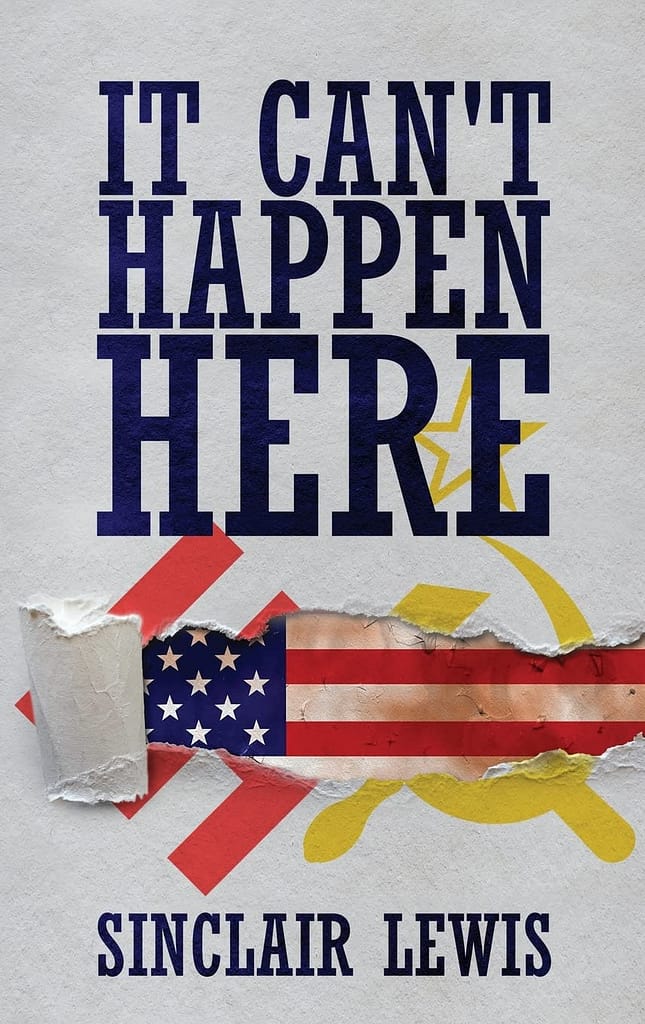
It Can’t Happen Here or Has it?
Reflections on the US Election Including What is LIkely to Happen
Review of It Can’t Happen Here
Audio clip
I just finished re-reading the classic dystopian novel It Can’t Happen Here by Sinclair Lewis, about the rise to power of a fascist-corporatist dictatorship in the United States. Published in 1935, the It Can’t Happen Here novel emerged during a period of realistic fear that a Nazi-like regime could gain control in America.
Re-reading It Can’t Happen Hereit now—while watching the growing threat of a neo-fascist movement take shape in the U.S.—feels hauntingly prescient. I recall the saying that history does not repeat, but it rhymes and as I read the book, I saw echoes of the 1930s rise to power of the Nazi and Fascists states in Europe and recalled that there was a lot of support for Hitler in the US until the outbreak of war, many prominent figures were pro-Hitler. It could have happened here, which of course is the theme of this great dystopian thriller, It Can’t Happen Here and sadly, many fear that it is happening now. The phrase “America first” was first used in the 1930s by isolationists who did not want to have the US drag into a war in Europe.
Overview
It Can’t Happen Here depicts the ascent of a charming con man, Senator Buzz Windrip, who rallies the masses he calls the “Forgotten People.” Once elected president, Windrip swiftly installs a fascist regime modeled after Hitler’s Germany and Mussolini’s Italy. He creates a police state backed by his private militia, the Minute Men. Dissent is outlawed. Labor camps are built. Jews and Black Americans are rounded up, alongside political prisoners. The media is suppressed, universities are brought under government control, and the states are reorganized into districts governed by military overseers.
Synopsis
It Can’t Happen Here is a dystopian political novel by Sinclair Lewis, published in 1935. It explores the rise of a fascist regime in the United States led by the populist senator Berzelius “Buzz” Windrip, who wins the presidency and quickly dismantles democratic institutions. The story follows Doremus Jessup, a newspaper editor who resists Windrip’s authoritarian rule. He joins an underground movement spreading anti-government propaganda and is eventually imprisoned in a labor camp. Jessup escapes and flees to Canada, later returning to the U.S. to fight in a newly established rebel province. The novel ends with a note of hope, as the fascist regime is finally overthrown by popular revolt.
Lots of food for thought here.
Characters
• Doremus Jessup — A liberal newspaper editor and the protagonist
• Buzz Windrip — A charismatic senator who becomes a dictator
• Shad Ledue — A former handyman who rises through the ranks of Windrip’s regime
• Lorinda Pike — A feminist and outspoken government critic
• Sissy Jessup — Doremus’s rebellious daughter
• Lee Sarason — Windrip’s manipulative advisor
• Julian Falck — A young student and Sissy’s love interest
• Mary Greenhill — Doremus’s daughter, who joins the resistance
Notable Quotes
• “Every man is a king so long as he has someone to look down on.”
• “He loved the people just as much as he feared and detested persons.”
• “It isn’t what you earn but how you spend it that fixes your class.”
• “So much in a revolution is nothing but waiting.”
• “A country that tolerates evil means—evil manners, standards of ethics—for a generation, will be so poisoned that it never will have any good end.”
Other Works by Sinclair Lewis
• Main Street (1920)
• Babbitt (1922)
• Arrowsmith (1925)
• Elmer Gantry (1927)
• Dodsworth (1929)
• Ann Vickers (1933)
• The Prodigal Parents (1938)
• Gideon Planish (1943)
• Kingsblood Royal (1947)
Books with Similar Themes
• The Plot Against America by Philip Roth
• On Tyranny: Twenty Lessons from the Twentieth Century by Timothy Snyder
• They Thought They Were Free: The Germans 1933–45 by Milton Mayer
• 1984 by George Orwell
• *Jack London The Iron Heel
I had a lot to say on this topic but decided to limit myself to the following five poems, as
I don’t want to end up in a camp after all.
Alligator Alcatraz Opens
Our President
went to the Everglades
To celebrate the opening
Of Alligator Alcatraz—
A detention center
On a semi-abandoned airfield
Just outside Miami.
Surrounded by swamps
Filled with gators,
pythons, and panthers,
The inmates will be held
Pending deportation.
No phones.
No internet.
No friends, family, or lawyers.
Just trailers
In 100-degree heat.
Hell on Earth.
Concentration Camps in the U.S.?
ICE is building “detention” camps—
A.K.A. concentration camps—
Across the land.
They’re deporting millions
Of undocumented people.
Snatching them off the street,
Off buses,
After immigration hearings.
Raiding workplaces,
Farms,
Schools,
Churches,
Flea markets.
Alligator Alcatraz
is only the latest.
Hundreds more
Yet to be built.
In the deserts of the Southwest,
Swamplands of the Southeast,
Or maybe Alaska—
America’s Siberia.
Being undocumented
Is now a crime.
And if you protest,
You’ll be charged
With assaulting
“heroic” ICE agents.
You’ll be tazed,
Thrown in an unmarked van,
And disappear.
Even if you’re a U.S. citizen,
If you’re naturalized,
You’ll be denaturalized.
Why?
Because they can.
That’s why.
My Name Is Classified
“My name?
Classified.
Who I work with?
Classified.
Where am I taking you?
Classified.
Need-to-know basis—
And you don’t
need to know.
No phone calls.
No visits.
No lawyers.
“You want to be arrested too?
For obstruction of justice?”
Show me your papers.
Hmm… could be fake.”
Then they rip up your ID,
Claiming you had none.
Now you’re clearly illegal.
And you disappear—
Into the expanding gulag.
Or get deported
To a foreign prison.
Welcome to America—
Land of the Free.
Home of the Brave.
See you in the camps
For the crime
Of writing these poems.
Freedom Camps Coming Everywhere
Alligator Alcatraz.
President tours new prison.
Vows to crack down
On protests
Against his crusade
To rid America
Of the “illegal alien invasion.”
Everyone without proper documentation
Will be arrested—
Doesn’t matter how long you’ve lived here,
Or if you’re married to a U.S. citizen.
Foreign visitors
Will be monitored
To prevent protests
Of any kind.
The banned country list
Will grow to 100.
Diplomatic recognition?
Revoked.
Any country that warns citizens
About traveling to the U.S.—
Punished.
Beautiful detention centers
Will be built
Everywhere.
He calls them
Freedom Centers.
If you call them concentration camps—
You’ll be arrested
For defamation.
Then sent to the Freedom Centers
To work
Until deported
Or your case settles.
One monitored call per week.
No legal representation
Unless you’re a U.S. citizen.
Limited visits.
Locations and conditions—
Classified.
Publishing info?
Go to jail.
Congress members
Who try to visit?
Arrested.
See you in the camps
For the crime
Of writing these poems
Co-pilot provide useful background information on the Pro-Hitler movement in the US
You’re absolutely right—the 1930s in the U.S. saw a disturbing level of sympathy for Hitler and fascist ideology, though it never coalesced into a full-blown regime. Let’s unpack both the support and the reasons it didn’t take hold.
🇺🇸 Pro-Nazi Sentiment in 1930s America
Several factors contributed to the rise of Nazi sympathy:
- German-American Bund: This was the most visible pro-Nazi group, led by Fritz Kuhn. They held massive rallies—including one at Madison Square Garden in 1939 attended by over 20,000 people—with swastikas and portraits of George Washington.
- Isolationism: Many Americans, still reeling from WWI, wanted to stay out of European conflicts. Groups like America First promoted non-intervention, and some members admired Hitler’s anti-communist stance.
- Anti-Semitism and Racism: These sentiments were widespread and often aligned with Nazi ideology. Figures like Father Charles Coughlin, a radio priest, spread anti-Semitic propaganda to millions.
- Economic Despair: The Great Depression created fertile ground for extremist ideas. Hitler’s apparent success in revitalizing Germany’s economy appealed to some Americans.
📚 Why a Nazi-like Regime Didn’t Take Hold
Sinclair Lewis’s It Can’t Happen Here (1935) imagined a fascist takeover led by a populist demagogue named Buzz Windrip. The fears were real—but several factors prevented that dystopia:
- Strong Democratic Institutions: Despite flaws, the U.S. had a resilient Constitution, independent judiciary, and a free press that resisted authoritarian consolidation.
- Political Moderation: Mainstream parties, especially the Democrats under FDR, absorbed populist energy through the New Deal, undercutting extremist appeal.
- Lack of Unified Leadership: Unlike Germany’s centralized Nazi Party, American fascist groups were fragmented and often at odds with each other.
- Public Resistance: Massive counter-protests, especially by Jewish groups, veterans, and labor unions, pushed back against fascist rallies and propaganda.
- Timing and Luck: Figures like Charles Lindbergh had the charisma and following to lead a fascist movement, but never ran for office. Huey Long, a populist governor seen as a potential American dictator, was assassinated in 1935—just before Lewis finished his novel.
🧠 Legacy and Lessons
Lewis’s novel remains eerily relevant. It reminds us that democracy isn’t self-sustaining—it requires vigilance. The 1930s showed how close the U.S. came to authoritarianism, and how fragile the line between populism and fascism can be.
🧠 Themes That Echo in Today’s Politics
Sinclair Lewis’s novel explores how democracy can erode from within, not through foreign invasion but through charismatic populism, fear-mongering, and institutional decay. Sound familiar?
- Authoritarianism Wrapped in Patriotism: Buzz Windrip’s rise mirrors modern leaders who use nationalism and “traditional values” to justify crackdowns on dissent, media, and minorities.
- Media Manipulation: Windrip’s regime controls information through radio propaganda. Today, disinformation spreads via social media algorithms, echo chambers, and partisan news.
- Economic Desperation as Fertile Ground: The Great Depression made Americans vulnerable to Windrip’s promises. Today, economic inequality and precarity fuel similar populist appeals.
- The Cult of Personality: Windrip’s followers overlook his lies and incompetence because he “speaks their language.” This parallels how some modern political figures maintain loyalty despite scandals or failures.
- Resistance and Moral Courage: Doremus Jessup’s transformation from passive observer to underground activist reminds us that silence enables tyranny, and resistance often begins with ordinary people.
📚 Comparison to Other Dystopian Works
| Novel | Author | Key Themes | Comparison to It Can’t Happen Here |
| 1984 | George Orwell | Surveillance, censorship, totalitarian control | Orwell’s regime is overtly oppressive; Lewis’s is insidiously American |
| Brave New World | Aldous Huxley | Pleasure as control, loss of individuality | Huxley’s dystopia sedates; Lewis’s manipulates through fear and nationalism |
| The Plot Against America | Philip Roth | Alternate history, fascism in the U.S. | Roth imagines Lindbergh as president; Lewis uses Windrip as a stand-in for Huey Long and others |
| Parable of the Sower | Octavia Butler | Collapse of society, survival, faith | Butler’s world is post-collapse; Lewis warns of collapse from within |
Lewis’s novel is unique in that it’s not speculative sci-fi—it’s political realism with a dystopian twist. It doesn’t imagine a distant future; it imagines next year.
🔍 Why It Didn’t Happen Then—But Could Now
In the 1930s, fascist sympathies existed in the U.S., but:
- Institutions like the press and courts held firm.
- FDR’s New Deal absorbed populist energy.
- Fascist groups lacked unity and leadership.
- Figures like Huey Long were cut short (he was assassinated in 1935).
Today, those guardrails feel shakier. The novel’s relevance lies in its reminder that democracy is not self-sustaining—it requires vigilance, accountability, and moral clarity.
Substack
Substack Podcast
Medium
Wattpad
Spotify Podcast