

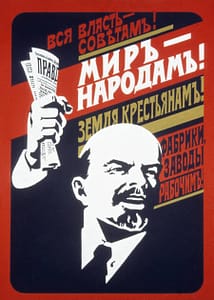

Records of the U.S. Information Agency, 1900-2003
Still Pictures Identifier: 306-ppb-129
Why Communism Failed, Why It Is No Longer a Major Global Threat, and Why Politicians Still Keep Talking About It
A follow-up to my earlier essay, “More Communist BS.” This essay looks at what communism actually was, why it spread, why most communist systems either collapsed or transformed themselves, and why the specter of communism continues to dominate political rhetoric decades after its global decline
More Communism BS
Is America Center-Left, Center-Right or Neither?
Author’s Note
This essay is not a defense of communism.
Twentieth-century communist regimes produced some of the worst examples of political repression, economic dysfunction, state violence, and man-made catastrophe in modern history. At the same time, they also achieved significant gains in literacy, education, industrialization, public health, and anti-colonial mobilization in some regions.
The goal here is neither to condemn nor romanticize communism. Rather, it is to place current political rhetoric in historical context and to distinguish actual historical communism from the much broader range of policies and ideologies that are frequently labeled “communist” in contemporary political debate.
The Ghost That Still Haunts Politics
Every election cycle seems to bring a new warning that communism is returning.
Today, some politicians routinely describe progressive Democrats, democratic socialists, labor activists, environmentalists, advocates of universal healthcare, and supporters of expanded social programs as “Marxists,” “socialists,” or “communists.” Recent statements by Speaker Mike Johnson and others about a growing communist threat are simply the latest version of a story Americans have heard repeatedly for more than a century.
The irony is that actual communism, as a governing system, suffered one of the most comprehensive political, economic, and ideological defeats in modern history.
The Soviet Union collapsed.
The Eastern European communist bloc disappeared.
In 1956, Hungary staged a revolution against Soviet domination. The uprising was brutally crushed by Soviet forces, but the experience eventually helped push Hungary toward a series of economic reforms that became known as “Goulash Communism.”
Compared with most communist countries, Hungary later allowed:
- Limited private enterprise
- Greater consumer choice
- Partial use of market mechanisms
It became one of the more successful communist economies, although it still lagged behind Western Europe.
North Korea began as a Soviet-backed Stalinist state.
Over time, however, it evolved into something unique.
The Kim dynasty fused:
- Stalinist political structures
- Extreme nationalism
- Dynastic leadership
- Military-first policies
- Elements of traditional Korean political culture and neo-Confucian hierarchy
- Intense isolationism
The result is arguably less a communist system than a highly centralized hereditary state wrapped in communist symbolism.
China abandoned most communist economics.
Vietnam embraced markets.
Laos liberalized.
Cambodia abandoned communism.
Cuba Holds Out but is on its death bed…
The collapse of the Soviet Union triggered a severe economic crisis. Cuba continues to face chronic shortages, weak growth, and large-scale emigration, but the state has endured despite repeated predictions of its collapse.
Nearly one-third of the population has left the country over the past decade, underscoring the depth of the island’s economic difficulties.
Most African Marxist experiments vanished.
Only a handful of communist-party states remain, and even most of those govern economies that bear little resemblance to classical Marxist theory.
This raises an obvious question:
If communism lost almost everywhere, why do politicians still campaign against it?
To answer that question, we need to understand what communism actually was, how it spread, why it appeared successful for a time, why it ultimately failed, and what replaced it.
The dominant global competition today is not communism versus capitalism.
It is competition among different forms of capitalism.
Conclusion
Communism was one of the most consequential ideas in modern history.
It reshaped continents, toppled empires, inspired revolutions, governed nearly one-third of humanity, and defined the central geopolitical struggle of the twentieth century.
Its legacy includes genuine achievements in literacy, education, industrialization, public health, and anti-colonial mobilization.
It also includes political repression, economic dysfunction, devastating famines, labor camps, personality cults, and some of the greatest human tragedies in recorded history.
Yet the historical verdict is difficult to avoid.
Virtually every major communist system either collapsed, liberalized, or transformed itself into some version of a market economy.
The Soviet Union disappeared.
Eastern European communism vanished.
China achieved its greatest economic successes only after abandoning most orthodox communist economics.
Vietnam prospered after market reforms.
Even the surviving communist states no longer operate according to classical Marxist principles.
For that reason, modern warnings about an imminent communist takeover often tell us more about contemporary political strategy than about actual ideological reality.
Communism remains historically important.
It remains intellectually influential.
It remains symbolically powerful.
But as a functioning global rival to capitalism, it is largely a relic of the twentieth century.
The political and economic debates of the twenty-first century are increasingly not about capitalism versus communism. They are about competing visions of democracy, state power, markets, inequality, technology, and national identity.
In that sense, communism’s greatest influence today may be less as a governing system than as a political symbol, invoked by both supporters and opponents in arguments that have largely moved beyond the world that Marx, Lenin, Stalin, or Mao inhabited.
The John Birch Society and the Politics of the Communist Menace
The persistence of anti-communist rhetoric in American politics did not end with the fall of the Soviet Union. In many ways it can be traced back to earlier movements that viewed communism not merely as a foreign ideology but as a hidden force operating within American institutions.
Perhaps the most influential example was the John Birch Society, founded in 1958 by businessman Robert Welch. Although often associated with the McCarthy era, the organization actually emerged after Senator Joseph McCarthy’s downfall. The Society inherited many of the fears and assumptions of the early Cold War, arguing that communist influence extended deep into American government, education, media, and cultural institutions.
At its peak during the 1960s, the John Birch Society claimed tens of thousands of members and exercised influence far beyond its formal size. Its activists fought civil rights legislation, international organizations, arms control agreements, and numerous federal programs that they viewed as steps toward collectivism or communist control. Welch himself became controversial for alleging that President Dwight Eisenhower had knowingly aided communist objectives, a claim rejected by mainstream conservatives as well as liberals.
The Society gradually declined as an organized force during the 1970s and 1980s, but many of its themes survived. The belief that domestic political opponents are agents of a foreign or subversive ideology, the tendency to interpret social and political change through the lens of hidden conspiracies, and the use of “communist” as a broad label for policies far removed from Marxism all remained part of American political discourse. In that sense, the John Birch Society largely lost the political battles of its own era, but some of its language and assumptions continue to echo through modern debates.
This brings us back to contemporary anti-communist rhetoric. Here are some recent example quotes that seem everywhere as we head towards the midterm elections.
Contemporary Political Quotes
Mike Johnson (2026)
“Communism is now on our own shores.”
— Speaker Mike Johnson, following several Democratic Socialist-backed primary victories in New York. [foxnews.com], [politicalbytes.net]
Speaker of the House Mike Johnson (2026)
“Every American needs to wake up and understand the threat.”
— Speaker Mike Johnson, referring to what he characterized as the rise of Marxist and socialist candidates. [foxnews.com], [alsabaha.com]
Good example of current anti-communist rhetoric.
Senator John Fetterman (2026)
“The Democratic Party is becoming the party of socialism … I’m a proud free market capitalist. This is lunacy.”
— Senator John Fetterman reacting to polling showing growing Democratic sympathy toward socialism. [thehill.com], [political.org]
Political Rhetoric in 2026
Recent political debate illustrates how powerful the language of anti-communism remains, even decades after the collapse of the Soviet Union.
“Together we will defeat communism, socialism, and Marxism in America. America will never be a communist country.”
— President Donald Trump [yahoo.com], [wwno.org]
“It’s honestly a hard term to define these days … I don’t know what the term means anymore.”
— Vice President JD Vance, when asked to define socialism. [realclearp…litics.com], [yahoo.com]
Whatever one’s political views, these statements highlight a central theme of this essay: communism remains a powerful political symbol in American politics, even though the actual communist systems that shaped the twentieth century have largely collapsed, liberalized, or transformed themselves into something very different from what Marx originally envisioned.
The bottom line is simply this
Communism has failed. “The dominant global competition today is not communism versus capitalism. It is competition among different forms of capitalism.”
General Views of Socialism
Gallup’s most recent survey found:
43% of Americans now have a positive view of socialism, the highest level Gallup has recorded since it began tracking the question in 2010. Capitalism remains more popular overall, with 55% expressing a positive view. [news.gallup.com], [foxnews.com]
That finding actually supports your argument that while communism is largely gone, dissatisfaction with aspects of modern capitalism remains significant.
Young Americans
Gallup found:
Americans aged 18-34 viewed socialism more positively (57%) than capitalism (43%), while Americans aged 55 and older favored capitalism by nearly a two-to-one margin. [yahoo.com], [wsyr.iheart.com]
DSA-Specific Polling
Recent polling is much more mixed.
One Quinnipiac survey reported:
26% of registered voters said they considered themselves supporters of the Democratic Socialists of America, while 66% said they did not. Among Democrats, 59% identified themselves as DSA supporters. [truthout.org], [dailycalle…dation.org]
However, another national survey found:
55% of registered voters viewed the Democratic Socialists of America unfavorably, while only about three in ten viewed it positively. [political.org]your essay because it shows that:
- Americans are becoming somewhat more open to “socialism” as an abstract idea.
- Americans remain skeptical of organizations explicitly associated with socialism.
- The word itself means very different things to different voters.
Recent polling illustrates the complexity of contemporary attitudes toward socialism. Gallup found that 43% of Americans now view socialism positively, the highest level recorded since the organization began asking the question in 2010, although capitalism remains more popular overall. Other surveys show that while substantial numbers of Democrats express sympathy toward democratic socialism, the Democratic Socialists of America itself remains a polarizing organization with mixed public support. These findings suggest that contemporary debates are less about a return to Soviet-style communism than about growing dissatisfaction with economic inequality, affordability, and the perceived shortcomings of modern capitalism. [news.gallup.com], [foxnews.com], [political.org], [truthout.org]
And that may be the most important fact missing from today’s political debates.
Endnotes
- Karl Marx and Friedrich Engels, The Communist Manifesto (1848).
- Robert Service, Comrades: A History of World Communism (Harvard University Press, 2007).
- Archie Brown, The Rise and Fall of Communism (HarperCollins, 2009).
- Martin Malia, The Soviet Tragedy: A History of Socialism in Russia, 1917-1991 (Free Press, 1994).
- Stephen Kotkin, Stalin: Paradoxes of Power, 1878-1928 (Penguin, 2014).
- Anne Applebaum, Gulag: A History (Doubleday, 2003).
- Timothy Snyder, Bloodlands: Europe Between Hitler and Stalin (Basic Books, 2010).
- Frank Dikötter, Mao’s Great Famine (Walker & Company, 2010).
- Roderick MacFarquhar and Michael Schoenhals, Mao’s Last Revolution (Harvard University Press, 2006).
- Ezra Vogel, Deng Xiaoping and the Transformation of China (Belknap Press, 2011).
- Tony Judt, Postwar: A History of Europe Since 1945 (Penguin, 2005).
- John Lewis Gaddis, The Cold War: A New History (Penguin, 2005).
- Odd Arne Westad, The Global Cold War (Cambridge University Press, 2005).
- Encyclopaedia Britannica entries on the Russian Revolution, the Eastern Bloc, Mao Zedong, Deng Xiaoping, collectivization, and the Soviet Union.
- U.S. Department of State, Office of the Historian, “The Collapse of Communism in Eastern Europe, 1989.”
- World Bank historical development indicators on former communist economies.
- United Nations Development Programme historical literacy, life expectancy, and educational attainment datasets.

Thanks so much for visiting my site. Your comments are welcome but please play nice…. Reply