Note: this may be offensive to some readers, if so, I apologizeI am simply trying to understand why Christian leaders are promoting such a cruel, vindictive, misogamist, inhuman policy that is contradicted by the core teachings of the Christian faith.
In Texas and other red states, (Indiana) Christian conservatives have been promoting and passing “ Fetus Funeral Bills “that require women who had an abortion or miscarriage to bury the fetus and have a funeral ceremony at their own expense. The reason is that they consider a fetus to be a human being that has full human rights and that all human beings when they die deserve to have a funeral and that women who have an abortion or miscarriagemust pay respect to the dead fetus and this somehow is fully consistent with their view of what their Christian faith commands.
I have been struggling to figure this out . What does the Bible teach about abortion and what does the Bible teach about miscarriages and what does the Bible teach about responsibility to have a funeral after someone dies?
I am not a Christian but I have read my Bible and I have read a lot of Christian writings over the years and I just cannot find any justification in the Bible , or in Jesus’s teachings or in the church itself that would justify such a barbaric cruel inhumane and degrading practice as requiring a woman who had a an abortionor miscarriage to hold a funeral for the fetus.I could not find any biblical references that clearly states that birth starts at conception and that fetuses are fully formed human beings and they must be treated as human beings. In fact I might be wrong but I do not believe that the Bible or Jesus address the issue of abortion at all nor did he mention what to do when a woman has a miscarriage, nor does he talk about life beginning at conception.Nor does he talk about fetus’s as having human rights..
Does God Decides when a woman will get pregnant?
I found a lot of references to the idea that God decides when woman will become pregnant and whether the woman’s pregnancy will be viable. How God decides that nobody has an explanation other than the usual “well God is God and God can do anything he wants,” but still assuming that there is a God and that God is directly involved in all of our lives including our sex lives then God must be incredibly busy overseeing the intimate activities of eight billion human beings. At the heart of Christian thinking there is the concept that God impregnated the Virgin Mary who was a virgin, i.e. having never never had sex before, even though she was married. God impregnatesher through the actions of the Holy Spirit which I assume is also known as the Holy Ghost and has some kind of supernatural being that can and does intervene in our daily lives without our knowledge or even our consent.And how the holly spirit got her pregnant is not explained – other than that is some sort of supernatural act.
I did find some references to the theory that abortion is murder and that doctors who perform abortions should be punished and woman who have an abortion should be punished as well. And some have advocated that women who have a miscarriage due to their activity including drinking, smoking, taking drugs, engaging in sex, or just engaging in work activities that might have contributed to the death of the fetus should also be charged with murder.
What I have not seen in the concept that since God decides when and if a woman gets pregnant, if God allows a miscarriage that miscarriage is a sense an abortion and God should be held responsible for having murdered the fetus.
No Biblical or other justification for fetal funerals
Therefore it does not seem that there is any biblical or Christian justification for requiring women who have had an abortion or miscarriage to hold a funeral for their Fetus at their own expense. These policies seem to have but one justification to punish women for engaging in sexual activity because pregnancy is a consequence of sexual activity and therefore a miscarriage is possible and or the woman may decide to have an abortion,at any case a potential human being is killed.This policy also violates essential Christian thinking about how we should act with compassion and mercy towards other human beings and violate certainly the golden rule that we should treat other people as we would want them to treat us and violates the privacy of women and their families and get the government into their bedroom supervising their intimate activity.Not to mention violates the religious liberties of the woman who may or may want to hold a funeral ceremony for their fetus. Funeral decisions are normally left to individuals and families to decide on their own.Up to now governments have not intervened in private funeral decisions.
I thought that the Christian conservatives wanted to keep the government out of our private business but apparently if itinvolves sex, then the government must intervene to protect us from the consequences of potentially wrong decisions.
To sum up requiring a woman who had abortion or a miscarriage to carry out a funeral for the fetus at her own expense is a cruel vindictive inhumane and anti Christian act, and government officials who are promoting this should go home reflect read their Bibles and do what Jesus would have done which is exactly the opposite of requiring woman who had an abortion or miscarriage having a funeral at their own expense.
Sent to Governor Abbot of Texas
Dear Governor Abbot
I wrote the following blog piece on your policies promoting Fetus funerals in the State of Texas.I would love to hear your justification for such a profoundly anti-Christian action?
there is too much to cover so will probably try to update this once a week every Monday. Enjoy: I have turned this into three different postings, my observations and news clippings, right wing Christian nonsense and corona poems.
updated assessment on the USG response:
I have to revise my assessment. I would give the government a B now and Trump a C. He is stepping up to the plate and a lot is going on. and the stimulus package if they can approve it and I am sure they will, will make a great difference.
but the President is still wasting everyone’s time. His advisors need to shut him up. Have him read his prepared statements then leave answering no questions. When he asked questions he veers off script and goes on unhelpful tangents. He is still too insulting and off message. And for God’s case he needs to stop calling it the China virus. It is just a matter of time before some nut case is going to start shooting Asians.
finally the US should start providing assistance to foreign governments rather that shutting borders. he should also ask for help from other governments and the WHO should ask for additional tests etc.
overall too little too late and he is still making it all about Trump. He needs to shut up, quit tweeting and let the VP lead the task force. He should not even be in the room but if he feels he needs to be there, he should just read his statement and leave and answer no questions and god forbid do not tweet anything.
Update on stimulus package –
if it passes with robust unemployment insurance, food security assistance, student debt relief, two thousand dollars stimulus cash payments, bailouts of the hotel and airline, and cruise ship industry and prohibitions against corporations using bail out money on stock buy backs and CEO bonuses, it will go a long way towards blunting the impact of the crisis. I fear though we are not prepared for the coming months. I hope it will calm down by June and with the help of the supercomputer resources pledged by MIT, google and others treatment and vaccines will be in place by the end of the summer and the crisis will be over early in the fall although experts believe it won’t be over for 18 months to 2 years but the shut down of the economy will end by June and the travel bans will be lifted by July. The Olympics will be postponed until next year. whoever is elected president will have to embrace medicare for all option as well as mandatory paid sick leave for all full time employees.
worst case scenario we are entering a world wide recession and by December we will be looking at 30% unemployment. and a revival of the civilian conservation corps and perhaps a draft as well. End update
original posting follows:
During the last two months the corona pandemic has been overwhelming governments, societies and individuals and me as it rapidly spreads across the globe. Here are my thoughts on the virus from my home in Youngjongdo, Korea, near the Incheon airport. Following my thoughts I have added some key articles for you to read. Then I post my corona poems. But I am having some audacity issues so I will post my audio clips next week along with perhaps a few more articles, and poems and update to my thoughts.
What governments need to do now
First, we realize that governments and societies around the world have failed miserably at handling the crisis as it unfolds.
Second, the pandemic has revealed that that the US health care system — and we need universal health care and we need paid sick leave now. Whoever becomes President will have to enact these two policies.
Third, governments around the world will have to spend a lot more money and policies on public health care.
Fourth, governments around the world will have to have a standing interagency public health task force that coordinates policies worldwide.
Fifth, WHO will have to have a lot more resources, governments and institutions will have share information around the world.
Sixth, the federal government must reallocate resources from the bloated military national security sector to the public health sector, including funding for medicare for all and paid family/sick leave for all.
Seventh, the federal government once this is over should hold a lesson learned exercise with all 50 states, major cities and major hospitals and universities taking part in the virtual national conference. A federal commission should conduct this. They should share the results with the public, and with foreign governments and WHO. The federal public health commission should become a standing body, with representatives from all the states, major hospitals and universities and pharmacies and labs and representatives from the military. They should hold a mini-public health conference once a year to review policies to prepare for the next pandemic which will hit us.
The USG should call upon the world community under the auspices of WHO to convene a world-wide virtual conference to prepare for the next pandemic based on lessons learned from this pandemic and WHO should hold an annual pandemic response virtual conference.
Eight, both the DNC and RNC must postpone the remaining primaries until June and turned them into mail in elections. This should also apply to the national election.
Nine, the DNC and RNC must turn the conventions into virtual conventions and that too should be the new normal.
Tenth, Universities and school districts across the country should move a significant number of classes online and that should also become the new normal.
the Democrats must ensure that the republicans don’t dismantle the rest of the federal budget to pay for expanded public health spending. And they must insist on some modest tax increases. But the democrats should consider some targeting reductions in less essential spending.
Public health screenings before traveling on planes, trains, long-distance buses and cruise ships must become the new normal. Those denied boarding must be able to-book their travel with a minimum of expense and bureaucratic delays.The basic principle must be that if you have a fever or a severe cough, you can’t travel. This also means that governments must grant automatic extensions of visas for those who can’t travel because of illness.
The USG should require foreigners to purchase Traveler’s medical insurance prior to travel to the U.S.
Drug companies, research labs and universities must share their research with the entire worldwide medical community, and WHO should set up a universal medical research data base so researchers can research the latest medical advances in real time.
The Olympics and major international sporting events should be postponed for one year.
the USG should consider the following emergency measures once the number of cases exceed 100,000 which it will with a week.
Total national shut down shelter in place for 30 days, re-newable at the end of the month and reviewed monthly
total shut down of the border, and US domestic travel except for essential travel defined as follows:
diplomatic travel
military travel
government travel related to the virus response
travel by medical worker
travel by private sector employee related to the virus response
travel by family members of military/diplomatics returning home
travel by non-essential employees and military/diplomatic family members returning home
travel by high level business delegations especially related to the virus response
travel by Americans coming returning overseas
other essential travel approved on a case by case basis
coupled with the travel ban, postponing all visa processing except as part of the exemptions listed above, and cancelling visa waiver travel except as part of the exceptions listed above, visa bans would remain in place as long as the travel ban remains in place
Before this is put into place the USG must coordinate with all of its partners so we all get on the same wave length.
Finally the US should convene a world wide high level virtual conference of world leaders followed up by actions that are agreed to by all leaders
Update: and the stimulus package must be enacted now with a supplemental package if needed this summer. Quit the politics now!
USG Response – updated from 2/10 or a Solid D to C
If I had to grade the US response, I would grade it as D so far up to now-given the President some credit for finally realizing in the last few days how it is indeed a real national emergency and taking steps that they should have taken back in January.
based on the presidents actions the last few days and the congressional finally putting politics aside I would upgrade the President’s response from a D to a C.It will take some time for me to rate him as a B.Hope he gets there.
Finally I am looking for the government to do the actions outlined above.
If we pull together and get the virus under control, we should be able to recover from this by September, if not, or we get a second waive before we get the vaccine under control we could be looking at another great depression which may take years to recover.
if we head down that path the government must set up an updated civilian conservation corps to put people to work. And we may need to re-impose the draft but if we do that we should couple it with a massive GI bill afterwards paying for college and training in return for national service.The national service requirement would also mean that people will be drafted to work in the health care system and industry as well as in the military.
we will know if we need to do this by June and if so we must set it up so it goes into effect by September.
Quit Calling It the China Virus
the one thing I am still upset about if Trump calling this the China flu.he needs to stop that sh,,,right now before unhinged nut cases with guns start shooting Asians because somehow they thought that Trump was either calling them to do so or condoning it.he needs to address this now and say that asians are not virus carriers and he will condemn any and all racist attacks on Asian owned businesses.He should also make it clear that we will not under any circumstances repeat the internment policies of world war 11.to top it off he should start orderingChinese food for the white house staffers and the pandemic support team.
Apologize for having gotten it wrong and responding too late use the dread words I take responsibility!!!!!
Final point I would call upon both Trump and Pence to take responsibility for their inept initial responses and promise to retire by the end of their term.
For Biden Keep your comments positive there will be time to cast blame later
For Biden I would call upon him to talk about what he would do if President but not criticize the President or his team instead he should congratulate them on their finally getting it together and offer concrete positive suggestions for moving forward.Now it not the time for political gamesmanship on either parties.
The one thing that I feared would happen has not yet happen. Gun nuts shooting up Asians. Hopefully that will not become a thing.
Update
the most important thing the president can do now is to read his prepared statement then walk away and not take questions. We don’t need to hear his extended boasting that he is a billionaire etc etc nor do we need to hear his inept answering of questions or his overly optimistic assessments etc. Let the task force speak and please no tweets!!!!!! I am going to send a link to my blog to Trump and to Biden and will let you know if anyone responses or if I am sued or arrested because I pissed off the President. I truly want the President to rise to the occasion and be the leader we need in these dark times and I hope if he is reading this that he understand that.
end comment
South Korean response Solid B
If I had to grade South Korea where I am currently lying low a grade I would give them a B – they have done something very well — mass testing, developing drive through and now walk through testing, public health tracing of infected people. They have failed in mask distribution, should have banned exports of masks right away, and their overly bureaucratic mask distribution policy requiring people to line up and get two masks per person based on the birthday is a disaster. And they like all governments around the world are not prepared for the massive unemployment that will soon hit the country. But on balance, we are probably better off here than in.
the one thing I would caution them is to assume that the crisis is over and return to business as usual. As long as there are cases spreading the government must be vigilant. It would not take much for a second wave to occur. By May or June perhaps the crisis will be over.
afterwards institutionalize health checks at the airport and refuse boarding to anyone who has a fever or put in quarantine if they are coming from abroad.
make the government corona task force a standing body that would meet weekly to coordinate public health measures and prepare for the next epidemic which will happen sooner or later. Korea has built up an impressive response to the pandemic. They need to keep it ready for future crises. And Korea needs to work with other governments in developing tests, medicine, vaccine and data collection techniques.
What governments need to do now
First, we realize that governments and societies around the world have failed miserably at handling the crisis as it unfolds.
Second, the pandemic has revealed that that the US health care system — and we need universal health care and we need paid sick leave now. Whoever becomes President will have to enact these two policies.
Third, governments around the world will have to spend a lot more money and policies on public health care.
Fourth, governments around the world will have to have a standing interagency public health task force that coordinates policies worldwide.
Fifth, WHO will have to have a lot more resources, governments and institutions will have share information around the world.
Sixth, the federal government must reallocate resources from the bloated military national security sector to the public health sector, including funding for medicare for all and paid family/sick leave for all.
Seventh, the federal government once this is over should hold a lesson learned exercise with all 50 states, major cities and major hospitals and universities taking part in the virtual national conference. A federal commission should conduct this. They should share the results with the public, and with foreign governments and WHO. The federal public health commission should become a standing body, with representatives from all the states, major hospitals and universities and pharmacies and labs and representatives from the military. They should hold a mini-public health conference once a year to review policies to prepare for the next pandemic which will hit us.
The USG should call upon the world community under the auspices of WHO to convene a world-wide virtual conference to prepare for the next pandemic based on lessons learned from this pandemic and WHO should hold an annual pandemic response virtual conference.
Eight, both the DNC and RNC must postpone the remaining primaries until June and turned them into mail in elections. This should also apply to the national election.
Nine, the DNC and RNC must turn the conventions into virtual conventions and that too should be the new normal.
Tenth, Universities and school districts across the country should move a significant number of classes online and that should also become the new normal.
the Democrats must ensure that the republicans don’t dismantle the rest of the federal budget to pay for expanded public health spending. And they must insist on some modest tax increases. But the democrats should consider some targeting reductions in less essential spending.
Public health screenings before traveling on planes, trains, long-distance buses and cruise ships must become the new normal. Those denied boarding must be able to-book their travel with a minimum of expense and bureaucratic delays. The basic principle must be that if you have a fever or a severe cough, you can’t travel. This also means that governments must grant automatic extensions of visas for those who can’t travel because of illness.
The USG should require foreigners to purchase Traveler’s medical insurance prior to travel to the U.S.
Drug companies, research labs and universities must share their research with the entire worldwide medical community, and WHO should set up a universal medical research data base so researchers can research the latest medical advances in real time.
The Olympics and major internationl sporting events should be postponed for one year.
read this one!
What symptoms are most common, which groups are most at risk, and more.
The outbreak of Covid-19, a coronavirus-caused illness that originated in Wuhan, China, and has since spread to most of the world, is one of the most serious public health crises in decades. It has spread far wider than Ebola did in 2014, and the World Health Organization has designated it a pandemic.
As of March 11, there have been more than 125,000 reported cases, more than 4,600 deaths worldwide, and more than 1,200 reported cases and 29 deaths in the US, according to Johns Hopkins’s tracker; its count is usually up to date and worth bookmarking as the crisis progresses.
The situation on the ground is evolving incredibly quickly, and it’s impossible to synthesize everything we know into clean, intelligible charts. But we do know a fair bit about how bad the outbreak is, what the disease does, and what controlling and ultimately ending the outbreak will look like.
With that in mind, here are nine charts that help explain the Covid-19 coronavirus crisis.
1) The virus is spreading rapidly
As of this writing, the Covid-19 caseload is rising rapidly day to day, but here’s where things stood as of March 8. The vast majority of reported cases are still in China, where the outbreak began, but whereas the number of new Chinese cases is falling, the number of new international cases is rising, indicating that the epicenter of the problem is shifting from China to new places like Italy.
Note that the huge spike in new cases was due to improved data reporting from China; there was not one particularly bad day in the middle of February.
2) Know the symptoms
The symptoms of Covid-19 vary from case to case, but the most common ones in China, from February data, are fever and dry cough (which are each seen in a majority of cases), fatigue, and sputum (the technical term for thick mucus coughed up from the respiratory tract).
If you have a fever and dry cough, that could be a good reason to get yourself tested if possible.
Note: if possible is the caveat. We don’t have enough tests still end , China has offered test kits, WHO, and South Korea but so far the Trump administration has refused all such offers perhaps because he does not want to appear that we are now a third world country in need of assistance. End note
3) Death rates in China have declined over time
One glimmer of hope in this story is that Chinese medical authorities appeared to get better at treating infections and preventing death as the outbreak proceeded. “Even the first and hardest-hit province, Hubei, saw its death rate tumble as public health measures were strengthened and clinicians got better at identifying and treating people with the disease,” Vox’s Julia Belluz explains.
The rate didn’t go down on its own; China took drastic, even authoritarian measures to lock down affected areas and contain the virus’s spread so that the medical system was not overwhelmed.
4) Older people in China have been at the greatest risk of dying from Covid-19
The Spanish flu of 1918-’19, the most horrific pandemic in modern times, focused mainly on the young. It had biological similarities to a flu pandemic in the 1830s that gave some older people in the 1910s limited immunity.
Covid-19 is not like that. So far, deaths in China have been concentrated among older adults, who have weaker immune systems on average than younger people and have a higher rate of chronic illness. People of all ages with chronic medical conditions are also at higher risk. The risk of death is real for younger people as well, but older people have the most reason to take care.
5) This is much more severe than an ordinary flu
It is tempting to compare Covid-19 to a more familiar disease: the seasonal flu. After all, the flu also has mild symptoms for most people, and can be dangerous and lethal among vulnerable populations like the elderly. President Trump even made this comparison recently.
But as the case fatality data shows, there’s no real comparison. About 6 percent of people 60 or older infected with Covid-19 die, according to data we have so far; that’s over six times the fatality rate for elderly people infected with the flu. The overall case fatality rate is at least 23 times greater (the fatality rate has risen since this chart was made).
6) Experts also think Covid-19 is more contagious than the ordinary flu
There’s another way that Covid-19 is a tougher adversary than the seasonal flu: Its R0 (“R nought”) is over 2, indicating that it’s more contagious than the typical flu. R0 estimates the number of people an average infected person spreads the disease to. “R0 is important because if it’s greater than 1, the infection will probably keep spreading, and if it’s less than 1, the outbreak will likely peter out,” the Atlantic’s Ed Yong explains. Covid-19’s R0 is substantially higher than 1, giving more reason for concern.
7) Spending on airlines, hotels, and cruises is collapsing
Warnings to avoid crowds, and cancellations of major gatherings like conferences and parades, have put a damper on travel in the US, and the consequences for airlines have been dire. According to Earnest Research, spending on airlines fell 16.5 percent in the last week of February relative to a year prior. Cruises have seen a similar dip, while hotels are only now starting to see sales mildly decline.
It’s unlikely that the economic impact will stay limited to the hospitality industry, as social distancing leads people to avoid coffee shops, restaurants, gyms, bars, etc.
The Trump administration’s slow rollout of testing for coronavirus has become something of a national scandal, and it’s easy to see why when you compare the US testing rate to that of other affected countries. South Korea stands out for its rapid rollout of extensive testing, including through innovative drive-through testing programs.
Drive-through testing is being piloted in some parts of the US, like New Hampshire, but we still have a long way to go before we match South Korean and Chinese testing levels.
Comment: the USG refused the offer of testing Kits from WHO, Alibaba and others because they did not want the world to think that the US was like a third world country that needed foreign aid. End Comment
9) Why canceling events and self-quarantining is so important
Covid-19 has quickly made large-scale gatherings and conferences unpopular if not socially frowned upon. This change arrived quickly, and may seem jarring, but it’s easier to see the logic when you understand the theory behind this kind of “social distancing” policy. The key is to “flatten the curve”: slowing the rate of increase in infections so that you spread out the cases, even if the total number doesn’t change. Flattening the curve slows the rate at which new cases arrive in hospitals, easing the burden on health care infrastructure and improving the odds that individual patients will survive.
comment: the cancellation of large events could spread and become the new normal for the next year or so in any events the Olympics have to be cancelled unless things change dramatically in the next few weeks. i.e. zero new cases in Japan or elsewhere by the end of May which is the drop dead deadline to cancel or postpone. the IOC has the power to postpone for a year through a simple change to the rules that otherwise state that the game must be held within that calendar year. End Comment
Part two some interesting articles – had a difficult choice to make – way too many to post.
Did Trump’s inaction make the coronavirus outbreak worse?
Cartoon Trump: ‘The markets are supposed to jump up and down! That means they’re excited!’Published 20 mins ago on March 15, 2020By Sarah K. Burris
President Donald Trump’s cartoon avatar appeared in the fake press briefing room Sunday evening to explain that everything was fine, and people shouldn’t panic over the coronavirus.
With sweat dripping off of his orange face, cartoon Trump was excited about the disaster, saying it meant he could work from home in his pajamas.
“What an exciting time to be barely alive!” he exclaimed from the podium.
When cartoon Vice President Mike Pence took to the podium, he explained that in troubling times he turns to the Bible. Trump then interrupted because he was bored.
“What can the American people do to stay safe?” a reporter asked.
Donald Trump look worse:
trump
If there’s one thing that has been revealed by the coronavirus crisis is that President
Donald Trump had never been tested and wasn’t prepared for it. Vice President Mike Pence, however, is earning praise for remaining calm, reassuring Americans and not screwing anything up. The bigotry of low expectations, combined with Trump’s failed leadership made it clear the president wasn’t prepared for a crisis.
An Axios piece highlighted the praise for Pence’s keen ability not to destroy the country and keep the stock market from falling when he speaks.
Tuesday March 17, 2020 · 2:54 AM Korean Standard Time
trump
In some cases, Donald Trump’s base reportedly trusts him exclusively to handle the coronavirus crisis gripping the nation.
But in other cases, fissures appear to be developing among some of Trump’s most fervent acolytes that could doom him electorally in November.
Politico reports that Fox News’ Tucker Carlson dared to tell his loyal following last week that Trump officials were trivializing “what is clearly a very serious problem.” Meanwhile, Sean Hannity framed the outcry among Democratic officials as “fear-mongering by the deep state.”
The mixed messages from Trump loyalists have played out across the board, from media figures to religious leaders to GOP lawmakers themselves. Even as Trump downplayed the coronavirus for weeks to the point of encouraging people to go to work with it, some of his most fervent defenders on Capitol Hill decided to self-quarantine and get tested, including Sen. Lindsey Graham of South Carolina and Trump’s newly tapped chief of staff, Mark Meadows.
Seth Mandel, editor-in-chief of the right-leaning Washington Examiner magazine, noted that conservatives have gone from electoral euphoria to dread in the span of about two weeks as they watched the prospect of a Trump reelection bid against Vermont Sen. Bernie Sanders turn to dust and horrifying coronavirus news out of Italy start migrating to U.S. headlines.
Mandel also lamented how Trump had initially responded to a crisis uniquely suited to a nationalistic framework—i.e., fear of outsiders, particularly China and its economic dominance. “When the president had a crisis that hit that would have, theoretically, been designed perfectly for the nationalist argument, he didn’t reach for it. So maybe he doesn’t really believe it,” he told Politico.
But bottom line, the mixed messages and splintering among his base are problems Trump simply can’t afford, given his razor-thin margin for error in November.
During the transition, Trump cabinet officials and other aides were given a three hour brief and a hypothetical exercise in responding to a global epidemic.
Detailed briefing books were prepared by Obama administration officials for scenarios like this and others. They were later found in the trash.
As Politico reports, incoming Trump administration officials gave Obama officials a big “meh.” Consequently, coupled with the tremendous turnover during the tumultuous Trump’s presidency, the U.S. was unprepared, by choice, to to meet the challenge of this very real global epidemic that has beleaguered America.
The briefing was intended to hammer home a new, terrifying reality facing the Trump administration, and the incoming president’s responsibility to protect Americans amid a crisis. But unlike the coronavirus pandemic currently ravaging the globe, this 2017 crisis didn’t really happen — it was among a handful of scenarios presented to Trump’s top aides as part of a legally required transition exercise with members of the outgoing administration of Barack Obama.
POLITICO obtained documents from the meeting and spoke with more than a dozen attendees to help provide the most detailed reconstruction of the closed-door session yet. It was perhaps the most concrete and visible transition exercise that dealt with the possibility of pandemics, and top officials from both sides — whether they wanted to be there or not — were forced to confront a whole-of-government response to a crisis. The Trump team was told it could face specific challenges, such as shortages of ventilators, anti-viral drugs and other medical essentials, and that having a coordinated, unified national response was “paramount” — warnings that seem eerily prescient given the ongoing coronavirus crisis.
Susan Rice had this to say about this January 2017 meeting and the reasons we now find ourselves facing likely mass infection in the U.S.
“Rather than heed the warnings, embrace the planning and preserve the structures and budgets that had been bequeathed to him, the president ignored the risk of a pandemic,” Rice wrote. (Trump’s former national security adviser John Bolton, who oversaw the dissolution of the NSC’s global health security and biodefense section, has defended it as necessary streamlining, countering that global health “remained a top NSC priority.” Trump, when recently asked about the reshuffling, called the question “nasty” and said, “I don’t know anything about it.”)
The story is another example of the unforced errors and nonchalance that led to threats we now face. Probably ‘because Obama.’ This event precedes Trump’s disbanding of the Pandemic Response Unit at the NSC.
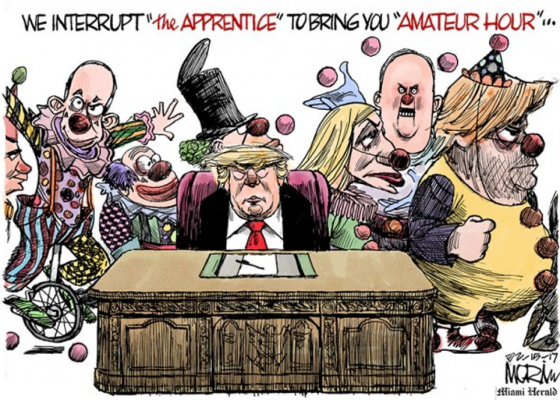
Thanks to the arrogant attitudes and inaction, the dangerous clown show Trump and his aides have made of their (oh, the irony) ‘pandemic response’ has put us all in danger.
Share stories like this far and wide. Perhaps some of Trump’s ardent followers will finally admit The Emperor Has No Clothes.
Another truth to share is Trump disbanding the Pandemic Response Unit of the NSC. He admitted it twice, now denying he knew nothing about it. Of course.
The article the diary was drawn from is linked here, along with other links about his calling for cuts at the CDC:
Eck. One more turd to plop in the festering stew of Trump’s incompetence, evidencing how careless, unprepared, and unworthy Trump is to be POTUS.
NBC News had a good report on this recently, noting that the president’s decision “to downsize the White House national security staff — and eliminate jobs addressing global pandemics — is likely to hamper the U.S. government’s response to the coronavirus.”
The truth is probably “because Obama,” who with VP Biden established the permanent Pandemic Response Unit within the National Security Council, able to rapidly respond in the U.S. to epidemics and work in concert with governments around the world to curb the spread of deadly diseases. Ebola and SARS outbreaks made it apparent we needed to be prepared for viral contagion that would more than likely arrive on our shores in the future.
When first questioned about why he disbanded the Pandemic Response Unit in 2018 — the same year Trump and Republicans had no problem giving a trillion dollar tax cut to people who didn’t need it— he responded:
“I’m a business person,” he explained two weeks ago in response to a similar question. “I don’t like having thousands of people around when you don’t need them. When we need them, we can get them back very quickly.”
Except you can’t reassemble a team like that ‘very quickly.’ One more check mark in the long column of items on the “Trump is clueless about …’ list. This one glaringly evidencing how utterly devoid he is in understanding, concern, or interest in how the executive branch should work.
Not to mention his absolute disregard as president in fulfilling his duty to protect American lives behind the scenes when the cameras aren’t rolling. When they are, he pompously pretends to have it all under control. His ego-driven dysfunction has put the health of all Americans in jeopardy.
We don’t yet know the extent of contagion because we haven’t had enough tests to go around. And the Trump administration wouldn’t allow independent testing.
As the threat to the U.S. grew, late last week he spewed a word salad of a differentexcuse when pressed again by a reporter about his 2018 decision to disband the pandemic response team we sure could have used right about now:
“I just think this is something, Peter, that you can never really think is going to happen. You know, who — I’ve heard all about, ‘This could be…’ — you know, ‘This could be a big deal,’ from before it happened. You know, this — something like this could happen…. Who would have thought? Look, how long ago is it? Six, seven, eight weeks ago — who would have thought we would even be having the subject? … You never really know when something like this is going to strike and what it’s going to be.”
So, let’s get this straight: he disbanded the NSC Pandemic Response Unit because he never realized America might need it one day (and “de-Obamacizing, no doubt).
Hm. Does having a military ‘just in case’ there’s an attack on the U.S., or the presidential bunker he can retreat to ‘just in case’ ring a bell? Or why we have fire departments ‘just in case’ there’s a fire? Helllllllo?
It’s clear the concept of ‘insurance’ is foreign to him.
We need to get rid of this clueless, narcissistic moron in November and replace him with someone who’s dedicated to the welfare of the American people instead of dedication to his self interests and daily displays of pomposity.
There is so much at stake in November.
I’m Voting Blue No Matter Who.
The Bay Area, long one of the world’s mightiest growth engines, could be headed for a coronavirus-induced recession, as shelter in place orders shutter stores and bars, construction grinds to a halt, and the tourism and hospitality industry all but disappears.
This week, UCLA Anderson Forecast issued its first revision to its quarterly report in its 68-year history. Despite a strong start to the year, it’s now predicting two quarters of negative economic growth nationally — enough to be considered a recession — and for the economy to take until 2022 to be fully recovered. California, according to the forecast, will be harder hit, with a projected 280,000 jobs lost in the state. And that’s not even accounting for the shelter in place order imposed on Monday throughout the Bay Area.
“We’re in uncharted territory as to the economic effects of the measures being taken to control the spread of this pathogen in the Bay Area,” said Jerry Nickelsburg, director of UCLA Anderson Forecast.
The forecast predicts unemployment in the state will reach 6.2 percent by the end of the year and average 6.6 percent during 2021. The January statewide unemployment rate was 3.9 percent, according to the California Employment Development Department. Personal income, adjusted for inflation, is expected to stay basically flat until 2022.
Not everyone is convinced about the worst-case outcome for the region, though.
“This is business delayed, not business canceled,” said Chris Thornberg, founding partner of Beacon Economics. “At least not yet.”
UCLA Anderson projects California will be hard hit because it has a large presence of the industrieslikely to be most affected by coronavirus, Nickelsburg said. That includes hospitality, tourism, leisure — bars, restaurants and entertainment — and warehousing and transportation.
There are about 165,000 warehouse and transportation workers in the San Jose and San Francisco metro areas alone, which covers the five-county Bay Area plus San Benito County, according to 2018 data from the U.S. Census Bureau. Another 313,000 work in leisure industries including arts, accommodation and food services. About a third of the job losses projected in the state by the UCLA Anderson Forecast will come from those industries.
Chris Hoene, executive director of the California Budget & Policy Center, is particularly worried about those workers because they tend to be lower paid. Other vulnerable populations she’s watching for are those who are at risk of being homeless — for example people couch-surfing with friends — and undocumented residents who can’t access all the same public benefits.
“My fear is that those folks will then become economically unstable for a much longer period of time, they’ll be less able to recover quickly,” Hoene said. “We could see an increase in the state’s already high levels of homelessness. We could see an increase in the poverty level.”
If those workers aren’t able to recover quickly it could make it harder for the whole region to recover, she said.
Ted Egan, chief economist at the San Francisco Office of the Controller, said some Bay Area businesses are also being affected by the potentially long-lasting damage the outbreak has done to the global supply chain.
“I think that there’s some types of business — you think about takeout and delivery services — that people will turn to when they can’t turn to their retails in person,” Egan said, which could include tech companies that do deliveries like DoorDash or online shopping like Amazon.
But in a recession where the financial system is in trouble and consumers are suffering, not even those businesses will be safe.
The Bay Area’s construction industry also is affected, with all but a few essential jobs at hospitals and public transit being postponed, said Daniel Romero, assistant business manager for electrical workers union in Santa Clara County.
“One guy called me, he was almost in tears yesterday,” Romero said. “He barely got back to work and the job was shut down.”
It’s hard to know if all building has stopped — housing construction is considered an essential service that will be allowed to continue — but Romero said he’s directing his members to file for unemployment if their job is shut down or to access the union’s disability benefits if they test positive for COVID-19. In the meantime, the union has closed its apprenticeship program and is down to a skeleton crew.
“The unknowing I think is the hardest part,” he said. “We’re complying, so we’re just doing the best we can.”
For those hoping that at least a recession might bring down the region’s sky-high home prices, research suggests that might not happen, according to a Zillow analysis of past outbreaks. During the SARS epidemic, Hong Kong’s home prices stayed basically the same but the number of home sales declined by as much as three quarters.
Although most forecasters are predicting short-term economic declines, not everyone thinks the region is headed toward a recession.
“Everybody take a deep breath,” said Thornberg, of Beacon Economics.”Shutting everything down right now is a way of preventing a problem, not causing a problem.”
He compared the outbreak to natural disasters like hurricanes or earthquakes, which cause temporary disruptions but aren’t a sufficiently long-term shock to tip the economy into a recession. He said it’s possible we’ll have one quarter of negative economic growth, but that’s it.
But all forecasters and experts agree on one thing: The economic damage done by the pandemic will be determined by how long it lasts and how quickly it is brought under control. In announcing its revision predicting a recession, UCLA Anderson Forecast included an important caveat.
“If the pandemic is much worse than assumed, this forecast will be too optimistic,” it said.
Welcome to The Hill’s daily roundup of coronavirus news.
covid 19 spread
There are 5,894 known cases in the U.S., including 97 deaths, according to
Johns Hopkins University.
The Trump administration wants to send checks to every American in an effort to try to blunt the worst of the economic impact from the coronavirus outbreak — but that might run into problems with Senate Republicans, who are frustrated that they were largely left out of the negotiations on the most recent House-passed bill.
Meanwhile, frontline health workers are running out of protective supplies, and states say they are not getting the help they need from the federal government. The Pentagon says it’s willing to help, but it will only be a temporary solution.
Here’s what you need to know today…
From the White House and Capitol Hill:
Treasury Secretary Steven Mnuchin said Tuesday that the Trump administration wants to send checks to Americans in the next two weeks in order to address the economic impact of the coronavirus outbreak. Mnuchin and Trump said the idea was to get checks to the American public as quickly as possible.Morgan Chalfant and Brett Samuels have more here.
But Mnuchin got pushback when he briefed Republican senators on the idea shortly afterwards. He also heard strong GOP criticism on the possibility of providing tens of billions of dollars to bail out the ailing airline industry.Alex Bolton has the rundown on Mnuchin’s visit to the Senate today.
The Trump administration is expanding telehealth benefits for Medicare users. The option lets seniors, who are most at risk for the coronavirus, get some medical care without leaving their homes. Read Marty Johnson on the move here.
From the frontlines:
Nurses and doctors say they don’t have enough gear to protect themselves from the coronavirus. States have asked the federal government for more supplies but have only received a fraction of their requests. Shortages could endanger health workers on the frontlines of the pandemic and weaken the public health response. Read more from Jessie Hellmann here.
President Trumpis sure to hear more on that issue from nurses when he meets with them Wednesday. Representatives from about a dozen nursing organizations are expected to attend, along with members of the White House’s coronavirus task force, The Hill’s Nathaniel Weixel reports.
The Pentagon will give 5 million respirator masks to the Department of Health and Human Services (HHS) but that makes up a small amount of the masks that U.S. is expected to need during the pandemic. There are currently 10.5 million respirators in the National Strategic Stockpile, but the HHS secretary says the U.S. needs at least 100 million. Ellen Mitchell has the full story here.
From the cities and states:
New York City Mayor Bill de Blasiosaid he is considering issuing a “shelter in place” order for all city residents. Six San Francisco-area counties issued a similar order Monday. De Blasio’s move comes as the city tops 800 coronavirus cases. Read more from Marty Johnson here.
The presidential primary will continue as scheduled Tuesday in Arizona, Florida and Illinois, as state officials say they’ve taken the necessary precautions to ensure that voters can safely cast ballots. Officials though are expecting light turnout. One state where it won’t happen? Ohio. Get the rest of the story from Jonathan Easley.
And as for the state to come, the Democratic National Committee (DNC) is asking them to not postpone primaries, but instead to make voting safer. More from Jon on the DNC.
From Wall Street:
Stock markets rebounded Tuesday after one of their worst drops in history a day earlier, as President Trump and Congress and Congress advanced economic stimulus plans and the Federal Reserve took actions to shore up the financial system in the face of the coronavirus pandemic. The Hill’s Niv Elis has the full story here.
From beyond the U.S.:
The European Union agreed to close external borders to most travelers for at least 30 days to ward off the advancement of the coronavirus. Britain is not participating in the travel ban. Read more from Kaelan Deese.
President Donald Trump offered assurances that the worst of the coronavirus might be over by the end of this month.
The president spoke Tuesday morning from the White House on the COVID-19 outbreak, which has resulted in mass closures of schools, churches, stores and businesses — and he broke with many doctors and scientists to claim the situation might be relatively short.
“Our guidance yesterday urges Americans to take action for 15 days to help stem the outbreak,” Trump said. “So it is a 15-day period. They would say it is a 14-day period. We are asking everyone to work at home if possible, postpone unnecessary travel, limit social gatherings to no more than 10 people. I am making shared sacrifices and temporary changes. We can protect the health of our people, and our economy, because I think our economy will come back very rapidly. So it is 15 days.”
Trump again assured the public the viral outbreak would dissipate, and possibly soon.
“It’s going to pop,” he said. “One day, we’ll be standing, possibly, up here, we’ll say, ‘Well, we won,’ and we’re going to say that. Sure as you’re sitting there, we’re going to say that, and we’re going to win, and I think we’re going to win faster than people think. I hope.”
From licking floors to praying for an inept government: America’s churches react to the coronavirus
By Daniel Schultz, Religion Dispatches @ Raw Story – Commentary
It’s particularly important for churches that continue to meet during the COVID-19 pandemic to follow the guidelines laid out by health experts given that worship services are among the largest regular gatherings in modern society, among the most physically intimate, and likely include the greatest number of vulnerable people. Even single members of large congregations can have a dramatic effect on how coronavirus spreads or doesn’t, as South Korea found out the hard way.
While many aren’t meeting at all or are streaming services, some churches that do meet feel like they need to support those who need it, in worship or otherwise. My mother’s congregation in Madison, Wisconsin elected to close for a week or two, but also voted to continue to allow Alcoholics Anonymous and other twelve-step programs to continue to meet in their building, at those groups’ discretion.
[The Rev. Graylan Hagler] preached a fiery sermon for the small congregation, denouncing the Trump administration for spending money on a border wall while cutting public health teams that might have otherwise been ready to respond to the pandemic.
“Yes, we will come through the coronavirus! Yes, we will come through the city quarantines,” he avowed. “Yes, we will come through an inept government that can’t handle a real crisis. Yes, we will come through an election season, in victory, I pray … Yes, we will come through all our troubles in hope.”
Other Christians seem less pro-social, let us say. Pastor Rodney Howard-Browne, a Tampa Bay televangelist, equated changing habits in an effort to “flatten the course” with weakness, declaring that his congregation wouldn’t adjust their behavior in worship because they weren’t “pansies.”
Right Wing Watch
✔
@RightWingWatch
Right-wing pastor Rodney Howard-Browne is not about to cancel church or prevent congregants from shaking hands because they are not a bunch of “pansies.”
Others are willing to go some lengths to show they just don’t believe in this whole coronavirus thing:
In Arkansas, the Rev. Josh King met with the pastors of five other churches on Thursday to decide whether to continue holding service. Their religious beliefs told them that meeting in person to worship each Sunday remained an essential part of their faith, and some of their members signed on to Trump’s claims that the media and Democrats were over-blowing the danger posed by the virus.
“One pastor said half of his church is ready to lick the floor, to prove there’s no actual virus,” said King, lead pastor at Second Baptist church in Conway, Ark.
“In your more politically conservative regions, closing is not interpreted as caring for you. It’s interpreted as liberalism, or buying into the hype,” said King, whose church draws about 1,100 worshipers on a typical Sunday.
I’m not sure what’s daffier or more offensive: the notion that God’s supposed demand for adherence to rigid gender roles outweighs protecting vulnerable members of the community, or the idea that coronavirus is just a conspiracy theory cooked up by liberals—never mind the insanity that it’s Christians’ duty to protect a president from political attacks. (On a separate note, floors aren’t particularly known to be COVID-19 transmission agents. They might get plenty of other nasty bugs that way, though.)
Like the Trump administration’s bumbling efforts, these local responses to the current situation relate back to conceptions of truth on some level. On the one hand, while there’s a recognition of the coronavirus’ power, there’s a sense that it’s more important to preach a message of comfort or a word of judgment against the White House.
On the other hand, there’s a denial of the reality, and a desire to demonstrate a counter-power in butch demonstrations of faith in God, or the inscrutable gnosticism of believing it to be nothing more than a liberal plot against God and country—and God and country’s designated representative, Donald Trump.
Religious types aren’t the only offenders, either. Twitter was on fire over the weekend with sightings of young folks partying it up, apparently either in the belief that COVID-19 wouldn’t affect them, or in simple defiance of health experts:
Alexandria Ocasio-Cortez
✔
@AOC
Mar 15, 2020
To everyone in NYC but ESPECIALLY healthy people & people under 40 (bc from what I’m observing that’s who needs to hear this again):
PLEASE stop crowding bars, restaurants, and public spaces right now. Eat your meals at home.
If you are healthy, you could be spreading COVID.
Katie Williams
@realkatiejow
I just went to a crowded Red Robin and I’m 30.
t was delicious, and I took my sweet time eating my meal. Because this is America. And I’ll do what I want.
Killing Grandma to own the libs is a heck of a political stance, to be sure.
Continuing to participate in massive boozefests seems ill-advised at best, downright irresponsible at worst. So does prompting a large congregation essentially to flip public health measures the bird.
Yet I want to hold back at least a bit of judgment. For one thing, the nation has hardly been getting clear signals from the top on how to respond to coronavirus. Sure, there are all kinds of reminders about what to do; but then there’s a president who mutes or undermines every single message his own administration puts out.
very abnormal three years. The craving for some kind of ordinary life is readily apparent across all kinds of social boundaries. However unfortunate their methods, people will fight to maintain homeostasis. My own family went out for dinner on Friday night, and were pleased to do so knowing that in particular service workers will need the money in coming weeks. Tomorrow our son will go to school for one last day, and I’ll keep a coffee date. Life goes on, one way or another.
At the same time, it seems spectacularly incompatible with the declared teachings of most religions to act so recklessly when so many lives are in the balance. So I’d like to propose a variation on Pascal’s famous wager: if you act as though COVID-19 were a real menace and you turn out to be wrong, you’ve lost nothing more than a few handshakes in church. But, if you blow the threat off and it turns out to be much more dangerous than you thought, you’re potentially responsible for the deaths of hundreds, if not thousands, of people. Pascal’s countryman (and NBA star) Rudy Gobert learned this the hard way.
Wouldn’t it be better in the eyes of your fellow citizens and whatever power you believe in to have erred on the side of caution? Or, you know, sure, don’t be a pansy. Go ahead and put the vulnerable at risk to make America great again. Super idea. And to my fellow Christians: St. Peter will no doubt be a big fan of that one at the Pearly Gates.
Why the coronavirus could be the tipping point in reshaping the global economy 1 hour ago on March 18, 2020By Marshall Auerback, Independent Media Institute
The coronavirus has now gone global, and economies are in freefall. The pandemic is clearly the precipitating cause of today’s crisis, but there’s an underlying disease that has been with us for a long time: neoliberal economics. Globalized travel and trade, multinational supply lines, offshoring and overly financialized economies that have prioritized banking interests, cartels and oligarchy above all else have made a large portion of our population highly vulnerable to the effects unleashed by this pandemic.
Policymakers have a tricky task ahead of them. The virus has created a supply shock, as businesses have shut down and workers have been told to stay at home. In response, demand is plunging as a result of the lost income and the corresponding collapse in sales. That’s highly deflationary (as the bond markets are now signaling). What is required is a robust fiscal response so that workers’ incomes are protected and have adequate financial resources to get health care.
Coronavirus is panicking Wall Street — but it’s got investors in Donald Trump’s second biggest creditor terrifiedPublished 8 hours ago on March 17, 2020By David Cay Johnston, DC Report @ Raw Story
Shares of the little, and little known, Ladder Capital (LADR) closed Monday at $8.32 a share, down from $18 less than three weeks ago.
Dow Jones Industrial average. Shares of Trump’s biggest creditor, the large Deutsche Bank, are down 43% in the same period.
— but now it’s an ’emergency’Published 12 hours ago on March 17, 2020By Amanda Marcotte, Salon
For weeks, Donald Trump clearly believed he could lie the coronavirus away. As David Leonhardt of the New York Times carefully chronicled, starting on Jan. 22, Trump began a campaign of falsehoods geared towards tricking Americans — and especially the stock market — into thinking everything was going to be fine, this epidemic was “very well under control,” that “like a miracle” the virus “will disappear” and that anyone who suggested otherwise was participating in a “hoax.” Fox News and other right-wing media, in the endless infinity symbol of conservative lies, both led and followed Trump on this, blanketing red-state America with a steady drumbeat of assertions that the “liberal media” was exaggerating the crisis to hurt Trump.
The country has around 125 confirmed cases, and it’s a bit of a puzzle how the world’s second-most-populous nation, with 1.3 billion people, has seemingly remained unscathed so far.
There could be many more cases in India than have been detected, because of the difficulties of getting tested. But it’s also possible that the country has actually managed to so far escape the worst — either because of quick and strict efforts right from the start, or another mix of factors.
The relative calm has fueled disbelief in some quarters that the virus is even a threat. Over the weekend in Lucknow, one of India’s bigger cities, young people packed into pubs. “I am not scared. I eat, party, sleep,” said Akshay Gupta, an accountant who was bar hopping on Saturday night. “The scare is overhyped.”
■ The European Union has adopted a 30-day ban on non-essential travel to European countries from the rest of the world, starting a stretch of isolation like nothing in modern history outside wartime.
■ After suffering their worst day in decades, stocks bounced back: The S&P 500 rose about 6 percent as Washington policymakers talked up plans to try to cushion the economy.
Coronavirus shut down Sin City, creating a potentially devastating situation for Las Vegas
A couple walks along the nearly empty Las Vegas Strip on Thursday. (David Becker/For The Washington Post)
LAS VEGAS — Don Gummerson and Josh “Pepper” Clarke left The Flamingo and sauntered alone down the sidewalk of the Strip, past locked casino doors and outdoor daiquiri machines shrouded in black trash bags, to the only restaurant serving food for a half mile in either direction: McDonald’s. The oil workers from Manitoba were in town for a wedding: Gummerson married Clarke’s stepmother at 11 a.m. Wednesday, the last nuptials at the tropical casino for the foreseeable future, a day after Nevada Gov. Steve Sisolak (D) announced a shutdown of all casinos, hotels and “nonessential” businesses in response to the rapidly moving coronavirus pandemic.
As Clarke slung a $7 bottle of Wycliff champagne from his hip to his stubbled lips, Gummerson, in a matching black tuxedo, lamented their lonely journey through an eerily quiet Sin City.
“That’s gonna be our wedding f—— supper,” he said. “McDonald’s.”
The sudden closure of all Nevada casinos was an overreaction, they insisted, drawing an expletive-laced tirade about how they didn’t think Las Vegas would throw in the towel. Clarke was especially upset because he thinks the virus is really affecting only old people: “I don’t believe that this should be happening.”
A worker updates the Fiesta Henderson Hotel & Casino marquee after all casinos were closed in Nevada as a result of the coronavirus outbreak. (David Becker/For The Washington Post)
The men were among the few remaining tourists navigating the Las Vegas Strip as no one has ever seen it: nearly devoid of revelers, gamblers and street hawkers. The governor’s directive, which fell on some deaf ears around the city (including those of an 18-and-over strip club offering drive-by lap dances), became a mandate Friday afternoon. Sisolak announced that police action would be taken as a last course of action against businesses that refused to comply with measures to stem the spread of a virus in a city reliant on the opposite of social distancing.
As casino floors fell silent — many for the first time since their construction — a desert town built on tourist traffic from around the globe boiled with anxiety. In local union headquarters, homeless shelters, around-the-block gun store lines and churches, people of all stripes braced for an uncertain future. It was almost unthinkable, this city up against the only true showstopper it has ever experienced: An insidious virus that was first detected on the other side of the world.
As the coronavirus forced Las Vegas to shutdown, tourists scrambled to head home
After Nevada Gov. Steve Sisolak (D) ordered all nonessential businesses to shut down on March 18, tourists in Las Vegas were forced to cut vacations short. (Ashleigh Joplin/The Washington Post)
Traffic on Las Vegas Boulevard has fizzled, and the continuous buzzing and beeping inside the monolithic casinos has given way to the low hum of electricity, whooshing air conditioning and 1990s pop hits played for an audience of security personnel and cleaning staff.
The waters of the spiraling Bellagio fountains lie still, though a few of the hotel marquees remain illuminated at night, painting the sky blue, white and gold on an empty desert soundstage. A few mumbling panhandlers remained seated on Strip sidewalks. Unable or unwilling to seek alternatives in this strange new reality, they held up cardboard signs with marker-scribbled messages to a handful of people in no mood.
“Disabled marine veteran. Homeless. Only God can save us now.”
As a White House news briefing on the coronavirus is broadcast on a television, an employee cleans the back bar inside the now-closed Emerald Island Casino in Henderson, Nev., on Friday. (David Becker/For The Washington Post)
Where are the keys?
The shutdown has not just been unpopular with departing tourists, it also has infuriated Mayor Carolyn Goodman, who offered a stern rebuttal to the governor’s decision at a City Council meeting on Wednesday. A shutdown of this magnitude was unprecedented, she said. Neither the events of 9/11 nor the October 2017 mass shooting that took 58 lives at a music festival here had the effect of a 30-day freeze in tourism.
“I know we, and they, cannot survive any total shutdown of the economy for any length of time beyond the immediate week or two,” Goodman said. “Please, governor, we need to be able to live our lives, support our families and, yes, keep Nevada strong, but together.”
She called for an eight- to 10-day shutdown, shorter than what the Centers for Disease Control and Prevention says can be a two-week incubation period for the virus. Goodman’s challenge to Sisolak, which was ignored, divided many Las Vegans as it has many people across the country. What’s better? An economically crippling shutdown long enough to ensure the virus is in the past, or fewer restrictions on everyday life and the risk of widespread infection?
“As someone in the tourism industry, I really liked what Mayor Goodman had to say, for selfish reasons,” said Tim Brooks, owner and general manager of Emerald Island Casino in Henderson. “But I don’t really know what’s realistic. Would I like to be back at work and not have these families suffer? Yes. But at what risk?”
The Emerald Island, a single-story casino with a bar and 24-hour restaurant, is far less reliant on tourism than most casinos in the heart of Las Vegas. Think “Cheers” with slot machines. Late last week, it dawned on Brooks that the front door of his 24-hour casino hadn’t been locked since he opened the place 18 years ago. Where on earth are the keys?Anticipating a shutdown, Brooks called a locksmith on Monday and had a new lock installed. When the news came, he gave last call for the first time ever, at 11:50 p.m.
The next day, his staff went about the unfamiliar business of closing a casino. Slot machines were emptied of cash and wiped down with disinfectant spray. Liquor bottles were capped and keg tap lines blown clear.
Casino porter Geralyn Johnson deep-cleans video poker machines inside the Emerald Island Casino after it closed. (David Becker/For The Washington Post)
Owner and general manager Tim Brooks checks a door as he surveys the closed Emerald Island Casino. Brooks had to hire a locksmith, as he has never had to lock the doors in the 18 years he has owned the business. (David Becker/For The Washington Post)
A month on the shelf will mean a six-figure loss in revenue, Brooks says, and he’s keeping 20 to 30 essential staff members on board and letting go of more than 130, most of whom trickled into the Island between 10 a.m. and 4 p.m. Friday to get educated on unemployment benefits.
“We were humming right along and planning an expansion at the end of the year and to employ 50 more people,” Brooks said. “We’re hoping the state will step up to the plate and ease some of the restrictions for all the people collecting unemployment. What hurts me more than anything is that it’s affecting the livelihood of the people we know and love.”
‘It’s insane right now’
Jose Triana emerged from the front desk of his health clinic Thursday afternoon at 4 p.m. to unlock the front door and tell a towering, mohawked man coughing into a blue medical mask that drive-through testing for covid-19 was over.
“I would rather you call tomorrow. It’s insane right now,” said Triana, 29. When the man asked how long he’d have to wait to be tested, Triana’s pain and exhaustion broke through his N95 mask and medical visor. “I don’t know. I really wish we could, I really wish we could. It’s just … I can’t afford it, I can’t afford to pay my staff.”
Sahara Urgent Care and Wellness was one of just a few clinics here offering coronavirus tests, available to people exhibiting symptoms. For three days beginning Monday, employees directed cars through a maze of traffic cones linked with white rope to a spot where technicians waited with nasal swabs. When the results were in, patients waited several hours after they were obtained to be notified if they had tested positive for the virus. Cars circled the block each day, and after more than 700 tests, the clinic limited them to appointment by phone or online.
“We’re not getting the support that we’d like,” Triana said as the man retreated to his parked car, where a woman in a mask waited in the passenger seat. “Our resources have been exhausted. Honestly, everyone that was coming in, they looked bad. We really didn’t turn away anybody.”
Triana said he wasn’t allowed to share how many confirmed cases his clinic has reported to Clark County — which includes Las Vegas and Nevada’s second-largest city, Henderson. According to the Southern Nevada Health District, 126 positive cases of covid-19 were reported in Clark County as of Friday, with two deaths, both being people in their 60s with underlying medical conditions. But the threat of transmission is especially high compared with the rest of the country, experts said, because in the region’s more than 200 casinos, people handle chips, cash, cards, slot machines and touch screens, all in proximity to one another.
Bertha Lopez, of Mexico, wears a face mask as she visits the “Welcome to Las Vegas” sign with her family on Thursday. (David Becker/For The Washington Post)
Six medical providers at five hospitals who spoke with The Washington Post said each had been inundated with patients seeking tests after exhibiting covid-19 symptoms. Such was the demand at Valley Hospital Medical Center, two nurses said, that security was concentrated in the admissions areas to deal with overflow and assist in screening. That provided an opportunity for badness: Thieves broke into five cars belonging to members of the hospital staff, and they took multiple garage door openers and registrations bearing home addresses, staff members said. The two nurses spoke on the condition of anonymity, citing a hospital rule against unauthorized contact with the media. The Las Vegas Police Department did not respond to a request for comment.
“When I first heard about it, I thought, no, that’s gotta be fake news,” said one of the nurses. Then she saw the pictures and spoke with those whose cars were targeted. “We’re just trying to do our jobs and trying to help people, and it feels like there’s no one helping us. It just doesn’t sound real. Who attacks the people trying to help them?”
People wait in line to enter the Briarhawk Firearms and Ammunition store in Las Vegas. (David Becker/For The Washington Post)
Four miles away, at the Briarhawk Firearms and Ammunition store, more than 30 people waited in line to purchase guns and/or ammunition when the store opened at noon, mirroring a scene at multiple other gun stores here. Some customers said they were motivated by stories circulating on social media of home invasions. Three cited a specific item they had seen on Snapchat that described a home invasion in nearby Henderson, in which men apparently dressed as utility workers held a family at gunpoint and stole supplies. Many such stories and claims from around the country — many debunked — have been circulating online and on social media for days, stoking fear; the Henderson Police Department said the posting was not deemed credible and has urged people to stop spreading rumors.
Shawna Sanders, one of the first in line when Briarhawk opened at noon Thursday, said she had heard stories of break-ins and seen videos of fights in grocery stores. When she read that someone was stabbed over supplies in another state, she figured the violence was coming to Las Vegas. She moved here four years ago from New Jersey to live with her mother, a decision she has come to regret. The single mother of two worked as a bartender until the shutdown, which caused her to be laid off. On Monday she Googled “guns for women,” then showed up at the Range 702, a local shooting venue, with an idea of which pistols she wanted to try out. She narrowed the options down to two small, light guns — a Glock 40 or a Glock 9 — both in the $400 to $600 range. “I can’t be out here trying to live life with a knife,” she said. “I need real protection.”
Volunteers load boxes of food at an emergency food distribution site in the parking lot of the Palace Station hotel-casino in Las Vegas. (David Becker/For The Washington Post)
‘The Twilight Zone’
Representatives from more than 130 nonprofit organizations in southern Nevada joined a United Way conference call Tuesday morning, hosted by Kyle Rahn, 60, the first female president of the United Way of Southern Nevada. Homeless shelters, meal providers, drug and alcohol treatment centers and state and local health and emergency assistance representatives joined in, aiming to take stock of resources and encouraging collaboration. Many anticipate that the shutdown of one of the nation’s largest county’s will put the people on the fringes of Las Vegas’ economy at great risk. Rahn three weeks ago set up an emergency assistance fund for the nonprofits, anticipating a shutdown.
“It’s no longer business as usual,” Rahn told the group. “And it may never be again.”
It’s the kind of work that can’t be done from home, so throughout the week a core group of five women came to the United Way offices every day, diligently washing their hands and maintaining social distancing while organizing a growing network of volunteers and nonprofits re-purposing themselves for a tsunami.
One of the women on the call, Terry Ruth Lindemann, runs Family Promise of Las Vegas, a group that helps newly homeless families find temporary housing in motels and with religious organizations. Lindemann requires visitors to wash their hands upon entry. After that, parents are introduced to case workers and go through the often-painful process of explaining how they got there. Children sprawl on couches and watch Pixar DVDs in the main room; the office is packed with stacked boxes of diapers.
She has been working 13-hour days, answering hundreds of emails. “I’m still not convinced that I’m not a star in an episode of ‘The Twilight Zone,’ ” Lindemann said.
Clark County, she says, typically finishes each school year with about 14,000 children listed as homeless, which she estimates to mean as many as 5,000 families are living in cars or otherwise oscillating between homeless and housed. Family Promise has about 40 families on its caseload, with plans to expand to 100 in 2020 with an operating budget of $700,000 per year, a portion of which is public funds.
Closing the Strip, she says, will create “a lot of need for food banks, for rental assistance, for motel shelter,” she said. “That means that this community is going to have to come together as we never have before, and we are beginning to respond in that way, much in the way they had to for Katrina and Sandy.”
Maintenance workers clean the stairs for a Las Vegas Strip pedestrian overpass. (David Becker/For The Washington Post)
As she spoke, the first housing casualties of the shutdown walked in from the street and parked on the Family Promise couch: A family of five, led by a single mother, who just last week made the pilgrimage from Utah to Las Vegas in search of work.
Two miles east, at the Culinary Workers Union headquarters, the largest union in Las Vegas and arguably the city’s most powerful, workers called in and filled the waiting room, wondering about their paychecks while casinos and hotels sit vacant.
“We’re negotiating that this week with casinos,” said Bethany Khan, director of communications for the culinary union. “For most workers that the culinary union represents, nothing will change. They’ll be paid throughout this. We are demanding that all employers, union and nonunion, pay their employees during the closure.”
While some nonunion casinos did offer compensation for furloughed employees — including notoriously anti-union Las Vegas Sands owner Sheldon Adelson — most smaller casinos, hotels and small businesses that exist on the periphery of the Strip will not. And with about 40 percent of residents not being members of a union, the impact of a month-long pay freeze will be long-lasting and severe, said Rusty McAllister, executive secretary-treasurer of the Nevada State AFL-CIO,
“If you look back at 9/11, we were one of the hardest-hit cities, and it
took the longest for us to come back,” McAllister says. “If people are worried or people have to look at places to cut back, one of the first places they cut back is on their vacation plans. That has an immediate impact on our city. We’re one of the first to feel it and the last to come out of it when something like this happens.”
Hair stylist Hunter Stewart collects her belongings from her work station at The Hair Lounge salon.
For small business owners beyond the reach of the union, but no less reliant on a vibrant Las Vegas Strip, the length of the shutdown and the decisions handed down by the state and federal government may mean the difference between owning a business and not. Lisa Ortiz, owner and operator of The Hair Lounge, says the future of her business is reliant on her hair stylists paying rent at a time when none of them are working.
“If they pay their rent, and we bounce back, I will waive some stuff and try to get everyone on their feet,” she said. “But if they don’t, it may not bounce back. It honestly depends on whether or not this lasts longer than 30 days. Everything’s up in the air right now.”
So she’ll wait. On Thursday evening, Ortiz brought her young son to the shop to meet one of her stylists who needed to pick up supplies. She had spent the week clearing out hair products, intending to sell them via social media at cost, and securing the shop against looters: locking up mirrors and expensive salon equipment. She had seen the home invasion claim on Snapchat, too. And the salon recently experienced a break-in after hours. Tucked in her jean waistband as she buckled her toddler into a car seat was a small loaded pistol.
“It just feels like anything can happen,” she said. “You don’t know what to believe.”
For others, the math ahead of them portended more desperate measures. Walking the aisles of a Cardena’s grocery store, Oscar Ibarra and Judy Luis contemplated what was required to feed their 10-month-old, Catalina, pay rent and feed themselves after both lost their jobs. She was a hostess at the Grand Lux Cafe on the Strip, and he worked for a pool-builder.
“Because of this whole shutdown, the clients don’t want us around right now, because they think someone might have it,” Ibarra said. “I have a little bit saved away, enough for the next few weeks.”
They’ve been buying in bulk, and skipping meals. That should work for four weeks. If the shutdown lasts longer than a month, the family might have to move to Portland, where his mother lives: “Unless they tell us we don’t have to pay rent for the next month, there’s not much else we can do.”
And while some walked grocery store aisles and performed the painful calculus of how long they might last in a Las Vegas without work, the last of the tourists who once propped up the city made their way home.
On the Strip, crossing paths with the hungry Canadian wedding party, Matt Cross and Gio Feusi had carry-ons rolling in tow. They had been asked to leave the Cosmopolitan two nights into a three-night stay that, combined with airfare out of San Francisco, cost just $480 in an economy gripped by the virus.
“We got out of San Francisco because things were shutting down, and it was so cheap to get here,” Cross said. Added Feusi: “We didn’t think Vegas would ever shut down.”
In this, they were not alone.
Inside California’s great lockdown, glimpse America’s stay-at-home future
More than 6 million people in the Bay Area have been ordered to stay home since Tuesday, prompting empty streets, cabin fever, creativity and acts of kindness
San Franciscans enjoy the fresh air and views along a stretch of beach at Crissy Field on Friday. (Photos by Melina Mara/The Washington Post)
SAN FRANCISCO — Nearly a week into an unprecedented health and social experiment, more than 6 million people here are asking: Just how long can one stay at home?
On Monday, San Francisco and five other Bay Area counties were among the first in the nation to officially order residents to stay home to slow the spread of the novel coronavirus. By penalty of law, going outside is allowed only for certain jobs, food shopping and other “essential” activity.
Life inside low-key lockdown is a battle against boredom, isolation, anxiety and the fear of no end in sight. The region known as the heart of the tech industry is both inventing a new online reality and feeling the strains of economic inequality. As the rest of California and more states issued stay-at-home orders this weekend, the Bay Area’s lesson to the 1 in 5 Americans now affected is: This is harder than you think, but you’ll be surprised at your creativity and the kindness of neighbors.
Tumbleweeds might as well have rolled across the Golden Gate Bridge during rush hour Friday, though cooped-up people filled nearby Crissy Field to exercise, mostly keeping a respectful distance. Boarded-up display windows for Christian Dior, Fendi and Louis Vuitton lined the city’s deserted Union Square shopping district. At 5:40 p.m., just one car was driving down the city’s windy Lombard Street.
TV weatherman Lawrence Karnow from KRON-4 now reports the forecast from a room at home decorated with a few candles and a WiFi router. Inspired by the 2010 World Cup, fourth-grade teacher Tom Culbertson and his 16-year-old son blow vuvuzelas at 6 p.m. every evening to encourage their Palo Alto neighbors to step into the street and say hi.
“We feel like we need to bring some kind of silliness to this as best we can,” Culbertson said.
Everyone is learning the self-quarantine rules.
TOP: Tom Culbertson blows a vuvuzela on Friday to encourage families to join their neighbors on Amarillo Avenue in Palo Alto, Calif. BOTTOM LEFT: Shoppers pick through fresh produce at Weirdly Farmers Market in Oakland, Calif. BOTTOM RIGHT: With help from her roommate, Pilates instructor Carley Henning streams a class from her apartment in San Francisco.
Allowed: walking your dog, ordering takeout food and cocktails, farmers markets, biking, getting gas, using laundromats, and shopping at some liquor stores and medicinal marijuana emporiums.
Not allowed: petting someone else’s dog, dinner parties, going to hair and nail salons, in-person yoga classes, shopping for nonessentials and even throwing Frisbees.
“Look, I don’t make the rules, okay? That’s the department of public health,” San Francisco Mayor London Breed said in an interview, adding that she would have to do her own hair, too. “I know it’s not in our nature to not be close to one another or interactive or social when we’re around one another. But unfortunately, this is necessary for getting through this and also for saving lives.”
So far, so good, she said. “I’m really proud of this city,” Breed said. “But this is week one. And I’m sure that in the beginning it might be a lot easier. And as time goes on, it’s going to get more challenging for people.”
For the most part, violators aren’t being arrested, although it carries a potential misdemeanor charge. A spokesman for the San Francisco Police Department, Officer Robert Rueca, said enforcement is a “last resort” and the goal is “voluntary compliance.”
Still, cracks appeared as the weekend approached and the weather turned sunny. Some residents were spotted holding picnics, while others reported receiving citations for going to parks. The East Bay Regional Park District said it voided some parking tickets issued Tuesday, and California’s state parks authority said it was not ticketing but was urging people to leave parks “where social distancing cannot be implemented.”
Witness an empty San Francisco under a coronavirus ‘shelter in place’ order
San Jose had to officially order a gun store to shut after lines started building out the door Tuesday. The Alameda County Sheriff’s Office advised Tesla to close up shop, issuing a ruling that the electric carmaker is not an “essential business” after chief executive Elon Musk had thousands of employees report to work.
In an interview, San Jose Mayor Sam Liccardo said the Bay Area may have it relatively easy when it comes to compliance, thanks in part to a highly educated population, including many who can continue to draw a paycheck by working at home with a computer.
“And yet even here in the largest city in Silicon Valley, we have this enormous divide with hundreds of thousands of residents facing horrific choices about how they’re going to make ends meet,” he said.
The counties made the drastic decision to force residents to stay at home in an effort to “flatten the curve,” essentially spacing out coronavirus cases so they don’t overwhelm local medical and emergency resources and contribute to rapid community spread. It will take weeks to know whether the measures prove effective. By Sunday, there were 1,468 confirmed cases in California and at least 27 deaths, less than a month after the state reported its first case of community transmission. The Bay Area was the first part of the country to report cases spreading in the community, in Solano and Santa Clara counties.
California Surgeon General Nadine Burke Harris said that while necessary to stop the spread of disease, the orders also have the potential to exacerbate depression, anxiety and such chronic health problems as diabetes and high blood pressure. Social connection is vital, she said, particularly for children.
“Whether it’s virtually — phone, text, FaceTime,” she said, “I would say it’s more important than ever for our communities to stay connected.”
While municipalities have published lists of rules, interpreting the orders is happening one household at a time.
Corinne Downey, 41, of Palo Alto, said her 11-year-old son was begging to see friends in person, so she invented a new game: quarantine basketball. Each boy brought his own basketball, which only he was allowed to touch. The kids would sing “social distancing!” whenever they got too close.
Love in the time of coronavirus requires creativity, too. Matthew Cooper, 37, proposed a first date at a park just kicking a soccer ball back-and-forth. “It feels like we can do that from a safe distance,” said Cooper, who lives in Oakland.
The vital organs of urban life still mostly function. Trash largely gets picked up on schedule. Trains are still running, though often empty. Crime reports are down, but officials worry about a potential increase in domestic abuse. Several local jails have released prisoners early, in hopes of reducing the risk of an outbreak. San Francisco has also ceased evictions and issuing parking tickets.
TOP: Kitchen workers take a break outside Nico’s Restaurant in quiet downtown San Francisco. BOTTOM LEFT: San Francisco residents ride an eerily quiet Bay Area Rapid Transit train on Friday. BOTTOM RIGHT: A traveler arrives to a quiet Norman Y. Mineta San Jose International Airport.
Some residents are choosing to severely limit their activities to avoid exposure. Kimberley Gilles, 63, of Piedmont, asked on Nextdoor.com for strangers to help with grocery shopping. She got seven responses in about an hour.
Gilles said self-quarantine has left her with a “low-grade melancholy” but given her a new appreciation for community. “One of the things we are all questioning is our ability to control everything,” the high school English teacher said. “I can control kindness. I can do that. But almost everything else is beyond my control.”
Things have gotten especially tricky in “co-living” houses, where young professionals cram together and share the cost of exorbitant Bay Area rents. Melissa Wong, one of 14 roommates in an Oakland home, faced a weighty decision when the house collectively decided to require residents to either socially distance themselves from significant others or stay with their partners during the outbreak. Wong, 32, chose to move in with her boyfriend of a year and a half while still paying $1,650 in rent to keep her bedroom. She said she and her boyfriend had been looking for a “more celebratory context” to live with each other. Fortunately, “it’s been pretty positive,” she said. “We will get our moment to actively choose living together.”
For many, the biggest challenge is passing time while normal life is on hold. Ashleigh Azzari, a 36-year-old manager at Anthropologie in Palo Alto, is still collecting a paycheck but can’t go to work or leave the house, except to walk the dog and grocery shop. She and her husband are trying to conceive, and even fertility treatments have taken a pause. To pass the time, she bought an unlimited annual subscription to Rosetta Stone for $99 to brush up on Italian and learn Japanese. At 6 p.m., she joins a virtual happy hour with co-workers.
She’s also a puzzle enthusiast but has been finishing them too quickly, piecing together a 1,000-piece art deco set in a couple of hours.
By the end of the day, “you can go through all the emotions,” she said. But it’s also been a reminder of what’s important to her. “Like hanging out with my husband. He’s a nice guy. We get along,” she said. “We are all taking a step back from how fast we were moving.”
A worker disinfects an elevator at a BART station in San Francisco.
Other people have had to choose between income and their health. Steve Gregg, 51, of Antioch, drives for Uber and on Friday decided to log off the app because his lungs don’t handle infection well. He’s now reliant on a side gig of writing.
“It went from ‘I can do this’ to ‘this is Russian roulette, I’m not playing it,’” he said, describing dropping off a passenger near a hospital that triggered a panic attack. “I went home and I haven’t driven since.”
Then there are the 28,000 Bay Area residents who have no home in which to quarantine themselves. T.J. Johnston, 53, has been living in the same San Francisco shelter since November, where he sleeps in a room with about 10 sets of bunk beds. “There’s literally another person on top of me,” he said. The city has told shelters to extend their reservations until the end of April. “I tried myself to maintain social distancing,” he said. “It is kind of difficult when you put so many people inside a confined space.”
Some restaurants are shuttering, unable to balance high rents with a decline in customers. Others are finding unexpected ways to adapt. The Los Gatos restaurant Manresa, which boasts three Michelin stars, has closed for dinner and told its hourly employees to sign up for unemployment. But it’s now transformed into a takeout joint, offering a gourmet “family meal to go” for $35 to $59 per head. Friday’s menuincluded Japanese medai a la plancha and seasoned sushi rice along with pineapple upside-down cake.
Ericka Wells was laid off as a waitress from Grand Lake Kitchen in Oakland on Thursday as the restaurant shut down. So the aspiring pastry chef took to Nextdoor to inform her neighbors she was officially open for business. She’s delivering 14 pastry boxes this weekend (she plans to leave them on porches in sealed plastic bags to avoid germs).
Her business, Layers By Xanthe (her middle name), has turned into a bright spot in an otherwise dismal time, she said. “The universe just put a stop button for all of us and told us to reevaluate our lives,” she said.
There are still moments of fear. Walking in the park or on the sidewalk — while technically allowed — prompts many passersby to swerve roughly six feet out of the way. Doctors and nurses keep going to the hospitals, where cases are starting to mount. Coronavirus testing sites have not been made public, in an effort to guard them from an overwhelming crowd.
TOP: Pigeons gather on an otherwise empty street in San Jose. BOTTOM LEFT: Dennis Wishnie and his daughter Lauren Altbaier practice social distancing near the Embarcadero in San Francisco on Friday. BOTTOM RIGHT: A San Francisco postal worker delivers packages.
The stay-at-home order can be especially terrifying for people with families who are feeling sick and can’t get tested. Pat Burtis, 50, a venture capitalist in Corte Madera, was coughing and had a fever of about 102 earlier in the week. He drove to an urgent-care clinic, a walk-in clinic and called his county health department, but he couldn’t get anyone to test him. So he grabbed a couple of extra masks from the hospital and has been isolating himself from his wife and 8-year-old daughter. “When I come downstairs, I am wearing a mask as much as possible and maniacally washing hands and wiping things down,” he said.
Still, there are many silver linings. One is how technology is bringing people together in new ways, from Zoom teleconference happy hours to online play dates for closed schools.
Amanda Deering, director of operations and strategy for Mariposa Kids, an after-school program in San Francisco, sent an email to all the parents in the program with a link to a free Google Hangout, where recreation leaders and a program director host two-hour virtual programs.
During the first session on Monday, there were plenty of kinks to iron out. Kids accidentally muted one another, and the rec leader was even silenced at one point. Things were going more smoothly by the end of the week, when staff members came up with creative ideas to keep kids engaged without just staring at the screen, including exercise classes, coloring contests and scavenger hunts in which kids find an object in their house that begins with a certain letter and then show it to the class. Students can earn “tickets” if they are well-behaved, letting everyone have a chance to speak and participate. When real-life class resumes, the tickets can be redeemed for prizes, like toys and ice cream sundaes.
“What we would like to create for kids is a space where they’re hanging out with friends but they’re also engaged with environment,” Deering, 29, said.
Even religion has found a home online. Cody Harris, 41, a lawyer in Mill Valley, held a virtual Jewish shabbat ceremony on Friday night with 20 other families over Zoom video conference. Attendees lit candles and sang together. “It’s just about being together and trying to bring some order and ritual and tradition into this situation,” he said.
A few people walk the streets of San Francisco on Friday.
Correction: Pat Burtis went to an urgent care clinic and a walk-in clinic to seek testing. An earlier version of this article incorrectly said he went to a hospital emergency room.
Nitasha Tiku contributed to this report. Photography by Melina Mara. Video by James Pace-Cornsilk. Photo editing by Annaliese Nurnberg. Design by Audrey Valbuena.
open letters to the candidates send to democratic candidates February 20, 2020. Will post any responses received, will also send to President Trump as well.
In any event, I believe that the time is now to call for national service in exchange for free college tuition/vocational training or grants to open small businesses. Three years of service followed by four years of either college/technical training, or assistance in opening a small business.
Call for Free College Education Coupled with National Service Requirements.
Dear Democratic Candidates:
I am writing to all of you and to President Trump to call for your to embrace national service in exchange for free college/technical training or assistance in opening a business.
It is time to change the game plan in Washington DC. You need a new bold proposal that will unite the country and heel the divisions.My proposal is for you to embrace mandatory national service for three years.Everyone finishing their service would receive full funding for college, technical training or a grant to set up their own business because after all not everyone needs to go to college, we need to encourage technical training and starting up small business as well.
the key is that the service would be universal and all citizens and LPR’s between age 18 and 25 would serve three years – no exceptions.Most would be military, but people could serve as fine fathers. adjust police officers, adjust border patrol officers, adjust teachers, peace corps volunteers or serve in state/local and federal government positions.
Call for all Americans to serve three years in public service either in the military or in the government or NGO sector and in return, they will get four years of college paid for. For recent graduates , they can serve and get their college debt forgiven. To those who say we can’t afford this, say we can’t afford to continue to put our college students in crippling debt they cannot afford. And everyone, especially the rich, should shoulder the burden of national service. and point out that shifting to a mandatory national service requirement would save the Pentagon money on salaries. the cost would be modest – minimum wage, housing, medical care and college tuition after their service. People would serve between age 18 and 25 one year of training and two years of service, with an optional second enlistment for three more years of educational benefits through PHD/professional degrees. Starting at age 18 until age 25 people will be randomly selected to begin service. those who are 25 will have until they turn 26 to report for service. They would have one year to report for service.
Free College/technical training or money to open a business in exchange for national service
Most people will start college, or tech training institute, then do military or other service, and then return to college to finish their college. That is fine. Ensure that colleges will not only accommodate that but will also offer college credits for military and other on the job training acquired during national service. This would also cut the cost of college attendance for most people to a manageable three years instead of four to five years. And of course, ensure that people can go to technical training institutes instead of a traditional college as we really need to grow the next generation of technical workers as well. and also ensure that those who wish financial assistance in setting up a small business would receive that assistance as well as we need to encourage the small business start ups as well.
After Service can compete to become an NCO/Officer or work for the Federal/State/Local/tribal government/ UN or NGO
After finishing basis service, those who wish to make a career of it could compete to become an NCO or an officer, and resume service after finishing college. And/or compete to enter government service for the Federal government or state and local government as well. and the service academies will only accept those who have finished basic service. This would apply to new service academies being set up, see below for more details.
All Must Serve
And most importantly, shared national service will help restore America’s sense that this is our land, this land belongs to everyone. The rich and the poor alike. We are all in this together. We have lost sight of that. The military has become an army of paid mercenaries recruited from the lower classes. If everyone serves, there will be less temptation to send troops into harms way. This will be a win- win for everyone except for the student loan vultures.
I would bring most of the troops home and station them along the southern border where they could be used to help bolster border security, and assist as first responders to natural disaster. Sell this as a real border security that will get the job done.
Establish New Service Academies for the Diplomatic, Intelligence Services/ Space Force/NASA, and law Enforcement
I would also call for four new national service academies to be set up. One would be for diplomatic and intelligence service, the other would be for law enforcement, the third would be for the Space Force/and NASA, the last would be more technical scientific agencies of the Federal government focusing on science and technology issues. These academies like the military academies including a coast guard academy, and beefing up the maritime service academy, would take only those who finished their military basis service. this would be a great way to restore our diplomatic corps and intelligence services as well as our law enforcement person. All graduates can meet their service obligation (five years post graduation) through working for Federal/State/local/tribal governments, the UN or NGO’s. all the service academies as well as the Medical Medical schools, the foreign service training center (which will be transformed into the new diplomatic/intelligence training academy) would work together on the national service academies consortium to coordinate policies and training, including post graduate training programs at the various military and other federal government training programs.
National Service Will Bring US together as one nation
I believe that this proposal could be enacted with wide spread bipartisan support.It would go a long way to help heal the divisions of our country and bring us all together as a nation. I hope you will fully embrace this proposal and I look forward to discussion it with yours staff.
bio follows
Jake Cosmos Aller is a blogger, writer and poet living in South Korea.he retired from serving 27 years in the Foreign Service working in ten countries doing a wide variety of positions including consular positions, economic and commercial positions and political positions.he speaks Korean, Spanish and Thai.He grew up in Berkeley, California.He graduated from UOP in Stockton, California and the University of Washington where he obtained a MA in Korean studies and a MPA degree.his work has been published in 45 literary journals.His web page is https://theworldaccordingtocosmos.com
open letters to the candidates send to democratic candidates December 27,2019. I send an earlier letter to Elizabeth Warren, Kamala Harris and Joe Biden on similar themes.
Will update if anyone responds. Follows an earlier letter to Donald Trump but his campaign has not answered the call as of today.
In any event, I believe that the time is now to call for national service in exchange for free college tuition/vocational training or grants to open small businesses. Three years of service followed by four years of either college/technical training, or assistance in opening a small business.
Call for Free College Education Coupled with National Service Requirements.
Dear Democratic Candidates:
I am writing to all of you and to President Trump to call for your to embrace national service in exchange for free college/technical training or assistance in opening a business.
It is time to change the game plan in Washington DC. You need a new bold proposal that will unite the country and heel the divisions.My proposal is for you to embrace mandatory national service for three years.Everyone finishing their service would receive full funding for college, technical training or a grant to set up their own business because after all not everyone needs to go to college, we need to encourage technical training and starting up small business as well.
the key is that the service would be universal and all citizens and LPR’s between age 18 and 25 would serve three years – no exceptions.Most would be military, but people could serve as fine fathers. adjust police officers, adjust border patrol officers, adjust teachers, peace corps volunteers or serve in state/local and federal government positions.
Call for all Americans to serve three years in public service either in the military or in the government or NGO sector and in return, they will get four years of college paid for. For recent graduates , they can serve and get their college debt forgiven. To those who say we can’t afford this, say we can’t afford to continue to put our college students in crippling debt they cannot afford. And everyone, especially the rich, should shoulder the burden of national service. and point out that shifting to a mandatory national service requirement would save the Pentagon money on salaries. the cost would be modest – minimum wage, housing, medical care and college tuition after their service. People would serve between age 18 and 25 one year of training and two years of service, with an optional second enlistment for three more years of educational benefits through PHD/professional degrees.
Free College/technical training or money to open a business in exchange for national service
Most people will start college, or tech training institute, then do military or other service, and then return to college to finish their college. That is fine. Ensure that colleges will not only accommodate that but will also offer college credits for military and other on the job training acquired during national service. This would also cut the cost of college attendance for most people to a manageable three years instead of four to five years. And of course, ensure that people can go to technical training institutes instead of a traditional college as we really need to grow the next generation of technical workers as well. and also ensure that those who wish financial assistance in setting up a small business would receive that assistance as well as we need to encourage the small business start ups as well.
After finishing basis service, those who wish to make a career of it could compete to become an NCO or an officer, and resume service after finishing college. And/or compete to enter government service for the Federal government or state and local government as well.
All Must Serve
And most importantly, shared national service will help restore America’s sense that this is our land, this land belongs to everyone. The rich and the poor alike. We are all in this together. We have lost sight of that. The military has become an army of paid mercenaries recruited from the lower classes. If everyone serves, there will be less temptation to send troops into harms way. This will be a win- win for everyone except for the student loan vultures.
I would bring most of the troops home and station them along the southern border where they could be used to help bolster border security, and assist as first responders to natural disaster. Sell this as a real border security that will get the job done.
Establish New Service Academies for the Diplomatic and Intelligence Services and law Enforcement
I would also call for two new national service academies to be set up. One would be for diplomatic and intelligence service, the other would be for law enforcement. These academies like the military academies including a coast guard academy, and beefing up the maritime service academy, would take only those who finished their military basis service. this would be a great way to restore our diplomatic corps and intelligence services as well as our law enforcement person
National Service Will Bring US together as one nation
I believe that this proposal could be enacted with wide spread bipartisan support.It would go a long way to help heal the divisions of our country and bring us all together as a nation. I hope you will fully embrace this proposal and I look forward to discussion g it with yours staff.
bio follows
Jake Cosmos Aller is a blogger, writer and poet living in South Korea.he retired from serving 27 years in the Foreign Service working in ten countries doing a wide variety of positions including consular positions, economic and commercial positions and political positions.he speaks Korean, Spanish and Thai.He grew up in Berkeley, California.He graduated from UOP in Stockton, California and the University of Washington where he obtained a MA in Korean studies and a MPA degree.his work has been published in 45 literary journals.His web page is https://theworldaccordingtocosmos.com
Dear President Trump
Call for Free College Education Coupled with National Service Requirements.
It is time to change the game plan in Washington DC. You need a new bold proposal that will unite the country and heel the divisions.My proposal is for you to embrace mandatory national service for three years.Everyone finishing their service would receive full funding for college, technical training or a grant to set up their own business because after all not everyone needs to go to college, we need to encourage technical training and starting up small business as well.
the key is that the service would be universal and all citizens and LPR’s between age 18 and 25 would serve three years – no exceptions.Most would be military, but people could serve as fine fathers. adjust police officers, adjust border patrol officers, adjust teachers, peace corps volunteers or serve in state/local and federal government positions.
Call for all Americans to serve three years in public service either in the military or in the government or NGO sector and in return, they will get four years of college paid for. For recent graduates , they can serve and get their college debt forgiven. To those who say we can’t afford this, say we can’t afford to continue to put our college students in crippling debt they cannot afford. And everyone, especially the rich, should shoulder the burden of national service. and point out that shifting to a mandatory national service requirement would save the Pentagon money on salaries. the cost would be modest – minimum wage, housing, medical care and college tuition after their service. People would serve between age 18 and 25 one year of training and two years of service, with an optional second enlistment. Those who complete six years will get six years’ worth of tuition.
Also talk about how this would allow college to be truly affordable for all, and would eliminate crippling college debts. Students will gain solid work experience in service, travel, and training. the training could be transferred into college credit making college shorter perhaps three years instead of four for most people.
All Must Serve
And most importantly, shared national service will help restore America’s sense that this is our land, this land belongs to everyone. The rich and the poor alike. We are all in this together. We have lost sight of that. The military has become an army of paid mercenaries recruited from the lower classes. If everyone serves, there will be less temptation to send troops into harms way. This will be a win- win for everyone except for the student loan vultures.
I would bring most of the troops home and station them along the southern border where they could be used to help bolster border security, and assist as first responders to natural disaster. Sell this as a real border security that will get the job done.
Establish New Service Academies for the Diplomatic and Intelligence Services and law Enforcement
I would also call for two new national service academies to be set up. One would be for diplomatic and intelligence service, the other would be for law enforcement. These academies like the military academies including a coast guard academy, and beefing up the maritime service academy, would take only those who finished their military basis service. this would be a great way to restore our diplomatic corps and intelligence services as well as our law enforcement personnel.
Benefits of National Service
The service requirement would be managed by the corporation for public service which would also manage the Peace Corps, VISTA programs and teach for America which would all qualify as qualified national service.
Regarding the Peace corps, and the other volunteer service opportunities, set it up that people would do their college service, then do the peace corps afterwards. they would receive college tuition etc while attending college.
Most people will start college, or tech training institute, then do military or other service, and then return to college to finish their college. That is fine. Ensure that colleges will not only accommodate that but will also offer college credits for military and other on the job training acquired during national service. This would also cut the cost of college attendance for most people to a manageable three years instead of four to five years. And of course, ensure that people can go to technical training institutes instead of a traditional college as we really need to grow the next generation of technical workers as well. and also ensure that those who wish financial assistance in setting up a small business would receive that assistance as well as we need to encourage the small business start ups as well.
After finishing basis service, those who wish to make a career of it could compete to become an NCO or an officer, and resume service after finishing college. And/or compete to enter government service for the Federal government or state and local government as well.
National Service Will Bring Us Together as a Nation
I believe that this proposal could be enacted with wide spread bipartisan support.It would go a long way to help heal the divisions of our country and bring us all together as a nation. I hope you will fully embrace this proposal and I look forward to discussion g it with yours staff
Sincerely
Jake Cosmos Aller
bio follows
jake Cosmos Aller is a blogger, writer and poet living in South Korea.he retired from serving 27 years in the Foreign Service working in ten countries doing a wide variety of positions including consular positions, economic and commercial positions and political positions.he speaks Korean, Spanish and Thai.He grew up in Berkeley, California.He graduated from UOP in Stockton, California and the University of Washington where he obtained a MA in Korean studies and a MPA degree.his work has been published in 45 literary journals.His web page is https://theworldaccordingtocosmos.com
The homeless crisis in the United States has gotten
out of control. Something must be done I’m both the federal state and local levels to solve the problem of homelessness in the United States. The private sector, especially large employers, the tech sector, the universities, and the NGO sector must be involved as well. This must must be made a top priority of the Federal and state governments to end the scourge of homelessness once and for all recognizing that housing is a basic human right and no one in America will be allowed to live on the streets anymore. Here are my proposals. I would call upon the Department of Housing to take the lead by convening a national convention on the Housing Crisis with follow-up legislation and action by the Federal government, in cooperation with State, Local governments and the private sector.
There’re four elements to my proposal
There must be a lot more housing built, mostly Multi family units, old-style boarding houses and single family residence hotels I’ve departed that picture as well including Group housing, and temporary housing for the chronic homeless should be set up knees tent cities would provide employment Basic medical care training and assistance to transition the residents into more permanent housing solutions.
Housing is a Basic human Right
One of the key elements of the proposal is the recognition that housing is a basic human right, no one and no one Will be allowed to live on the streets. If someone cannot afford housing today would be a sign to the homeless camps and this would be mandatory.
I know that this part of the proposal will be controversial from a civil liberty point of view, but I feel it is essential to solve the homeless problem. It is simply unacceptable then in the richest country in the world are being forced to live on the streets.
To pay for new housing and the the shelter system, a modest increase and income taxes is warranted. Most of the cost of running the shelters an expansion of housing should be done to the federal government.
As part of the solution, housing vouchers should be provided to people who are earning less than I hundred 200 of the poverty line so that they could afford to rent housing.
More housing Must Be Build
There must be a lot more housing built everyhere, and most of them must be built along transit lines, and most must be multi family unit facilities. The era of single-family homes Will have to come to and end. As part of this it must be made easier to convert single-family homes in the multifamily units, so call granny flat must be made available everywhere, short term housing must be regulated and made part of the pictures well.
Changes to Zoning, Smart Growth Policies
Local zoning laws that restrict housing in the residential areas only need to be revised, the goal should be mixed use development everywhere. Large buildings should consist of apartment offices and retail, smaller scale developments must include offices and retail as well. The goal should be a cityscape something similar to develop to the development any station where most housing is multi use buildings and everyone is within walking distance of offices retail and transit. Metropolitan governments need to have a regional planning office to coordinate new housing we develop mental housing retail commercial development an improved access to transit. Developers Will be giving incentives to build most housing at market value or below market value housing.
In California in other states that have similar restrictions, prop 13 and other property tax restrictions must be revised to encourage courage people to sell properties or renovate properties. Similarly zoning laws must be changed to encourage housing development, and mixed use development, and smart growth policies. The era when developers build housing far from transportation systems without any coordination with local government or planning must end.
Boarding Houses , Dormitories, other Group Housing and SOH’s need to be revived
As part of the housing problem, boarding houses, Group houses, dormitories for corporate workers, government workers including fire fighters, police and teachers, and university students on site need to be part of that package as well. inexpensive single occupancy hotels must be part of the package with the recognition that Half the population will end up living in these group housing arrangements. Very few people Will live in single-family homes anymore, most people will live in need of poop housing for apartment buildings, although there will be still people living in single-family homes and that is fine.
temporary housing camps including a revival of the Civilian Conservation Camp need to be part of the Proposal
Homeless tent camps should be legalized and located and areas near downtown. The camps must be located along transit lines. Anyone who needs a place to stay would be given a cot in a four man tent. The tenants will be heated and have air-conditioning, and Wi-Fi access. All the residents of the camp will work 30 hours a week to help maintain the camps in an hygienic attractive a manner, administrative services and law enforcement services for the camp, or will work in the national, state and local parks and forrest doing conservation projects, or serving as first responders. thus some people will live off site for a considerable amount of time near the forest, and park conservation sites, but all people will be assigned to a home camp. That camps will have food services for the residents food services for the residents medical services an offer education and training services as well.
the Camps would be run like the old CCC camps award of the great depression. The Cams will provide temporary housing for people in exchange for assistance and public service employment activities including conservation activities. Drug use alcohol use and gambling of course will be illegal in the camps, as will panhandling. Sleeping on the streets outside the camp will be illegal and the homeless will be rounded up and taken to the camps involuntarily if needed.
To pay for these camps, the federal government we’ll pay for most of the cost.
State and local governments working with the real estate developers, will develop low cost permanent housing, and camp residents will be transited into permanent housing as a housing is brought online.
The Camps will be open to all who need them including undocumented Aliens. No one will be turned away board turned into an immigration.
The camps be training and educational service centers, and temporary employment centers, with most residents living elsewhere.
We can Solve the Problem if We Make it an Urgent National Priority
If all these proposals are enacted in a comprehensive national strategy, the scourge of homelessness can be defeated and no one in America we’ll be forced to live on the streets.
Broken Down Souls Poems
Broken Down Souls
Homeless Fears
No One Knows Their Names
Trump’s Social Cleansing Program
Social Purification Drives
Broken Down Souls Do You See Them?
Broken Down Souls
Broken Down Souls
You see them everywhere
On the street
On the bus
On the metro
But mostly wandering the streets
Lost souls
Broken down defeated souls
The souls of the living dead
Dead inside
Waiting for death
To deliver them
from the agony
Of the living dead
They make do
They beg
They steel
They con their way
Living the street life
Living death
Broken Souls
You have two minds
One part of you
the fearful part of you
Conditioned to ignore
Conditioned to walk by
Ignoring the tragic wounded lives
The broken souls all around you
But part of you knows
That you can’t do that
But you can’t save everyone
So, you do what you can
You help those
whom you can
All it takes
is a little act of compassion
A little human kindness
A few bucks or a cup of coffee
And you walk by
Knowing just knowing
That by a simple act of acknowledging
Our shared humanity
You have made a small victory
And brought happiness
To yet another
broken down soul
And the fear
that you will
be a broken soul some day
Recedes away
Not me never
Never will happen to me
But one forgets
It is a simple matter
A wrong turn in life
The wrong place
wrong time
wrong thing
And you could be the broken soul
On the street
Begging to be heard
Begging to be taken away
And so,
I walk on by no more
I will listen
I will talk to them
I will make a small difference
And in so doing
Avoid becoming
a broken-down soul
Homeless Fears
I almost became
a broken-down soul
Out on the street
So many years ago
I was in college
Adrift for the summer
Smoking too much weed
Aimless
And I hung out
And got to know
Some of the homeless
Some of the bums on the street
And I vowed
That I would never be that person
Never sink that low
Never ever
Be the homeless bum
The invisible man
And that knowledge
Stuck with me
Throughout my life
Now many decades later
I try to remember
And I try to help
When I can
And recall what
it would be like
To be on the street
With nothing
but your clothes
And the money you borrowed
To keep you alive
No One Knows Their Name
The worst part of it all
As I survey the homeless
Across this great land of ours
The worst part of it all
Is that no one knows their name
No one knows their story
No one cares at all
And in this age of hatred
Sponsored by our president himself
The homeless are being treated
More and more as disposable trash
More and cities
Are banning the homeless
From their cities
Banning feeding the homeless
Banning begging
Banning sleeping in the streets
And banning their camp sites
If they could
they would
round them all up
And shoot them
Or let them run for their life
In some sort of game on TV
Because the homeless
Are an affront
to these so called
Christian patriots
They are lazy good for nothing losers
Who cause problems for good citizens
They should be locked up
Or removed
For the good of us all
No one wants them
No one cares
And no one knows their name
President Trump Discovers the Homeless
President Trump
Our dear compassion leader
Recently discovered
That homeless people
Were everywhere
All over DC
NYC
And especially LA and SF
The homeless were becoming
A huge problem
And something must be done
The homeless were taking
Up the best real estate
And making life difficult
For the masters of the Universe
Something must be done
The homeless have to be rounded up
And sent to camps
Out of sight
out of mind
and people would wonder
where did the homeless people go
To end the scourge of homelessness
Once and for all
The decree went out
The police rounded them all up
Shut down the street vendors
and homeless shanty towns
Sent them off for re-education
Deep in the countryside
Just in time for the Olympics
The homeless disappeared
Broken Down Souls Do You See them?
Broken down Souls Do You see them
Or are they invisible
all the broken souls
wandering the streets
no where to go
but to hell
on earth
now
now
you see
that they are
everywhere you see
can you see them now
will you be friend them now
or will you still look away
afraid that you will become them
the following sites are good sites to learn more and get involved in helping solve the problem. I will share this blog posting with them and update it if they respond to my blog
these are some of my most recent poems that I have posted on All Poetry, Poetry Soup, Cosmos-funnel, Hello Poetry, Poetry Opus Magnum, Fan Story and Sweek among other places. Check it out.
end of the worldDeep Fake Era
Demon Cat from Oregon
Strange Cat Looking at Me
Cat Dreams Kill All Humans
Visiting Father’s Grave
Ghosts of Yakima
Another Day Another
Mountain Forrest
End Times Approaches
Rumors of War
Deep Fake Era is Upon Us
The Deep fake era is upon us
Every thing is fake these days
Everything is a fraud
Prepare for the deep fake world
Fakery, fraud, and falsehoods abound
All artfully done Killing the last shred of human decency left
Everything is a deep fake
these days
Oregon Demon Cat
The demon cat
Lived in Medford Oregon
The demon cat was a big black cat
His eyes were filled with demonic energy
He stared at you
Looking into your very soul
Filled with anger, and hatred
For the entire human race
He seemed at times
To be not from this planet
Perhaps an alien species
Studying the human race
Or perhaps he came
Form hell itself
The demon cat loved to torment visitors
For some reason he hated the man’s daughter
The cat would stare at her from his perch
Down the hall from the old man
Then he would run at her
Screaming like an escaped banshee
Straight out of hell
She told her dad
Either the cat goes
Or I go
He said
See you later
The demon cat smiled
At the small victory
And she left the house
With the demon cat
Screeching good bye
Strange Cat Watching Me
A cat sits on the edge of a bed
Watching me watching him
Both of us thinking
What sort of strange creature this is
That has invaded our personal space
Upending our daily routines
The cat came up to me
Staring at me
with his soulful eyes
Boring into my very soul
Looking for answers
To these dark fundamental questions
The cat smiles a mysterious smile
And purrs in contentment
Having found an answer of sorts
And indicates that we can be friends
As long as I know
That he is the boss of me
And I pet him
Acknowledging
the time honored
Ritual of human cat interaction
That dates
back to the dawn of time
When humans and cats
First became aware
Of the other
Strange creature
that shared
our planet
Cat Dreams Kill Humans
cat sitting smiling
cat lost in buddha trance thought
cat dreams kill humans
Visiting Father’s Grave
Visiting my father’s grave
In Yakima
The ancestral land of the Aller clan
Thinking about my father
And his legacy
And thinking that I am
My father’s son
There is so much
I wanted to tell him
So much I wanted to share
So much I wanted him to see
My accomplishments
He was taken from me
Before I had achieved
my dreams
Before I had become the man
That he and I both knew
I was destined to be
Ghosts in Yakima
Walking along a graveyard
Looking for my father’s grave
Seeing all the gravestones
I begin to sense the spirits
Of the restless dead
They linger around the graveyards
Waiting for visitors
Eager to talk to anyone
Who cares to stop
And chat
So lonely being a ghost
With no one to haunt
Mountain Forests
Driving through the vast forests
Of Central Oregon
Through the wall of trees
I imagine them talking to me
The trees are whispering
Dark satanic rituals
Voodoo mumble jumble
Evil chanting
Then they speak
Loud and clear
Welcome humans
To our world
You think you are
The king of the world
The lords of creation
Masters of the universe?
Soon, all too soon
God and Gaia his daughter
Will tire of you
Their latest plaything
They will discard you
Throw you down
Disgusted at the world
You have made
You took the world
They gave you for your pleasure
This huge wonderful world
Filled with life
You took a paradise
Beautiful, bountiful
Rich and wonderful world
Turned it into a sewer dump
God and Gaia
are not happy
Not happy at all
With you stupid humans
They will rise up
Smite you down
And turn you
Into dust in the cosmic wind
And we will laugh
and we will be witnesses
at your funeral
but we will not cry
No one will cry
No one will miss you
No one cares about
The fate of humanity
And so you
Will fade away
Into the distance past
Just dust in the cosmic wind
And the trees started laughing
And the birds and bees
And all the other animals
All joined in the maniacal laughter
Laughing at the prospect
Of poetic justice For the enemies
Of the natural world
And the coyotes
And the wolves
Joined in howling
Under the light of the full moon
Thus I imagined
Would be the end of days
The end of the world
And the end of humanity
Another Day Another Shooting
another day in paradise
just another day in America
land of the free
Home of the brave
and guns
lots of guns
more guns for all
cries the NRA
yes another day
another gun battle
another white man
who just wants to kill
the President sends his condolences
Thanks the law enforcement
for an incredible job well done
It was horrible
Hate has no place
in our country
and we will take of it
and do what ever we can do
condolences
nothing but false words
empty words
lots of things to do
it is mental illness problem
but he fails to mention
the words gun at all
not at all
and tomorrow and tomorrow
but he at least finally said
hate has no role in our country
nothing but prime BS
in my humble opinion
he did not mention
white supremacy
his rhetoric had nothing
nothing to do about this at all
and so tomorrow
I will turn on the TV
and we see nothing
nothing has changed at all
and the dead
will remain dead
the guns will fire again
nothing will be done
welcome to America
land of the free
home of the brave
the End Times Approaches
why do I feel
the end times are approaching
with each passing day
the news gets worst
the hatred grows
the fear grows
the end of time
comes closer to our door
and I fear
the growing power
of the fascists
and their ilk
and I fear
that the world
is ending soon
Rumors of War
it seems that
we are in the end times
wars, and rumors of war
terrorism all around us
the dogs of war
are restless, just waiting
to emerge from their lairs
to unleash havoc
death and destruction
end of the world
and the leader of the world
our purported president
is every day
becoming more deranged
moment by moment
loosing his mind
as the inner demons
take over
and at such a time
when the whole world
seems to be sliding towards war
Our dear leader
seems determined
to lead us to the ultimate
war of all
world war 111
looms ahead
it could start any day
and nothing will stop
our idiot in chief
from unleashing
the dogs of war
I am writing to you to offer you my advice for winning the nomination and the Presidency. In a nutshell, you have to offer a bold progressive vision that will excite not only your base, but the entire country and change the direction of the U.S. This campaign has to be about competing visions and yes about how to restore American greatness. An optimistic vision is the key. People are tired of anger, and despair and pessimism. If you just campaign on how bad Donald Trump is, you will lose. And we can’t allow that to happen. The future of the world and the U.S. lies with you. I sincerely hope you won’t blow it. I hope you take my advice to heart. You may be our best choice to take down Trump and Trumpism for good. You go Girl.! here’s how to do it.
I retired from the U.S. State Department in 2016 after 27 years of service. I grew up in Berkeley went to college at the University of the Pacific and graduated from the University of Washington (MA Korean Studies, MPA). I also served in the Peace Corps in Korea. I have been to 50 states and 45 countries. and I too am part Cherokee and have distant relatives in Oklahoma.
Don’t Repeat Hillary’s Mistakes
Hillary’s biggest mistake was in my view making it all about how bad Donald Trump is, and not giving the voters a real sense of where she wanted to take the country. And in an age where the voters were ready for a big change to the status quo, being the establishment candidate was the kiss of death. Not to mention she refused to compete everywhere. And allowed Donald Trump to paint her as “crooked Hillary” and as too much part of the establishment which the public rightly distrusted so much. Donald Trump hit a nerve. the system was indeed rigged against the average Joe and the vested interests controlled the politicians. The public said, Screw the system lets go for the bomb thrower. and that is how we got Trump.
She could have picked Bernie Sanders as her running mate, and perhaps defeated Donald Trump. In the end she won where it did not matter and did not compete where she should have competed. and she never overcame the impression that she was the status quo candidate and the establishment’s favorite. You have to be a real outsider, and a real shall I say it revolutionary.
Restoring the old status quo will not work.
That is why I am supporting you vis Joe Biden. Joe Biden is the establishment’s guy. You have to be the establishment’s greatest threat as well as the greatest threat to Trump and his evil cohorts. And Bernie, comes across too much as an angry old man. We already have that in Donald Trump. The voters will ultimately be turned off by Bernie’s anger. The other candidates all have something to offer but for some reason are not taking off. You have momentum building and perhaps it is your time to step up to the stage and become a giant killer and kill Trump off politically. The stakes are that high as you know.
So, in this upcoming election you have to tell the voters why you are so much better for them and the country than Donald Trump. It will not be enough to run against the Donald. People have to want to vote for you. Your experience counts for a lot but it is not enough. Your age is the same as Donald’s so that is a wash.
Let Donald Trump Be Impeached and Self Destruct
I would not waste too much time on impeachment. let the process play itself out. Donald Trump may self-destruct anyway. You don’t need to do too much other than let him self-destruct. If he somehow survives, mock him constantly and challenge the Republicans for the craven support of the Conman Don.
GO BOLD OR BE RETIRED
The times cries out for bold progressive challenges and for fresh thinking. You have three strikes against you. First, your age, second your gender and third your past experience as a college professor. Can’t do anything about the first two, but you can run as a can do moderate progressive who knows how to get things done. The key is to make bold achievable goals. Then resist the temptation to campaign against Donald. The best thing we can all do is to mock him, and tell him time to retire, Grandpa Trump. Go home and play golf, we are tired of your rants, your incoherent tweets, your chaos. We need someone to clean up your messes. I’d start calling him Conman Don, or Loser Don, that will get under his skin and make him make mistakes which you can and should exploit…Make people want to vote for you as they share your vision of the possible future and make people feel that conman Donald Trump is indeed a conman looser who is not fit to be re-elected. .
Here are my suggested policy proposals.
I would put forth a series of comprehensive bold future-oriented policies and reiterate them every chance you get. You could call them Elizabeth’s Plan for the Future of America, or something along those lines. Maybe
“Let’s Boldly Go into the Future,”
“Make America Work Again”
“Rebuild America”
“Let’s Restore the American Dream’
But be big, bold, brassy, optimistic and challenge your opponents to produce a better plan or shut up and work with you to solve the nation’s problems.
Don’t Play Donald’s Game – Don’t Take the Bait
Don’t take whatever bait Trump throws out at you. Ignore his daily tweets. Let him destroy himself. He may be impeached or even removed from office or die of an heart attack. Just ignore him and play your own game. That’s the key to handling Trump. Ignore him, mock him, challenge him on how his plans will make America great. But play your game not his game.
Call for Free College Education Coupled with National Service Requirements.
Call for all Americans to serve three years in public service either in the military or in the government or NGO sector and in return, they will get four years of college paid for. For recent , they can serve and get their college debt forgiven. To those who say we can’t afford this, say we can’t afford to continue to put our college students in crippling debt they cannot afford. And everyone, especially the rich, should shoulder the burden of national service. and point out that shifting to a mandatory national service requirement would save the Pentagon money on salaries. the cost would be modest – minimum wage, housing, medical care and college tuition after their service. People would serve between age 18 and 25 one year of training and two years of service, with an optional second enlistment. Those who complete six years will get six years’ worth of tuition.
Also talk about how this would allow college to be truly affordable for all, and would eliminate crippling college debts. Students will gain solid work experience in service, travel, and training. the training could be transferred into college credit making college shorter perhaps three years instead of four for most people. And most importantly, shared national service will help restore America’s sense that this is our land, this land belongs to everyone. The rich and the poor alike. We are all in this together. We have lost sight of that. The military has become an army of paid mercenaries recruited from the lower classes. If everyone serves, there will be less temptation to send troops into harms way. This will be a win- win for everyone except for the student loan vultures.
I would bring most of the troops home and station them along the southern border where they could be used to help bolster border security, and assist as first responders to natural disaster. Sell this as a real border security not the fake wall fantasy that Trump is selling.
I would also call for two new national service academies to be set up. One would be for diplomatic and intelligence service, the other would be for law enforcement. These academies like the military academies including a coast guard academy, and beefing up the maritime service academy, would take only those who finished their military basis service. this would be a great way to restore our diplomatic corps and intelligence services as well as our law enforcement personnel.
Benefits of National Service
The service requirement would be managed by the corporation for public service which would also manage the Peace Corps, VISTA programs and teach for America which would all qualify as qualified national service.
Regarding the Peace corps, and the other volunteer service opportunities, set it up that people would do their college service, then do the peace corps afterwards. they would receive college tuition etc while attending college.
Most people will start college, or tech training institute, then do military or other service, and then return to college to finish their college. That is fine. Ensure that colleges will not only accommodate that but will also offer college credits for military and other on the job training acquired during national service. This would also cut the cost of college attendance for most people to a manageable three years instead of four to five years. And of course, ensure that people can go to technical training institutes instead of a traditional college as we really need to grow the next generation of technical workers as well.
After finishing basis service, those who wish to make a career of it could compete to become an NCO or an officer, and resume service after finishing college. And/or compete to enter government service for the Federal government or state and local government as well.
Call for The Green New Deal
Point out time and time again China, Germany, and other countries are building the green energy resources of the future while the U.S. which invented green energy is moving back to the 19th century. We invented green energy technology! And we should be the world’s leaders in making the transition to a green energy economy. Talk about jobs this will create, and talk about saving the world from the ravages of climate change. be bold call for a moonshot approach to building a completely green energy economy within ten years.
When critics say we can’t afford this, tell them we can’t afford to ruin the world for our children’s future. We can’t afford to continue burning fossil fuels. Climate change is real and the U.S. must lead the way forward. We should be the world leaders! That is what great nations do, lead the world in embracing change, in embracing the promise of the future. We can do no less. And when Trump and other climate change deniers talk nonsense, call them on their BS. Ask Trump doing the debates how does he know that climate change is not real? Has he ever studied climate change? Does he have a PHD in science? Is he smarter than 99% of the world’s scientists? Throw it at him, make him out to be the ignorant tool of the fossil fuel industry that he is. When he talks about bring back coal jobs, challenge him. Why would anyone want to work in a coal mine? It is dangerous work, and the mines are played out. We can transition the miners to new energy jobs that pay better, and are so much safer for the workers and the environment. If he goes on about wind power, point out how absurd his arguments are and how he does not know what he is talking about.
Call to Fix Obama Care
Point out time and time again that we still have a broken down too expensive too burdensome a health care system. Point out time and time again that we have the most expensive system in the world yet we are about 25th in terms of health care outcomes. No one in this land should fear going bankrupt if they need to get medical care. We can do this right and we must do it right.
I would acknowledge that Obama Care is not perfect and that if you had a chance to re-do it you would make it much less bureaucratic and less burdensome. But be proud of what the democrats accomplished. Promise to fix it and make it work.
One potential fix would be to open the Federal Health Care system to anyone who needs insurance and continue to provide subsidies to keep the premiums down.
Another option would be an expansion of Medicare so it covers about half the country
I would not make Medicare for all the goal for now. it is a step too far and too disruptive a change, and opens you up to all sorts of nonsense about socialism etc. .
I am a social democrat not a socialist
When the republicans attack you saying you are socialist, respond that you are a social democrat you want to make the system work for everyone and that you are in favor of capitalism as long as capitalism works for the people
When they say you want to turn the US into something like Norway, admit it. Say the European counties have got it right. No one in Europe goes bankrupt because of an illness, and everyone can afford college. What the hell is wrong with that? Why would you want to continue the health care system that is not working and the college debt trap?
When they say you want to turn the US into a Venezuela laugh at them. That is absurd on so many levels. Norway is not Venezuela. America is a capitalist society and there is nothing wrong with that but capitalism has to work for the people.
When Republicans proclaim that they will repeal Obamacare and replace it with something, call them on their bullshit. Demand to know the plan now or tell them to shut up and work with you to fix Obamacare.
if you do this right this could be a winning issue. But again, I’d avoid getting into the Medicare for all trap that the Republicans will try to push you into. And to avoid getting painted as out of touch socialist who will destroy the American way of life.
Call to repair our alliances
Declare that our allies are our allies and our friends and we will work with them to solve the world’s problems and restore American leadership. We will rejoin the Paris Climate Change and work to make sure it works. We will rejoin the Transpacific Partnership. We will treat China and Russia as rival powers, cooperate where we can, but stand up to them and make sure that their aggression does not stand.
Offer a New Deal to North Korea
We will continue to negotiate with the North Koreans, offering them a way towards reunification with South Korea and rejoining the world economic community. You can damn the President here with faint praise. Say that it was good that he took the initiative to break the log jam and talk to the North but due to his inexperience and his naivety he was unable to make a deal. You can finish the job.
Offer to Talk with The Iranians
Tell the Iranians we are ready to talk with them and want a new deal that would benefit them and the U.S. along the lines of what we are offering the North Koreans.
Bring the Troops Home
I would call for most U.S. troops to return to the U.S., where they will be posted along our borders and serve as adjunct border patrol agents and first responders as part of their mandatory new national service. Again, paint this as better way to ensure border security that the President’s absurd wall.
this would also involve cutting military spending, including privatizing the commissaries and PX systems. there is no real why the military should continue to run the 8th largest grocery chain in the world when the private sector can and should take on that responsibility. There are many other areas where the military budget can be reformed saving money.
Rebuild America
I would gradually reduce military spending and devote resources to rebuilding America’s crumbling infrastructure. This must include high-speed trains, and must include perhaps hyperloop technology or Maglev trains? And the next generation of airplanes as well. We must rebuild our mass transit systems. We must embrace the development of driverless vehicles.
Challenge the Republicans on their “you are weakening national security” BS. When the Republican scream you are weakening national security call them out on their BS.
Ask them how repositioning troops to help deal with national security issues at home weakens national security? How does going to universal military service weaken national security? How does getting out of endless wars weaken national security? How does closing a few bases in Europe weaken national security? Or closing a golf course? Or a commissary? Point out that we already spend more on national security than any other nation on earth. How does rebuilding America’s failed infrastructure weaken national security? Challenge them to produce a better plan.
Call for Comprehensive Immigration Reform
Start by acknowledging we need to improve security at the border but the wall is a waste of time and money that will not solve the problem. We need a comprehensive 21st century immigration policy that balances the need for continued immigration with the need to ensure that immigrants contribute to our country and enrich our country as they always have and always will. One area that I agree with the President on is that we should eliminate the F4 sibling visa category. Unlike the President though I would grandfather anyone in line and let them immigrate within two years then shut down this category entirely. I would also change the system so that prospective immigrants have basic English language skills. If you require it, they will learn English before applying and that would be better for them and the country. Finally, I would increase the number of skilled immigrant visa slots. I would cut the number of visa categories making the system much simpler. For non-immigrant visas there should be the following categories
Tourist/business visitors
Student and exchange visitors
Diplomatic visas
Temporarily work visas
All the various non-immigrant categories should be subsumed under one of these four rubrics.
For immigrant visas, I would shift to two categories – family based and employment base. I would eliminate the country by country preference system and allow as many immigrants to immigrate per year as warranted. The process should be streamlined so anyone who qualifies can immigrate within one year of applying providing that they speak English, have the required employment background or family relationship. Making a fraudulent application should result in a ten year ban on travel to the U.S. I would eliminate the Diversity visa lottery entirely as well. I would eliminate the public charge ineligibility but require family members to be financially responsible for immigrants once they arrive in the U.S.
I would also merge the consular service of the State department and the immigrant service of DHS into a new cabinet level department of immigration and consular services. The current system of three different agencies handling immigration is part of the broken system.
Challenge the Republicans to come up a better plan and work with you to implement it.
Call for A Return to Space Including Lunar Colonies and Martian Colonies
It is time for the U.S. to lead the world again in space exploration. Offer to lead the way in building lunar and Martian colonies with the participation of the world’s other space powers.
Call for The Legalization of Marijuana, Emptying the Prisons of Marijuana Offenders
End the endless war on drugs. Repeal marijuana prohibition. Empty the prisons of marijuana offenders. End the private prison for profit system. End the prison pipeline that sweeps up brown and black youths and sucks them into prison for life. Reserve prisons for the most dangerous offenders, all other prisoners should be sentenced to community service, drug treatment or other non-prison sentences. Use the money saved by closing prisons for rebuilding infrastructure.
Gun Control
I like your gun control proposals. It is a step forward. Continue to push for universal background checks.
Fully Support LGBT rights
Fully Support the religious freedom of all Americans including non-believers
Call for a Return to traditional American civil norms that Trump has so badly damaged
For VP Pick a Hispanic man
It is important that you pick a minority as your VP and pick a male as well to balance the ticket. Juan Castro would be a good pick, Major Pete perhaps, Beito perhaps, Cory perhaps. I would not pick Joe Biden = – he is really past his prime so to speak. Pick someone who can appeal to the minority voters, and pick a male VP. I think a two woman ticket might be a step too far.
You get my point by now. Be bold, inventive, optimistic, full of hope and energy and you will prevail. Make people share your bold vision. Be cautious, small-minded, narrowly focused, and all about how bad the Donald is, you will lose.
My advice, to sum up, is to make this a campaign about the future and your vision of the future. Paint your opponent Donald Trump as yesterday’s candidate, and mock him, calling on Grandpa Trump to retire to Florida and play golf. Depict him as senile, out of touch, and focused on returning America to the 19th Century. And call for progressive bold new ideas for the future of America. Be optimistic, be full of hope and good will.
Seoul and DC opened their subways in 1974. I rode both for the first time in 1979.Both had about the same number of stations five or six stations on one line. What adifference 45 years has made. Seoul has build a world class subway system with over 600 stations stretching over 200 miles, while DC has build five lines and many people consider it to be among the worst subway systems in the world. I rode both for the first time in 1979 and I have been riding both ever since. I love the Seoul Metro and am glad that it has become one of the best subways in the world and I am very disappointed at the deterioration of the DC subway system and concur in the opinion that is now one of the worst mass transit systems in the world.
Seoul World Class System in 45 Years
45 years later since opening in 1974, the Seoul city subway has grown to be one of the biggest subway system in the world with 19 lines over 600 station stretching over 200 miles connecting many outlining cities too so as part of one integrated mass transit system. it is fast efficient cheap safe and most people in the soul metro area live within a half a mile ofa station. there are five more lines being planned and build. By 2025 there will be over 700 stations. The signs are bilingual and all announcements are in four languages and are very clear. Each subway station has a has a TV screen for stop announcements in four languages – Korean, Japanese, Chinese and EnglishThe fair machines operate in four languages as well.The subway attendance all speak some English and are very helpful and friendly. Every subway stop has clean restrooms. Every station has services and restaurants a number of stations featuring long underground shopping malls. The metro system makes so much money in renting shops and servicesand advertising that the fares are heavily subsided. You can pay by phone, credit card or T transit card. The trains are very clean and people can eat on the train without fear of being arrested. Close to 70% use the train frequently . The trains are safe, violent crime is unheard of, and there has never been a derailment or serious accident. and the trains are repaired quickly, maintenance is never neglected.Foreign visitors love the system and use it frequently as it is quite foreigner friendly. Ridership at night is quite strong due to newly imposed strict drunk driving laws.
DC Metro a Broken System
Contrast that with the DC Metro.The DC Metro has five lines about 125 stations and will finally connect to the Dulles Airport next year, 50 years after first planning to extend to the airport. the system was planned before the dramatic development of suburban Virginia and Maryland and the system does not serve the suburban areas very well as the majority of the train stations are in DC, or Arlington county. Because there is only one tunnel under the river trains to Virginia are forced to use one tunnel making it difficult to schedule trains.The train are expensive, overcrowded, dangerous and only about 25% of the region are within a one mile walk to the a train stations. there have been a number of derailments, fires, and violent attacks on the subway. It takes months to repair the escalators which are frequently broken. The stations do not have restrooms or any service and is against the law to eat or drink on the train.The Subway has just added Wifi,You can not pay by phone, or credit card.The loudspeaker system is very poor and most of the time you cannot hear the announcement; announcements are only in English, and occasionally Spanish. The subway fare machines are also only in English.The cost to use the metro is about 10 times the cost of using the Seoul Metro, in recent years, a number of stations have been taken off-line for repairs.The attendants are not friendly or helpful. Only ten percent of the public use the metro but half of tourists use the metro. and the metro is confusing and foreigner unfriendly.
What Accounts for the Difference in Outcomes?
What accounts for these different outcomes for systems that were build in the same year?
Political Will to Construct a World Class System in Seoul
First and foremost the Korean government put money, effort and political will into buildinga modern world class transportation and infrastructure most of the cost of the metro comes through rental revenues and advertisement income.Less than 10 % comes from fares because the government subsidizes fares to keepthe cost of using the system very reasonable to ensure larger ridership.
Second in Korea public domain laws are very strong and it is almost impossible to block extensions of either subways or freeway system and there would be no support for blocking construction. In fact there is strong support for continuing expanding the system and five more lines are under planning or construction when the system is completed in a few years it will be perhaps this second largest system in the world.
Third there is no requirements for environmental impact assessments or other regulatory burdens that make it difficult to build public infrastructure in the United States
Forth there is broad public support for Government investment in infrastructure.
Fifth the subway system is managed very efficiently. There are actually four Corporation involved but coordination it’s very well-done and the user does not even know that there are four corporations involved, for the user there is only one system.Transfers between different lines is easy as there are always underground passageways connecting the different lines.
Finally and most importantly, everyone uses the metro, even the wealthy use the system from time to time,It is truly a mass transit system for the benefit of the public.
Contrast this with the DC Metro Experience – lack of political will to construct and maintain a world class system
The DC Metro generates about half of revenues through fares,There is no rental income, but some advertisement income and parking fee income as well. . Keeping fares low was never a priority for the system. There is no dedicated funding.The system is run jointly by DC ,Virginia, Maryland and the federal government and they don’t often agree on fundamental issues, and no one is really in charge. Lack of funding especially no rental income and marginal ad revenue and parking revenues, has always meant that the system neglected maintenance to the point that they have to rebuild the system station by stationat a very high cost.The constant construction has resulted in many riders fleeing the system, leading to decreased revenues and the need to increase fares due to the shortage of fare income.In many respects the DC metro system is a perfect case study of how not to manage a large transit system whereas the Seoul system is a poster child for proper transit system management.
Second although there is support for the Metro among residents of DC there is not that much support in the outer suburbs and congressman from rural areas are hostile to spending tax dollars to support public transit improvements as it does not benefit their constituents.Due to Gerrymandering and the requirement that each state has two Senators, rural interests are vastly over represented in congress. Related to this is the widespread feeling that all government spending is somehow bad, and that the private sector will and should solve all problems. The Republican party is also committed to keeping taxes as low as possible especially for the rich donor class, and starving the federal government of needed funds for such things as infrastructure improvements. and will not consider raising taxes today for infrastructure especially mass transit. There is a wide spread feeling that transit systems should be funded entirely through fares, while freeways should be kept free to users.
Only Losers Use Public Transit
Since so few people actually use the system, and there is a widespread feeling that only lower class people use the system, there is little political support for the system which is used by other people.Or as Homer Simpson said once, “only losers ride the bus.” Unfortunately the view is widespread in the U.S.As a result, US infrastructure has been consistently rated a D- grade by the American Association for Civil Engineering. a
Government Quit Investing in Infrastructure Starting in the late 70’s
Related to this the government starting in the 1980s quit making investments in public infrastructure and the cost to rebuildAmerican infrastructure will exceed $3 trillion. There is no political well to cut bloated defense and national security spending to devote to rebuilding infrastructure nor is there any willingness to raise taxes to pay for infrastructure investments.
Third environmental regulations, legal restrictions and the NIMBY ( Not in my backyard) feeling makes planning and funding infrastructure very difficult.
Fourth the system was not planned out very well there’s no equivalent to the number two line circular line and transferring between stations is difficult . There is one station where two lines come together about a half a mile apart but there is no underground passageway connecting the two lines. When the system was planned in the late 60’s, most people commuted to jobs in the district or in Arlington county.No one anticipated the rapid development of Fairfax, London and Prince William counties in Virgina and suburban Maryland as well. Thus the stations no longer go where people need to go.
Kissinger Moved the Metro from the State Department Fearing Some One Would Bomb the State Department
An interesting anecdote is that the original planwas for a Metro stop under the State Department with an underground passageway to the Kennedy Center .Kissinger felt that someone might blow up the State Department ordered the line to be relocated 3/4 mile away, andan underground passage way to the Kennedy center was never built.
The plan station in Georgetownwas block by opposition from mostly white locals who were afraid too many black undesirables would be able to easily get to Georgetown.
Finally because the metro is divided between three statesand the federal government and no one is really charge it is very difficult to manage the system. This is compounded by the lack of dedicated funding and no rental income. All of which makes it difficult to keep up on maintenance or to expand the system which needs to be done. The DC metro area has grown to over 7 million people and is close to NYC in population density without the transit and other infrastructure to support such a large population.
Recommendations for DC Metro
My recommendations to the DC metro system is to ask for dedicated funding, to open retail services in all stations in order to the increase revenues and ridership. Add restrooms to each station.Lift the ban on eating and drinking on the trains.Fix the announcement system and make all announcements in English, Spanish and perhaps Chinese?make the fare boxes trilingual as well.
Reorganize the system to become the Metropolitan Metro authority with authority over the trains, the bus systems and the commuter railroads. An advisory committee consisting of representatives of DC, Maryland, Virginia, the Federal Government, riders and employees would advise the board.
Expand or Die
The DC metro needs to dramatically expand the number of stations, doubling the number of stations within ten years and expanding the system all the way to Quantico in Virginia and all the way to Baltimore where it would connect to the Baltimore transit system. They also need to construct another tunnel under the river.
the Metro system needs to develop an ambitious plan to double the number of station within ten years including building a new tunnel underground river under the Potomac River and building two Circular lines, an inner line and an outer line, perhaps on top of 495, 395 and 295, (Note: Seoul needs to build an outer circular line as well end note)
. One line would go down to Quantico, going through Ford Belvoir, another line should connect Springfield to Tysons anda final line should be constructed along Columbia Pike and Little River Turnpike. in Maryland I would build a line along Rockville Pike, and build a line connecting Colombia to Baltimore connecting with the Baltimore metro system.
Visit Seoul for Inspiration and to Learn How to Do it Right
I would recommend sending a team to theSeoul City metro system to study how they created such a world class metro system and learn from their success. There is no reason to reinvent the wheel and I’m sure the Seoul Metro staff would love to give you the benefit of their success.
the writer, a retired US diplomat living inYeongjongdo first rode both systems in 1979 and has used both systems over the years.He is very pleased at the development of the Seoul system into one of the best in the world, and very disappointed in the deterioration of the DC Metro over the same time period.
additional comments November 22, 2019
Dream 10,236 Metro pet Peeves
My top pet peeves for the DC metro are
not enough stations should be at least double
no restrooms
no services.In Korea, Japan, China the metro pay for themselves out of rental income as every station ismini-shopping mall, or has offices and housing built on land owned by the metroA major source of revenue. In DC metro only a few stations are build that way.
4. No food or drink on the station
5. discriminatory enforcement of this rule seems only black and brown teenagers are arrested, white people and foreign visitors are warned
6. lack of signage advising people to stand on the right, walk on the left
7. people who don’t stand on the right, walk on the left
8.lack of connections between nearby stations.why Farragut West and Farragut North don’t have an underground connection is beyond me.
9. serious lack of signage throughout the system
10. loudspeakers that no one can hear
11. inaccurate signage re next train coming
12.total lack of communication where they is a problem
13.constant repair work
14.why does it take months to repair the escalators?
15.Why don’t they get rid of the escalator except in a few stations?
16.total lack of planning for planned disruptions.Last summer it took four hours to get home from a base ball game because Metro had not provided enough shuttle buses at the Pentagon station.
17.total lack of planning for unplanned disruptions.when that occurs, lots of luck getting on the proverbial shuttle bus that never come
18 god help us if there is a terrorist incident
19. violent disruptive passenger everywhere
20.muggings at night
21. coyote attacks
22.lack of coordination between different transit providers – it should be one system
23. too damn expensive
24. too slow
25.Does not go everywhere
Dream10, 237 Seoul Metro Pet Peeve
top pet peeves for Seoul metro?
why does the ARA stop at Geoman station only why not go to the airport every time? Makes no sense.
same thing for the other lines. why not just run them to the end stations? would be a lot easier to do
deceptive signs for bathrooms – indicating that they are on the other door of the elevator only to find that there are no restrooms there
restrooms only available inside the paid area
Dream DC 10,238 Metro Expansion Plans
the DC metro system needs to be expanded perhaps doubled in size.Here are some of the proposed extensions all of which have considerable merit and should be expedited
One thing that metro should consider and I am amazed that they are not is building on every site commercial establishments making each station a mini-shopping destination.this would provide Metro with tremendous rental income allowing Metro to pay for most of its expansion without incurring additional costs or tax subsidies and would allow Metro to keep fares low.
such mini-station developments are a key feature of the success of the Korean, Japanese and Chinese metro systems.
WMATA expects an average of one million riders daily by 2030. The need to increase capacity has renewed plans to add 220 cars to the system and reroute trains to alleviate congestion at the busiest stations.[189] Population growth in the region has also revived efforts to extend service, build new stations, and construct additional lines.
The most prominent expansion is the Dulles Corridor Metrorail Project, dubbed the Silver Line, a 23-mile (37 km) extension from the Orange Line into Loudoun County, Virginia, by way of Tysons Corner and Washington Dulles International Airport. Rail to Dulles has been discussed since the system opened in 1976. The current Silver Line project was formally proposed in 2002 and initially approved by the Federal Transit Administration in 2004.[190] After several delays, federal funding for Phase 1 was secured in December 2008[191] and construction began in March 2009.[192] The line is being constructed in two phases; the first phase to Wiehle–Reston East in Reston, Virginia opened July 26, 2014,[193] and the second phase to Ashburn, beyond Dulles Airport, is projected for completion in 2020.[194]
In 2008 officials began to explore the possibility of adding an infill station called Potomac Yard in the Potomac Yard area of Alexandria, on the Blue and Yellow Lines between the National Airport and Braddock Road stations. In 2010 the Alexandria City Council approved a portion of the proposed $240 million construction of the station. Construction would start in 2019 and the station is expected to open in 2021.[195]
The original plan called for ten “future extensions” on top of the core system. The Red Line would have been extended from the Rockville station northwest to Germantown, Maryland. The Green Line would have been lengthened northward from the Greenbelt station to Laurel, Maryland, and southward from the Branch Avenue station to Brandywine, Maryland. The Blue Line initially consisted of a southwestern branch to Backlick Road and Burke, Virginia, which was never built. The Orange Line would have extended westward through Northern Virginia past the Vienna station, and northeastward past New Carrollton to Bowie, Maryland. Alternatively, the Blue Line would have been extended east past Largo Town Center to Bowie. The future Silver Line was also included in this proposal.[16]
In 2001, officials considered realigning the Blue Line between Rosslyn and Stadium–Armory stations by building a bridge or tunnel from Virginia to a new station in Georgetown. Blue Line trains share a single tunnel with Orange Line and Silver Line trains to cross the Potomac River. The current tunnel limits service in each direction, creating a choke point.[196] The proposal was later rejected due to cost,[197] but Metro again started considering a similar scenario in 2011.[198]
In 2005 the Department of Defense announced that it would be shifting 18,000 jobs to Fort Belvoir in Virginia and at least 5,000 jobs to Fort Meade in Maryland by 2012, as part of that year’s Base Realignment and Closure plan. In anticipation of such a move, local officials and the military proposed extending the Blue and Green Lines to service each base. The proposed extension of the Green Line could cost $100 million per mile ($60 million per kilometer), and a light rail extension to Fort Belvoir was estimated to cost up to $800 million. Neither proposal has established timelines for planning or construction.[199][200]
The Virginia Department of Transportation (VDOT) announced on January 18, 2008, that it and the Virginia Department of Rail and Public Transportation (DRPT) had begun work on a draft environmental impact statement (EIS) for the I-66 corridor in Fairfax and Prince William counties. According to VDOT the EIS, officially named the I-66 Multimodal Transportation and Environment Study, would focus on improving mobility along I-66 from the Capital Beltway (I-495) interchange in Fairfax County to the interchange with U.S. Route 15 in Prince William County. The EIS also allegedly includes a four-station extension of the Orange Line past Vienna. The extension would continue to run in the I-66 median and would have stations at Chain Bridge Road, Fair Oaks, Stringfellow Road and Centreville near Virginia Route 28 and U.S. Route 29.[201] In its final report published June 8, 2012, the study and analysis revealed that an “extension would have a minimal impact on Metrorail ridership and volumes on study area roadways inside the Beltway and would therefore not relieve congestion in the study corridor.”[202]
In 2011 Metro began studying the needs of the system through 2040. WMATA subsequently published a study on the alternatives, none of which were funded for planning or construction.[198][203] New Metro rail lines and extensions under consideration as part of this long term plan included:
Before construction on Metro began, a proposed station was put forward for the Kennedy Center. Congress had already approved the construction of a station on the Orange/Blue/Silver Lines at 23rd and H Streets, near George Washington University, at the site of what is now Foggy Bottom station. According to a Washington Post article from February 1966, rerouting the line to accommodate a station under the Center would cost an estimated $12.3 million.[204] The National Capital Transportation Agency‘s administrator, Walter J. McCarter, suggested that the Center “may wish to enhance the relationship to the station by constructing a pleasant, above-ground walkway from the station to the Center,” referring to the soon-to-be-built Foggy Bottom station. Rep. William B. Widnall, Republican of New Jersey, used it as an opportunity to push for moving the Center to a central, downtown location.[205]
The 2011 Metro transit-needs study identified five additional sites where infill stations could be built. These included Kansas Avenue and Montgomery College on the Red Line, respectively in Northwest D.C. and Rockville, Maryland; Oklahoma Avenue on the Blue, Orange, and Silver Lines near the D.C. Armory in Northeast D.C.; Eisenhower Valley on the Blue Line in Alexandria, Virginia; and the St. Elizabeths Hospital campus on the Green Line in Southwest D.C.[203]:11
A number of light rail and urban streetcar projects have been proposed to extend or supplement service provided by Metro. Like the Silver Line in Virginia, the proposed Purple Line has been in planning since the 1980s.[206] The project was originally envisioned as a circular heavy rail line connecting the outer stations on each branch of the Metrorail system, in a pattern roughly mirroring the Capital Beltway.[207] The current proposal would create a light rail system in Maryland between the Bethesda and New Carrollton stations by way of Silver Spring and College Park. Such a plan would connect both branches of the Red Line to the Green and Orange Lines, and would decrease the travel time between suburban Metro stations.[206][208]
The Corridor Cities Transitway (CCT) is a proposed 15-mile (24 km) bus rapid transit line that would link Clarksburg, Maryland, in northern Montgomery County with the Shady Grove station on the Red Line.[209] Assuming that the anticipated federal, state, and local government funds are provided, construction of the first 9 miles (14 km) of the system would begin in 2018.[210]
In 2005, a Maryland lawmaker proposed a light rail system to connect areas of Southern Maryland, especially the rapidly growing area around the town of Waldorf, to the Branch Avenue station on the Green Line.[211]
The District of Columbia Department of Transportation is building the new D.C. Streetcar system to improve transit connectivity within the District. A tram line to connect Bolling Air Force Base to the Anacostia station and was originally expected to open in 2010. Streetcar routes have been proposed in the Atlas District, Capitol Hill, and the K Street corridor.[212] After seven years of construction, the Atlas District route, known as the H/Benning Street route, opened on February 27, 2016.[213]
In 2013, the Georgetown Business Improvement District proposed a gondola lift between Georgetown and Rosslyn as an alternative to placing a Metro stop at Georgetown in its 2013–2028 economic plans.[214] Washington, D.C and Arlington County have been conducting feasibility studies for it since 2016.[214]
Dream 10,239 Seoul Metro Expansion Plans
Some possible metro extensions I’d love to see
extending the gold line to Ganghwa island
extending a line down Ganghwa and over to the airport
extending the Maglev across Yeongjongdo and linking Changha international city and Songdo
theuijeongbu LRT Should be extended to Nowon
A line should be built between Songdo and the International Airport, and Kimpo airport as well
the maglev around the island project needs to be accelerated
the maglev in Incheon city should be operated as a rapid transit line not just as a novelty for tourists.
the ARA should be extended to Muido with the terminus the beaches at the end of the island with two other stops on the island and one stop before Youngju station. The maglev should be extended to the beaches
the maglev should be extended to Songdo. In the meantime a RTBline should be set up
the planned bridge to Change should be accelerated and include a subway line or Maglev line
the planned bride to Ganghwa should be expanded to include maglev or subway lines
the gold line should be extended to Ganghwa
Line 3,4,5,6.7, 8 and 9 lines should be extended on both ends
Other possible extensions include extending a line south to Sejong City and Taejon.
Finally an outer loop ring line should be consorted as well linking the end lines of many of the lines
I am writing to you to offer you my advice for winning the nomination and the Presidency. While I had hoped that you would have decided to retire from politics and let a new generation challenge Donald Trump, I understand why you chose not to do so. But I am afraid that you are about to commit the same fundamental mistake that Hillary Clinton did and in the end will end up retiring after losing to Donald Trump.
I retired from the U.S. State Department in 2016 after 27 years of service. I grew up in Berkeley went to college at the University of the Pacific and graduated from the University of Washington (MA Korean Studies, MPA). I also served in the Peace Corps in Korea. I have been to 49 out of 50 states (minus Alaska) and 45 countries, including two visits to Jamaica.
My advice, in a nutshell, is to make this a campaign about the future and your vision of the future. Paint your opponent Donald Trump as yesterday’s candidate, and mock him, calling on Grandpa Trump to retire to Florida and play golf. Depict him as senile, out of touch, and focused on returning America to the 19th Century. And call for progressive bold new ideas for the future of America. Be optimistic, be full of hope and good will.
Hillary’s biggest mistake was in my view making it all about how bad Donald Trump is, and not giving the voters a real sense of where she wanted to take the country. And in an age where the voters were ready for a big change to the status quo, being the establishment candidate was the kiss of death. Not to mention she refused to compete everywhere. And allowed Donald Trump to paint her as “crooked Hillary” and as too much part of the establishment which the public rightly destructed so much. She could have picked Bernie Sanders as her running mate, and perhaps defeated Donald Trump. In the end she won where it did not matter and did not compete where she should have competed.
So, in this upcoming election you have to tell the voters why you are so much better for them and the country than Donald Trump. It will not be enough to run against the Donald. People have to want to vote for you. Your experience counts for a lot but it is not enough. Your age is the same as Donald’s so that is a wash.
GO BOLD OR BE RETIRED
The times cries out for bold progressive challenges and for fresh thinking. You have two strikes against you. First, your age and your experience. Can’t do anything about either but you can run as a can do moderate progressive who knows how to get things done. Then resist the temptation to campaign against Donald. Make people want to vote for you as they share your vision of the possible future.
Here are my suggested policy proposals.
GO BOLD OR GO HOME!!!!
I would put forth a series of comprehensive bold future-oriented policies and reiterate them every chance you get. You could call them Joe’s Plan for the Future of America, or something along those lines. Maybe
“Let’s Boldly Go into the Future,”
But be big, bold, brassy, optimistic and challenge your opponents to produce a better plan or shut up and work with you to solve the nation’s problems.
Call for Free College Education Coupled with National Service Requirements.
Call for all Americans to serve three years in public service either in the military or in the government or NGO sector and in return, they will get four years of college paid for. For recent grads, they can serve and get their college debt forgiven. To those who say we can’t afford this, say we can’t afford to continue to put our college students in crippling debt they cannot afford. And everyone, especially the rich, should shoulder the burden of national service.
Call for The Green New Deal
Point out time and time again China, Germany, and other countries are building the green energy resources of the future while the U.S. which invented green energy is moving back to the 19th century.
When critics say we can’t afford this, tell them we can’t afford to ruin the world for our children’s future. We can’t afford to continue burning fossil fuels. Climate change is real and the U.S. must lead the way forward. That is what great nations do, lead the world in embracing change, in embracing the promise of the future. We can do no less.
Call to Fix Obama Care
Point out time and time again that we still have a broken down too expensive too burdensome a health care system. Point out time and time again that we have the most expensive system in the world yet we are about 25th in terms of health care outcomes. No one in this land should fear going bankrupt if they need to get medical care. We can do this right and we must do it right.
I would acknowledge that Obama Care is not prefect and that if you had a chance to re-do it you would make it much less bureaucratic and less burdensome. But be proud of what you and Obama accomplished. Promise to fix it and make it work.
One potential fix would be to open the Federal Health Care system to anyone who needs insurance and continue to provide subsidies to keep the premiums down.
Another option would be an expansion of Medicare so it covers about half the country.
When Republicans proclaim that they will repeal Obamacare and replace it with something, call them on their bullshit. Demand to know the plan now or tell them to shut up and work with you to fix Obamacare.
Call to repair our alliances
Declare that our allies are our allies and our friends and we will work with them to solve the world’s problems and restore American leadership. We will rejoin the Paris Climate Change and work to make sure it works. We will rejoin the Trans Pacific Partnership.
Offer a New Deal to North Korea
We will continue to negotiate with the North Koreans, offering them a way towards reunification with South Korea and rejoining the world economic community. You can damn the President here with faint praise. Say that it was good that he took the initiative to break the log jam and talk to the North but due to his inexperience and his naivety he was unable to make a deal. You can finish the job.
Offer to Talk with The Iranians
Tell the Iranians we are ready to talk with them and want a new deal that would benefit them and the U.S. along the lines of what we are offering the North Koreans.
Bring the Troops Home
I would call for most U.S. troops to return to the U.S., where they will be reposted along our borders and serve as adjunct border patrol agents and first responders as part of their mandatory new national service.
Rebuild America
I would gradually reduce military spending and devote resources to rebuilding America’s crumbling infrastructure. This must include high-speed trains, and must include perhaps hyperloop technology or Maglev trains? And the next generation of airplanes as well. We must rebuild our mass transit systems. We must embrace the development of driverless vehicles.
Challenge the Republicans on their “you are weakening national security” BS. When the Republican scream you are weakening national security call them out on their BS.
Ask them how repositioning troops to help deal with national security issues at home weakens national security? How does going to universal military service weaken national security? How does getting out of endless wars weaken national security? How does closing a few bases in Europe weaken national security? Or closing a golf course? Or a commissary? Point out that we already spend more on national security than any other nation on earth. How does rebuilding America’s failed infrastructure weaken national security? Challenge them to produce a better plan.
Call for Comprehensive Immigration Reform
Start by acknowledging we need to improve security at the border but the wall is a waste of time and money that will not solve the problem. We need a comprehensive 21st century immigration policy that balances the need for continued immigration with the need to ensure that immigrants contribute to our country and enrich our country as they always have and always will.
Challenge the Republicans to come up a better plan and work with you to implement it.
Call for A Return to Space Including Lunar Colonies and Martian Colonies
It is time for the U.S. to lead the world again in space exploration. Offer to lead the way in building lunar and Martian colonies with the participation of the world’s other space powers.
Call for The Legalization of Marijuana, Emptying the Prisons of Marijuana Offenders
End the endless war on drugs. Repeal marijuana prohibition. Empty the prisons of marijuana offenders. End the private prison for profit system. End the prison pipeline that sweeps up brown and black youths and sucks them into prison for life. Reserve prisons for the most dangerous offenders, all other prisoners should be sentenced to community service, drug treatment or other non-prison sentences. Use the money saved by closing prisons for rebuilding infrastructure.
Gun Control
I like your gun control proposals. It is a step forward. Continue to push for universal background checks.
Fully Support LGBT rights
Fully Support the religious freedom of all Americans including non-believers
Call for a Return to traditional American civil norms that Trump has so badly damaged
For VP Pick a Hispanic woman
I think that you get my point by now. Be bold, inventive, optimistic, full of hope and energy and you will prevail. Make people share your bold vision. Be cautious, small-minded, narrowly focused, and all about how bad the Donald is, you will lose.
I am writing to you to offer you my advice for winning the nomination and the Presidency. I believe you have the potential to be our next President and I hope you take this advice to heart. I would love to discuss it with you or your staff at an appropriate time.
I retired from the U.S. State Department in 2016 after 27 years of service. I grew up in Berkeley went to college at the University of the Pacific and graduated from the University of Washington (MA Korean Studies, MPA). I also served in the Peace Corps in Korea. I have been to 49 out of 50 states (minus Alaska) and 45 countries, including two visits to Jamaica.
My advice, in a nutshell, is to make this a generational change election like in 1960, and in 2008. Paint your opponent Donald Trump as yesterday’s candidate, and mock him, calling on Grandpa Trump to retire to Florida and play golf. Depict him as senile, out of touch, and focused on returning America to the 19th Century. And I would also call upon Joe Biden, Bernie Sanders, and Elizabeth Warren to retire from the field and let the next generation battle it out to become the nominee.
You are the product of the 21st Century and proud of it. Embrace your multicultural roots and embrace the wonderful diversity of your home town Oakland. Embrace Californian values as American values for the 21st century.
Then regarding policy proposals
GO BOLD OR GO HOME!!!!
I would put forth a series of comprehensive bold future-oriented policies and reiterate them every chance you get. You could call them
Kamala’s Plan for the Future of America, or something along those lines.
Maybe
“Let’s Boldly Go into the Future,”
But be big, bold, brassy, optimistic and challenge your opponents to produce a better plan or shut up and work with you to solve the nation’s problems.
Call for Free College Education Coupled With National Service Requirements.
Call for all Americans to serve three years in public service either in the military or in the government or NGO sector and in return, they will get four years of college paid for. For recent grads, they can serve and get their college debt forgiven.
To those who say we can’t afford this, say we can’t afford to continue to put our college students in crippling debt they cannot afford. And everyone, especially the rich, should shoulder the burden of national service.
Call for The Green New Deal
Point out time and time again China, Germany, and other countries are building the green energy resources of the future while the U.S. which invented green energy is moving back to the 19th century.
When critics say we can’t afford this, tell them we can’t afford to ruin the world for our children’s future. We can’t afford to continue burning fossil fuels. Climate change is real and the U.S. must lead the way forward. That is what great nations do, lead the world in embracing change, in embracing the promise of the future. We can do no less.
Call to Fix Obama Care
Point out time and time again that we still have a broken down too expensive too burdensome a health care system. Point out time and time again that we have the most expensive system in the world yet we are about 25th in terms of health care outcomes. No one in this land should fear going bankrupt if they need to get medical care. We can do this right and we must do it right.
One potential fix would be to open the Federal Health Care system to anyone who needs insurance and continue to provide subsidies to keep the premiums down.
Another option would be an expansion of Medicare so it covers about half the country.
When Republicans proclaim that they will repeal Obamacare and replace it with something, call them on their bullshit. Demand to know the plan now or tell them to shut up and work with you to fix Obamacare.
Call to repair our alliances
Declare that our allies are our allies and our friends and we will work with them to solve the world’s problems and restore American leadership. We will rejoin the Paris Climate Change and work to make sure it works. We will rejoin the Trans Pacific Partnership.
Offer a New Deal to North Korea, Iran, Cuba, Venezuela
We will continue to negotiate with the North Koreans, offering them a way towards reunification with South Korea and rejoining the world economic community.
Offer to Talk with The Iranians
Tell the Iranians we are ready to talk with them and want a new deal that would benefit them and the U.S. along the lines of what we are offering the North Koreans.
Bring the Troops Home
I would call for most U.S. troops to return to the U.S., where they will be reposted along our borders and serve as adjunct border patrol agents and first responders as part of their mandatory new national service.
Rebuild America
I would gradually reduce military spending and devote resources to rebuilding America’s crumbling infrastructure.
This must include high-speed trains, and must include perhaps hyperloop technology or Maglev trains? And the next generation of airplanes as well. We must rebuild our mass transit systems. We must embrace the development of driverless vehicles.
When the Republican scream you are weakening national security call them out on their BS. Ask them how repositioning troops to help deal with national security issues at home weakens national security? How does going to universal military service weaken national security? How does getting out of endless wars weaken national security? How does closing a few bases in Europe weaken national security? Or closing a golf course? Or a commissary? Point out that we already spend more on national security than any other nation on earth. How does rebuilding America’s failed infrastructure weaken national security? Challenge them to produce a better plan.
Call for Comprehensive Immigration Reform
Start by acknowledging we need to improve security at the border but the wall is a waste of time and money that will not solve the problem. We need a comprehensive 21st century immigration policy that balances the need for continued immigration with the need to ensure that immigrants contribute to our country and enrich our country as they always have and always will.
Challenge the Republicans to come up a better plan and work with you to implement it.
Call For A Return To Space Including Lunar Colonies And Martian Colonies
It is time for the U.S. to lead the world again in space exploration. Offer to lead the way in building lunar and Martian colonies with the participation of the world’s other space powers.
Call for The Legalization Of Marijuana, Emptying The Prisons Of Marijuana Offenders
End the endless war on drugs. Repeal marijuana prohibition. Empty the prisons of marijuana offenders. End the private prison for profit system. End the prison pipeline that sweeps up brown and black youths and sucks them into prison for life. Reserve prisons for the most dangerous offenders, all other prisoners should be sentenced to community service, drug treatment or other non-prison sentences.
Use the money saved by closing prisons for rebuilding infrastructure.
Gun Control
I like your gun control proposals. It is a step forward. Continue to push for universal background checks.
Fully Support LGBT rights
Fully Support the religious freedom of all Americans including non-believers
Call for a Return to traditional American civil norms that Trump has so badly damaged
call on Trump to retire to Florida to play golf
regarding how to deal with Trump, gentle mockery is in order. it drives him crazy. just respond,
“there he goes again”. or, “time to retire, Old man.” “I hear that golfing is fun once you are retired.”
For VP Pick a Man
To get elected you need to appeal to men as well as women and to appeal to white people as well as minorities. So, for your VP pick, I’d be a bit cautious and go with a white man, perhaps a Hispanic man. I’d pick a governor from the Midwest. Perhaps the governor of Colorado? Picking Mayor Pete would be a bold move.
I think that you get my point by now. Be bold, inventive, optimistic, full of hope and energy and you will prevail.
Stay away from the professionals. Don’t play it safe. Be real, in your face, and authentic East Bay. Groove to Tower of Power on the campaign trail! Keep it real, my dear. 100 percent real you.
More Soul Power for You!
Be cautious, small-minded, narrowly focused and you will lose. In short,
Kamala, GO BOLD OR GO HOME.
Sincerely
Jake Cosmos Aller
703-436-1402
Jakecaller@gmail.com
I have been thinking about the future of the world recently. I read a lot of articles on Open Culture summing up the predictions of the future written by various SF writers. Hence this blog posting. I’ve included those comments below with my own comments afterwards.
In 1945 when the Far East Asia Review was launched in Hong Kong they commissioned a study to predict how Asia would look like in 50 years in 1985. In 1985 they reprinted that article. I wished I had saved it. But I recall the basic conclusionTon 1985 the most important countries in Asia would be
top five countries in Asia in 1985 according to FEER in 1945
Burma,
the Philippines,
India,
Indonesia
Malaysia.
If any one reading this has access to the original article, I’d greatly appreciate receiving a copy. Send me a FB message or leave a comment on the blog….
UN list of top economies in Asia in 1950
Japan
Philippines
Taiwan
South Korea
Indonesia
China
Pakistan
India
Bangladesh
Burma
Comment: this is an anachronist entry Bangladesh did not exist when the original report was written.
the source is an historical look back at the rankings of economies in 1950 according to UN Statistics from 1950, but edited with today’s spelling etc added in.
Curiously Singapore is not listed although one could just as easily make a case it should have been included if Bangladesh was included. Hong Kong is also not listed separately.
South Korea was highly ranked but according to conventional wisdom at the time South Korea was considered a hopeless basket case heavily subsidized by the U.S.
United States. Despite facing challenges at the domestic level along with a rapidly transforming global landscape, the U.S. economy is still thelargest in the world with a nominal GDP forecast to exceed USD 21 trillion in 2019. …
China would not be economic power house it is now and would not be communist country. Korea would be unified as would Vietnam. Japan would not be the second largest economy in the region. There would be no US troops in Korea, or Japan. The Korea war and the Vietnam war would not have occurred.
They missed the growth of the internet; the rise of consumer electronics and automobiles as major export products and they missed the rise of the East Asia tigers.
They felt that Asia would be a marginal factor in the world economy except for India, the Philippines and Burma.
They did for see the independence of India, but thought that Pakistan would be part of an unified India. They missed completely the Chinese revolution and the rise of Taiwan.
They also foresaw the decolonization of Asia.
Most missed the rapid immigration of Asians to the US, and Canada.
The editors concluded that they got about 20 percent of it accurate. they asked the original writers left to comment on what they were thinking, and how they got it so wrong.
With that sobering statistic in mind let’s turn to my predictions first, then look at the CIA predictions and finish with looking at what famous SF writers had to say.
But before I get to their comments, I’d like to offer my own predictions for the year 2025.
Here there are my predictions for 2025.
And I hope to revisit this in 2025 to see how accurate I was.
I would like to see other predictions. Send them to me and I will revise this list accordingly. let’s have an interactive conversation. what do you think? agree, disagree? have other predictions? Send them to me, please and share them with my readers…
Korea is reunified, US troops return home except for marine security guards.
Climate Change is Out of Control but US finally gets serious
40 percent of energy produced worldwide is produced with renewables. And that figure is rapidly increasing as both markets and governments finally begin to convert to a green energy economy. The West Coast is almost 100 percent there, and Kansas of all places is also close due to wind power. Appalachia is lagging behind but King Coal is no longer King in Appalachia or Wyoming. Cost of coal mining has just become too much.
Japan becomes the fifth economic power in the world down from number 2
China becomes the world’s largest economy, with India number 2 and the U.S. number 3. Germany is number 4 and the UK is number 5.
the rest of the top ten are Brazil, South Africa, Russia, Mexico, and Italy.
As an independent country California is number 4. the West Coast Federation is number 3. Texas is number 8.
The EU after Brexit is disbanded. A new European community called the European community emerges as a common market but with no central authority and no common currency. The UK reluctantly re-joins the European community as does Canada.
Democrats sweep the 2020 elections – with a woman President and an Hispanic VP. The house and Senate are under Democratic control, and half the States as well, the democrats are reelected in 2024 but loose the Senate. .
Trump leaves office but only after considerable pressure as he and his supporters refuse to concede the election until December.
The corrosive impact of Trumpism continues unabated. Trump and the Republicans vow to resist the incoming Democrats who they accuse of being dangerous socialists. 40 percent of the public believe that to the true, 60 percent are ready for the Democrats to restore democratic norms and reverse the worst Trumpian policies. Trump becomes head of Fox News and remains influential in Republican circles.
A new epidemic of super bugs breaks out killing millions of people around the world
There is a nuclear terrorist incident in the U.S and in Europe
ISIS continues to cause global problems
right wing nationalist terror attacks are also common
bombings become common in the US. Why that has not occurred is beyond me. Coordinated attacks on shopping malls and churches become increasingly common with gun men mowing down survivors and first responders.
gun violence continues but at much reduced rate as finally some gun laws are enacted including banning people on the no fly list from buying guns and universal background checks coupled with a week off cooling off period, and a yearly limit of ten guns per person. California and other West Coast states now require a license to buy a gun. The license is run by the hunting and fishing license division not the DMV. the requirement to buy a gun include a clean record, no domestic violence history, passing a gun law test, demonstrating that one can fire the gun, and a simple statement as to why one wants to buy a gun. and one has to buy personal liability insurance that covers you in case your gun is used in commission of a crime. one can only be turned down if one fails the background check. the essay is more to understand why people are buying guns but will only play a role in a denial if some one threatens to kill someone in the essay.
The national security state continues to grow in power and strength
There are 20 new states. DC, PR, VI, Guam, and to appease Republicans, Illinois is split into Chicago, (with its suburbs) and Southern Illinois, New York split into NYC (with all the suburban areas) and New York State, and California is split into six new States, Jefferson (NE California, eastern Oregon and Eastern Washington), Northwestern California, Sacramento Valley, San Francisco, Monterrey and the Central Coast, Los Angeles, San Diego which includes TJ, and the Inland Empire, the Indian nations receive state hood as well.
There are Four new regional governments that emerge.
One is the West Coast Alliance, and the Other is the East Coast Alliance. Both came about in resistance to Trump and to solidify democratic votes. They are federations and the leaders are demanding a constitutional convention. These two federations also contain Canadian provinces and Mexican provinces.
Texas declares itself to be a new federation and like the other three will stay in the US pending a constitutional convention.
The Southeast Alliance revives the old confederacy.
Civil war was narrowly avoided in the U.S. after the 2020 election, and the emergence of the four regional governments.
Resolving this conflict is the biggest issue in the 2022 midterms and the 2024 elections.
The constitutional convention is set for July 2025.
Mandatory public service has been established and all young people serve three years. In return they receive 4 years of free tuition.
Most US Troops have been returned and are stationed along the Southern Border where the troops serve as adjunct border patrol agents and first responders for natural disasters.
Marijuana is legal in all states. Cocaine is legal in 25 states. Other drugs remain illegal.
Prostitution is legal in 25 states; trafficking is illegal everywhere .
Abortion is illegal is 30 states after the Supreme Court abolished Roe V Wade
Homosexuality is illegal in 30 states after the Supreme Court reverse earlier court cases.
Same sex marriage is illegal again in 30 states after the Supreme Court reverses earlier court cases.
Finally, there is a new sexual revolution that for the first time reveals that close to half of sexually active adults are now bisexual and oral sex is the number one sexual position. Demands to recognize plural marriages grow, as the west coast and east coast alliances recognize plural group marriages.
A New norm has appeared called the California consensus. It requires affirmative of sexual activity before commencing, woman take the lead in initiating sexual activity and either party can terminate consent by saying Stop at any point. As a result of this change sexual harassment and sexual complaints become very rare.
The Pope ends celibacy for priests, and nuns and gets married. He also allows nuns to be ordained as priests, cardinals and bishops.
Buddhist orders also end celibacy rules.
a new implant connecting people to the internet becomes the latest rage
driverless vehicles become common – DUI becomes very rare, alcohol and drug uses increase
contraceptive implants become widespread
First lunar colony launched
first contact with another civilization rocks the world
CIA Predictions mostly On the Money
Now let’s look at the CIA predictions, shall we? As part of their global trends the CIA has been putting out assessments every couple of years.
And they constantly go back and revisit them to see what they have gotten right and what they have gotten wrong. I sat in on a panel discussion once with people from the agency where they discussed these global trend analyses. Fascinating stuff. The CIA has also hired thriller writers to participate in these threat analyses and many of the most famous thriller writers have been CIA consultants but they are forbidden from discussing their role with the CIA. If the CIA is listening in, contact me I’d love to participate!
Overall I think they get most of it right. I think though that they are downplaying the risks of climate change which threatens the entire world political economy and should have been addressed in much more detail. Otherwise it seems that they spot on.
Executive Summary
Introduction: A Transformed World More Change than Continuity
Alternative Futures 1 3 3
Chapter 1: The Globalizing Economy Back to the Future
Growing Middle Class
State Capitalism: A Post-Democratic Marketplace Rising in the East?
Bumpy Ride in Correcting Current Global Imbalances
Multiple Financial Nodes
Diverging Development Models, but for How Long?
Chapter 2: The Demographics of Discord Populations Growing, Declining, and Diversifying—at the Same Time
The Pensioner Boom: Challenges of Aging Populations Persistent Youth Bulges
Changing Places: Migration, Urbanization, and Ethnic Shifts Demographic Portraits:
Russia, China, India, and Iran
Chapter 3: The New Players Rising Heavyweights: China and India
Other Key Players Up-and-Coming Powers
Global Scenario I: A World Without the West
Chapter 4: Scarcity in the Midst of Plenty?
The Dawning of a Post-Petroleum Age?
The Geopolitics of Energy Water, Food, and Climate Change
Global Scenario II: October Surprise
Chapter 5: Growing Potential for Conflict A Shrinking Arc of Instability by 2025?
Growing Risk of a Nuclear Arms Race in the Middle East
New Conflicts Over Resources?
Terrorism: Good and Bad News
Afghanistan, Pakistan, and Iraq: Local Trajectories and Outside Interests
Global Scenario III: BRICs’ Bust-Up
Chapter 6: Will the International System Be Up to the Challenges?
Multipolarity without Multilateralism How Many International Systems?
A World of Networks
Global Scenario IV: Politics is Not Always Local
Chapter 7: Power-sharing in a Multipolar World
Demand for US Leadership Likely to Remain Strong,
Capacities Will Shrink
New Relationships and Recalibrated Old Partnerships
Less Financial Margin of Error
More Limited Military Superiority
Surprises and Unintended Consequences
Leadership Will Be Key
Executive Summary The international system—as constructed following the Second World War—will be almost unrecognizable by 2025 owing to the rise of emerging powers, a globalizing economy, an historic transfer of relative wealth and economic power from West to East, and the growing influence of nonstate actors.
By 2025, the international system will be a global multipolar one with gaps in national power2 continuing to narrow between developed and developing countries. Concurrent with the shift in power among nation-states, the relative power of various nonstate actors—including businesses, tribes, religious organizations, and criminal networks—is increasing. The players are changing, but so too are the scope and breadth of transnational issues important for continued global prosperity.
Aging populations in the developed world; growing energy, food, and water constraints; and worries about climate change will limit and diminish what will still be an historically unprecedented age of prosperity.
Comment: my biggest critique is the downplaying of Climate Change. I believe that Climate change will by 2025 be one of the key driving factors in world politics due to the extreme weather patterns that emerge throughout the world. Two to three Katrina like storms per year becomes the new norm and the Siberian express in the shorter but much more intense and colder winters become the norm as well.
Historically, emerging multipolar systems have been more unstable than bipolar or unipolar ones. Despite the recent financial volatility—which could end up accelerating many ongoing trends—we do not believe that we are headed toward a complete breakdown of the international system, as occurred in 1914-1918 when an earlier phase of globalization came to a halt.
However, the next 20 years of transition to a new system are fraught with risks. Strategic rivalries are most likely to revolve around trade, investments, and technological innovation and acquisition, but we cannot rule out a 19th century-like scenario of arms races, territorial expansion, and military rivalries. This is a story with no clear outcome, as illustrated by a series of vignettes we use to map out divergent futures.
Although the United States is likely to remain the single most powerful actor, the United States’ relative strength—even in the military realm—will decline and US leverage will become more constrained. At the same time, the extent to which other actors—both state and nonstate—will be willing or able to shoulder increased burdens is unclear. Policymakers and publics will have to cope with a growing demand for multilateral cooperation when the international system will be stressed by the incomplete transition from the old to a still-forming new order.
Comment: The U.S. will clearly be number 2 or 3 economically by then. and number 5 in population. Still the most advance military in the world but with a much reduced global foot print. Instead of stationing troops overseas for extended deployments, most troops will rotate as a unit for a six month deployment overseas during a three year military service. Many troops will opt for a second tour including an a second overseas deployment so that they can go through graduate school on the government dime. end comment
Economic Growth Fueling Rise of Emerging Players In terms of size, speed, and directional flow, the transfer of global wealth and economic power now under way—roughly from West to East—is without precedent in modern history. This shift derives from two sources. First, increases in oil and commodity prices have generated windfall profits for the Gulf states and Russia. Second, lower costs combined with government policies have shifted the locus of manufacturing and some service industries to Asia.
Growth projections for Brazil, Russia, India, and China (the BRICs) indicate they will collectively match the original G-7’s share of global GDP by 2040-2050. China is poised to have more impact on the world over the next 20 years than any other country. If current trends persist, by 2025 China will have the world’s second largest economy and will be a leading 2 National power scores, computed by the International Futures computer model, are the product of an index combining the weighted factors of GDP, defense spending, population, and technology. vii military power. It also could be the largest importer of natural resources and the biggest polluter. India probably will continue to enjoy relatively rapid economic growth and will strive for a multipolar world in which New Delhi is one of the poles.
China and India must decide the extent to which they are willing and capable of playing increasing global roles and how each will relate to the other. Russia has the potential to be richer, more powerful, and more self-assured in 2025 if it invests in human capital, expands and diversifies its economy, and integrates with global markets.
On the other hand, Russia could experience a significant decline if it fails to take these steps and oil and gas prices remain in the $50-70 per barrel range. No other countries are projected to rise to the level of China, India, or Russia, and none is likely to match their individual global clout.
We expect, however, to see the political and economic power of other countries—such as Indonesia, Iran, and Turkey—increase. For the most part, China, India, and Russia are not following the Western liberal model for self-development but instead are using a different model, “state capitalism.”
my prediction top 20 countries economically in 2025
China
India
US
Germany
Japan
UK
France
Italy
Unified Korea
Brazil
Russia
Mexico
South Africa
Saudi Arabia
Vietnam
Thailand
Indonesia
Nigeria
Canada
Australia
State capitalism is a loose term used to describe a system of economic management that gives a prominent role to the state.
Comment: Glad that the writers recognized the obvious, many countries are following a different economic model as the old Washington consensus neo-economic models fall out of favor. They got this right I think… I never accepted that there are universal economic laws that govern all countries regardless of history and culture. I also believed that East Asian Capitalism is different from Anglo American capitalism, and European capitalism, and some what similar to Russian Capitalism.
the basis of East Asian capitalism is a sort of fascist system where corporations and governments work hand in hand to achieve economic and political goals designed to further the economic and political wealth of the country with the government being the senior partner.
So many American writers looking at East Asia write utter nonsense about the so called economic freedom of the societies. The reality is anything but …. the big companies dominate the economy, work with the government, and smaller companies and foreign invested companies are screwed over all the time.
End comment
Other rising powers—South Korea, Taiwan, and Singapore—also used state capitalism to develop their economies. However, the impact of Russia, and particularly China, following this path is potentially much greater owing to their size and approach to “democratization.” We remain optimistic about the long-term prospects for greater democratization, even though advances are likely to be slow and globalization is subjecting many recently democratized countries to increasing social and economic pressures with the potential to undermine liberal institutions.
Many other countries will fall further behind economically. Sub-Saharan Africa will remain the region most vulnerable to economic disruption, population stresses, civil conflict, and political instability. Despite increased global demand for commodities for which Sub-Saharan Africa will be a major supplier, local populations are unlikely to experience significant economic gain. Windfall profits arising from sustained increases in commodity prices might further entrench corrupt or otherwise ill-equipped governments in several regions, diminishing the prospects for democratic and market-based reforms.
Although many of Latin America’s major countries will have become middle income powers by 2025, others, particularly those such as Venezuela and Bolivia that have embraced populist policies for a protracted period, will lag behind—and some, such as Haiti, will have become even poorer and less governable.
Overall, Latin America will continue to lag behind Asia and other fast-growing areas in terms of economic competitiveness. Asia, Africa, and Latin America will account for virtually all population growth over the next 20 years; less than 3 percent of the growth will occur in the West. Europe and Japan will continue to far outdistance the emerging powers of China and India in per capita wealth, but they will struggle to maintain robust growth rates because the size of their working-age populations will decrease. The US will be a partial exception to the aging of populations in the developed world because it will experience higher birth rates and more immigration.
The number of migrants seeking to move from disadvantaged to relatively privileged countries is likely to increase. viii the number of countries with youthful age structures in the current “arc of instability” is projected to decline by as much as 40 percent. Three of every four youth-bulge countries that remain will be located in Sub-Saharan Africa; nearly all of the remainder will be located in the core of the Middle East, scattered through southern and central Asia, and in the Pacific Islands.
New Transnational Agenda Resource issues will gain prominence on the international agenda. Unprecedented global economic growth—positive in so many other regards—will continue to put pressure on a number of highly strategic resources, including energy, food, and water, and demand is projected to outstrip easily available supplies over the next decade or so. For example, non-OPEC liquid hydrocarbon production—crude oil, natural gas liquids, and unconventional such as tar sands— will not grow commensurate with demand. Oil and gas production of many traditional energy producers already is declining.
Comment: They are missing the rapid growth of renewable energy everywhere and leapfrogging of technology in many countries as for example countries by pass land lines and go to 5 G (7 G by 2025). End Comment
Elsewhere—in China, India, and Mexico—production has flattened. Countries capable of significantly expanding production will dwindle; oil and gas production will be concentrated in unstable areas. As a result of this and other factors, the world will be in the midst of a fundamental energy transition away from oil toward natural gas, coal and other alternatives.
comment: at least they acknowledge the transition is happening. End comment
The World Bank estimates that demand for food will rise by 50 percent by 2030, as a result of growing world population, rising affluence, and the shift to Western dietary preferences by a larger middle class. Lack of access to stable supplies of water is reaching critical proportions, particularly for agricultural purposes, and the problem will worsen because of rapid urbanization worldwide and the roughly 1.2 billion persons to be added over the next 20 years.
Comment: world population is slowing and our predictions are way out of date. End comment
Today, experts consider 21 countries, with a combined population of about 600 million, to be either cropland or freshwater scarce. Owing to continuing population growth, 36 countries, with about 1.4 billion people, are projected to fall into this category by 2025. Climate change is expected to exacerbate resource scarcities. Although the impact of climate change will vary by region, a number of regions will begin to suffer harmful effects, particularly water scarcity and loss of agricultural production. Regional differences in agricultural production are likely to become more pronounced over time with declines disproportionately concentrated in developing countries, particularly those in Sub-Saharan Africa. Agricultural losses are expected to mount with substantial impacts forecast by most economists by late this century.
For many developing countries, decreased agricultural output will be devastating because agriculture accounts for a large share of their economies and many of their citizens live close to subsistence levels. New technologies could again provide solutions, such as viable alternatives to fossil fuels or means to overcome food and water constraints. However, all current technologies are inadequate for replacing the traditional energy architecture on the scale needed, and new energy technologies probably will not be commercially viable and widespread by 2025. The pace of technological innovation will be key. Even with a favorable policy and funding environment for biofuels, clean coal, or hydrogen, the transition to new fuels will be slow. Major technologies historically have had an “adoption lag.”
Comment: insect based food especially protein powders will become part of daily food consumption. End comment
In the energy sector, a recent study found that it takes an average of 25 years for a new production technology to become widely adopted. ix Despite what are seen as long odds now, we cannot rule out the possibility of an energy transition by 2025 that would avoid the costs of an energy infrastructure overhaul.
Comment: oh it is really and happening baby. End comment
The greatest possibility for a relatively quick and inexpensive transition during the period comes from better renewable generation sources (photovoltaic and wind) and improvements in battery technology. With many of these technologies, the infrastructure cost hurdle for individual projects would be lower, enabling many small economic actors to develop their own energy transformation projects that directly serve their interests—e.g., stationary fuel cells powering homes and offices, recharging plug-in hybrid autos, and selling energy back to the grid. Also, energy conversion schemes—such as plans to generate hydrogen for automotive fuel cells from electricity in the homeowner’s garage—could avoid the need to develop complex hydrogen transportation infrastructure.
Comment: and the holly grail hydrogen fusion plants. they also downplay geothermal and tidal power which I think will emerge as key elements in world energy production. End comment
Prospects for Terrorism, Conflict, and Proliferation Terrorism, proliferation, and conflict will remain key concerns even as resource issues move up on the international agenda.
Terrorism is unlikely to disappear by 2025, but its appeal could diminish if economic growth continues and youth unemployment is mitigated in the Middle East. Economic opportunities for youth and greater political pluralism probably would dissuade some from joining terrorists’ ranks, but others—motivated by a variety of factors, such as a desire for revenge or to become “martyrs”—will continue to turn to violence to pursue their objectives. In the absence of employment opportunities and legal means for political expression, conditions will be ripe for disaffection, growing radicalism, and possible recruitment of youths into terrorist groups.
Terrorist groups in 2025 will likely be a combination of descendants of long established groups—that inherit organizational structures, command and control processes, and training procedures necessary to conduct sophisticated attacks—and newly emergent collections of the angry and disenfranchised that become self-radicalized. For those terrorist groups that are active in 2025, the diffusion of technologies and scientific knowledge will place some of the world’s most dangerous capabilities within their reach.
One of our greatest concerns continues to be that terrorist or other malevolent groups might acquire and employ biological agents, or less likely, a nuclear device, to create mass casualties. Although Iran’s acquisition of nuclear weapons is not inevitable, other countries’ worries about a nuclear-armed Iran could lead states in the region to develop new security arrangements with external powers, acquire additional weapons, and consider pursuing their own nuclear ambitions. It is not clear that the type of stable deterrent relationship that existed between the great powers for most of the Cold War would emerge naturally in the Middle East with a nuclear-weapons capable Iran. Episodes of low-intensity conflict taking place under a nuclear umbrella could lead to an unintended escalation and broader conflict if clear red lines between those states involved are not well established.
We believe ideological conflicts akin to the Cold War are unlikely to take root in a world in which most states will be preoccupied with the pragmatic challenges of globalization and shifting global power alignments. The force of ideology is likely to be strongest in the Muslim world—particularly the Arab core. In those countries that are likely to struggle with youth bulges and weak economic underpinnings—such as Pakistan, Afghanistan, Nigeria, and Yemen—the radical Salafi trend of Islam is likely to gain traction. x
Comment: Why no mention of right wing white nationalism terrorism? I think that the 2025 world will feature terrorism threats from both Islamic groups as well as white nationalist groups. About equal in terms of impact. I also foresee the development of white nationalist enclaves and cities in the mountain states and in the deep south. End comment
Types of conflict we have not seen for a while—such as over resources—could reemerge. Perceptions of energy scarcity will drive countries to take actions to assure their future access to energy supplies. In the worst case, this could result in interstate conflicts if government leaders deem assured access to energy resources, for example, to be essential for maintaining domestic stability and the survival of their regimes. However, even actions short of war will have important geopolitical consequences.
Maritime security concerns are providing a rationale for naval buildups and modernization efforts, such as China’s and India’s development of blue-water naval capabilities. The buildup of regional naval capabilities could lead to increased tensions, rivalries, and counterbalancing moves but it also will create opportunities for multinational cooperation in protecting critical sea lanes. With water becoming scarcer in Asia and the Middle East, cooperation to manage changing water resources is likely to become more difficult within and between states.
The risk of nuclear weapon use over the next 20 years, although remaining very low, is likely to be greater than it is today as a result of several converging trends. The spread of nuclear technologies and expertise is generating concerns about the potential emergence of new nuclear weapon states and the acquisition of nuclear materials by terrorist groups. Ongoing low-intensity clashes between India and Pakistan continue to raise the specter that such events could escalate to a broader conflict between those nuclear powers.
The possibility of a future disruptive regime change or collapse occurring in a nuclear weapon state such as North Korea also continues to raise questions regarding the ability of weak states to control and secure their nuclear arsenals. If nuclear weapons are used in the next 15-20 years, the international system will be shocked as it experiences immediate humanitarian, economic, and political-military repercussions. A future use of nuclear weapons probably would bring about significant geopolitical changes as some states would seek to establish or reinforce security alliances with existing nuclear powers and others would push for global nuclear disarmament.
comment: North Korea and South Korea will unify as a nuclear power much to the annoyance of the U.S., Japan, Russia and China.
the Saudis and the Iranians will both become nuclear powers as perhaps Brazil and South Africa
and there is a 90 percent certainty that there will be a nuclear terrorist incident somewhere in the U.S. and in Europe before 2025. end comment
A More Complex International System
(Comment: a bit Mr. Obvious to me. End comment)
The trend toward greater diffusion of authority and power that has been occurring for a couple decades is likely to accelerate because of the emergence of new global players, the worsening institutional deficit, potential expansion of regional blocs, and enhanced strength of nonstate actors and networks. The multiplicity of actors on the international scene could add strength— in terms of filling gaps left by aging post-World War II institutions—or further fragment the international system and incapacitate international cooperation. The diversity in type of actor raises the likelihood of fragmentation occurring over the next two decades, particularly given the wide array of transnational challenges facing the international community.
The rising BRIC powers are unlikely to challenge the international system as did Germany and Japan in the 19th and 20th centuries, but because of their growing geopolitical and economic clout, they will have a high degree of freedom to customize their political and economic policies rather than fully adopting Western norms. They also are likely to want to preserve their policy freedom to maneuver, allowing others to carry the primary burden for dealing with such issues as terrorism, climate change, proliferation, and energy security. xi Existing multilateral institutions—which are large and cumbersome and were designed for a different geopolitical order—will have difficulty adapting quickly to undertake new missions, accommodate changing memberships, and augment their resources.
Nongovernmental organizations (NGOs)—concentrating on specific issues—increasingly will be a part of the landscape, but NGO networks are likely to be limited in their ability to effect change in the absence of concerted efforts by multilateral institutions or governments. Efforts at greater inclusiveness—to reflect the emergence of the newer powers—may make it harder for international organizations to tackle transnational challenges. Respect for the dissenting views of member nations will continue to shape the agenda of organizations and limit the kinds of solutions that can be attempted.
Greater Asian regionalism—possible by 2025—would have global implications, sparking or reinforcing a trend toward three trade and financial clusters that could become quasi-blocs: North America, Europe, and East Asia. Establishment of such quasi-blocs would have implications for the ability to achieve future global World Trade Organization (WTO) agreements. Regional clusters could compete in setting trans-regional product standards for information technology, biotechnology, nanotechnology, intellectual property rights, and other aspects of the “new economy.”
On the other hand, an absence of regional cooperation in Asia could help spur competition among China, India, and Japan over resources such as energy. Intrinsic to the growing complexity of the overlapping roles of states, institutions, and nonstate actors is the proliferation of political identities, which is leading to establishment of new networks and rediscovered communities. No one political identity is likely to be dominant in most societies by 2025.
Comment: they are missing the unification of Korea. End comment
Religion-based networks may be quintessential issue networks and overall may play a more powerful role on many transnational issues such as the environment and inequalities than secular groupings.
The United States: Less Dominant Power By 2025 the US will find itself as one of a number of important actors on the world stage, albeit still the most powerful one
duh
Even in the military realm, where the US will continue to possess considerable advantages in 2025, advances by others in science and technology, expanded adoption of irregular warfare tactics by both state and nonstate actors, proliferation of long-range precision weapons, and growing use of cyber warfare attacks increasingly will constrict US freedom of action.
A more constrained US role has implications for others and the likelihood of new agenda issues being tackled effectively. Despite the recent rise in anti-Americanism, the US probably will continue to be seen as a much-needed regional balancer in the Middle East and Asia. The US will continue to be expected to play a significant role in using its military power to counter global terrorism.
On newer security issues like climate change, US leadership will be widely perceived as critical to leveraging competing and divisive views to find solutions. At the same time, the multiplicity of influential actors and distrust of vast power means less room for the US to call the shots without the support of strong partnerships. Developments in the rest of the world, including internal developments in a number of key states—particularly China and Russia—are also likely to be crucial determinants of US policy. xii 2025—
What Kind of Future? The above trends suggest major discontinuities, shocks, and surprises, which we highlight throughout the text. Examples include nuclear weapons use or a pandemic. In some cases, the surprise element is only a matter of timing: an energy transition, for example is inevitable; the only questions are when and how abruptly or smoothly such a transition occurs.
An energy transition from one type of fuel (fossil fuels) to another (alternative) is an event that historically has only happened once a century at most with momentous consequences. The transition from wood to coal helped trigger industrialization. In this case, a transition—particularly an abrupt one—out of fossil fuels would have major repercussions for energy producers in the Middle East and Eurasia, potentially causing permanent decline of some states as global and regional powers. Other discontinuities are less predictable. They are likely to result from an interaction of several trends and depend on the quality of leadership.
We put uncertainties such as whether China or Russia becomes a democracy in this category. China’s growing middle class increases the chances but does not make such a development inevitable. Political pluralism seems less likely in Russia in the absence of economic diversification.
Pressure from below may force the issue, or a leader might begin or enhance the democratization process to sustain the economy or spur economic growth. A sustained plunge in the price of oil and gas would alter the outlook and increase prospects for greater political and economic liberalization in Russia. If either country were to democratize, it would represent another wave of democratization with wide significance for many other developing states. Also uncertain are the outcomes of demographic challenges facing Europe, Japan, and even Russia. In none of these cases does demography have to spell destiny with less regional and global power an inevitable outcome.
Technology, the role of immigration, public health improvements, and laws encouraging greater female participation in the economy are some of the measures that could change the trajectory of current trends pointing toward less economic growth, increased social tensions, and possible decline.
Whether global institutions adapt and revive—another key uncertainty—also is a function of leadership. Current trends suggest a dispersion of power and authority will create a global governance deficit. Reversing those trend lines would require strong leadership in the international community by a number of powers, including the emerging ones. Some uncertainties would have greater consequences—should they occur—than would others.
In this work, we emphasize the overall potential for greater conflict—some forms of which could threaten globalization. We put WMD terrorism and a Middle East nuclear arms race in this category. The key uncertainties and possible impacts are discussed in the text and summarized in the textbox on page vii. In the four fictionalized scenarios, we have highlighted new challenges that could emerge as a result of the ongoing global transformation. They present new situations, dilemmas, or predicaments that represent departures from recent developments. As a set, they do not cover all possible futures.
None of these is inevitable or even necessarily likely; but, as with many other uncertainties, the scenarios are potential game-changers. •
Nostradamus’ prophecies foresee that 2019 is going to be a year of justice, and earthquakes and hurricanes will be possible in many states of America (Florida, Georgia and South Carolina, but also Texas), especially in the Earth months of the year (January, April, July, and October).
The year lacks financial prosperity, but this only encourages us to design strategies that could improve things. Like stated in the 2019 horoscopes , it is indicated to work harder, it is necessary to adopt new strategies, to avoid taking risks and to be well informed, but also to attract prosperity using the right remedies.
Socially, we will more open, we will socialize more and we will extend our circle of friends very carefully though because the flower of outside love can bring a third person in, who can destabilize the couple.
The stock market is going to be more profitable in the summer and especially in the fall months and 2019 is going to be a year of new discoveries health-wise, a year that encourages us to be more careful about any possible issues related to heart and circulatory system, stomach, pancreas and this is why it is recommended to take into consideration a balanced diet and relaxing activities, but also to avoid sleeping in the west sector (especially the pregnant women and the elders) and stress.
Over the last decade, the global economic crisis had a strong impact in Europe, but also in certain regions of the US. European Union helped many countries to deal with the economic difficulties and to set the foundation of the so-called “bank union” in order to make the banking sector more secure and reliable.
Over the course of three years, Nostradamus has written over 900 of quatrains and centuries in which he foretold the future. In these works, Nostradamus presages the future of the world, 70% of them being fulfilled to date.
He predicted Napoleon’s reign, the World War II, the rise of Hitler, John F. Kennedy’s assassination, the moon landing. In one of the quatrains, Nostradamus talks about the “sky on fire”, “the new city”, “huge lightning” and “two brothers torn apart by chaos”.
Many scientists who have analyzed this quatrain concluded that it talks about the 9/11/01 attacks.
Nostradamus Predicted the Notre Dame Fire
The dreadful Notre Dame Fire in Paris on Monday 15th April at 5.50pm local time, was predicted by Nostradamus. A quatrain written 500 years ago by the French astrologer anticipated it.
“The head of Aries, Jupiter and Saturn,
God eternal, what changes can be expected?
Following a long century, evil will return
France and Italy, what emotions will you undergo?”
Given that Nostradamus was writing in the mid 1500’s, his use of the word ’emotions’ is bizarre, not only because as we saw earlier, Macron used it – but also because UNESCO used it too. This are the words from Twitter:
“Notre-Dame is engulfed with flames. Emotion of the whole nation. Thoughts are with Catholics and all the French. Like all citizens, I am sad to see this part of us burn.”
“Deep emotion in the face of this dramatic fire at the cathedral.”
Also, Macron declared:
“We will rebuild Notre-Dame because that’s what the French people want,” said Macron, who was visibly moved. “That’s what our history deserves, because that is our destiny.”
April 15 is a black day, a day that marks many sad and unfortunate events. Things that have happened on April 15:
The Titanic sank – 1912
Lincoln died – 1865
Boston marathon bombings 2013
Notre Dame burned – 2019
Comment: Kim Il Sung and Hitler were both born on April 15. The US Foreign Service evaluation system has a April 15th deadline as well. Coincidence? I think not….End Comment
Here are Nostradamus predictions for 2019:
1. According to Nostradamus’s quatrains, in 2019, some European countries will deal with floods of extraordinary magnitude. Among others, the countries that will suffer the most damage are Hungary, Italy, the Czech Republic, but also Great Britain.
Globally, both the European countries and the US will deal with issues regarding not only the dilemma of managing the immigration but also with the increased number of terrorist attacks.
According to Nostradamus’s prophecies, the increased religious extremism in the Middle East and in different countries and regions of the world will lead to disorder and wars, which will force many people to leave their country and to try and find refuge in Europe.
“From a place though to bring famine
From here will come relief.
The eye of the sea like a greedy dog,
For the one shall give oil and the other wheat.”
Here, the text doesn’t refer to organic famine, but to a spiritual famine, considering the migration of so many Christians to other religions and sects, out of the desire to know the religious truth.
It is about the spiritual hunger. The sea of people will decide to embrace Christianity.
Nostradamus predicts that the climate changes will continue to affect the planet, and the political leaders will come to an agreement regarding the reduction of air pollutant emissions.
“We shall see the water rising, and the earth falling under it” portended the prophet for 2019.
5. The climate changes are common, and the hurricanes that will occur in different regions of America will shape the dreary landscape described by Nostradamus. There will be many category 1 hurricanes, which will hit the US during 2019, bringing winds of 40 mph.
The Americans living in Florida, Texas and New Orleans must be prepared to face the bad weather. As Andrew Como, the Governor of New York, also declared:
“Extreme weather is a reality. We face storms of an unseen severity”. The global warming will cause many armed conflicts. Through a strategic move, China will become the new world leader.
World War III will involve two superpowers and will last 27 years. It is believed that World War III will start after the death of the last Pope (the one that will follow after the death of Pope Benedict XVI), who will be assassinated by the antichrist.
“Mount Aventine will be seen to burn at night:
The sky very suddenly dark in Flanders:
When the monarch will chase his nephew,
Then Church people will commit scandals.”
Here it could be a reference to Saint Aventine, who is considered the protector of those who suffer from mental illnesses, but also Aventine, one of the Seven Hills of Rome.
Also, a (total) Sun eclipse will occur on July 23 of 2019, which is possible to mark the beginning of the disaster that will envelop the Catholic Church, but also all others Christian churches.
Comment: mark you calendars!!!! End comment
The assassination of the leader of the Catholic Church will bring chaos all over the world, and this event will take place in the following period.
The people from the USA must get ready for the “Big Earthquake”. With a length of more than 500 miles, the subduction area covers the entire distance between California, US and Vancouver Island, Canada.
Here, two tectonic plates meet, and one slides beneath the other (subduction) slowly but surely. If only an area from Cascadia slips, the magnitude of the earthquake will be between 8.0 and 8.6 degrees on the Richter scale.
If the entire cleft splits open, we will witness an earthquake of 8.7 to 9.2 degrees, “The Big Earthquake”. In that region, 225,000 square miles will be unrecognizable. From Seattle, Tacoma, Portland, Eugene, Salem (the capital of Oregon), to Olympia (the capital of Washington). Over 7.000.000 people live in that area.
They will be affected by the greatest natural disaster in the history of UnitedStates.
The prophet also predicted that people will be able to speak to animals. He claimed that the animals will be closer and more loyal to people than their fellow men.
“The pigs will become brothers to man”, wrote the prophet for 2019. Some think this means that the humans will stop scarifying animals. Others believe this means that the technology will allow us to talk to animals.
Medicine will advance a lot. New discoveries will help extend people’s lives. Those who read Nostradamus prophecies claim he predicted that people will get to live up to 200 years.
Also, “After a new engine will appear, the world will be as in the days before Babel.” Many believe that the engine he refers to is the Internet and that the technology will eventually create a new global language. Others say it is about the social networks that continue to develop every day.
Nostradamus – Bio, Facts
As e medic fascinated by occultism, Nostradamus risked provoking the wrath of the Catholic Church when he predicted the future for the next twenty centuries. Was he a true visionary or maybe his legendary accuracy is just a myth amplified by time?
The short and lively individual, with a long and thick beard, was a freak of nature at the Renaissance Court of king Henry the Second of France. Being known as the son of converted Jews, passionate by astrology and other occult sciences, Nostradamus was invited to Paris in 1556 mostly as a source of entertainment.
But his prophecies about the king will bring him international fame. One of these seemed to be true, but absurd nonetheless, suggesting that a “blind man” will soon become king. Another one, cryptic and interpretable in its nature: “The young lion will defeat the older one on the battlefield, in a single fight.
It will pierce his eyes in the golden cage, two wounds in one, and then he will suddenly pass away.”
On June 1st, 1559 when the king was taking part in a tournament, by accident, the lance of his friend, who was his adversary, pierced the royal golden helmet and continued into his eye. The horrified culprit, Count of Montgomery, was younger than the sovereign.
A splinter from the broken weapon caused a secondary injury, and the king suffered greatly for ten days straight, after which he passed away.
The words of Nostradamus were duly remembered. Because of their strong opposition against magicians and wizards, the leaders of the Romano-Catholic Church would have preferred to burn this dangerously exact prophet alive.
The peasants, on the belief that the prediction was actually a curse, burned him in effigy. Only due to the now widowed queen, Caterina de Medici, did he manage to avoid execution.
Secluded in shadow
Being on the brink of civil war, France represented an ideal environment for the dark and cryptic prophecies of Nostradamus, published in 1555 – the first 100 out of the almost 2000 which he will release until 1557.
These Belts were immediately successful and so represented the grounds for the author’s acceptance in Court.
Recognizing that he intentionally went for a “cryptic way of expression”, Nostradamus wrote in an obscure language, originating from his contemporary French, but full of Italian, Greek, Hebrew and Latin phrases and words.
Each prediction was made of four verses, a quatrain, but none resembled a poem. The visionary claimed this style defended him from the punishment of the powerful, who weren’t exactly delighted by his words.
Some of the more skeptical observants agree on the fact that the vague style is consciously adopted so as to develop open for interpretation pieces of writing. As a result, there probably are almost 400 different interpretations of the Belts, each of them trying to reveal the secrets of the prophecies dating to 3797.
Nostradamus becomes a royal councilor
On the grounds of the internal disturbances, many people in France, like queen Ekaterina, didn’t feel the need to have history confirm the words of the medic. His prediction regarding the death of her husband was sufficient.
Without any shadow of doubt, she stands behind his promotion as leading medic of her son, Carol IX.
According to a well-known tale, Nostradamus once called for an angel, named Anael, and asked him to use a magic mirror and reveal to him the fate of the queen’s children. The mirror had showed the three sons as rulers, but only temporary, while her disgraced son in law, Henric de Navarra, was bound to rule for 23 years. Scared, the queen demanded the finalization of that unpleasant show.
Actually, Nostradamus probably visited her in Court only to create the horoscope for her and the children. It’s highly likely that Nostradamus was capable enough to envelop his unpleasant visions in ambiguous phrases, given the fact that monarchs – no matter how kind initially presented themselves to clairvoyants – were renowned for punishing the messengers because of their message.
Predicting a bloody century
For many interprets of Nostradamus’ Belts, the text is full of prophecies regarding extremely violent contemporary events – from the rising of Hitler to power, to the assassination of both John F. Kennedy and his little brother, Robert.
In Germany people strongly believed in the sayings regarding the Third Reich. Actually, both in England and in Germany, they falsified a series of quatrains, thus making them more favorable to their cause, and threw them from an airplane as means propaganda.
On the other hand, one of his authentic quatrains was considered by many to be the foreteller of the war: “A live fire and death hidden in globes will be horribly unleashed. By nightfall, the enemy forces will obliterate the entire city.”
The interest manifested towards the renaissance prophet was reborn following the dramatic events in Iran, when the Shah was banished by the followers of the ayatollah Khomeini, who had been previously exiled in France.
According to a translation, Nostradamus wrote: “Rain, famish, and war will not cease in Persia. A belief too strong will betray the monarch. What began in France will finish there, a secret sign will be put away.
“An accurate prediction or an altered interpretation? Could it provide credibility to another prophecy meant to come true in the future, one of the few with a precise date?”
He announced his own death
One of the biggest poets of France, Pierre de Ronsard, wrote about his contemporary: “Like an antique oracle, for many years he predicted a large part of our destiny.” Obviously, the prophet dwelled in the respect of the royal family and an increasing fame, up until his death, in 1566.
Inevitable, many remained extremely skeptical regarding his work, or worse, they thought he was a simple intelligent con man who took advantage of the credulous.
Per some researchers, Nostradamus even predicted his own death: “Beside the bench and bed I will be found dead.” After which, one evening he announced he will not survive the following night, he died because of his gout and was found cold the next morning in the bedroom, beside his working table.
SF Writers Predict the Future – with Mixed Accuracy
And let’s look at the predictions made by SF writers over the years. Open Culture recently collected a number of such predictions.
Science fiction, they say, doesn’t really deal with the future; it uses the setting of the future as a way to deal with the present. That would explain all the standard preposterous tropes you regularly see in the genre’s less gracefully aging novels and films: jetpacks, flying cars, holo-phones, that sort of thing. So when you look into sci-fi’s back pages and do come across the occasional accurate or even semi-accurate prediction of the future — that is, an accurate prediction of our present — it really jumps out at you. Many such predictions have jumped out at readers from the pages of Jules Verne’s lost second novel, Paris in the Twentieth Century.
Originally written in 1863 but not published until found at the bottom of a vault in 1994, the book’s scorecard of seemingly bang-on elements of the then-future include the explosion of suburban living and shopping and large-scale higher education; career women; synthesizer-driven electronic music and a recording industry to sell it; ever more advanced forms of ever cruder entertainment; cities of elevator-equipped, automatically surveilled skyscrapers electrically illuminated all night long; gas-powered cars, the roads they drive on, and the stations where they fill up; subways, magnetically-propelled trains, and other forms of rapid transit; fax machines as well as a very basic internet-like communication system; the electric chair; and weapons of war too dangerous to use.
You may sense that the young Verne did not see the future, which takes its form in the novel of Paris in 1960, as a utopia. In fact, he went a little too far in using the setting and its story of an artistic soul adrift in a culturally dead, progress-worshiping technocracy to express his own anxieties about the 19th century and its rise of conglomeration, automation, and mechanization — or so thought his publisher, who believed the book’s bleak predictions, even if accurate, would fail to win over the common reader. “My dear Verne,” he wrote in his rejection letter to the author, “even if you were a prophet, no one today would believe this prophecy… they simply would not be interested in it.”
But over 150 years later, the predictions of Paris in the Twentieth Century do interest us, or at least those of us who wonder whether we’ve handed too much of our humanity over to the realms of technology, finance, and entertainment. Even if Richard Bernstein, reviewing the novel in The New York Times when it finally saw publication, found its satire “weak, innocent and adolescent in light of what actually happened in the 20th century,” it has given us more than ever to talk about today. To get in on the conversation, have a listen to the episode of the Futility Closet podcast on the book just above. Do you think Verne accurately foresaw our current condition — or does his dystopia still lie in wait?
Most people know that Mark Twain wrote about Jim and Huckleberry Finn navigating down the Mississippi. Less well known is that he occasionally dabbled in the burgeoning genre of science fiction. His 1898 short story “The Great Dark” is about a ship that sails across a drop of water on a microscope slide. His novel Connecticut Yankee in King Arthur’s Court is one of the first to explore time travel. And, in a short story called “From The ‘London Times’ in 1904,” Twain predicted the internet. In 1898. Read it here.
Set five years into the future, the story starts off as a crime mystery. Clayton, a quick-tempered army officer, is accused of murdering Szczepanik, the inventor of a new and promising device called the Telelectroscope. The tale’s unnamed narrator describes it like this:
As soon as the Paris contract released the telelectroscope, it was delivered to public use, and was soon connected with the telephonic systems of the whole world. The improved ‘limitless-distance’ telephone was presently introduced and the daily doings of the globe made visible to everybody, and audibly discussable too, by witnesses separated by any number of leagues.
That sounds a lot like social media. Mark Twain dreamed up Twitter and Youtube during the Grover Cleveland administration.
Facing the hangman’s noose, Clayton asks for, and receives, a telelectroscope for his cell. As the narrator describes Clayton’s telelectroscopic revelry, it sounds uncannily like a bored cubicle dweller surfing the web at work.
…day by day, and night by night, he called up one corner of the globe after another, and looked upon its life, and studied its strange sights, and spoke with its people, and realized that by grace of this marvelous instrument he was almost as free as the birds of the air, although a prisoner under locks and bars. He seldom spoke, and I never interrupted him when he was absorbed in this amusement. I sat in his parlor and read, and smoked, and the nights were very quiet and reposefully sociable, and I found them pleasant. Now and then I would hear him say ‘Give me Yedo;’ next, ‘Give me Hong-Kong;’ next, ‘Give me Melbourne.’ And I smoked on, and read in comfort, while he wandered about the remote underworld, where the sun was shining in the sky, and the people were at their daily work.
The story itself is an admittedly minor work by the master of American fiction. In its last third, the story abruptly turns into a surprisingly sour satire about the sad state of our legal system. As Clayton is getting marched to the gallows, the narrator spots the guy Clayton supposedly murdered on the telelectroscope screen, standing in a crowd for the coronation of the new “Czar” of China. Even though no crime took place, Clayton is still sentenced to hang.
“From The ‘London Times’ in 1904” contains two long-running themes in Twain’s work and life. One is the absurdity of the courts – see, for example “The Facts in the Great Landslide Case.”
And the other is a fascination with technology. In spite of his folksy image, he was, as they say now, an early adopter. He was the first in his neighborhood to get a telephone. He may or may not have been the first major author to use a typewriter to write a novel. He lost his shirt investing in a Victorian-era start up hawking an exceedingly complex printing press called the Paige Compositor. And he allowed himself to be filmed by Thomas Edison in 1909, a year before his death.
One wonders what he would have thought of his telelectroscope in action.
Note: The character Szczepanik mentioned above was clearly named after a Polish inventor, Jan Szczepanik, who talked about creating a “telectroscope,” in the late 19th century. However, if you read a report in The New York Times in 1898, it becomes apparent that Szczepanik’s “telectroscope” wasn’t as visionary as what Twain had in mind.
I’ve been thinking lately about how and why utopian fiction shades into dystopian. Though we sometimes imagine the two modes as inversions of each other, perhaps they lie instead on a continuum, one along which all societies slide, from functional to dysfunctional. The central problem seems to be this: Utopian thought relies on putting the complications of human behavior on the shelf to make a maximally efficient social order—or of finding some convenient way to dispense with those complications. But it is precisely with this latter move that the trouble begins. How to make the mass of people compliant and pacific? Mass media and consumerism? Forced collectivization? Drugs?
Readers of dystopian fiction will recognize these as some of the design flaws in Aldous Huxley’s utopian/dystopian society of Brave New World, a novel that asks us to wrestle with the philosophical problem of whether we can create a fully functional society without robbing people of their agency and independence. Doesn’t every utopia, after all, imagine a world of strict hierarchies and controls? The original—Thomas More’s Utopia—gave us a patriarchal slave society (as did Plato’s Republic). Huxley’s Brave New Worldsimilarly situates humanity in a caste system, subordinated to technology and subdued with medication.
While Huxley’s utopia has eradicated the nuclear family and natural human reproduction—thus solving a population crisis—it is still a society ruled by the ideas of founding fathers: Henry Ford, H.G. Wells, Freud, Pavlov, Shakespeare, Thomas Robert Malthus. If you wanted to know, in the early 20th century, what the future would be like, you’d typically ask a famous man of ideas. Redbook magazine did just that in 1950, writes Matt Novak at Paleofuture; they “asked four experts—curiously all men, given that Redbook was and is a magazine aimed at women—about what the world may look like fifty years hence.”
One of those men was Huxley, and in his answers, he draws on at least two of Brave New World’s intellectual founders, Ford and Malthus, in predictions about population growth and the nature of work. In addition to the ever-present threats of war, Huxley first turns to the Malthusian problems of overpopulation and scarce resources.
During the next fifty years mankind will face three great problems: the problem of avoiding war; the problem of feeding and clothing a population of two and a quarter billions which, by 2000 A.D., will have grown to upward of three billions, and the problem of supplying these billions without ruining the planet’s irreplaceable resources.
As Novak points out, Huxley’s estimation is “less than half of the 6.1 billion that would prove to be a reality by 2000.” In order to address the problem of feeding, housing, and clothing all of those people, Huxley must make an “unhappily… large assumption—that the nations can agree to live in peace. In this event mankind will be free to devote all its energy and skill to the solution of its other major problems.”
“Huxley’s predictions for food production in the year 2000,” writes Novak, “are largely a call for the conservation of resources. He correctly points out that meat production can be far less efficient than using agricultural lands for crops.” Huxley recommends sustainable farming methods and the development of “new types of synthetic building materials and new sources for paper” in order to curb the destruction of the world’s forests. What he doesn’t account for is the degree to which the overwhelming greed of a powerful few would drive the exploitation of finite resources and hold back efforts at sustainable design, agriculture, and energy—a situation that some might consider an act of war.
But Huxley’s utopian predictions depend upon putting aside these complications. Like many mid-century futurists, he imagined a world of increased leisure and greater human fulfillment, but he “sees that potential for better working conditions and increased standards of living as obtainable only through a sustained peace.” When it comes to work, Huxley’s forecasts are partly Fordist: Advances in technology are one thing, but “work is work,” he writes, “and what matters to the worker is neither the product nor the technical process, but the pay, the hours, the attitude of the boss, the physical environment.”
To most office and factory workers in 2000 the application of nuclear fission to industry will mean very little. What they will care about is what their fathers and mothers care about today—improvement in the conditions of labor. Given peace, it should be possible, within the next fifty years, to improve working conditions very considerably. Better equipped, workers will produce more and therefore earn more.
Unfortunately, Novak points out, “perhaps Huxley’s most inaccurate prediction is his assumption that an increase in productivity will mean an increase in wages for the average worker.” Despite rising profits and efficiency, this has proven untrue. In a Freudian turn, Huxley also predicts the decentralization of industry into “small country communities, where life is cheaper, pleasanter and more genuinely human than in those breeding-grounds of mass neurosis…. Decentralization may help to check that march toward the asylum, which is a threat to our civilization hardly less grave than that of erosion and A-bomb.”
While technological improvements in materials may not fundamentally change the concerns of workers, improvements in robotics and computerization may abolish many of their jobs, leaving increasing numbers of people without any means of subsistence. So we’re told again and again. But this was not yet the pressing concern in 2000 that it is for futurists just a few years later. Perhaps one of Huxley’s most prescient statements takes head-on the issue facing our current society—an aging population in which “there will be more elderly people in the world than at any previous time. In many countries the citizens of sixty-five and over will outnumber the boys and girls of fifteen and under.”
Pensions and a pointless leisure offer no solution to the problems of an aging population. In 2000 the younger readers of this article, who will then be in their seventies, will probably be inhabiting a world in which the old are provided with opportunities for using their experience and remaining strength in ways satisfactory to themselves, and valuable to the community.
Given the decrease in wages, rising inequality, and loss of home values and retirement plans, more and more of the people Huxley imagined are instead working well into their seventies. But while Huxley failed to foresee the profoundly destructive force of unchecked greed—and had to assume a perhaps unobtainable world peace—he did accurately identify many of the most pressing problems of the 21st century. Eight years after the Redbook essay, Huxley was called on again to predict the future in a television interview with Mike Wallace. You can watch it in full at the top of the post.
Wallace begins in a McCarthyite vein, asking Huxley to name “the enemies of freedom in the United States.” Huxley instead discusses “impersonal forces,” returning to the problem of overpopulation and other concerns he addressed in Brave New World, such as the threat of an overly bureaucratic, technocratic society too heavily dependent on technology. Four years after this interview, Huxley published his final book, the philosophical novel Island, in which, writes Velma Lush, the evils he had warned us about, “over-population, coercive politics, militarism, mechanization, the destruction of the environment and the worship of science will find their opposites in the gentle and doomed Utopia of Pala.”
The utopia of Island—Huxley’s wife Laura told Alan Watts—is “possible and actual… Island is really visionary common sense.” But it is also a society, Huxley tragically recognized, made fragile by its unwillingness to control human behavior and prepare for war.
“If by some miracle some prophet could describe the future exactly as it was going to take place, his predictions would sound so absurd, so far-fetched that everyone would laugh him to scorn.”
That was Sir Arthur C. Clarke, science fiction author best known for 2001: A Space Odyssey, describing the inherent folly of predicting the future in a 1964 BBC documentary. Of course, he then goes on to do exactly that – with remarkable, unnerving accuracy. Part one of the documentary is above. Part two is below.
The piece opens with a generic narration that describes a diorama of future society at the GM pavilion at the 1964 World Fair. Perhaps because it was a more innocent time or maybe because it was sponsored by an automaker, this vision of the future is touchingly oblivious to anything related to climate change. Machines with laser guns will clear jungles in hours flat and people will live in domed communities on the ice caps. (Ice caps in the future. Hilarious.)
Then the reedy, bespectacled author appears and starts to describe how he thinks the world in fifty years (i.e. 2014) will look. And this is where the movie starts to feel uncanny. He talks about how the advancement of transistors and satellites will radically alter our understanding of physical space.
These things will make possible a world in which we can be in instant contact wherever we may be. Where we can contact our friends anywhere on earth, even if we don’t know their actual physical location. It will be possible in that age, possibly 50 years from now, for a man to conduct his business from Tahiti or Bali just as well as he could from London.
For the record, I’m writing this post in a coffee shop in Los Angeles, hundreds of miles from the massive Open Culture headquarters in Palo Alto, but I could just as easily be writing this on a beach in Sri Lanka or a hotel room in Dubrovnik. Clarke sounds here less like some pie-in-the-sky futurist than an aspirational lifestyle guru like Tim Ferris.
Clarke then describes how medicine might change. “One day, we might have brain surgeons in Edinburgh operating on patients in New Zealand.” The long-distance virtual surgery first was pioneered back in 2001 and it continues to improve as internet speeds increase.
And he predicts that at some point science will invent a “replicating device” that would create an exact copy of anything. That sounds an awful lot like a 3D printer. Clarke warns that this invention might cause massive societal disruption. “Confronted by such a device, our present society would probably sink into a kind of gluttonous barbarism. Since everyone would want unlimited quantities of everything.” In other words, 3D printers might turn the world into Black Friday at Walmart.
Some of his other ideas are just weird. Clarke proposes to tame and train armies of chimpanzees to cook, clean and do society’s grunt work. “We can certainly solve our servant problem with the help of the monkey kingdom. “ Planet of the Apes wouldn’t come out for another four years so Clarke could be forgiven for not realizing that that is one terrible idea. On the other hand, it’s hard to see how hiring monkeys could possibly make the customer service at Time Warner Cable any worse than it already is.
Two giants of 20th century science fiction: Robert Heinlein and Isaac Asimov (see them together above, with L. Sprague de Camp in-between). Like every young sci-fi geek, I read them both assiduously, got lost in their dizzying universes that stretched across novels and significant teenage milestones. Even as an awkward kid, I could clearly identify an essential difference in tone between their forecasts of the future. Heinlein, the Navy man forcibly retired from service by tuberculosis, had the darker vision, in which the brute force of mass militarism continued to thrive and heroic men of action carried the day. Asimov, the practicing scientist—whose “Norby” series of kids books might be the cutest introduction to sci-fi ever written by an American—favored a future that, if still quite dangerous, was managed by robots and their creators, the technocrats.
As we can plainly see, we are no less a bellicose species than when these two authors wrote of the future, but Asimov seems to have had it right. The technocrats came out on top; too many battles are fought not by massed battalions but by deadly flying robots making (so we’re told) “surgical” strikes. A few weeks ago, we brought you a series of technocratic predictions of the year 2014 from Asimov, many of them surprisingly accurate. Today, we have a list of predictions from Heinlein, this time of the year 2000, and written in 1949 and published in 1952 in Galaxymagazine. How does his predictive ability stack up against his contemporary? Well, I’d say that 2 (stripped of some exaggeration), 8, and 11 either hit the mark or come pretty damn close. 19 is self-evidently true, and 15 is arguably not terribly far away, though it may not have seemed so in 2000. 4 is painfully ironic. The rest? Eh, not so much. Take a look and try to imagine yourself in Heinlein’s shoes in 1949. Not an easy task? Try to imagine what the world will look like in 2063. Which version of IOS will you be running then?
Interplanetary travel is waiting at your front door — C.O.D. It’s yours when you pay for it.
Contraception and control of disease is revising relations between the sexes to an extent that will change our entire social and economic structure.
The most important military fact of this century is that there is no way to repel an attack from outer space.
It is utterly impossible that the United States will start a “preventive war.” We will fight when attacked, either directly or in a territory we have guaranteed to defend.
In fifteen years the housing shortage will be solved by a “breakthrough” into new technologies which will make every house now standing as obsolete as privies.
We’ll all be getting a little hungry by and by.
The cult of the phony in art will disappear. So-called “modern art” will be discussed only by psychiatrists.
Freud will be classed as a pre-scientific, intuitive pioneer and psychoanalysis will be replaced by a growing, changing “operational psychology” based on measurement and prediction.
Cancer, the common cold, and tooth decay will all be conquered; the revolutionary new problem in medical research will be to accomplish “regeneration,” i.e., to enable a man to grow a new leg, rather than fit him with an artificial limb.
By the end of this century mankind will have explored this solar system, and the first ship intended to reach the nearest star will be a-building.
Your personal telephone will be small enough to carry in your handbag. Your house telephone will record messages, answer simple inquiries, and transmit vision.
Intelligent life will be found on Mars.
A thousand miles an hour at a cent a mile will be commonplace; short hauls will be made in evacuated subways at extreme speed.
A major objective of applied physics will be to control gravity.
We will not achieve a “World State” in the predictable future. Nevertheless, Communism will vanish from this planet.
Increasing mobility will disenfranchise a majority of the population. About 1990 a constitutional amendment will do away with state lines while retaining the semblance.
All aircraft will be controlled by a giant radar net run on a continent-wide basis by a multiple electronic “brain.”
Fish and yeast will become our principal sources of proteins. Beef will be a luxury; lamb and mutton will disappear.
Mankind will not destroy itself, nor will “Civilization” be destroyed.
Here are things we won’t get soon, if ever:
— Travel through time
— Travel faster than the speed of light
— “Radio” transmission of matter.
— Manlike robots with manlike reactions
— Laboratory creation of life
— Real understanding of what “thought” is and how it is related to matter.
— Scientific proof of personal survival after death.
— Nor a permanent end to war.
Curiously, neither Heinlein nor Asimov foresaw that most terribly banal and ubiquitous phenomenon of reality TV, but really, what kind of monster could have imagined such a thing?
In 1967, executives at CBS television made a bold move and changed the network’s long-running documentary series, The 20th Century, from a program looking back at the past to one looking ahead to the future. The 21st Century, as it was renamed, was hosted by Walter Cronkite and ran for three seasons. In one of the early episodes, “At Home, 2001,” which aired on March 12, 1967, Cronkite cites a government report predicting that by the year 2000, technology will have lowered the average American work week to 30 hours, with a one-month vacation. What will people do with all that free time? In the scene above, Cronkite makes a fairly accurate prediction of today’s state-of-the-art home entertainment systems. Although the knobs and dials look a bit archaic, the basic principle is there. But whatever happened to that 30-hour work week?
Home office, 2001:
“Now this is where a man might spend most of his time in the 21st century,” says Cronkite as he walks into the home office of the future, above. “This equipment will allow him to carry on normal business activities without ever going to an office away from home.” In envisioning the office of the future as a masculine domain, Cronkite makes the same mistake as Stanley Kubrick and Arthur C. Clarke of imagining technological change without social change. (Remember the moon shuttle stewardess in 2001: A Space Odyssey?) But he otherwise offers a fairly prescient vision of some of the home computing, Internet and telecommunications advances that have indeed come to pass.
Kitchen, 2001:
Cronkite’s powers of prediction fail him when he reaches the Rube Goldbergian “kitchen of 2001,” which mistakes gratuitous automation for convenience. As one YouTube commentator said of the clip above, the only thing that resembles the kitchen of today is the microwave oven–and microwaves already existed in 1967.
But “At Home, 2001,” is much more thought-provoking than a few “gee whiz” predictions about the gadgets of the future. Cronkite interviews the architect Philip Johnson and other leading designers of his day for a deeper discussion about the tension that exists between our deep-seated, basically agrarian expectations for a home and the realities of urban congestion and suburban sprawl. You can watch the complete 25-minute program at A/V Geeks. And to read more about it, see Matt Novak’s piece at PaleoFuture. “Can we find a compromise between our increasingly urban way of living and the pride and privacy of the individual home?” asks Cronkite at the end of the program. “It will take decisions that go beyond technology, decisions about the quality of the life we want to lead, to answer the question ‘How will we live in the 21st century?’”
The gender stereotypes might be backward-looking (we’ll make up for it later in the day), but the technological vision is on the mark, right down to email, e-commerce and online banking. Of course, these weren’t the only people imagining an electronic, connected world during the 1960s.
In 1964, the futurist Arthur C. Clarke peered into the future and saw our connectedness coming. By 2000, he predicted, “We could be in instant contact with each other, wherever we may be,” and “it will be possible in that age … for a man to conduct his business from Tahiti or Bali just as well as he could from London.”
And then Marshall McLuhan understood the trend too. He saw electronic media turning our world into a social one, a world where services like Facebook and Twitter would make complete sense. You can watch the prescient Marshall McLuhan right here. H/T Sasa
Say you were a fan of Steven Spielberg’s moving coming-of-age drama Empire of the Sun, set in a Japanese internment camp during World War II and starring a young Christian Bale. Say you read the autobiographical novel on which that film is based, written by one J.G. Ballard. Say you enjoyed it so much, you decided to read more of the author’s work, like, say, 1973’s Crash, a novel about people who develop a sexual fetish around wounds sustained in staged automobile accidents. Or you pick up its predecessor, The Atrocity Exhibition, a book William S. Burroughs described as stirring “sexual depths untouched by the hardest-core illustrated porn.” Or perhaps you stumble upon Concrete Island, a warped take on Defoe that strands a wealthy architect and his Jaguar on a highway intersection.
You may experience some dissonance. Who was this Ballard? A realist chronicler of 20th century horrors; perverse explorer of—in Burroughs’ words—“the nonsexual roots of sexuality”; sci-fi satirist of the bleak post-industrial wastelands of modernity? He was all of these, and more. Ballard was a brilliant futurist and his dystopian novels and short stories anticipated the 80s cyberpunk of William Gibson, exploring with a twisted sense of humor what Jean Lyotard famously dubbed in 1979 The Postmodern Condition: a state of ideological, scientific, personal, and social disintegration under the reign of a technocratic, hypercapitalist, “computerized society.” Ballard had his own term for it: “media landscape,” and his dark visions of the future often correspond to the virtual world we inhabit today.
In addition to his fictional creations, Ballard made several disturbingly accurate predictions in interviews he gave over the decades (collected in a book titled Extreme Metaphors). In 1987—with the film adaptation of Empire of the Sun just on the horizon and “his most extreme work Crash re-released in the USA to warmer reaction,” he gave an interview to I-D magazine in which he predicted the internet as “invisible streams of data pulsing down lines to produce an invisible loom of world commerce and information.” This may not seem especially prescient (see, for example, E.M. Forster’s 1909 “The Machine Stops” for a chilling futuristic scenario much further ahead of its time). But Ballard went on to describe in detail the rise of the Youtube celebrity:
Every home will be transformed into its own TV studio. We’ll all be simultaneously actor, director and screenwriter in our own soap opera. People will start screening themselves. They will become their own TV programmes.
The themes of celebrity obsession and technologically constructed realities resonate in almost all of Ballard’s work and thought, and ten years earlier, in an essay for Vogue, he described in detail the spread of social media and its totalizing effects on our lives. In the technological future, he wrote, “each of us will be both star and supporting player.”
Every one of our actions during the day, across the entire spectrum of domestic life, will be instantly recorded on video-tape. In the evening we will sit back to scan the rushes, selected by a computer trained to pick out only our best profiles, our wittiest dialogue, our most affecting expressions filmed through the kindest filters, and then stitch these together into a heightened re-enactment of the day. Regardless of our place in the family pecking order, each of us within the privacy of our own rooms will be the star in a continually unfolding domestic saga, with parents, husbands, wives and children demoted to an appropriate supporting role.
Though Ballard thought in terms of film and television—and though we ourselves play the role of the selecting computer in his scenario—this description almost perfectly captures the behavior of the average user of Facebook, Instagram, etc. (See Ballard in the interview clip above discuss further “the possibilities of genuinely interactive virtual reality” and his theory of the 50s as the “blueprint” of modern technological culture and the “suburbanization” of reality.) In addition to the Vogueessay, Ballard wrote a 1977 short story called “The Intensive Care Unit,” in which—writes the site Ballardian—“ordinances are in place to prevent people from meeting in person. All interaction is mediated through personal cameras and TV screens.”
So what did Ballard, who died in 2009, think of the post-internet world he lived to see and experience? He discussed the subject in 2003 in an interview with radical publisher V. Vale (who re-issued The Atrocity Exhibition). “Now everybody can document themselves in a way that was inconceivable 30, 40, 50 years ago,” Ballard notes, “I think this reflects a tremendous hunger among people for ‘reality’—for ordinary reality. It’s very difficult to find the ‘real,’ because the environment is totally manufactured.” Like Jean Baudrillard, another prescient theorist of postmodernity, Ballard saw this loss of the “real” coming many decades ago. As he told I-D in 1987, “in the media landscape it’s almost impossible to separate fact from fiction.”
Revolution was in the air and the future seemed bright. That year, Stanley Kubrickreleased his masterpiece 2001: A Space Odyssey– a big-budget, experimental rumination on the evolution of mankind. The film was a huge box office hit when it came out; its mind-bending metaphysics resonated with the culture’s newfound interest in chemically altered states and in spirituality.
In the September issue from that year, Playboy magazine published a lengthy interview with Kubrick. Even at a time when public figures were supposed to sound like intellectuals (boy, times have changed), Kubrick comes across as insanely well read. During the course of the interview, he quotes from the likes of media critic Marshall McLuhan, Winston Churchill, and 19th Century poet Matthew Arnold along with a handful of prominent academics.
Kubrick is characteristically cagey about offering any explanations of his enigmatic movie but he does readily expound on philosophical questions about God, the meaning of life (or lack thereof) and the possibility of extraterrestrial life. But perhaps the most interesting part of the 17-page interview is his vision of what 2001 might look like. It’s fascinating to see what he got right, what might be right a bit further into the future, and what’s completely wrong. Check them out below:
“Within ten years, in fact, I believe that freezing of the dead will be a major industry in the United States and throughout the world; I would recommend it as a field of investment for imaginative speculators.”
“Perhaps the greatest breakthrough we may have made by 2001 is the possibility that man may be able to eliminate old age.”
“I’m sure we’ll have sophisticated 3-D holographic television and films, and it’s possible that completely new forms of entertainment and education will be devised.”
“You might have a machine that taps the brain and ushers you into a vivid dream experience in which you are the protagonist in a romance or an adventure. On a more serious level, a similar machine could directly program you with knowledge: in this way, you might, for example, easily be able to learn fluent German in 20 minutes.”
“I believe by 2001 we will have devised chemicals with no adverse physical, mental or genetic results that can give wings to the mind and enlarge perception beyond its present evolutionary capacities…there should be fascinating drugs available by 2001; what use we make of them will be the crucial question.”
“The so-called sexual revolution, mid-wifed by the pill, will be extended. Through drugs, or perhaps via the sharpening or even mechanical amplification of latent ESP functions, it may be possible for each partner to simultaneously experience the sensations of the other; or we may eventually emerge into polymorphous sexual beings, with male and female components blurring, merging and interchanging. The potentialities for exploring new areas of sexual experience are virtually boundless.”
“Looking into the distant future, I suppose it’s not inconceivable that a semisentient robot-computer subculture could evolve that might one day decide it no longer needed man.”
For such a famously pessimistic filmmaker, Kubrick’s vision of the future is remarkably groovy – lots of sex, drugs and holographic television. He wasn’t, of course, the only one out there who thought about the future.
“What’s the one thing that all great works of science fiction have in common?” asks a 1997 episode of The Net, the BBC’s television series about the possibilities of this much-talked-about new thing called the internet. “They all tried to see into the future, and they all got it wrong. Orwell’s 1984, Huxley’s Brave New World, Arthur C. Clarke’s 2001: all, to some extent or other, wrong. And there’s another name to add to this list: William Gibson.” But then on strolls Gibson himself, fresh off the writing of Idoru, a novel involving a human who wants to marry a digitally generated Japanese pop star, to grant the interview above.
In it Gibson admits that computers hadn’t gone quite the way he’d imagined thirteen years earlier in his debut novel Neuromancer — but in which he also offers prescient advice about how we should regard new technology even today. “The thing that Neuromancer predicts as being actually like the internet isn’t actually like the internet at all!” Gibson says in a more recent interview with Wired. “I didn’t get it right but I said there was going to be something.” Back in the mid-1980s, as he tells the BBC, “there was effectively no internet to extrapolate from. The cyberspace I made up isn’t being used in Neuromancer the way we’re using the internet today.”
Gibson had envisioned a corporate-dominated network infested with “cybernetic car thieves skulking through it attempting to steal tidbits of information.” By the mid-1990s, though, the internet had become a place where “a really talented and determined fifteen-year-old” could create something more compelling than “a multinational entertainment conglomerate might come up with.” He tells the BBC that “what the internet has become is as much a surprise to me as the collapse of the Soviet Union was,” but at that point he had begun to perceive the shape of things to come. “I can’t see why it won’t become completely ubiquitous,” he says, envisioning its evolution “into something like television to the extent that it penetrates every level of society.”
At the same time, “it doesn’t matter how fast your modem is if you’re being shelled by ethnic separatists” — still very much a concern in certain parts of the world — and even the most promising technologies don’t merit our uncritical embrace. “I think we should respect the power of technology and try to fear it in a rational way,” he says. “The only appropriate response” is to give in to neither technophobia nor technophilia, but “to teach ourselves to be absolutely ambivalent about them and imagine their most inadvertent side effects,” the side effects “that tend to get us” — not to mention the ones that make the best plot elements. Seeing as how we now live in a world where marriage to synthetic Japanese idols has become a possibility, among other developments seemingly pulled from the pages of Gibson’s novels, we would do well to heed even these decades-old words of advice about his main subject.
Philip K. Dick died in 1982, but readers — more readers than ever, in all probability — still thrill to his daring, unconventional imagination, and how tightly he could weave the inventions of that imagination into mundane reality. (Sometimes they wonder, as in his meeting with God, to what extent he himself could tell the two apart.) And like many strong-visioned writers of what roughly fell into the category of science fiction, Dick got consulted now and again as something of a futurist.
In 1980, David Wallechinsky, Amy Wallace, and Irving Wallace (the Book of Lists people) rounded up visions of the future from all manner of sages past and present, prescient and incompetent, in order to create The Book of Predictions. Dick’s contributions, republished in the September 2003 issue of fanzine PKD Otaku, go like this.
1983: The Soviet Union will develop an operational particle-beam accelerator, making missile attack against that country impossible. At the same time the U.S.S.R. will deploy this weapon as a satellite killer. The U.S. will turn, then, to nerve gas.
1984:The U.S. will perfect a system by which hydrogen, stored in metal hydrides, will serve as a fuel source, eliminating a need for oil.
1985:By or before this date there will be a titanic nuclear accident either in the U.S.S.R. or in the U.S., resulting in shutting down all nuclear power plants.
1986:Such satellites as HEAO-2 will uncover vast, unsuspected high energy phenomenon in the universe, indicating that there is sufficient mass to collapse the universe back when it has reached its expansion limit.
1989:The U.S. and the Soviet Union will agree to set up one vast metacomputer as a central source for information available to the entire world; this will be essential due to the huge amount of information coming into existence.
1993:An artificial life form will be created in a lab, probably in the U.S.S.R., thus reducing our interest in locating life forms on other planets.
1995:Computer use by ordinary citizens (already available in 1980) will transform the public from passive viewers of TV into mentally alert, highly trained, information-processing experts.
1997:The first closed-dome colonies will be successfully established on Luna and Mars. Through DNA modification, quasi-mutant humans will be created who can survive under non-Terran conditions, i.e., alien environments.
1998:The Soviet Union will test a propulsion drive that moves a starship at the velocity of light; a pilot ship will set out for Proxima Centaurus, soon to be followed by an American ship.
2000:An alien virus, brought back by an interplanetary ship, will decimate the population of Earth, but leave the colonies on Luna and Mars intact.
2012:Using tachyons (particles that move backward in time) as a carrier, the Soviet Union will attempt to alter the past with scientific information.
Cherry-pickers among us will fixate on Dick’s near-hits: the development of DNA modification, a 1985 nuclear accident in the U.S.S.R. (Chernobyl happened in 1986), and computer use by ordinary citizens (though our status as “mentally alert, highly trained, information-processing experts” admittedly remains questionable). Others might prefer to highlight the most improbable, such as the eliminated need for oil, the creation of artificial life, and not just the 21st-century existence but eventual time-traveling capabilities of the Soviet Union.
Still, even in his fiction, Dick does have his moments of prophecy, especially for those who share his paranoia that we’ve unwittingly let ourselves slip into surveillance-state conditions. But I’ve always found him best, especially in the what-if-Japan-won-the-war story The Man in the High Castle, as a teller of alternate histories, whether of the past, present, or future. These predictions, stretching from just after the writer’s death to just before our time, strike me as nothing so much as the premises for the best novel Philip K. Dick never wrote.
Isaac Asimov’s readers have long found something prophetic in his work, but where did Asimov himself look when he wanted to catch a glimpse of the future? In 1964 he found one at the New York World’s Fair, the vast exhibition dedicated to “Man’s Achievement on a Shrinking Globe in an Expanding Universe” that history now remembers as the most elaborate expression of the industrial and technological optimism of Space Age America. Despite the fanciful nature of some of the products on display, visitors first saw things there — computers, for instance — that would become essential in a matter of decades.
“What is to come, through the fair’s eyes at least, is wonderful,” Asimov writes in a piece on his experience at the fair for the New York Times. But it all makes him wonder: “What will life be like, say, in 2014 A.D., 50 years from now? What will the World’s Fair of 2014 be like?” His speculations begin with the notion that “men will continue to withdraw from nature in order to create an environment that will suit them better,” which they certainly have, though not so much through the use of “electroluminescent panels” that will make “ceilings and walls will glow softly, and in a variety of colors that will change at the touch of a push button.” Still, all the other screens near-constantly in use seem to provide all the glow we need for the moment.
“Gadgetry will continue to relieve mankind of tedious jobs,” Asimov predicts, and so it has, though our kitchens have yet to evolve to the point of preparing “‘automeals,’ heating water and converting it to coffee; toasting bread; frying, poaching or scrambling eggs, grilling bacon, and so on.” He hits closer to the mark when declaring that “robots will neither be common nor very good in 2014, but they will be in existence.” He notes that IBM’s exhibit at the World’s Fair had nothing about robots to show, but plenty about computers, “which are shown in all their amazing complexity, notably in the task of translating Russian into English. If machines are that smart today, what may not be in the works 50 years hence? It will be such computers, much miniaturized, that will serve as the ‘brains’ of robots.”
“The appliances of 2014 will have no electric cords,” Asimov writes, and in the case of our all-important mobile phones, that has turned out to be at least half-true. But we still lack the “long-lived batteries running on radioisotopes” produced by “fission-power plants which, by 2014, will be supplying well over half the power needs of humanity.” The real decade of the 2010s turned out to be more attached to the old ways, not least by cords and cables, than Asimov imagined. Even the United States of America hasn’t quite mastered the art of designing highways so that “long buses move on special central lanes” along them, let alone forms of ground travel that “take to the air a foot or two off the ground.”
But one advance in transportation Asimov describes will sound familiar to those of us living in the 2010s: “Much effort will be put into the designing of vehicles with ‘Robot-brains,’ vehicles that can be set for particular destinations and that will then proceed there without interference by the slow reflexes of a human driver.” Indeed, we hear about few reportedly imminent technologies these days as much as we hear about self-driving cars and their potential to get us where we’re going while we do other things, such as engage in communications that “will become sight-sound and you will see as well as hear the person you telephone,” on a screen used “not only to see the people you call but also for studying documents and photographs and reading passages from books.”
Conversations with the moon colonies, Asimov needlessly warns us, “will be a trifle uncomfortable” because of the 2.5-second delay. But immediately thereafter comes the much more realistic prediction that “as for television, wall screens will have replaced the ordinary set.” Still, “all is not rosy” in the world of 2014, whose population will have swelled to 6,500,000,000 — or 7,298,453,033, as it happened. This has many implications for development, housing, and even agriculture, though the “mock-turkey” and “pseudosteak” eaten today has more to do with lifestyle than necessity. (“It won’t be bad at all,” Asimov adds, “if you can dig up those premium prices.”)
Finally, and perhaps most importantly, “the world of A.D. 2014 will have few routine jobs that cannot be done better by some machine than by any human being. Mankind will therefore have become largely a race of machine tenders.” Asimov foresees the need for a change in education to accommodate that, one hinted at even in General Electric’s exhibit in 1964, which “consists of a school of the future in which such present realities as closed-circuit TV and programmed tapes aid the teaching process.” His envisioned high-school curriculum would have students master “the fundamentals of computer technology” and get them “trained to perfection in the use of the computer language.”
But even with all these developments, “mankind will suffer badly from the disease of boredom, a disease spreading more widely each year and growing in intensity.” The “serious mental, emotional and sociological consequences” of that will make psychiatry an important medical specialty, and “the lucky few who can be involved in creative work of any sort will be the true elite of mankind, for they alone will do more than serve a machine.” Though Asimov may have been surprised by what we’ve come up with in the quarter-century since his death, as well as what we haven’t come up with, he would surely have understood the sorts of anxieties that now beset us in the future-turned-present in which we live. But even given all the ways in which his predictions in 1964 have proven more or less correct, he did miss one big thing: there was no World’s Fair in 2014.
In 1980, scientist and writer Isaac Asimov argued in an essay that “there is a cult of ignorance in the United States, and there always has been.” That year, the Republican Party stood at the dawn of the Reagan Revolution, which initiated a decades-long conservative groundswell that many pundits say may finally come to an end in November. GOP strategist Steve Schmidt (who has been regretful about choosing Sarah Palin as John McCain’s running mate in 2008) recently pointed to what he called “intellectual rot” as a primary culprit, and a cult-like devotion to irrationality among a certain segment of the electorate.
It’s a familiar contention. There have been critiques of American anti-intellectualism since the country’s founding, though whether or not that phenomenon has intensified, as Susan Jacoby alleged inThe Age of American Unreason, may be a subject of debate. Not all of the unreason is partisan, as the anti-vaccination movement has shown. But “the strain of anti-intellectualism” writes Asimov, “has been a constant thread winding its way through our political and cultural life, nurtured by the false notion that democracy means that ‘my ignorance is just as good as your knowledge.’”
Asimov’s primary examples happen to come from the political world. However, he doesn’t name contemporary names but reaches back to take a swipe at Eisenhower (“who invented a version of the English language that was all his own”) and George Wallace. Particularly interesting is Asimov’s take on the “slogan on the part of the obscurantists: ‘Don’t trust the experts!’” This language, along with charges of “elitism,” Asimov wryly notes, is so often used by people who are themselves experts and elites, “feeling guilty about having gone to school.” So many of the American political class’s wounds are self-inflicted, he suggests, but that’s because they are beholden to a largely ignorant electorate:
To be sure, the average American can sign his name more or less legibly, and can make out the sports headlines—but how many nonelitist Americans can, without undue difficulty, read as many as a thousand consecutive words of small print, some of which may be trisyllabic?
Asimov’s examples are less than convincing: road signs “steadily being replaced by little pictures to make them internationally legible” has more to do with linguistic diversity than illiteracy, and accusing television commercials of speaking their messages out loud instead of using printed text on the screen seems to fundamentally misunderstand the nature of the medium. Jacoby in her book-length study of the problem looks at educational policy in the United States, and the resistance to national standards that virtually ensures widespread pockets of ignorance all over the country. Asimov’s very short, pithy essay has neither the space nor the inclination to conduct such analysis.
Instead he is concerned with attitudes. Not only are many Americans badly educated, he writes, but the broad ignorance of the population in matters of “science… mathematics… economics… foreign languages…” has as much to do with Americans’ unwillingness to read as their inability.
There are 200 million Americans who have inhabited schoolrooms at some time in their lives and who will admit that they know how to read… but most decent periodicals believe they are doing amazingly well if they have circulation of half a million. It may be that only 1 per cent—or less—of Americans make a stab at exercising their right to know. And if they try to do anything on that basis they are quite likely to be accused of being elitists.
One might in some respects charge Asimov himself of elitism when he concludes, “We can all be members of the intellectual elite.” Such a blithely optimistic statement ignores the ways in which economic elites actively manipulate education policy to suit their interests, cripple education funding, and oppose efforts at free or low cost higher education. Many efforts at spreading knowledge—like the Chatauquas of the early 20th century, the educational radio programs of the 40s and 50s, and the public television revolution of the 70s and 80s—have been ad hoc and nearly always imperiled by funding crises and the designs of profiteers.
Nonetheless, the widespread (though hardly universal) availability of free resources on the internet has made self-education a reality for many people, and certainly for most Americans. But perhaps not even Isaac Asimov could have foreseen the bitter polarization and disinformation campaigns that technology has also enabled. Needless to say, “A Cult of Ignorance” was not one of Asimov’s most popular pieces of writing. First published on January 21, 1980 in Newsweek, the short essay has never been reprinted in any of Asimov’s collections. You can read the essay as a PDF here.https://mail.google.com/mail/u/1/#inbox/WhctKJVRFzVKqkngRtWbJzqZxKpxVsbtcWmzMSWwmcFPFFbvtX
“If by some miracle some prophet could describe the future exactly as it was going to take place, his predictions would sound so absurd, so far-fetched that everyone would laugh him to scorn.”
That was Sir Arthur C. Clarke, science fiction author best known for 2001: A Space Odyssey, describing the inherent folly of predicting the future in a 1964 BBC documentary. Of course, he then goes on to do exactly that – with remarkable, unnerving accuracy. Part one of the documentary is above. Part two is below.
The piece opens with a generic narration that describes a diorama of future society at the GM pavilion at the 1964 World Fair. Perhaps because it was a more innocent time or maybe because it was sponsored by an automaker, this vision of the future is touchingly oblivious to anything related to climate change. Machines with laser guns will clear jungles in hours flat and people will live in domed communities on the ice caps. (Ice caps in the future. Hilarious.)
Then the reedy, bespectacled author appears and starts to describe how he thinks the world in fifty years (i.e. 2014) will look. And this is where the movie starts to feel uncanny. He talks about how the advancement of transistors and satellites will radically alter our understanding of physical space.
These things will make possible a world in which we can be in instant contact wherever we may be. Where we can contact our friends anywhere on earth, even if we don’t know their actual physical location. It will be possible in that age, possibly 50 years from now, for a man to conduct his business from Tahiti or Bali just as well as he could from London.
For the record, I’m writing this post in a coffee shop in Los Angeles, hundreds of miles from the massive Open Culture headquarters in Palo Alto, but I could just as easily be writing this on a beach in Sri Lanka or a hotel room in Dubrovnik. Clarke sounds here less like some pie-in-the-sky futurist than an aspirational lifestyle guru like Tim Ferris.
Clarke then describes how medicine might change. “One day, we might have brain surgeons in Edinburgh operating on patients in New Zealand.” The long-distance virtual surgery first was pioneered back in 2001 and it continues to improve as internet speeds increase.
And he predicts that at some point science will invent a “replicating device” that would create an exact copy of anything. That sounds an awful lot like a 3D printer. Clarke warns that this invention might cause massive societal disruption. “Confronted by such a device, our present society would probably sink into a kind of gluttonous barbarism. Since everyone would want unlimited quantities of everything.” In other words, 3D printers might turn the world into Black Friday at Walmart.
Some of his other ideas are just weird. Clarke proposes to tame and train armies of chimpanzees to cook, clean and do society’s grunt work. “We can certainly solve our servant problem with the help of the monkey kingdom. “ Planet of the Apes wouldn’t come out for another four years so Clarke could be forgiven for not realizing that that is one terrible idea. On the other hand, it’s hard to see how hiring monkeys could possibly make the customer service at Time Warner Cable any worse than it already is.
Jonathan Crow is a Los Angeles-based writer and filmmaker whose work has appeared in Yahoo!, The Hollywood Reporter, and other publications. You can follow him at @jonccrow.
this is the end of my forecasting. Would love to hear other’s predictions. and again if someone can find the FFER review article that would be awesome.