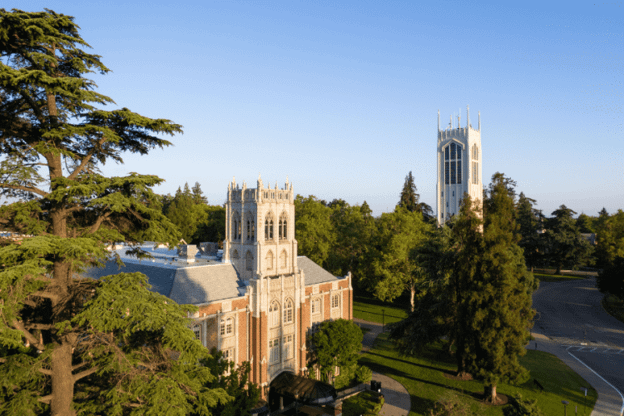
University of the Pacific to Launch New Medical School

Time for National ServiceDear President Callahan
Review of the Blues and BIllie Armstrong By Roy
Call for Public Service
guest post by Roy Dufraine
Audio clip
Dear President Calahan:
I would like to extend my sincere congratulations to you and your team on moving forward with plans to establish a full-fledged medical school on the Stockton campus—an initiative that was first discussed when I was a student at the College of the Pacific in 1979.
I graduated from the University of the Pacific in 1979 with a dual degree in Political Science and Humanistic Psychology. At that time, the University was ranked approximately 300th nationally and around 20th in California. Its subsequent rise in prominence—to roughly 85th nationally and among the top 10 institutions in California—reflects a remarkable trajectory of growth and achievement, placing it alongside distinguished institutions such as Santa Clara University and the Claremont colleges, and just behind Stanford and the University of Southern California among private universities.
Following graduation, I served in the Peace Corps in Korea, where I taught English and government. I later earned both a Master of Arts and a Master of Public Administration from the University of Washington. I subsequently joined the United States Foreign Service, where I served for 27 years as a diplomat in more than ten countries. During my career, I had the opportunity to return to campus to speak with students and faculty about careers in the Foreign Service.
Since retiring in 2016, I have focused on writing, blogging, managing rental real estate, and traveling. I have completed seven unpublished novels and maintain an active presence through my blog, The World According to Cosmos, as well as on Substack and Spotify. This summer, I will return to the Alexandria, Virginia area on a semi-permanent basis, while continuing to spend several months each year in Korea.
The University’s decision to move forward with the long-envisioned medical school is both timely and highly encouraging. I am confident that this initiative will further enhance the institution’s academic standing and national reputation under your leadership.
A Defining Opportunity: Pacific’s New Medical School and the Future of Healthcare Education
Review of the Blues and BIllie Armstrong By Roy Dufrain
The University of the Pacific’s recent announcement that it plans to open a new School of Medicine in Stockton by 2030 is a transformative moment—not just for the university, but for the entire Central Valley.
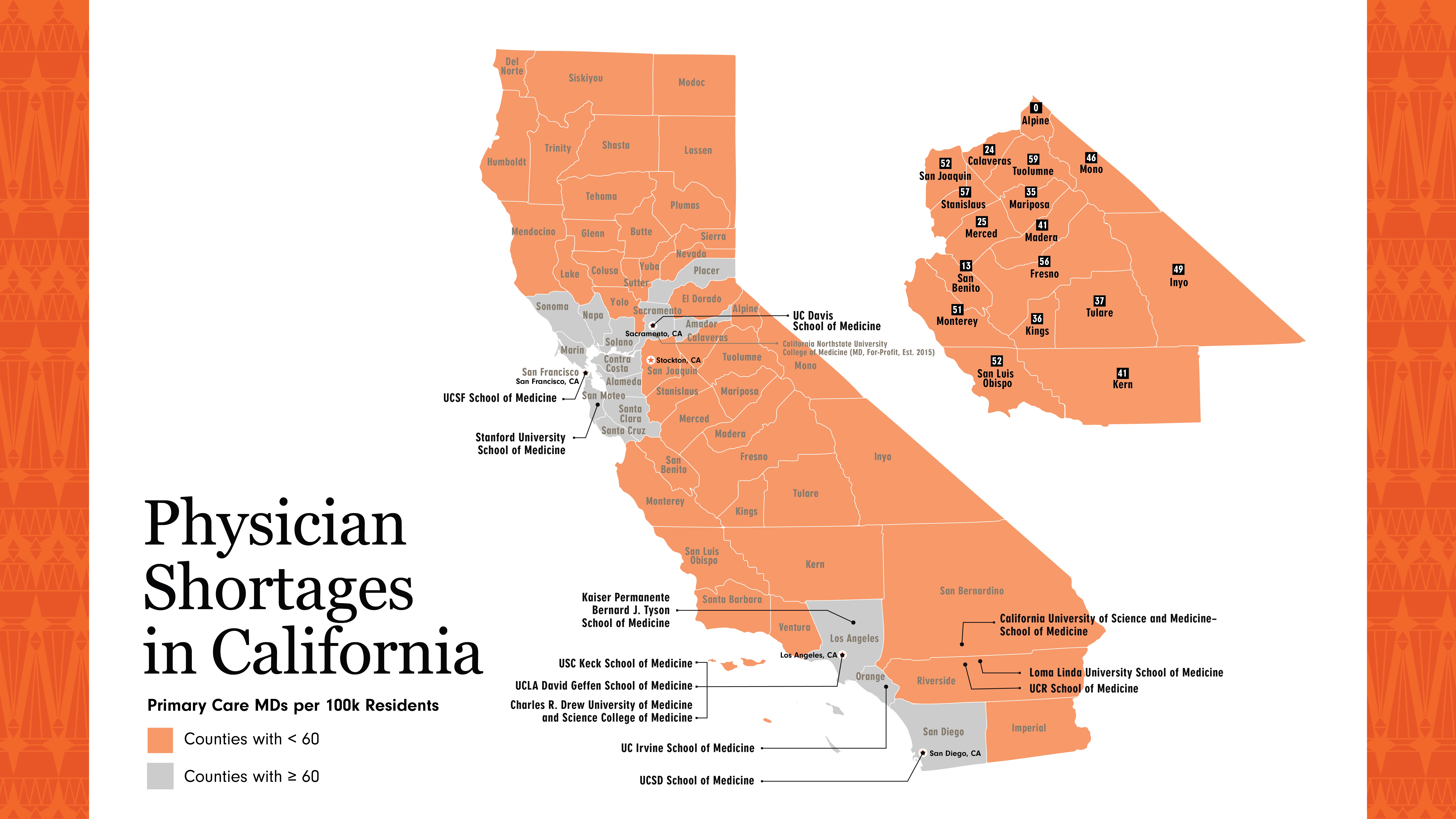
For decades, the region has faced severe physician shortages, with millions of residents underserved compared to California’s major metropolitan areas. The new medical school aims to directly address this gap by preparing physicians who are trained locally and committed to serving in the communities that need them most. This is not just an academic expansion—it is a regional investment in health equity, economic development, and long-term opportunity.
Pacific’s leadership has made clear that this initiative aligns with its mission to expand access and produce practice-ready professionals. As President Christopher Callahan noted, the university sees addressing the physician shortage not only as a capability, but as a responsibility. [pacific. Edu]
The school will also build on an already strong foundation. Pacific is one of a small number of universities with programs in dentistry, pharmacy, and health sciences—and adding an M.D.-granting medical school will place it among an elite group of comprehensive health education institutions.
But what makes this moment especially important is not just the creation of a medical school—it is the opportunity to design something fundamentally different. Pacific is not constrained by legacy systems. It can build a model that reflects the future of medicine, rather than the past.
Designing a Medical School for the 21st Century
If Pacific embraces bold thinking, its School of Medicine could become a national model. Here are several ideas that could help realize that vision.
-
Make Access a Cornerstone
Medical education remains prohibitively expensive. If Pacific truly wants to attract top talent committed to community service, it should explore making tuition significantly more affordable—ideally free or heavily subsidized for many students.
Reducing financial burden shifts incentives: graduates are more likely to choose primary care and underserved areas if they are not driven by debt repayment.
-
Tie Education to Community Impact
A natural extension of tuition support is a service commitment. Students who receive financial assistance could commit to serving in underserved communities for several years after graduation. This ensures the university’s investment directly benefits the region it is designed to serve.
-
Build Integrated Pathways from Day One
Pacific could create a highly attractive model by admitting students into pre-health tracks as first-year students. Students would complete three years of undergraduate preparation—augmented by clinical exposure, internships, and research—before advancing into professional programs such as medicine, public health, or health administration.
This pipeline approach would give motivated students clarity, reduce uncertainty, and accelerate entry into the workforce.
-
Expand the Definition of Medical Training
Modern healthcare increasingly recognizes the importance of prevention and whole-person care. Pacific could differentiate itself by incorporating coursework in nutrition, preventive health, physical fitness, oriental medicine including acupuncture, ayurvedic medicine, eastern medicine, and moxibustion, and integrative medicine early in the curriculum and take courses in medical ethics, medical law, and AI/Robotics and medical technology.
This does not replace traditional medical training—it strengthens it by producing physicians who think beyond symptom treatment to long-term wellness.
-
Make Global Competence Essential
California’s diversity—and healthcare’s global nature—require physicians who can operate across cultures. Requiring proficiency in a second language, along with a study-abroad experience, would ensure graduates are better prepared for real-world practice.
-
Balance Local Commitment with Global Perspective
Pacific’s mission should include strong representation from the Central Valley, ensuring the school reflects and serves its surrounding community. At the same time, inviting international students would enrich the academic environment and foster broader perspectives in care delivery.
-
Lead in Technology and Innovation
Artificial intelligence, data analytics, and robotics are rapidly reshaping medicine. Pacific has a rare opportunity to embed these tools into its curriculum from the start—rather than retrofitting them into legacy systems.
Graduates should leave not only as competent clinicians but as fluent users of emerging healthcare technologies. including a new major in the Engineering School on AI/Robotics and Biomedical technology with all health care program students required to take the foundational course in this new cutting edge major.
-
Think Beyond Traditional Boundaries
The university could also consider expanding into complementary areas such as integrative or Eastern medicine, creating a broader ecosystem of health education. Such interdisciplinary approaches are increasingly relevant in modern healthcare systems.
-
Use This Moment to Innovate Institution-Wide
Finally, the creation of the School of Medicine should catalyze broader reform. Pacific could:
Expand use of hybrid and online learning models
Recognize prior learning, including military training
Incorporate leading platforms such as Coursera or similar tools into general education
Offer accelerated pathways that reduce time-to-degree while maintaining rigor
This kind of innovation would strengthen not just the medical school, but the entire university.
The University of the Pacific has a long history of innovation—it was California’s first chartered university and has repeatedly redefined its role in higher education. [pacific. Edu]
Now, with the School of Medicine, it faces its most important opportunity yet.
This is more than a construction project or a new academic program. It is a chance to reimagine what medical education should look like in the 21st century—accessible, community-driven, technologically advanced, and globally informed.
If Pacific rises to this moment, it will not simply build a medical school. It will build a model others strive to follow.
There are a few other suggestions I have for you to consider..
Bring Back the Cluster Colleges
First, revive the old Cluster colleges. They never should have been abandoned.
Overhaul General Education Courses
Second make most of the general education courses Coursea courses with a professor/TA leading a weekly discussion with each student watching two to three episodes per week in their room. And university professors should all participate in making new video online course offerings.
Bring Back College Football
Third, bring back College football following up with the 49 agreement and get the 49s to adopt/sponsor the program or at least fund most of it as well as funding football programs in the Stockton School District and San Joaquin Community College. UOP should not have abandoned football either.
Require All Students to Study Aboard and Pass Foreign Language Tests
Forth, require all students to take foreign language courses to graduate and spend one semester studying abroad., they would spend the summer prior to their overseas study studying the language and culture of the country they are going to go to.
New Programs in Real Estate Management, Hospitality Management, Food Service Management, Construction Management, Arts Management, and MFA Program
I would offer eight new major programs: AI/Robotics, Arts Management, Construction Management, Food Service Management, Hospitality Management, Medical Technology, MFA (Master of Fine Arts), and Real Estate Management.
All programs (except the MA program) would be housed within the Business College and would require students to complete the appropriate state-level certifications so that, upon graduation, they are both fully licensed and hold a degree. In addition, each program would include a mandatory internship.
These programs would include appropriate legal coursework (see below). Students in the Food Service Management program would help manage campus dining operations, while students in the Hospitality Management program would oversee the alumnae lodge, which would be converted into a hotel for campus visitors, including alumni, they would also take restaurant and hospitality law courses ..
I would also seek partnerships with the business community and pursue corporate sponsorships, particularly for the Construction Management and Real Estate Management programs, including real estate, and construction management law courses..
All students in these new majors would be required to obtain relevant professional licenses (such as brokerage licenses, where applicable) prior to graduation and complete a semester-long internship with organizations such as real estate firms or construction contractors.
Additionally, I would expand the existing music management program into a broader Arts Management program with arts law courses incorporated into the program. The MFA program would be offered both as a full time program and a low residency program with all students on campus two weeks twice a year in January and June.
.Six, admit students to the various health care programs and professional programs as first-year students,
Six, admit students to the various health care programs and professional programs as freshmen, and after doing three years of pre-med or pre-law admit them to the health care or professional schools such as law, business or public admistration. And make the MPA program its own school.
Make three years including summer courses the new normal to cut the costs of attending the university by 25 percent.
Seven, expand the number of credits students can earn through education, prior educational credits, and AP.
The basic idea should be that students spend three years doing pre-professional training, including one summer paid internship,, one summer intensive langauge training, and one semester studying overseas at the beginning of the their junior year then they come back to campus take professional entrance exams and prepare either to go on to the professional schools or graduate with a BA or BS degree fully prepared for employment.
I would welcome the opportunity to discuss this with your staff and at some point in the next year or so I would love to return to campus see how things have changed and discuss my career with the State Department with interested students and faculty. I am returning to Alexandria Virginia from Korea this summer.
And hope to meet you when you are next in DC
Thank you
John (Jake) Cosmos Aller
COP 79 Political Science and Humanistic Psychology (Raymond)
Retired US State Department Foreign Service Officer
RPC Korea
703-436-1402
Http://theworldaccordingtocosmos.com
Direct URL:
University Announcement
Pacific plans School of Medicine to Address Central Valley Physician Shortages
May 28, 2026
Burns Tower
University of the Pacific, founded 175 years ago as California’s first college, today unveiled plans to launch a School of Medicine, a transformational initiative to address the severe and growing physician shortages across the Central Valley and other areas facing dangerous health care disparities.
The Pacific School of Medicine will be California’s first M.D.-granting institution outside of the state’s largest population centers in Southern California, the Bay Area, and Greater Sacramento.
Located on the university’s historic Stockton Campus, the new School of Medicine will focus on educating a new cadre of doctors for severely underserved areas. The regions located south of the Bay Area and Greater Sacramento and north of Los Angeles—the San Joaquin Valley, southern foothills, Central Coast and Eastern Sierra—all fall below the minimum standards for primary care physicians per capita while California’s largest metropolitan areas—home to the state’s 13 M.D.-granting schools—meet the recommended physician-to-population ratios.
The new School of Medicine will build on Pacific’s existing health care strengths from the Arthur A. Dugoni School of Dentistry, the Thomas J. Long School of Pharmacy, and the School of Health Sciences, which prepares new nurses, physician assistants, audiologists, physical therapists, and other health care professionals for the workforce.
Pacific will be just the 36th American university to have schools of medicine, dentistry, pharmacy, and health sciences.
“We are enormously proud of our tradition of providing top quality educational opportunities for all qualified students—no matter their background or socioeconomic status—and creating hundreds of caring, practice-ready health care professionals each year who are desperately needed in our communities and beyond,” said Pacific President Christopher Callahan.
“The new School of Medicine aligns perfectly with our mission,” the president said. “We are not only ready, willing and able to tackle the dangerous and growing problem of the severe lack of physicians, but we believe it is our duty and responsibility.”
Gov. Gavin Newsom said today’s announcement “will be transformative for generations of Californians to come.”
“This brand-new University of the Pacific medical school opening near the heart of the Central Valley will create a critical pipeline bringing more physicians into our rural communities to serve and expand care for our state’s most vulnerable populations,” the governor said. “Now more than ever, investments like these in our higher education system create opportunities for empowering Californians to give back to their communities and build a healthier future across the Golden State.”
The Board of Regents, university leaders, private and government funders, and health industry executives have been working behind-the-scenes for more than a year exploring the feasibility of a Pacific medical school. The Board voted unanimously May 15 to approve the new school.
“Our long history at Pacific is one of innovation,” said Board Chair Mary-Elizabeth Eberhardt. “We were the first college in California, created less than a year after statehood. We were California’s first coeducational institution of higher learning. We created the first conservatory of music west of the Mississippi. And 102 years ago, we moved the university from San Jose to Stockton to become the Central Valley’s first school to confer four-year degrees. But the School of Medicine might be our most important undertaking yet.”
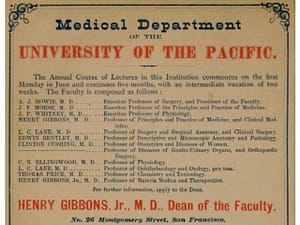
Eberhardt noted that in 1858 Pacific created the first medical school in the American West, in San Francisco. It later became part of what is now the Stanford University School of Medicine.
An essential centerpiece of the new School of Medicine at Pacific is a strategic clinical partnership with Dignity Health St. Joseph’s Medical Center. Under the partnership, Dignity Health will place third- and fourth-year medical school students from Pacific in clinical rotations at St. Joseph’s and other hospitals across the region.
David Ziolkowski, president and CEO of Dignity Health St. Joseph’s Medical Center, collaborated closely with President Callahan to develop the strategic partnership.
Ziolkowski said the two institutions are “deeply committed to our shared values of excellence, inclusion, integrity, collaboration and human kindness, and are aligned in the urgent desire to address the region’s deep physician shortages.”
The physician shortage is worsening as one in four California doctors is now 65 or older. While the state’s two largest population centers—the Bay Area and Southern California—have seen significant population declines over the past six years, the population in medically underserved regions is growing. San Joaquin County, for instance, increased by 50,000 residents—second most in the state.
St. Joseph’s Medical Center, located less than two miles from the Pacific campus, is undergoing a massive expansion that will make it one of the largest hospitals in the state outside of the Bay Area and Southern California. That expansion is expected to be completed by 2030, which also is the scheduled opening of the School of Medicine if accreditation approvals are secured.
A global consulting firm conducting an in-depth feasibility study concluded that $150 million would be needed to create a financially self-sustaining medical school at Pacific. The estimate includes a 100,000-square-foot state-of-the-art medical education complex, simulation labs and other specialized equipment, and operational costs over the first decade.
The university secured more than $25 million from several major donors in advance of today’s announcement, including from Pacific Regent Tony Chan and his wife, former Regent Virginia Chan, both 1977 pharmacy school graduates, and the Stockton-based Cortopassi Family Foundation.
Tony Chan called the medical school “transformational for the future of the university and the health of our communities.”
“I started in this Valley pushing a mop. Because people believed in me, I’m standing here today,” Chan said. “This medical school is how we make sure the next kid mopping floors doesn’t have to leave the Valley to become a doctor. They can stay here. Learn here. Serve here.”
With today’s announcement, Pacific launched a public fundraising campaign to support the School of Medicine.
“This is a remarkable opportunity for Pacific to change the trajectory of our region,” said Scott Biedermann ’05, ’20, vice president for development and alumni relations. “Opening a medical school is an ambitious undertaking, and its success requires robust community support. We are incredibly grateful to the Chans, the Coreopsis and all who have invested in the school thus far, and we look forward to welcoming more partners in this historic effort.”
Legislators also have been actively pursuing funding for the new School of Medicine.
In the State Capitol, California State Assemblymember Rhodesia Ransom is pushing for a $50 million appropriation to help launch the school.
“California is facing a growing physician shortage, and families in San Joaquin County are already feeling it through longer wait times, fewer primary care options and the need to travel farther for care,” the state lawmaker said. “Pacific has long been a trusted institution in our region, and this new School of Medicine is exactly the kind of long-term investment we need to train homegrown doctors who understand our communities and are prepared to serve them. I am proud to push for state funding to help make this school a reality.”
State Sen. Jerry McNerney, who like Ransom represents San Joaquin County in the Statehouse, also is working on the state funding initiative.
McNerney called the Pacific School of Medicine “a pivotal step” toward “strengthening access to essential health care services in the region, especially in rural and underserved areas.”
In Washington, U.S. Rep. Josh Harder has been battling for federal funding that would cover the costs of the specialized equipment for the medical school.
“The Valley needs more doctors, nurses and health care workers—it’s that simple,” the congressperson said. “Bringing the first medical school to the Valley is a huge step forward because it means training more doctors right here in our community. The people caring for Valley families should know this community, understand our challenges and be able to build their lives here, too.”
The School of Medicine also will have a major economic benefit for the region, generating more than $1.3 billion in economic output over the first decade, according to an analysis by the Center for Business and Policy Research at the Eberhardt School of Business.
Pacific will launch a national search this summer for the school’s founding dean.
Provost and Executive Vice President Gretchen Edwalds-Gilbert said the School of Medicine will draw on the many strengths of the university’s nine other schools and colleges and Pacific’s focus on interdisciplinary education and research.
“We have long been a leader in health science education, teaching our students to work across health professions while in training,” the provost said. “The medical program will build on our strengths in teaching and research, allowing us to offer new opportunities to our students and faculty while at the same time better serving the communities of the Central Valley.”
Pacific plans to design clear pathways to the M.D. program from a wide array of pre-med undergraduate degree programs. The university also plans on specialized pre-med tracks in the Pacific Summer High School Institute, a two-week residential program that serves about 1,800 high school students annually.
Over the past half-dozen years, during a time when many American universities have been struggling, Pacific has been on the rise by every measure, enjoying its highest enrollments, fundraising, research, financial strength, and academic rankings in its 175-year history.
The Wall Street Journal ranks Pacific at No. 85 among all U.S. colleges and universities, and the university was named one of America’s 75 “Dream Schools” by author Jeff Selingo for exemplifying academic excellence, experiential learning, accessibility, affordability, and exceptional student outcomes.
Pacific places a premium on the social mobility of its students.
The Georgetown University Center on Education and the Workforce rated Pacific first in the nation in career earnings among U.S. colleges and universities that have high percentages of Pell Grant recipients. Two of every five Pacific undergraduates receive Pell Grants, a federal program to support college students from low-income households. Half of the current first-year class identify as first-generation college students.
The New York Times ranked Pacific No. 23 in the nation among all colleges and universities—private and public—in economic diversity among students. Pacific is also the highest ranked U.S. university to have both Hispanic-Serving Institution and Asian American and Native American Pacific Islander-Serving Institution designations from the U.S. Department of Education.
The Carnegie Foundation for the Advancement of Teaching and the American Council on Education, in its first-ever measurement of alumni earnings and access to a college education no matter a student’s economic background, placed Pacific in the highest category—Higher Access, Higher Earnings.
“Pacific gave me more than an education,” said Board of Regents Vice Chair Leticia Robles, a 1989 Pacific graduate, a first-generation college graduate and the founder of Pacific Homecare Services, which now serves thousands of families across the region with in-home care for seniors and developmentally disable patients. “It gave me confidence. It gave me purpose. And it taught me that where you come from does not define how far you can go.”
“There are students sitting in classrooms across our region right now who dream of becoming physicians but wonder if there will ever be a place for them,” she said. “Today, Pacific is telling them: There is a place for you here. Your story matters. Your dreams matter. And your future matters.”
Pacific plans to welcome its first medical school cohort in Fall 2030, pending accreditation approval, with the school eventually growing to 400 students by 2037.
|
|
|
|
|
|
|
Prior Letter to President of UOP

 UOP
UOP

Letter to President of the University of the Pacific
Author note: I graduated from the University of the Pacific in Stockton, California in 1979. It was my third college, after flunking out of Oberlin college. it was a good fit for me as it was a student-centric small-medium sized University, mostly white in those days. Now it is about 55% white. It was expensive but I got some financial aid and worked on campus throughout my time there. I sent a letter to the President of the University via FB and Linkidlin this morning. These days there are real concerns whether universities in the U.S. will survive and many marginal universities will fail. I hope that does not happen to UOP which is the oldest University in California founded in 1854. Here then is my letter and concerns. If I get a response I will post an update.
I am an alumnus of UOP (COP 1979, BA in Political Science and Psychology (Human Development). After graduation, I served in the Peace Corps in Korea, then taught ESL overseas for three years before going to Graduate school at the University of Washington where I obtained a MA in Korean studies, and an MPA degree in 1988. I then taught at a Korean University and the University of Maryland in Korea until 1991 when I joined the U.S. State Department as a Foreign Service officer. I served in ten countries over my 27-year career. I retired in 2016 and have been residing in Korea and Oregon since then. I have been blogging and writing fiction and poetry and have been published in over 40 journals. My blog is https://theworldaccordingtocosmos.com
Recently I thought back on my college experience and thought of my time at UOP, and thinking about the future of UOP.
This last year has been very challenging for all in the higher education community and many people are speculating that there will be a shakeout of Universities and many may go under over the next few years.
To forestall that fate from happening to UOP it is essential that UOP continues to be an innovative student-centered university and that the University continues to offer new opportunities.
In reviewing the UOP academic programs, I was struck by the strength of the general education program. I have only a few suggestions to make. First, it is important to ensure that all students take US, California and world history courses, and world literature courses. I would add a world religions course, and a personal financial management course as well, but otherwise, keep the program as it is.
Revise the Cluster Colleges
cluster colleges – see below for more details
I would revive the old cluster colleges of the 1960-70 era. Raymond College, Callison, and Elbert Covell College, the Cluster Colleges were innovative colleges at the time. Raymond pioneered interdisciplinary studies, Callison pioneered international studies, and Colbert college pioneered programs focusing on Latin American students and offered classics in Spanish. The SIS could be renamed Callison International Studies, Raymond college could continue to pioneer interdisciplinary courses and could manage the general education program for the University, and Colbert College could be revived.
Require all Students to Study One Semester Abroad
I would require all undergraduate students regardless of major complete one semester abroad with appropriate language training before going overseas. I would let the new college of international studies coordinate the study abroad program for the entire university. The study abroad semester will take place between the second half of the sophomore year and the first semester of the senior year or could be done over a summer break
New Programs in Real Estate Management, Hospitality Management, Food Service Management, Construction Management, Arts Management and MFA program.
I would offer seven new major programs – real estate management, hospitality management, food service management ,construction management, arts management and MFA programs. All programs would require that their students take all the appropriate state-level certifications so that when they graduate, they are fully licensed as well as having the degree and both programs should require a mandatory internship. All programs would be housed in the Business College. These programs would include appropriate legal courses, (see below). The students in the Resturant management program will help manage food services on Campus, and the students in the Hospitality Management program will manage the alumnae lodge which will be converted into a hotel for visitors to the campus including of course alums. I would also reach out to the business community and seek corporate sponsorship. This would be especially appropriate for the real estate and construction management courses.
I would also expand the music management program to be an arts management program.
I would offer a MFA program in writing – that would offer both on campus, low residency and virtual options.
Embrace Virtual Learning Options
The university should offer some of their courses as video courses and should also consider contracting with Coursera to offer some of their courses as well. For the Coursera courses, a university faculty member will facilitate discussion of the course materials after the video lectures are completed.
And UOP should consider licensing some of their more innovative programs such as music management as to course courses as well. Finally students off site during internships could take a few courses via distant learning as well.
Require all students to do one internship and one community volunteer project
all students should be required to complete one internship and one community service project. the internships should be paid. the Business college should coordinate the program. the Pharmacy, Health Care, Education and Engineering programs should be exempt as they already have an internship requirement.
Offer Some Law Classes to Undergraduate Majors
I would offer some law courses to undergraduates as part of their field of study. This would include basic business law, real estate law, construction contracting law, music and arts management law, and engineering management law. These classes should be held at the law school in the evening and students would go to them via University shuttles (electric of course) leaving at 4:30 and returning at 8:30 with the courses being held twice a week from 6 pm to 8 pm.
Bring Back Football
Regarding UOP athletics, I would consider bringing back football. I would also pledge that all UOP student-athletes would graduate on time. I would work with other university leaders to work towards requiring professional sports teams to commit to only hiring students who have graduated from university (or perhaps require them to complete their studies within one year of becoming professional.) this is something that should have been done a long time ago and requires Universities to step up and demand that the professional sporting teams require college graduation before starting professional careers.
If you are complacent, UOP may not survive.
I believe that if you offer these new programs and continue to innovate, UOP will survive the coming shake-up of Universities in the United States. If you are complacent, UOP may not survive.
Thank you for your consideration. I would love to talk with your staff about any of these ideas.
Jake Cosmos Aller
COP 79
Tel: 703-436-1402 Korea
https://theworldaccordingtocosmos.com
Raymond College, a liberal arts and sciences college that had no letter grades and no academic departments, allowed students to earn a bachelor’s degree in only three years. Established in 1962, the curriculum was interdisciplinary, well before that became an academic buzz word. Students earned credit through teacher evaluations. Eventually, there weren’t even required courses, and students were free to shape their own course of study.
Elbert Covell College, a liberal arts and sciences college also, was unique because all courses were taught in Spanish. Half of the students were from North America and half of the students were from South and Central America. Most students chose to participate in a semester abroad in Costa Rica. Established in 1963, Covell gave University of the Pacific a head start in international recruitment, an area in which the University continues to excel.
Callison College, established in 1967, was dedicated to the study of international relations and required students in the sophomore year to spend a year abroad in Asia together with their fellow classmates. In the early years, the students went to India, and later they studied in Japan.
Raymond and Callison Colleges were closed in 1979, and the courses taught through Covell were finally transferred to other schools in 1986. However, their emphasis on global education continued in a new School of International Studies, established in 1986, the first university-based undergraduate school of international studies in California.
The learning community concept of the cluster colleges was strengthened in College of the Pacific, the liberal arts and sciences core of the University, recognized for preparing responsible citizen leaders who will contribute in lasting ways in their careers and communities.
the End

Thanks so much for visiting my site. Your comments are welcome but please play nice…. Reply