
2026 Music Journal
\On Playing Mozart Piano Sonata
My Music List for 2026


Reigniting My Passion for Piano: The Journey Continues in 2026
Over the past year, I have rediscovered one of the great joys of my life: playing the piano.
Music has always been important to me. Like many people, though, life, work, travel, and other commitments gradually pushed regular practice into the background. In 2025 and continuing into 2026, I made a conscious decision to return to the piano and make it part of my daily routine once again. It has proven to be one of the most rewarding decisions I have made.
Today, I practice for about an hour each day. Some days are better than others, but the consistency itself has become the key. I am not trying to become a concert pianist. My goal is much simpler: to continue improving, keep learning, and enjoy the process.

My Current Musical Goals
My long-term objective is to work my way through the piano sonatas of Mozart and Beethoven while also exploring a wider range of music, including jazz, blues, funk, rock, and popular standards.
Along the way I have been expanding my knowledge of music theory and composition. Earlier this year I completed introductory studies in both subjects and plan to continue with more advanced coursework. Understanding the structure behind the music has made practicing more enjoyable and has helped me learn pieces more efficiently.
I am also interested in music notation and composition software. At some point I hope to purchase a MIDI interface and begin learning Sibelius or a similar program. One of my personal goals is to revisit music I composed during high school and begin writing new music again.
A Piano on Two Continents
Because my wife and I divide our time between the United States and South Korea, I wanted to eliminate one obstacle that often interrupted my practice: not having a piano available.
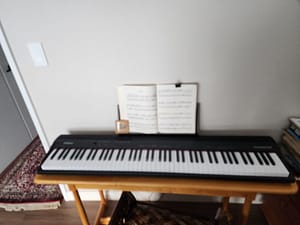
To solve the problem, I purchased a Casio keyboard for our home in Alexandria while keeping my Rhodes piano in Gimpo. Having instruments in both locations allows me to maintain continuity regardless of where we are living at the time.
Working Through the Casio Song Books
One of the most useful decisions I made was purchasing a used Casio keyboard that came with three volumes of instructional and repertoire books ranging from beginner to intermediate levels.
Rather than jumping immediately into difficult classical works, I worked methodically through these books. The experience proved invaluable.
The pieces ranged from folk songs and standards to simplified classical selections. Many of them were not technically demanding, but they provided an excellent opportunity to strengthen sight-reading skills and improve overall fluency at the keyboard.
One lesson that has helped me tremendously is learning to trust muscle memory and avoid constantly looking down at the keys. This remains a work in progress, but I can already see significant improvement. The less I look at the keyboard, the more confidently I can focus on the music itself.
Learning to Analyze Music
One practice that has made a dramatic difference in my playing is the habit of analyzing a piece before I begin learning it.
I still create what I jokingly call “cheat sheets” directly on the score. Before practicing a piece, I identify:
- Key signatures
- Flats and sharps
- High and low register passages
- Repeated patterns
- Difficult transitions
- Ornamentation such as turns and mordents
Taking ten minutes to understand how a piece is constructed often saves hours of frustration later. More importantly, it helps me understand the music rather than simply memorizing finger movements.
Adding Chords and Building Theory Skills
Many of the pieces in the Casio song books contain only simple melody lines and basic accompaniment.
As an additional exercise, I began experimenting with adding fuller chord structures to the left hand. This was sometimes challenging, but it became an excellent practical application of music theory.
The process forced me to think about harmony rather than simply reading notes from the page. It also made many of the pieces more enjoyable to play.
Rediscovering Mozart and Beethoven
One of my motivations for working through the instructional books was to prepare myself for the classical repertoire I eventually hope to master.
Recently I revisited a Mozart sonata and was pleasantly surprised by the results. While there is still much work ahead, I played more confidently than I expected. That experience reinforced my belief that steady, structured practice produces results, even when progress feels slow.
My plan is to continue building my foundation and then gradually return to larger works by Mozart, Beethoven, and other classical composers.
What I Have Learned About Relearning an Instrument
If I had to summarize the process of returning to piano, it would be this:
Start simpler than you think you need to.
Work through beginner and intermediate materials systematically. Analyze each piece before you play it. Focus first on accuracy and rhythm, not speed. Listen to recordings of the music. Practice difficult passages separately. And most importantly, be patient.
Progress comes from consistency rather than intensity.
A Broader Goal: Keeping the Mind Active
One reason I have committed myself to regular piano practice is the belief that lifelong learning is valuable in its own right.
For me, piano study is part of a broader effort to remain mentally engaged through learning languages, reading, writing, creative projects, and continuous education. Whether or not these activities provide long-term cognitive benefits, they undoubtedly enrich daily life and provide a constant source of challenge and satisfaction.
Looking Ahead
The attached repertoire list contains the pieces I have worked through so far. Looking ahead, I expect to continue with additional classical repertoire, Clementi sonatinas, blues standards, composition studies, and eventually some of the music I wrote many years ago.
For anyone approaching retirement, or anyone who has put aside an ihstrument for years and is wondering whether to begin again, my advice is simple:
Do it.
You do not have to be great. You only have to start. The enjoyment, the sense of progress, and the satisfaction of making music are rewards in themselves.

Thanks so much for visiting my site. Your comments are welcome but please play nice…. Reply