Tag: friends

  • Review of the Blues and BIllie Armstrong By Roy Dufrain

    Review of the Blues and BIllie Armstrong By Roy Dufrain

    The Dead are Dead -Love Live the Dead

    Personal Note:

    I’ve known Roy for 50 years. We first met at UOP in Stockton, California in 1975 when we lived together in the Euclid House for three years with five other students—two girls and two guys. We were infamous for our weekly house parties, splitting bar duties and DJ responsibilities. Roy spun the Grateful Dead, and I played the blues, Tower of Power, funk, and Frank Zappa.  We consider ourselves a counter-cultural co-ed fraternity.

    We often held impromptu poetry slams, with Roy on blues harp and guitar while I ranted and raved about life. Over the years, we’ve kept in touch. Roy lived in Clear Lake for many years and recently “retired” to Alabama—of all places.

    The Blues and Billie Armstrong is his first novel, and I’m certain it won’t be his last. Roy is also a gifted musician and songwriter. He introduced me to the Grateful Dead, and I introduced him to Frank Zappa. While he never turned me into a true Deadhead, I stayed “Dead-adjacent,” so to speak We went once to a Frank Zappa concert, one of the wildest nights of my life, and that is another story for another time..

    📚 Check out my companion post for the full review and details!
    👉 [Link to Review]

    Title:
    🎸 The Blues and Billie Armstrong – A Novel That Sings the Truth 🎶

    Post:

    Roy Dufrain Jr’s The Blues and Billie Armstrong is a haunting, music-infused coming-of-age story set in the 1970s California. It’s about Archer King, a boy navigating grief, secrets, and the power of the Blues—only to face those ghosts decades later when Billie Armstrong, his rebellious stepsister, returns accused of murder.

    If you love novels that blend history, music, and redemption, this one’s for you.

    📚 Read more: Amazon Link
    ✍ Explore the author’s thoughts: Roy Dufrain on Substack

    Title:
    🎶 The Blues and Billie Armstrong: A Novel That Echoes Through Time

    Subtitle:
    Roy Dufrain Jr’s debut blends music, memory, and moral complexity into a story that feels both timeless and urgent.

    Introduction

    In The Blues and Billie Armstrong, Roy Dufrain Jr delivers a lyrical, haunting tale set against the turbulence of 1970s California. This is more than a novel—it’s a meditation on truth, identity, and the enduring power of music.

    Synopsis

    The story begins with Archer King, a thirteen-year-old grappling with his mother’s sudden death. His father’s quick remarriage introduces Billie Armstrong, a rebellious stepsister whose arrival shatters Archer’s fragile world. Together, they uncover old blues records and hidden love letters, sparking a quest that will unravel family secrets and test their loyalties.

    Decades later, Archer—now a Pulitzer-winning columnist—must confront the ghosts of his past when Billie resurfaces, accused of murder. To save her, Archer risks exposing truths that could destroy his career and identity.

    Characters

    • Archer King: A deeply sympathetic protagonist whose evolution forms the novel’s emotional core.
    • Billie Armstrong: Charismatic and unpredictable, embodying rebellion and freedom.
    • Hank Timmons: Archer’s mentor and local baseball hero, torn between ambition and morality.

    Themes & Style

    Dufrain explores grief, betrayal, and redemption with remarkable sensitivity. The Blues serves as both soundtrack and metaphor—a symbol of resilience and cultural memory.

    The End

    Substack

    Medium

    Wattpad

    Spotify

    The End

  • the 2024 Oscars  According to Roy Dufrain

    the 2024 Oscars According to Roy Dufrain

    May be an image of 1 person

    More Roy Dufrain Writing

    Roy Dufrain Updates

    guest post by Roy Dufraine

    Master Movies Seen 1970- 2024

    The 2024 Oscars According to Roy Dufrain

    THE OSCARS AT OUR HOUSE.

    For more than twenty years now, Mrs D and I have made it an annual quest to see all of the Best Picture nominees before the Oscars telecast. This year we saw 9.5 of the 10 movies nominated.
    It started in 2000, when there were only five nominees (instead of up to 10 like now) and we usually had to see them in a theater, because they weren’t available to rent on VHS yet. (Yes, I said VHS).
    And we’ve done it every year since, except for 2019 which was interrupted by Mrs D’s infamous extended hospital stay. We have even ventured to other cities to see movies that weren’t playing at the one theater in our little town. I remember seeing Chocolat in Ukiah and more recently The Revenant in Rohnert Park. But now we can usually stream everything, and this year the whole project ran us around a hundred bucks in streaming rentals and purchases on top of our existing subscriptions to Amazon, etc.
    Several years ago I started writing about our tradition on Facebook. Now the writeup itself has become part of the deal. As I’ve said before, I’m no film student, nor expert critic. Just a regular dude who loves movies.
    Snap reviews and top picks below.

    American Fiction –

    Bold, wryly funny, contrarian, with the ring of truth. Brilliantly calls out the publishing industry, where retread tropes seem to trump story, art and insight, particularly when it comes to depictions of Black characters and writers. And I feel like there’s an even larger truth here about the way culture is degraded in general through over-commercialization.

    Anatomy of a Fall –

    A French film that moves carefully, piece by piece, and manages to be slow and taut at the same time. I found the characters to be inscrutable. I feel like I need to watch again just to see if maybe this time I would fully understand these people. It left me with a suspicion that perhaps all the story’s secrets have still not been revealed, that the resolution we see on the screen is still not the truth of these characters. And, in this case, that ambiguity is a good thing.

    Barbie —

    Cleverly funny in spots, but also unsubtly preachy in spots, an issue I’ve had with director Greta Gerwig before. But Margot Robbie was perfect and the movie is visually stunning in all its pinkish glory and devoted detail. Still, I think this movie appears in the Best Picture category more on the strength of its perceived politics than its success as an artistic endeavor.

    The Holdovers —

    A darkly funny, entertaining, and deeply reflective odd couple sort of story that’s enjoyable to watch. Maybe a little out of its league in the Best Picture category, but elevated to a higher status by Paul Giamatti’s performance, which is irresistibly engaging as always. Well worth a second watch.
    Killers of the Flower Moon — Having read the book, I felt the impact of the true part of this story was diminished by the fictionalized part of the movie. Reading the book I was deeply struck by the callous indifference shown toward the humanity of the Osage Indians. It resonated like an echo of Shindler’s List, underlining the incredible and frightening capacity of humans to rationalize literally any behavior in their fear or greed. But the movie revolves around Ernest Burkhardt (Leonardo DiCaprio) and depicts a somewhat tried and true arc of romantic tragedy, a weak-minded man caught up in the schemes of others, pulled along by greed and the need for approval, until he is in the process of killing the only real love he’s ever known. As is often the case, the truth was more complex. And more disturbing.

    Maestro –

    I usually make a conscious effort to limit my preconceptions of these movies. I don’t read reviews or watch trailers. But it’s hard to avoid a relentless ad campaign like the one mounted for Maestro. I’d seen the rousing TV spots touting the performances and the early awards. But I found the movie depressing, its characterization of Bernstein disappointing and unlikeable. But yes, Bradley Cooper and Carey Mulligan
    were both outstanding.
    Comment:  on my list to watch as I am a big Bernstein fan – one of the best classical composers of the 20th century in my opinion.

    Oppenheimer –

    Not what I would call a pleasant watch, at times slow and ponderous, even confusing with some of the time jumps. But the acting was so engrossing, immersive, mesmerizing even. Cillian Murphy in the title role was riveting. Robert Downey Jr simply disappeared into the role of Lewis Strauss. Emily Blunt was also captivating as Kitty Oppenheimer. The effects director Christopher Nolan used to heighten the sense of Oppenheimer’s interiority were brilliant and effective.
    For example when Oppenheimer steps on a charred corpse that only exists in his tortured, guilty mind. But the lasting impact of this film is the way it echoes in the mind afterward—how sad and terrible and absurd it is that we reckless humans have attained the power to destroy the world. It will probably win Best Picture. And it probably should.
    Comment: Also on my must see list

    Past Lives –

    Eventually, someone had to do a movie like this — an old romance is rekindled through the internet and complications ensue. In this particular case the past romance is an adolescent crush, cut short by one family’s immigration, and later complicated not just by the years, but also by geographic and cultural distance. This one stayed with me, kept me thinking for days afterward about its larger implications regarding fate, destiny, acceptance, grief and closure. Well worth more than one watch.

    Poor Things –

    Half of this movie was twice as much as I needed. We actually turned it off, extremely rare for us during Oscar season. What we saw played like a terrible excuse for some creepy, gratuitous soft porn. All the weirdness of the sets, costumes, cinematography and makeup felt like a desperate attempt at artistic status. If someone out there actually saw some redeeming value in this thing, feel free to explain in the comments section what I am missing.

    The Zone of Interest –

    This one’s all in German, with subtitles. But the dialog is sparse and the film’s biggest strength is in the fascinating dichotomy presented in its basic premise. It gives us a window into the surprisingly mundane personal lives of a “normal” family literally in the shadow of Auschwitz during the Holocaust. The sense of cognitive dissonance is alarming.

    Honorable Mention

    – I don’t usually do this, but I wanted to mention one film that was not even nominated for Best Picture but, in my opinion, should have been. Nyad has wonderful, engaging performances by Annette Bening and Jodie Foster, and it’s a suspenseful, satisfying, story of friendship, determination, human spirit, and triumph over the longest odds.

    Finally, here are my choices for the top awards.

    Don’t worry, the Academy almost always disagrees.
    Actor in a Leading Role: Cillian Murphy, Oppenheimer Winner
    Actor in a Supporting Role: Robert Downey Jr, Oppenheimer Winner
    Actress in a Leading Role: Annette Bening, Nyad
    Actress in a Supporting Role: Emily Blunt, Oppenheimer
    Best Picture: Oppenheimer Winner 
    Soon it’s time to pop the popcorn, get cozy on the couch, badmouth the fashion and root for your favorites.
    Happy Oscars folks.

    here’s the winners 

    The 96th Academy Awards, held at the Dolby Theatre in Hollywood on March 10, 2024, celebrated outstanding movies released in 2023. Here are some of the notable winners:

    1. Best Picture“Oppenheimer”
    2. Best ActorCillian Murphy for his role in “Oppenheimer”
    3. Best ActressEmma Stone for her performance in “Poor Things”
    4. Best Supporting ActorRobert Downey Jr. in “Oppenheimer”
    5. Best Supporting ActressDa’Vine Joy Randolph from “The Holdovers”
    6. Best DirectorChristopher Nolan for “Oppenheimer”
    7. Best Adapted Screenplay“American Fiction”
    8. Best Original Screenplay“Anatomy of a Fall”
    9. Best Animated Feature“The Boy and the Heron”
    10. Best Documentary Feature“20 Days in Mariupol”
    11. Best International Feature Film“The Zone of Interest”
    12. Best Cinematography“Oppenheimer”
    13. Best Costume Design“Poor Things”
    14. Best Film Editing“Oppenheimer”
    15. Best Makeup and Hairstyling“Poor Things”
    16. Best Original Score“Oppenheimer”
    17. Best Original Song“Barbie”
    18. Best Production Design“Poor Things”
    19. Best Sound“The Zone of Interest”
    20. Best Visual Effects“Godzilla Minus One”
    21. Best Documentary (Short Subject)“The Last Repair Shop”
    22. Best Animated Short Film“War Is Over!”
    23. Best Live Action Short Film“The Wonderful Story of Henry Sugar” 12


    All reactions:

    15

  • More Roy Dufrain Writing

    More Roy Dufrain Writing

    More Roy Dufrain Writing

    Roy Dufrain Updates

    guest post by Roy Dufraine

    The Year of Twelve Songs Pt 2. Some of you have heard this one before, but not quite like this. Link to the whole story in the comments section below. 😎
  • Roy Dufrain Updates

    Roy Dufrain Updates

    https://wp.me/p7NAzO-2MW

    Roy Dufrain Updates

    guest post by Roy Dufrain

    Roy Dufrain is my college roommate from UOP.  We lived at the Euclid House next to campus which became an alternative frat house of sorts. We had wild parties every Friday night for two and a half years – the best parties on campus. Boy, we had fun   He taught me so much, became a “deadhead” because of him, and tried various things with him, and we occasionally performed demented music together at campus events.  He was a Raymon College student, but unfortunately, because of money problems did not finish his senior year.  He was also the editor at the university’s paper and published a number of my poems and essays while we were there.

    University of the Pacific Raymond college history

    Raymond College, an undergraduate honors college at the University of the Pacific, existed from 1962 to 1979. Located in Stockton, California, it was a unique institution with an interdisciplinary curriculum that emphasized learning across the natural sciences, social sciences, and humanities. Let’s delve into its fascinating history:

        1. Founding and Vision:
          • Raymond College was the brainchild of University of the Pacific President Robert Burns. Faced with a new generation of qualified applicants, he sought to create a personalized educational experience for students.
          • Inspired by the success of Oxford, Cambridge, and the Claremont colleges, President Burns envisioned residential cluster colleges as a way to maintain high academic standards while expanding the university.
          • Raymond College was the first of three cluster colleges developed under this vision.
        2. Curriculum and Structure:
          • The college offered an innovative interdisciplinary liberal arts curriculum.
          • Initially, it provided an accelerated three-year program, but later expanded to offer a four-year program as well.
          • Key components of the curriculum included:
            • Introduction to the Modern World: A shared cohort experience for incoming first-year students.
            • Language study: A year of language learning.
            • Math, physics, chemistry, and biology: Sequential courses.
            • Humanities and social science classes: Literature, philosophy, art, religion, economics, history, psychology, and sociology.
          • Students received written evaluations (term letters) instead of traditional letter grades.
        3. Provost and Philosophy:
          • Provost Warren Bryan Martin played a pivotal role in shaping Raymond College.
          • He emphasized the importance of the liberal arts and the holistic preparation of students for a fulfilling life.
          • The first class of students arrived in the fall of 1962.
        4. Legacy and Impact:
          • Raymond College influenced the entire University of the Pacific.
          • Its emphasis on student-centered learning, liberal arts, and interdisciplinary studies raised academic expectations across campus.
          • The college operated in the tradition of the liberal arts, fostering intellectual curiosity and engagement.

    Raymond College, though short-lived, left a lasting mark on education, demonstrating that sometimes “growing larger by growing smaller” can lead to transformative experiences for students1234.

    He is a talented writer and musician living in Clear Lake California.

    you can check his work out here at Medium and on Substack as well as on his web page

    Roy Dufrain.Com

    THE YEAR OF TWELVE SONGS is my latest music project. Some of you got a preview recently, with an all-acoustic version of a song called Finish Strong. Now I’m sharing a new version with added instruments and my efforts at sound production. Plus some backstory and something sort like old-fashioned liner notes (remember those?). I plan to do this with a different song every month and hopefully learn a lot in the process. Check it out with the link below and let me know what you think.

    Roy Dufrain Jr.

    Hey Jake, everything is at roydufrain.com. hope all’s well with you.

    ROYDUFRAIN.COM

    ROY DUFRAIN JR | Substack

    ROY DUFRAIN JR

    Roy’s Best Books 2023

    Some words I liked a lot this year.

    ROY DUFRAIN JR

    Far Sickness, by Joshua and Ava Mohr

    This is my 8th annual December ramble about the books of my year. Not necessarily books that came out this year, but books I read (or heard) that moved me, taught me, made me cry, or cracked me up. It kind of feels like I’m late with this year’s edition but hey—two-day shipping at your preferred online bookseller, right?

    FICTION

    Nowadays I often avoid reading the latest best-selling, prize-winning, must-read fiction that everyone’s talking about. Because over the years I’ve learned not to trust hype. I like to wait a few years to see if anyone’s still talking about the book. See if the title comes up in a discussion and someone says, God, I loved that book, years after they read it, and they start talking about the character or scene that stuck with them. To me, that’s how you know. Not by critics’ reviews book trailers or Reese Witherspoon. (However, if Ms Witherspoon is out there somewhere, this does not mean I wouldn’t want MY book on your list someday! Just sayin’).

    ROY DUFRAIN JR is a reader-supported publication. To receive new posts and support my work, consider becoming a free or paid subscriber.

    Upgrade to paid

    But this year I read two of the latest novels from two big names in fiction—because I had loved previous work by both authors and because multiple writer-friends flat-out raved about these new books. And now I will rave about them myself.


    Demon Copperhead, by Barbara Kingsolver, is the best novel I’ve read in years. The best overall reading experience that delivers in all facets. The sense of total immersion in a world, the intense rooting interest in a main character, the epic scope of historical context, the deep underlying interrogation of the real world, and the sheer delight in artful language. I can’t think of what more to ask from a novel. And, frankly, I can say pretty much the same things about The Vaster Wilds, by Lauren Groff, although Groff’s tale delivers in its particular way. Read them both, and see what you think.

    NON-FICTION

    The Gutenberg Revolution: How Printing Changed the Course of History, by John Man. Okay, I admit there are maybe three people reading this who could be marginally interested in this book. One of them is my father, a fellow ink-stained wretch as we used to say in the biz. And the others have similar or adjacent backgrounds. But, even if you don’t have ink and perhaps newsprint in your blood, or an old pica pole in a desk drawer at home, this is a fascinating blow-by-blow account of the twists and turns of fate, greed and genius that resulted in one of humankind’s most impactful technologies, on a par with gunpowder, the electric light or the personal computer.

    BONUS NON-FICTION

    Beatles 66: The Revolutionary Year, by Steve Turner. An amazingly detailed, month-by-month tour through a year in which the world changed the Beatles and the Beatles changed the world. I went to Audible on this one and listened to most of it in the car on a long drive to and from a writer’s retreat. It made for a great company.

    Consider This: Moments in My Life After Which Everything was Different, by Chuck Palahniuk, author of the novel, Fight Club. This is a very different kind of craft book: personal, direct, funny, truth-telling, even illuminating at times. The subtitle hints at one of the biggest takeaways because Palahniuk is referencing what he sees as the key piece of wisdom he has to pass on—in the end, writes about the moment after which everything was different. If that gets your writer’s brain running like a hamster, this book’s for you.

    And in the GREAT BOOKS BY NICE FOLKS I KNOW category… Far Sickness, by writer/teacher/editor Joshua Mohr, who is a huge favorite among scribblers here on the Upper Left Coast. This slightly demented short novel—a collaboration with Josh’s ten-year-old daughter Ava—seems to live somewhere between the old Fractured Fairy Tales cartoons from the Rocky and Bullwinkle Show, and a Guillermo del Toro film, and this juxtaposition of innocence beside horror is only enhanced by Ava’s charmingly bloody illustrations. But underneath all of that is a heart-wrenching journey through the deepest kind of trauma and regret to somewhere resembling hope. Which is exactly what readers usually get from Josh’s work.

    That’s all for this year, folks. Remember, as Stephen King said…

    “Books are a uniquely portable magic.”

    ROY DUFRAIN JR is a reader-supported publication. To receive new posts and support my work, consider becoming a free or paid subscriber.

    The Last Great Acid Trip

    Or how I won a footrace against a dog named Pig Pen

    ROY DUFRAIN JR

    Remember the Red River Valley

    A story, a drink, and a song

    ROY DUFRAIN JR

    Ready for more?

    Subscribe

    © 2024 Roy Dufrain

    Remember the Red River Valley

    A story, a drink and a song

    I was watching the movie based on Cheryl Strayed’s memoir Wild, and there’s this scene where a little boy with the sweetest voice sings Red River Valley to Reese Witherspoon. I hadn’t heard that song in I don’t know how long, and in an instant I was transported—in that way that a song can flip a switch and turn your mind (and your heart) into a four-chord time machine. Know what I mean?

    I was no longer a late-middle-aged man reclined on my couch watching Reese Witherspoon’s hit movie. I was eight or nine years old, and it was 1966 or 67. My older sister Debi and I were staying with our grandparents somewhere in Sacramento. I don’t remember why or for how long, yet I’m sure I could draw an accurate floorplan of the tiny one-bedroom bungalow they had. Memory is such a rickety contraption

    https://www.roydufrain.com/p/remember-the-red-river-valley?r=kcikc&utm_campaign=post&utm_medium=web

    r=kcikc&utm_campaign=post&utm_medium=web

    https://www.roydufrain.com/p/the-last-great-acid-trip?r=kcikc&utm_campaign=post&utm_medium=web

    The Red Shoebox Guitar

    Sting-Rays, Stratocasters, Beatle Boots and Destiny

    1
    Share

    Previously published by the Coachella Review. (thecoachellareview.com)

    Photo by Dima Dimax from Pexels

    On hot Saturdays the neighborhood men took refuge in their garages.

    They opened their garage doors and ran portable fans, and they turned up the Giants game on the transistor radios that sat on their workbenches. The men fixed things and made things and drank bottled beer out of old round-shouldered refrigerators. Wives and children were generally not invited.

    That summer of 1966, Bobby Highfill and I were both eight years old. Our mothers were forever shooing us out from under their feet and into the great outdoors, which in our corner of suburbia consisted of a few square blocks of housing tract and one dead-end street of undeveloped lots known to local kids as the Trashlands, where Bobby and I both served honorably in the Great Dirt Clod Wars of Concord, California.

    Another garage to which we were generally not invited belonged to Mrs. Chambers, a widow who seemed to always have her hair in curlers and parked her pale green Hudson Hornet by the curb and turned the garage over to her only child’s rock and roll band. Her son, Larry Chambers, was the lead guitarist, and my own uncle sang and played rhythm guitar.

    Uncle Art, my mother’s baby brother, lived with us on Cranbrook Way because he’d been kicked out by my grandparents for reasons my mother insisted I was too young to understand. He was seventeen years old, and he went to high school and drove a red Corvair and had a blonde girlfriend who wore pink lipstick and pointy sweaters. And he played guitar in a real working band that played dances all over the Bay Area and once opened up for Martha and the Vandellas.

    The band was called the Royal King’s Four. They played Top Forty fluff like Sherry by the Four Seasons and Sugar Shack by… whoever the hell did Sugar Shack. But, like every other cover band in the world in 1966, they were now learning Beatles songs as fast as they could.

    They rehearsed in Mrs. Chambers’ garage, usually in privacy, but when it was hot they would open the garage just like the neighborhood men. A small crowd would gradually form in the driveway, mostly teen girls in tight shorts with pastel blouses tied up in front to flash their soft, smooth bellies. Yes, even at eight I noticed how the girls were drawn to the music. But Bobby Highfill and I would wriggle our way through the girls to get a clear view of the band. Well, not the band so much as their instruments—more precisely, the guitars.

    The guitars were called Stratocasters, and they were magical. Mysterious chrome knobs and complicated hand movements controlled the sounds that traveled across the wires and erupted from the amplifiers as sparks of music. The guitar my uncle played was painted like a flame, and Larry’s guitar was black as his bad-boy pompadour. When the band took a break, the Stratocasters were laid down in cases lined with gold velvet, where they waited for their masters like swords locked in stone.

    It’s possible to want something so much that you don’t dare ask for it or even speak of it, for fear of the hole that a no would leave in your heart.

    And yet, someone noticed.

    It was one of those hot Saturdays, and Bobby and I were pedaling our Sting-Rays homeward after another glorious battle in the Trashlands, when we heard his father’s whistle on the wind. I’ve never been able to whistle like Mr. Highfill. My sister learned to do it, but I never could. He had one of those two-finger whistles that you heard from blocks away and recognized as a command. We pedaled harder.

    When we arrived at Bobby’s house, Mr. Highfill stood in the driveway, arms crossed. The garage door was open. He was a balding man in khaki slacks and a short sleeve button-down shirt. I’m not sure I ever knew what he did for a living—sales I think, but of what I have no idea.

    We skidded to a stop and dropped our bikes on the front lawn. Without a word, Mr. Highfill turned and, with a wave of his arm, invited us into the garage. We followed numbly beyond the raised door, into the inner sanctum, where the fan whirred and the refrigerator hummed and the fluorescent light sputtered. The live smell of fresh sawdust and the sweetness of paint hung in the warm air.

    Mr. Highfill took something off the workbench and bent down to lay it in my arms. It was my first guitar—handmade from the finest materials available in the closets and garages of suburbia: a Keds shoebox for the body; a plywood neck, nails for string pegs and four industrial-strength rubber bands for strings. The plywood was marked with thin stripes of brown paint to represent frets. The shoebox body of the guitar was spray-painted cherry red and decorated with golden musical notes rendered in glitter and Elmer’s glue.

    It was the most beautiful, most inspiring thing I had ever touched.

    My own father often said that I was old before my time. I was an oddly serious kid, frequently reading deep meanings in the tea leaves of my young life, and in my restless mind the red shoebox guitar foretold something momentous and inexorable. Of course, Bobby received a matching guitar, and I decided right then that we were manifestly destined to embark on a career as a performing duo.

    But first, we needed a repertoire.

    A year before, when I was seven, my favorite Beatle was Paul—you know, the cute Beatle. I liked John too, but he was merely the clever and cheeky Beatle. Some would say he was actually a smart-aleck punk overflowing with attitude. Then, at a certain point, it became clear that John was something more—he was the troubled Beatle.

    It became clear with the song, Help! It was one of the first Beatles records with lyrics that were noticeably more complex and interesting than “I want to hold your hand” or “She loves you, yeah yeah yeah.” I didn’t understand my reaction consciously at all, but I was drawn to it immediately. (Like I said, an oddly serious kid.) Forever after, my favorite Beatle was John—the Beatle with inner demons.

    Bobby and I spent most of that Sunday in my bedroom with a portable phonograph, a notepad, and the 45rpm record of Help! By day’s end, we had the vocals down cold… okay, we had the vocals down lukewarm.

    Next, we needed outfits.

    All the big bands wore matching outfits. The Beatles had shiny blue-gray suits with collarless jackets and black leather boots. The Beach Boys had striped shirts. Every band on TV matched—except for those hoodlums, the Rolling Stones. Even the Royal King’s Four had matching suits and skinny ties and boots like the Beatles.

    Bobby and I had seen pictures of the Beatles wearing turtleneck sweaters, and we each had red turtleneck shirts. We’d seen the Royal King’s Four wearing their jeans “pegged” at the bottom, and we bothered our mothers into doing the same to ours. But we still needed that final touch.

    We needed the boots.

    I don’t know how Bobby got his Beatle boots, but I had my aunt to thank. It happened when I was dragged along on a shopping trip with Aunt Irene and my mother. My two older sisters could be left on their own for the entire day, but I could not be trusted to the same degree.

    The shopping itinerary included Kinney Shoes. The ladies inspected pumps and flats and sandals and kept the salesman busy measuring their feet and helping them with try-ons. I posted myself at the display of kid-size Beatle boots, and I didn’t move. I didn’t say anything. I just stayed and stared in a trance of longing. Like all mothers, mine was adept at tuning out her children when convenient. And my Aunt Irene was not a sucker for a child’s dreamy yearning. She was a woman with both the posture and character of a straight-backed chair. But, to my surprise and relief, she became my benefactor. “Will you buy the damn shoes already,” she said to my mother. “I can’t stand to look at him anymore.”

    Now, all we needed was an audience.

    Our first (and only) paying gig was something of a guerrilla performance. We were not, per se, invited to perform in Mrs. Chambers’ driveway. However, it was conveniently located within our limited touring radius, being just down the street from my house on Cranbrook Way.

    We showed up on a Tuesday afternoon unannounced, looking sharp in our matching turtlenecks, pegged jeans and Beatle boots. The garage was open and the Royal King’s Four were practicing. A crowd of four or five girls loitered on the concrete, popping their gum, looking out cooly from under long bangs. We waited for the band to take a break, then we stepped out front with our matching shoebox guitars.

    Our setlist for this engagement consisted of Help!… followed, of course, by an encore performance of Help! In the showbiz vernacular of today, we killed. We were paid a whole quarter each by the fawning Mrs. Chambers and every member of the band. The teen girls squealed and said “Aww, so cute.” One of them tousled my hair.

    Being an oddly serious kid, I quickly invested most of my fortune in literature. Batman, Superman, Richie Rich, Little Archie. Comic books were twelve cents apiece then, three for a quarter. I’ve since performed for less satisfying payment on more than a few occasions.

    I didn’t yet know that the summer of ‘66 would be my last on Cranbrook Way.

    My father was fed up with the Bay Area rat race, especially some of the rats in charge. He found a new job in a small town by a big lake in the distant hills of Northern California. The Royal King’s Four broke up when Uncle Art joined the army. On our last day in Concord, Bobby came over to say goodbye and we took one last spin around the Trashlands on our Sting-Rays. Then my father added my bike to the pickup load while Bobby and I stood on the bright sidewalk and shook hands like men as tears slipped onto our cheeks.


    I found my second guitar under the Christmas tree in 1968—a three-quarter size Harmony acoustic from the Sears catalog. Classic sunburst finish, with a white plastic pick guard and a golden braided cord to use as a strap. I begged my parents for lessons at the local music store known as Bandbox Music. I was sure that Skip, the owners’ son, would turn me into a full-fledged guitar god in no time at all.

    After three weeks of one-finger chords and plinking out Twinkle Twinkle, I was hopelessly, irredeemably bored. Now I begged my parents to let me quit. But, thanks to those excruciating lessons, I wrote my first song in 1970, an instrumental I called Psychedelic Butterfly. By then I was twelve years old, the Beatles had broken up, and I was newly under the musical spell of Jerry Garcia and the Grateful Dead.

    I guess you’d have to say that Harmony acoustic was my first “real” guitar—certainly more real to the hands and eyes and ears. But perhaps not to the heart.

    My newest guitar is a beautiful all-mahogany Martin acoustic that cost more than many automobiles I’ve owned. But, every time I pick it up, some part of me is back at that garage on Cranbrook Way, keeping time with my Beatle boots and strumming that glittering red shoebox guitar.

    https://www.roydufrain.com/p/the-red-shoebox-guitar?r=kcikc&utm_campaign=post&utm_medium=web

    https://www.roydufrain.com/p/for-the-great-john-prine?r=kcikc&utm_campaign=post&utm_medium=web


    Roy introduced me to Baseball, and American Football. We saw a lot of basebal games on TV at the Euclid House as well as SNL in its prime time seasons.  as well as 70’s classic TV shows.

    THE YEAR OF TWELVE SONGS is my latest music project. Some of you got a preview recently, with an all-acoustic version of a song called Finish Strong. Now I’m sharing a new version with added instruments and my efforts at sound production. Plus some backstory and something sort like old-fashioned liner notes (remember those?). I plan to do this with a different song every month and hopefully learn a lot in the process. Check it out with the link below and let me know what you think.

    Roy Dufrain Jr.


  • More Jim Davidson Music

    More Jim Davidson Music

    More JIm Davidson Music

    Introducing Jim Davidson

    Jim Davidson Music Links

    Jim Davison is a piano player I have known since 1970.  Here are some more of his piano music. Enjoy.

    Here’s our latest recording. Karen shines, as she applies her melodious vocal talents to an old swing-era favorite, “Pennies From Heaven.” It was also an opportunity for me to play some stride piano, a style I love (though it’s technically challenging). Hope you enjoy it and find it as “nice” as we did.

    <iframe width=”1170″ height=”658″ src=”https://www.youtube.com/embed/DgYtCHr9CGs?list=PLX1JF6laivmDeiTySUhrFho-Aq3NYa5Yn&#8221; title=”Pennies From Heaven – Karen Sudjian and Jim Davidson – Take 2″ frameborder=”0″ allow=”accelerometer; autoplay; clipboard-write; encrypted-media; gyroscope; picture-in-picture; web-share” allowfullscreen></iframe>

    Jim Davidson

    Professional Jazz Musician at Various San Francisco Bay Area Venues

    Various San Francisco Bay Area Venues

    New England Conservatory of Music

    Oakland, California, United States

    Professional Jazz Musician

    Various San Francisco Bay Area Venues

    – Present · 9 yrs 1 moJan 2015 – Present · 9 yrs 1 mo

      • Pianist, arranger, and producer for the Karen Sudjian and Jim Davidson group; sideman with the Dewayne Oakley Blues Ensemble. Former sideman with the Larry Stefl Group.

    ·       Karen Sudjian & Jim Davidson — Baker & Commons

    • WebJul 27, 2019 · Jim Davidsonattended the New England Conservatory of Music in Boston, where he studied piano with jazz great Jaki Byard. Through the years he has played with …


    EXPLORE 6 RELATED PAGES

    Beautiful Love – Karen Sudjian and Jim Davidson – YouTube

    Karen Sudjian, vocalJim Davidson, pianoWayne Samdahl, bassPaul Yonemura, drumsBaker & Commons, Berkeley, CAMarch 6, 2018

    1www.youtube.com

  • guest post by Roy Dufraine

    guest post by Roy Dufraine

    Guest Blog Roy Dufrain

    Roy was my college roommate at UOP in Stockton, California from 1976 to 1978 when we lived at the Euclid House with Sara, Sharon, Kevin (now Karen) Jeff C, and others.  We had a wild two-year ride with weekly parties every Friday night.   Roy introduced me to the Grateful Dead, the beatnik writers, and so much more.   We lost touch over the years but became Face Book friends and zoom friends about seven years ago.  I miss our time together.  Here are some of his recent Facebook musings re-posted with his permission.

    THE 7TH ANNUAL EDITION OF ROY’S BEST BOOKS,

    wherein I muse, perhaps entirely for my own entertainment, on some books I read or heard this year that landed somewhere in the vicinity of my heart and stayed there for whatever reason.

    This year, I get to start with a special category I’ve never officially included before: GREAT BOOKS BY NICE PEOPLE I ACTUALLY KNOW.

    LIVE CAUGHT

    R Cathey Daniels is swampy and dank, with a magnetic, lyrical voice and a lead character who is properly mystified by life and desperate to rescue one little girl, if not himself, from its worst inclinations. You’ll want to save everyone in the book. Well, almost everyone.

    ATTRIBUTION

    Linda Moore, is an engaging mystery set in the world of art history scholars, with a smart, idealistic heroine to root on toward empowerment and recognition and self-acceptance. And romance!

    BESTSELLING FICTION

    THE LINCOLN HIGHWAY

    Amor Towles, who came to critical acclaim with ‘A Gentleman in Moscow’ several years ago. This newer one feels like a charming thought-provoking coming of age period piece, encased in wonderful and evocative prose, until it all slides sideways into darkness and finally ends with a couple slackmouth twists, the kind that seem shocking yet inevitable at the same time.

    NON-FICTION

    MUSIC: A SUBVERSIVE HISTORY

    Ted Gioia, who is considered by some as one of America’s (if not the world’s) leading writers on music history. This is Gioia’s most far-reaching work yet. The overarching thesis of the book is that innovation in music has always come from outsiders, usually those kept outside the mainstream by self-appointed and self-interested gatekeepers. Nonetheless, over and over, the greatest talents and their ideas somehow find a way to slip past the gates and change everything. It’s a huge book, covering a lot of information; I listened to it on audio, and in spurts, over a few months. Well worth the stretched-out journey! (Also: Ted Gioia writes on many other topics as well, and is one of my favorites on substack.) And BTW, it’s pronounced Joy-uh.

    WORDCRAFT

    I read lots of books on writing craft. I don’t always get a wealth of useful info from them, but I read for the odd bit that resonates and, more than that, for the constant nudge to think deeply about my own reading and writing. Because of that, my favorite craft book is often the one I’m reading right now, and that happens to be THE NUTSHELL TECHNIQUE by Jill Chamberlain. This is actually a screenwriting book, but also offers fiction writers an interesting no-frills framework to analyze the basic ingredients of all stories and their interrelationships.

    ALRIGHT, THAT’S IT FOR THIS YEAR. Make room in your life for a book. Each one is a world on paper.

    (Disclaimer: no books were harmed in the making of this post.)

    ////////////Random observation about baseball

    HARD TO EXPLAIN how MLB teams are signing guys for 20-30-40 million a year right now, but just a couple months ago, they were saying the game’s popularity is slipping so far they have to change the rules to make it faster and more exciting. WTF?!

    The Giants sure are killin’ it on the free agent market so far, right?

    Long before TJ Holmes and Amy Robach there was Kelfy Couric and Gumby Damnit. Big time front page tabloid stuff back in the day.

    Well Christmas

    I’m dreaming of a well Christmas

    Just like the ones I used to know

    Where there is no sneezing

    And lungs aren’t wheezing

    And masks aren’t needed when you go

    I’m dreaming of a well Christmas

    Without a fever or the chills

    May your tests have nothing to tell

    And may all your Christmases be we


    Look, Santa: yes I’ve been a naughty boy, but only in the best possible way

    You can find his work at

    Roy Dufrain Jr.

    roydufrain.substack.com


  • Introducing Gary Noland’s Music

    Introducing Gary Noland’s Music

    Introducing Gary Noland’s Music

    Introducing Jim Davidson

    Introducing David Mason Korean Culture Expert


    Introducing Gary Noland’s Music

    I have known Gary Noland since high school.  He is a very talented composer, piano player, and cartoonist who lives in Portland.  His music is eclectic with a snarky sarcastic tone to it, somewhat like listening to Frank Zappa’s classical music scores.   His cartoons are very Robert Crumpian in spirit.  Take a listen and let me know what you think.

    https://soundcloud.com/gary-noland/sets/new-album-by-gary-lloyd-1

    Here’s a link to a page on my website where orders for this CD and others can be made:

    https://composergarynoland.godaddysites.com/discography

    Here’s a link to the home page on my website, which includes my short bio:

    https://composergarynoland.godaddysites.com/

    Here’s a link to my chamber novel JAGDLIED and my play NOTHING IS MORE. Jag lied is offered in several versions: https://www.amazon.com/Dolly-Gray-Landon/e/B07GJV8Y11?ref=sr_ntt_srch_lnk_1&qid=1624516602&sr=1-1

    If you need anything else, don’t hesitate to ask.

    Thanks!

    All best,

    Gary L. Noland

    You can contact Gary Noland at nolandgary5@gmail.com

    BIO

    Introducing Gary Noland’s Music

    Dr. Gary Lloyd Noland (a.k.a. author Dolly Gray Landon & artist Lon Gaylord Dylan), grew up in a crowded house shared by ten people on a plot of land three blocks south of UC Berkeley known as People’s Park, which has distinguished itself as a site of civic unrest since the late 1960 Dr. Gary Lloyd Noland (a.k.a. author Dolly Gray Landon & artist Lon Gaylord Dylan), grew up in a crowded house shared by ten people on a plot of land three blocks south of UC Berkeley known as People’s Park, which has distinguished itself as a site of civic unrest since the late 1960s. As an adolescent, Gary lived for a time in Salzburg and Garmisch-Partenkirchen, where he absorbed many musical influences. Having studied with a long roster of acclaimed composers and musicians, he earned his Bachelor’s in music from UC Berkeley in 1979, continued studies at the Boston Conservatory, and transferred to Harvard University, where he added to his credits Dr. Gary Lloyd Noland (a.k.a. Author Dolly Gray Landon & artist Lon Gaylord Dylan), grew up in a crowded house shared by ten people on a plot of land three blocks south of UC Berkeley known as People’s Park, which has distinguished itself as a site of civic unrest since the late 1960s.

    As an adolescent, Gary lived for a time in Salzburg and Garmisch-Partenkirchen, where he absorbed many musical influences. Having studied with a long roster of acclaimed composers and musicians, he earned his Bachelor’s in music from UC Berkeley in 1979, continued studies at the Boston Conservatory, and transferred to Harvard University, where he added to his credits a Masters’ and a Ph.D. in Music Composition in 1989.

    Gary’s catalog consists of hundreds of works, which include piano, vocal, chamber, experimental, and electronic pieces; full-length plays in verse, “chamber novels,” and other text pieces; as well as graphically notated scores. His award-winning chamber novel JAGDLIED for Narrator, Musicians, Pantomimists, Dancers & Culinary Artists was listed by one reviewer as the “Top Book of 2018.” Gary’s compositions have been performed and broadcast (including on NPR) in many locations throughout the United States, as well as in Europe, Asia, and Australia. He founded the Seventh Species concert series in San Francisco in 1990 and, for 23 years, produced well over 50 concerts of contemporary classical music on the West Coast. He is also a founding member of Cascadia Composers. Gary has taught music at Harvard, the University of Oregon, and Portland Community College. His musical scores are available from J.W. Pepper, RGM, Sheet Music Plus, and Freeland Publications. Six CDs of his compositions are available on the North Pacific Music label at: www.northpacificmusic.com. He has well over 300 videos of his music and narratives available for listening on YouTube at: https://www.youtube.com/channel/UCJt_eNyJqOZBErG9McQ51nA and numerous other sites on the Internet. composition lessons Lake Oswego Beaverton

    The PIMPLETON PROCRASTURBATION ENSEMBLE performs STATE-OF-THE-ART EAR EXERCISES for MUSICAL COGNOSCENTI Op. 119 by GARY LLOYD NOLAND.

    Featuring the composer and his five alter egos:

    GARY LLOYD NOLAND: panda harmonium, malapropsichord, climaxophone, smorgasborgasmatron, bombasticordion, whoopeeboard, air cacophony or

    ORLAN DOY GLANDLY: squealharp, ventilator guitar, squawkarina, Gulag whistle, dodecaphone, double-crossillators, electro-kakazoo

    DARNOLD OLLY YANG: googah, hee-haw, harrumphinator, dalzheimers, oink bells, nerdy gurdy, didgeridoowahdoo, jello thumpers, custard pounders

    LON GAYLORD DYLAN: unstitched concussion, belly button cymbals, lambastanets, barking spider engines, underarmonica, stiletto knockers, pudding whackers

    DOLLY GRAY LANDON: forbidden flute, yo-yo-boe, C-sharp clarinet, stench horn, C-flat crumpet, smackbutt, bombdrone, polyphonic foot tuba

    ARNOLD DAY LONGLY: steam viola, nose cello, nostril bass, power-barf machine, scaremin, toilet brushes, discordion

    Review:

    Composergarynoland – Composition Lessons, Music, Piano

    GARY LLOYD NOLAND CHALLENGES MUSICAL CONVENTIONS, TRADITIONS, AND CUSTOMS


    The distinction between music and noise is, I think, perfectly described by Physics.info. “Music and noise are both mixture


    the music of sound waves of different frequencies. The component frequencies of music are discrete, separable, and rational, with a discernible dominant frequency. The component frequencies of noise are continuous and random with no discernible dominant frequency.” Hence, the further we delve into dissonant or even atonal music, the more likely it is to be perceived as noise. Ultimately the line between the two is very blurry, and writer Meghan Davis took this concept to task smartly, when she wrote: “Someone nearby is tapping their toe. Is this an irritating noise or a musical sound? As it turns out, the difference depends almost entirely upon the listener.” And that ultimately is the point, my friends. The beauty of sound is in the ears of the beholder.

    So why this long premise on sonic contrasts? Well, when you engage with the music of an avant-garde composer, and dare I say, sound designer, such as Gary Lloyd Noland, there is no sitting on the fence. You either judge his album, “State-of-the-Art Ear Exercises for Musical Cognoscenti Op. 119”, as ingeniously brilliant, or utter hogwash. If this hard and fast assumption sounds dramatically drastic, well then so does Noland’s classically inspired, post-modern sonic concoctions.

    Gary Noland has boundless artistic spirit

    Gary Lloyd Noland, who has received glowing critiques, has a boundless artistic spirit, and a seemingly endless technical and musical ambition. His compositions strive to challenge the listener to cast away conventions, traditions, customs, and any formal limitations their musical mindsets may have locked them into. The 18 tracks contained within this album will take you through sounds composed of multiple frequencies that are produced by instruments whose names alone will have your mind twisting into a loop.

    Your ears will be teased, stroked, stretched, and surprised, by the featured players – Gary Lloyd Noland and his alter-egos: Orland Doy Gladly, Darnalod Olly Yang, Lon Gaylord Dylan, Dolly Gray Landon, and Arnold Day Longly. Even more surprising, are the names of the instrumentation used by the players. Among them, the pandaharmonium, squealharp, googah, unstitched concussion, stench horn, nose cello, and toilet brushes.

    Now if you’re thinking of, outright dissonant bombast, think again. Because the album is awash with beautiful classical motifs filled with luscious melody and harmony. They’re simply interposed by varying flurries of atonal sounds which most people link to dissonance. If you could imagine an ensemble led by the combined minds of Richard Strauss, Frank Zappa, Brain Eno, and Luigi Russolo, you may just have the slightest idea of where Gary Lloyd Noland is going. And that’s practically everywhere.

    Even the song titles themselves will make you sit up and take notice: “Murder Hornet Lullaby”, “Vaginavenger Vortex”, “Elevator Mucus”, “Only Drooly Grubbles” and “Larcabounger Zizz”, being just a selected few. That being said, Gary Lloyd Noland’s endearing eccentricities only really seem far more subversive to those stuck in the conventions of the mainstream jungle.

    Warped Musical Sensibilities

    Though Noland’s appeal comes from his warped musical sensibilities; most of the melodies and core structures contained within the album are fairly accessible, reflecting an alluring fondness for classical music. It’s just that his arrangements are far more unusual and idiosyncratic than your normal or garden variety of music. The infusion of Noland’s avant-garde sensibility and experimental spirit makes for a fascinating combination, and very much is, what sets him apart everyone else. And I mean, EVERYONE else.

    This album is literally packed with ideas and sounds, as Gary Lloyd Noland ventures into a different avenue with every track. The instrumentals have distinctive identities, and they’re extremely palatable in even in their most unusual forms. In 2021, you will definitely find fewer challenging albums, and maybe even more challenging albums, but you will never find anything quite like “State-of-the-Art Ear Exercises for Musical Cognoscenti Op. 119” anywhere else on this planet…maybe even in the entire universe for that matter!

    —TUNEDLOUD!

    WAYWARD AFFECTS & AFFLICTIONS

    $17.00

    The PIMPLETON PROCRASTURBATION ENSEMBLE performs WAYWARD effects & AFFLICTIONS Op. 120 by GARY LLOYD NOLAND

    Fever DREAMS Op. 118,

    an Unequivocal Crustbucket List of Smexy and Sophistocratic Quarantunes for Perspicacious Connoisseurmudgeons, Trans melancholiac Insomniacs, Necromantic Misanthropes, Compulsive Transgress mists, and other Categorical Certifiable from the Psycho-Experimental Ward of Herr Doctor Noland’s Avantgarde-Boiled Cynic Clinic

    24 Interludes for Piano, Vol. 2

    October 2006: “Twenty-Four Interludes” for piano Vol. 2  (Op. 71, Nos. 13-24), performed by Gary Noland. Duration: 75 minutes. www.NorthPacificMusic.com (NPM LD 027).

    24 Postludes for Piano, Vol. 2

    February 2006: “Twenty-Four Postludes for Piano” Vol. 2  (Op. 72, Nos. 13–24), performed by Gary Noland. Duration: 75 minutes. www.NorthPacificMusic.com (NPM LD 025). music CDs original compositions Beaverton Portland Lake Oswego

    More REVIEWS

    “Gary Noland is one of those 21st Century composers seeking to forge a new aesthetic based on older models that do not traffic in serialism or minimalism. These dry, playful pieces pay homage to classical forms from various periods while gently satirizing them. Zany waltzes, ragtime riffs, chorales, toccatas, and much else romp and tear through these depictions of superheroes and villains from his ‘chamber novels’; other pieces spoof serial music (‘Ventured, nothing gained’) to grand operas (‘Meditative’) and Jewish guilt (‘Spikes’). The irreverent program closes with two serious, impressive, endlessly modulating memorials: one to George Rothberg, an allusive homage to an important neo-romantic who was himself a master of allusion; another to Jon Sutton, an artist Noland feels was wrongfully neglected by a corporate culture that promotes dreck and mediocrity, making it ‘possible to have a Brahms or Schubert next door and not even realize it. This is a culture that ‘confers towering soapboxes to impostors of all persuasions, all too often to the exclusion of first-rate minds who are less savvy about how to work the system to their advantage’.

    North Pacific Music

    Smaller labels like North Pacific Music represent a new way of working that system, a small means of saving what Noland regards as ‘an endangered (and fast becoming extinct) high culture’. I could do without the ugly cover art, but the piano sound is extremely vivid—and Noland plays his work with wit and conviction.”

    —Jack Sullivan, American Record Guide, July/August 2007

    “Yesterday, the first day of the year [2004], I opened your CD package—and could hardly believe my ears when I listened to your Venge Art and 24 Postludes for Piano, Op. 72—how magnificent!!  I will include most [of] your works in our local shows, especially in the Art Block program Sound Sculpture—a program for visual and sonic art.… I listen to all arriving music and [respond] seldom as excited as I did to your music.… Have a terrific 2004.  You made mine with your inspiring music, talent, and creativity. Thank you.”

    —Brita Heisman, Executive Producer, KAZU Local Programming, Pacific Grove, CA.

    Royal Oil works Music

    January 2006:  “Royal Oil works Music” (electro-acoustic). Duration: ca. 75 minutes. Includes: “Prelude in E Minor” (Op. 34), “Serial Lullaby” (Op. 80, No. 1), “Spray Taint” (Op. 80, No. 2), “Dog Duo” (Op. 66), “Rag bones” (Op. 11), “Grey Malignant Banks” (Op. 80, No. 3) “My Babe’s Gone Down to Do Her Glue” (Op. 80, No. 4), “Royal Oil works Music” (Op. 80, No. 5) “Prelude & Zoo trot” (Op. 22), “Something Rotten” (Op. 80, No. 6) “Music is Dead” (Op. 53), “Treadmill” (Op. 37), “Deformed Fugue” (Op. 17), “Insurrection of the Office Slaves” (Op. 80, No. 7), “Psycho-Bacchanal” (Op. 80, No. 8). www.NorthPacificMusic.com  (NPM LD 024). music CDs original compositions Beaverton Portland Lake Oswego

    “We recently received a CD [Royal Oil works Music] of Gary Noland’s here at WOBC. I must say that upon previewing some of the tracks and reading the program notes that all of us have never laughed so hard in our lives. We usually don’t play music as arrogant and docile as Gary’s but the ironic-postmodern-naive-pretension that this CD showed made me reconsider. I would like to get in touch with M. Noland and arrange a telephone interview for one of our classical radio shows.”

    —Joshua Morris, Classical Director, WOBC 91.5 FM, Oberlin, OH

    “Gary Noland is a composer to end all composers

    … his attitude is not subtly disestablishmentarian, and you’d better enjoy it.… Some of the sounds are amusing, but the music is sort of deliberately annoying, both in sonority and in the mood—deliberately uninspired, almost to the point of inspiration. From Bach to rags to whatever, Noland seems determined to annoy as many people as he can, in an amusing way. He is an angry guy but witty.

    If the idea of deliberate lack of originality purveyed in an atmosphere of political incorrectness appeals to you, here, in no uncertain terms, it is. Titles such as ‘Spray Taint’, ‘Dog Duo’, and ‘Insurrection of the Office Slaves’ give the mood, while the title tune [‘Royal Oil works Music’] is the real purpose of the Bush administration, as explained in the notes.…”

    —David Moore, American Record Guide

    Seriously Odd Classical Tongue in Check Electro-Acoustic

    “Seriously odd classical… Tongue-in-cheek electro-acoustic combines baroque harpsichord and cheesy electronic sounds. Funny like Satie is funny – zany and irreverent. Lots of serialism … but the bizarre collage of styles and periods is brilliant. Oh, it’s also like PDQ Bach/Peter Schickele in some ways. Absurd liner notes!  Baroque-sounding … Serialist electro-acoustic … very refreshing, given how “ivory tower” this type of music often is. Cheesy synths, electronic percussion, and trumpets … up tempo and funky. Baroque harpsichord with pop and world music sounds going on in off-kilter, almost random rhythms. WTF? Very cool …Waa Waa synth, fugue-like … Zany … Cecil Taylor piano over drum machine breakbeats … Close to Dual (Ed Chang and Doug Theriault – crazy dense guitar and laptop processing), with national anthem-like moments?? And bird song?? Zany … Slow serialist/romantic … prelude to baroque trills to Richian/rag arpeggios to a Chopin breakdown to a jazz ending. Phew. This rocks … Bogy woozy synth with jazz percussion and serialist randomness. Lots of noodling, er, electronic wanking? Upbeat … Staccato baroque fugue on electronic choral sounds and pipe organ sounds … funny … Rhythmically interesting …  Fugue for harpsichord … Some free jazz freak-outs … Great title for this … Squeaky sounds with sax and choral synthesizer—like if you played the Handel theme from the film A Clockwork Orange, Sonny Rollins, Tchaikovsky, and, well, a psychotic serialist all at once.”

    —KZSU FM90.3, Stanford, CA

    “A look at the head-note will alert you to Gary Noland’s very personal way with words. Not for Noland the lures either of Olympian detachment or lower case “significance.” No, Noland is full-on and takes few linguistic prisoners. Similarly with the booklet artwork, Noland’s own, which is an example of crazed Robert Crumb à Africanize. And his music is much the same, Deformed Fugue, his 1977 piece for harpsichord summoning up pretty nicely his compositional stance. This is an elixir brewed of Couperin and Rameau, Scott Joplin, Bach, free funk, free Jazz (Cecil Taylor?), the Fugue, and an unholy alliance of straight sounding neo-classicism and its subsequent assault by the forces of percussive militancy.


    Noland may be a romantic but doesn’t want you to know.

    His Prelude is baroque-convincing though attended by some sour-is off notes he follows it with Serial Lullaby, a synthesizer-rich free funk piece that mocks its title. Spray Taint gives us assaulted baroque, the percussion blizzards full of jazz offbeat and whoop-bang noises (plus telephone rings and disco inferno). He subjects Ragtime to the same souring procedures as he does to his off-note harpsichord baroque and evokes a drugs fix (in My Babe’s Gone Down to Do Her Glue) with some haywire free form. He writes an American fanfare for the title track and subjects it to anti-Bush assault by bird song and drum blister.

    Quixiotic Sense

    His quixotic sense extends to opus numbers – the bowels of Op. 80 are scattered throughout the disc, and to instrumentation as well. I assume he makes all the noises, both pianistic and harpsichord synthesized and vocalized. He’s a veritable one-man band of off-kilter influences, the procedural repetition of which sometimes got me seriously down, though I did like his Swingle Sisters take-off on Music is Dead: A Paradox in Fugue.”

    —Jonathan Woolf, Music Web International

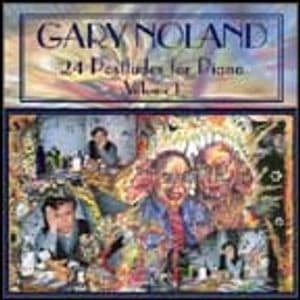
    24 Postludes for piano, Vol. 1

    August 2004: “Twenty-Four Postludes for Piano” Vol. 1 (Op. 72, Nos. 1–12), performed by Gary Noland. Duration: 72 minutes.  North Pacific Music (PO BOX 82627, Portland, Oregon 97282-0627, USA, tel/fax:  1-800-757-7384, www.NorthPacificMusic.com (NPM LD  018). music CDs original compositions Beaverton Lake Oswego

     REVIEWS/ENCOMIUMS

    “As usual I have been fiendishly busy and during my last absence, our humidification system went bonkers, depositing condensation and mold all over the place so now I am trying to deal with that on top of my overload. Nonetheless, I have put on the postludes whenever I’ve been at the computer and found them up to your usual iconoclastic, stylistic potpourri standards of giddy humor, no holds barred soup to nuts and high spirits. They are balm to the grim state of mind in which I find myself.”

    —Robert Levin, pianist (cadenza improviser extraordinaire), scholar, Professor of Music, Harvard University

    “Many thanks for the CDs you sent me, which I have been listening to with great pleasure and fascination.… I am bowled over by the expertise of your music:  you use certain elements from the 19th century and jazz, etc., and just at the moment when I am about to say, OK, what else is new? you do several things, such as speeding up, becoming wildly dissonant, modulating to a distant continent, stopping completely, and throwing some kind of total surprise. All of these things are possible, but you seem to know exactly when to do what and how much.  I don’t know anybody else who can do it!  And the brief electronic statements are spooky in the best and most extreme sense.  They make my hair (what’s left of it) stand on end.…”

    —Andrew Imbrue, composer, Pulitzer Prize finalist

    “Mr. Noland’s Postludes are a collection of wild and crazy pieces for … piano. These are essentially parodying of various styles, set in a dizzying harmonic language that loops uncontrollably through a wide-ranging gamut of possible and impossible tonalities. He applies this procedure to the fugue, ragtime, German dances (Schubert), romantic waltzes (Richard Strauss seems to be a favorite), and virtuosic piano scherzos. There’s a Chinese polonaise, a whiff of pentatonic Debussy; and, like most composers after Berlioz, he can’t seem to keep his hands off the Dies Irae (though fortunately, the tongue is firmly in cheek). Both Peter Schickele and Conlon Nan arrow hover over the proceedings. I’d even throw in Mark Applebaum, another Californian … The opening fugue is dedicated to the late David Lewin, the prominent Harvard theorist.  Lukas Foss gets a dedication, also (maybe his Baroque Variations had some sort of influence on Noland at some point).

    The general effect is like watching wet paintings of 19th Century musical memorabilia drip into frazzled 21st Century oblivion. The comic-book grotesquerie that graces the jewel box pretty much says it all … these pieces are striking and entertaining … (Postlude 12, an interminable exercise in blues montage, is the most daunting.) The pieces all have funny titles … Mustaches on the Mona Lisa, but those can be interesting if you’re in the right frame of mind.”

    —Allen Gimbel, American Record Guide

    “Composer and pianist Gary Noland are into ‘ha-ha music’—that is, classical music played for laughs, a genre famously (or infamously, depending on your taste in humor) popularized by Peter Schickele, also known as P.D.Q. Bach. This collection of solo piano music, identified as postludes rather than the more traditional preludes designation, indicates that, despite occasionally forcing the musical jokes (and writing far too many tortured puns in his liner notes), Noland has both the writing and playing chops to compensate for his painful musical humor. Dedicated to the late music theorist David Lewin, ‘Philomathetique’ is a witty trope on the music of Richard Strauss, with characterful motives and abundant quick modulations. ‘Effete Singulations’ is a deft, splashy bit of ragtime, while ‘Pickthanks and Premediates’ is a light-hearted romp played at a dizzying tempo and ‘Psychonipptions’ (dedicated to composer Henry Martin) is a send-up of 20th Century French music. Overall, Postludes is a mixed bag, but when Noland focuses on playing the piano well rather than simply playing for laughs, his compelling artistry shines through.”

    —Christian Carey, Splendid Magazine

    “Gary—you continue to be one of the most original of the contributors to ‘The Classical Salon.’ And ‘Effete Singulations’ [Postlude #2] opens one of my ragtime shows.”

    —David Rifkin, Host, “Classical Salon” and “The Ragtime Machine,” KUSF 90.3 FM, University of San Francisco.

    24 Interludes for piano, Vol. 1

    August 2004: “Twenty-Four Interludes for Piano” Vol. 1 (Op. 71, Nos. 1-12), performed by Gary Noland. Duration: 74 minutes. North Pacific Music (PO BOX 82627, Portland, Oregon 97282-0627, USA, tel/fax: 1-800-757-7384, www.NorthPacificMusic.com (NPM LD  019). music CDs original compositions Beaverton Lake Oswego

    “… intriguing, irritating, … distinctive, inventive, … subversive, … [the music] is never what you expect.  You hear all sorts of styles and influences—Beethoven, ragtime, Nan arrow, stride—often in very quick succession.… I had the strange feeling with many of these pieces [Interludes and Postludes] that, about halfway through, I had got fed up with them, but I was then sorry when they finished.… You can hardly be indifferent to Noland’s music and so I would urge you to try it. Despite my frequent irritation, I will certainly be returning to it and seeking out examples of Noland’s chamber works and multimedia compositions. Music aside, speaking as a cat-lover, I feel an instinctive sympathy with the composer depicted on the front cover of the Interludes fondly embracing his cat. Illogical? Well, yes; I think this music has got to me after all.”

    —Roger Blackburn, Music Web International

    “Gary Noland, a composer, and pianist with an impressive academic pedigree (including a Ph.D. from Harvard) and extensive performing experience, here presents an album of solo piano compositions, or ‘interludes.’ Actually, some of these pieces seem in no way transitory; instead, they present extended musical dialogues that call upon a host of musical styles and require the considerable technical facility to perform. Noland, a fleet-fingered, ebullient performer, is more than up to the task. Pastiche pieces like ‘Mumbo Gumbo’ and ‘Expresso Wagon’ evoke all manner of Romantic-era classical piano figurations; they gently lampoon some of the genre’s conventions, but always remain bright, witty, and engaging. ‘The Temptation of Saint Floyd’ also channels Romanticism, particularly the Strassman sort, demonstrating a more reflective demeanor and adding a dollop of schmaltz to the proceedings. ‘Push Button Fingers’ is prevailingly modern in construction, with syncopated rhythms and sprightly, angular runs creating a far more contemporary sound world. Noland’s work may be eclectic—sometimes even a bit goofy—but Interludes is cleverly constructed and consistently well performed.”

    —Christian Carey, Splendid Magazine, 12/29/2005

    FIND OUT MORE

    Selected Music from Venge Art

    July 2002: “Gary Noland:  Selected Music from VENGE ART.”  Duration:  75 minutes. Cellist Hamilton Heifetz and pianist Victor Steinhardt playing “Fantasy in E Minor” for cello & piano (Op. 24), pianist Randall Hodgkinson playing “Humoresque” for piano (Op. 3) and the “Russell Street Rag” (Op. 5), Gary Noland performing three segments of “P*run*Music” (Op. 48), Violist Katherine Murdock and pianist Randall Hodgkinson playing “Romance” for viola & piano (Op. 10), a computer-driven Disklavier performance of “Grande Rag Brillante” (Op. 15), The Onyx String Quartet playing “American Bozo Dance” (Op. 32, No. 8), and Guy Tyler conducting “Septet” (Op. 43) with clarinetist Carol Robe, alto saxophonist Tom Bergeron, French hornist Ellen Campbell, violinists Tawana Nagahara and Anthony Dyer, double-bassist Forrest Moyer, and pianist Art Maddox. Released by North Pacific Music (PO BOX 82627, Portland, Oregon 97282-0627, USA, tel/fax:  1-800-757-7384, www.NorthPacificMusic.com (NPM LD  012). music CDs original compositions Beaverton Lake Oswego

    “Mr. Noland writes as a ‘time traveler’ in styles long abandoned by most composers as well as styles so new as to not have been imagined but by him.  This he accomplishes naturally, convincingly, with originality and true passion.  His command of all musical languages and his ability to traverse musical time is nothing less than remarkable.  Listen!”

    —Donald Martino, Pulitzer Prize-winning composer

    “Composer Gary Noland is possessed of a rich musical imagination, whose technique distills the achievements of Roger, Strauss, and Schoenberg but also refracts their post-romantic/expressionist tendencies through the lens of twenty-first-century post-modernism, American style. Moreover, he fits Stravinsky’s definition of a great composer:  one who doesn’t merely steal but knows what to steal.  This Noland does with wit and aplomb unique to the music of our time.”

    —Ira Braes, pianist, musicologist, Professor of Music, The Hart School

    “Gary Noland’s Venge Art is more than just a collection of music.…inspiring.  He walks with assurance through the treacherous landscape of late tonality and early post-tonality (e.g., Strauss).…a gifted composer.”

    Payton MacDonald—American Record Guide

    FIND OUT MORE

    Player less Pianos

    May 2000: “Player less Pianos: Virtual Music for Pianos Virtual and Otherwise.” Seventh Species Composers Series Debut Recording, Limited Collector’s Edition (NPM LCE 007—North Pacific Music). A compilation recording of works by various composers. Includes Gary Noland’s “Grande Rag Brillante” (Op. 15), which was recorded on August 19, 1998, on a Disklavier at SPARK Studios in Emeryville. music CDs original compositions Beaverton Portland Lake Oswego

    Original Compositions by Gary Noland music CDs

    1996: “Passion.” A compilation recording of works by composers Gary Noland, George Rothberg, Georges Enescu, Greg Steinke, and Jackie T. Gabel performed by violist Rozanne Weinberger and pianist Evelyne Lust. Includes Noland’s “Romance” for viola & piano (Op. 10).  (NPM LD 003—North Pacific Music).  Recorded September 1994 at MET Studio Ball State University, Muncie, Indiana.  In Schwann Catalog. music CDs original compositions Beaverton Portland Lake Oswego

    FIND OUT MORE

    Be sure and listen to performances of Gary Noland’s music on this website under “videos,” “more videos,” etc.

    All CDs are available for purchase from www.northpacificmusic.com music CDs original compositions Beaverton Portland Lake Oswego


    The End