Updated information below on Yeongjaecheon stream based on a Kindle booklet about the stream.
Over the last decade, Korea has build hundreds of stream bed parks throughout Seoul and Korea. There are great places to take a walk, to observe wild life, to enjoy nature in the city. There is some information in English on these parks but not enough. For those readers in Korea, please feel free to send me info on other stream bed parks, so I can update this from time to time.
The most famous one is the one that started it all. Cheongjejon in down town Seoul.
Formerly polluted and covered with an elevated road since 2005, this stream has been cleaned up and made into an Art and nature walkway through the heart of Seoul.
Suggested Duration:1-2 hours
It is the prototype perhaps of stream restoration.
SEOUL, South Korea For half a century, a dark tunnel of crumbling concrete encased more than three miles of a placid stream bisecting this bustling city.
The waterway had been a centerpiece of Seoul since a king of the Choson Dynasty selected the new capital 600 years ago, enticed by the graceful meandering of the stream and its 23 tributaries. But in the industrial era after the Korean War, the stream, by then a rank open sewer, was entombed by pavement and forgotten beneath a lacework of elevated expressways as the city’s population swelled toward 10 million.
Today, after a $384 million recovery project, the stream, called Cheonggyecheon, is liberated from its dank sheath and burbles between reedy banks. Picnickers cool their bare feet in its filtered water, and carp swim in its tranquil pools.
The restoration of the Cheonggyecheon is part of an expanding environmental effort in cities around the world to “daylight” rivers and streams by peeling back pavement that was built to bolster commerce and serve automobile traffic decades ago.
Environmentalists point out other benefits. Open watercourses handle flooding rains better than buried sewers do, a big consideration as global warming leads to heavier downpours. The streams also tend to cool areas overheated by sun-baked asphalt and to nourish greenery that lures wildlife as well as pedestrians.
After its opening in 2005, hundreds of thousands of people have visited the new stream with friends and family.Credit…Jean Chung for The New York Times
Some political opponents have derided Seoul’s remade stream as a costly folly, given that nearly all of the water flowing between its banks on a typical day is pumped there artificially from the Han River through seven miles of pipe.
Golden Waterway In Gimpo
GW 1
gw3jpg
gw5]
My favorite though is the Golden Waterway in Gimpo north of Kimpo airport, close to Janngi station on the new Gold Line. The Gyeongi and Gimpo tourist promotors have dubbed this “the Venice of Korea”. Not quite, but still quite nice.
.
it is a 5.9 long walk way along a stream that used to be an open sewage dump back not too long ago. It is lined with trees, flowers, beaches, and quirky public art. The northern end is pretty boring though. The central and southern end is very nice.
It is lined with restaurants and cafes, and has a boat house where you can rent boats to go out on the water. The cost is 20,000 per hour. a popular boat choice is the moon boat, which is a boat shaped like a crescent moon that is ideal for a couple to take out on the water. There are also family boats and paddle boats for individuals. There are also bikes for rent.
[4K] Beautiful evening walk along Laveniche March Avenue in Gimpo Korea Tour 김포 한강신도시 장기동 라베니체 저녁 걷기
안녕하세요 Seoul Walker 입니다.
오늘은 경기도 김포한강신도시에 위치한 라베니체 마치 에비뉴의 저녁을 함께 걸어봅시다. 깨끗해진 공기 만큼이나 아름다운 노을을 계속 볼 수 있기를 희망합니다.아침 7시, 당신을 위한 새로운 영상이 공개 됩니다.
당신의 새로운 아침, 그리고 오후 저녁 저의 영상을 보며 한결 여유로운 하루의 시작과 마무리가 되었으면 하는 바램입니다. 최대한 다채롭고 흥미로운 영상을 즐기실 수 있도록 노력하겠습니다.영상이 마음에 드셨다면 좋아요, 구독, 알림 설정 부탁드립니다.
그럼 오늘도 행복한 하루 되세요!
Hello all my friends, I’m Nathan from Seoul Walker.
Today, let’s walk together at Laveniche March Avenue in Hangang River New City, Gimpo, Gyeonggi-do.
Ravenice March Avenue is a themed canal street created by Venetian motifs on a total of 33,000 m² waterfront commercial areas in total of 26 parcels around the golden waterway, which is an artificial waterway in the Han River New City of Gimpo, Gyeonggi Province. It is a commercial facility.
Other Streams in Seoul
Jungnangcheon (Stream)
Jungnangcheon stream is the biggest contributor to the Hangang River. It starts at Yangju-si, Gyeonggi-do, joins with the Cheonggyecheon stream, and curves around Geumho-dong, Seongdong-gu until it finally flows under the Bridge of Gangyeonbuk-ro and into the Hangang river.
Hongjecheon (Stream)
Hongjecheon (Stream) begins at Bukhansan (Mountain) and runs for 11.1km through Jongno-gu and Mapo-gu. The stream is named after the Hongjewon, an official building where Chinese envoys were received. Once dried up and neglected, the stream was revived under Seoul’s ‘No Dry Streams’ project. Within two short years clean water was once again flowing through both Hongjecheon (Stream) and Cheonggyecheon (Stream).
Yangjaecheon Stream and Tancheon Stream are two tributaries of the Hangang River.
Yangjaecheon (Stream)
Update: there is a nice booklet available on Kindle called Gangnam Style by Kyungsuk Oh, all about Yongjaecheon stream. They recommend starting at Hangyegul station on the Orange line. At the end of the stream, it flows into the Tancheon stream and then into the Han River. When you get to the Tancheon stream, there is a nice cafe street called Cafe Street or Metasequia Street lined with eateries. if you keep going along the Tangcheon stream, you enter into the Han river park system, or you could follow the Tancheon stream bed park back towards the mountains.
Yangjaecheon (Stream) originates from Gwanaksan (Mountain) and Cheonggyesan (Mountain). The 15.6km stream flows across Gwacheon and into the Gangnam district in Seoul until it joins up with the Hangang (River). The stream flows across Dogok-dong and Gaepo-dong in the district of Gangnam, and is a popular spot with locals for its well-paved pedestrian and cycling paths. It is a pleasant patch of green in a concrete jungle. Many Seoulites visit the stream for relaxation and to spend a day being closer to nature.
Tancheon Stream is another one of the Hangang’s tributaries.
The stream is 35.6km long and starts in the city of Yongin in GyeongGi Province and ends at the Hangang River in Gangnam-gu, Seoul.
* Subway Line 3, Maebong Station, Exits 3 & 4 (5 mins on foot)
* Subway Line 3 & Bundang Line, Dogok Station, Exits 3 & 4 (5 mins on foot)
Hanyeoul Stream, is a tributary of the Hangang River.
The stream is 18.5km long and flows from Gwacheong in GyeongGi Province to the southern part of Seoul. The stream’s name is derived from the area in Seoul it flows through, Yangjae-dong.
Visit Songdo Central Park
Find a pleasant oasis along the water in this large, bustling city. Canoe, ride a bike, relax on the lawn or visit rabbits and deer.
Stroll along the peaceful promenade of Songdo Central Park and view sculptures and animals. Here pretty grassy spaces border a manmade waterway while skyscrapers tower nearby. Completed in 2009, the stylish city park has become a landmark of the large city of Incheon in South Korea’s northwestern region.
In 2001, Incheon began creating Songdo International Business District on mostly reclaimed land. The multi-functional space offers residents a pleasant and sustainable place for home, work, school and leisure. The 101-acre (41-hectare) park is an integral part of the overall design. Join residents and other visitors using this vast green space and exploring the cultural institutions surrounding the park.
One highlight of the park is the seawater canal symbolizing the rivers of Korea flowing to the West Sea. Cruise along the canal under your own power in a canoe with sun umbrellas or on a comfortable water-taxi or small cruise boat.
Gaze at and visit some of the futuristic buildings surrounding the park. Tri-Bowl, with the appearance of a bowl resting on water, has cultural event spaces. The Songdo G-Tower’s diagonal lines and atriums provide a stunning setting for the offices of IFEZ (Incheon Free Economic Zone) Authority. Visit the building’s 29th-floor Sky Garden for views across the city.
Most of the streams passing through Suwon originate on Gwanggyosan or other nearby peaks. Since Suwon is bounded to the east by other hills, the streams, chiefly the Suwoncheon (and one notable tributary being the Jungbocheon), flow southwards through the city, eventually emptying into the Yellow Sea at Asan Bay. The entirety of Suwon is drained in this manner
Manisan Stream
Manisan in Gangwha Island has a delightful stream running through the mountain. the trail follows the stream for the first mile or so.
Manisan is a mountain in Incheon, South Korea. It is situated in Ganghwa County and is the highest peak on Ganghwa Island. Manisan has an elevation of 469.4 m (1,540 ft).[1] There is a popular hiking trail to the summit; at the summit is Chamseongsdan, an altar where Dungun (the founding father of Korea) performed ritual ceremonies.
Manisan is the highest peak in Ganghwa island. It is a legendary mountain where Dungun the founder of Korea came to the earth. The park signs are all in Korea.as is the map. There are four routes, blue, yellow, red, and purple. The blue route is the shortest route to the top. The first part of the trail is along an asphalt road following Manisan creek through an old-growth forest. The blue trail branches off to the left and from that point on is a dirt trail, a trail with steps, and some scrambling up rocks. There is a rail all the way so that helps. The elevation gain is steep at times. At the top of the mountain there is a nice sky bridge trail to view points. The view is spectacular.
There is a camp ground on the other side of the mountain where the red and purple trails originate. The round trip is about two and one half hours and is about a 4-mile round trip. One could make it a loop by taking the yellow course back down the mountain.
Chamseongsdan was closed for renovation. However, there is a replica at the foot of the mountain where the occasional ritual are still held.
Near By Resturants
There are several restaurants at the bottom of the mountain. One served a great belt fish menu.
Manisan is a mountain in Incheon, South Korea. It is situated in Ganghwa County and is the highest peak on Ganghwa Island. Manisan has an elevation of 469.4 m (1,540 ft). There is a popular hiking trail to the summit; at the summit is Chamseongsdan, an altar where Dangun (the founding father of Korea) performed ritual ceremonies.
Chamseong-dan altar, Mt. Mani-san, Ganghwa-do Island The “Demon Expelling Mountain” is the most sacred site on Ganghwa Island of Incheon City, relatively quite famous throughout the nation. There is an ancient stone shrine on its highest peak (469m, the Chamseong-dan [Truly Holy Altar], that commands a wide view of the Yellow Sea.
Manisan Mountain (Ganghwa Island) is a 3.4 mile heavily trafficked loop trail located near Seo-gu, Incheon, South Korea that features a great forest setting and is rated as moderate. The trail is primarily used for hiking, walking, and nature trips and is accessible year-round. Length 3.4 miElevation gain 1,459 ftRoute type Loop
One funny thing about this mountain is that it would be just about as easy to visit on a layover as it would be from anywhere else on the Korean peninsula. Manisan is by far the closest 100 summits mountain to Incheon International Airport! At least, it’s close as the crow flies. Manisan is not exactly on the way anywhere – it’s on Ganghwa island! If you actually do the aforementioned airport plan, one-way transit will take you nearly two hours (bus 9000 from the airport, connecting to bus 700-1 in Yangcheon – if you’re curious!). The trip is a little longer from Incheon. Take the orange, Incheon line 2 metro to Majeon station and then catch the 700-1 bus for just over two hours (starting from downtown Incheon). From Seoul, navigate your way to Yangcheon by bus or subway (different depending on your starting point – but aim for Gurye station on the brown line 9) – then catch bus 700-1. Seeing the theme? Bus 700-1 runs to the Hwado bus terminal, just north of Manisan. A few other bus…
Oct 20, 2012 · One of three sacred Korean mountains, Manisan is located on Ganghwa Island on the west coast. It’s less than an hour from Incheon airport, and connected by two bridges to the mainland.
The Manisan Mountain is a mountain located on the Ganghwa-do mountain range. The Ganghwa-do mountain range is located in Incheon, South Korea. This mountain is 496.4 meters over sea level. It is also the tallest mountain in this mountain range.
Dec 03, 2014 · Manisan stands at 469 meters (or 1539 feet) above sea level, and it offers two hiking paths. We took the tougher route, the Stairway Path. As you can guess from the name, there were a lot of stairs, as is quite common with hiking in Korea, but this mountain is definitely worth the work.
Jul 05, 2010 · Ganghwado (Ganghwa Island) is Korea’s fifth largest island. Its strategic west sea location, in the estuary of the Han River, has resulted in an immensely important role in Korean history. Wars, kingdoms, sacrifices, temples, UNESCO world heritage sites… a lot has happened here.
With the primary fortifications protecting the Joseon capital of Seoul from foreign invasion, Ganghwa Island was the site of several 19th-century punitive expeditions.The mass execution of Catholic French missionaries and Korean converts under the ministry of the Heungseon Daewongun in the mid-1860s led to a French invasion in 1866 which held the island for several weeks, although the …
Manisan Mountain (Ganghwa Island) is a 5.5 kilometer heavily trafficked loop trail located near Seo-gu, Incheon, South Korea that features a great forest setting and is rated as moderate. The trail is primarily used for hiking, walking, and nature trips and is accessible year-round.
Length5.5 kmElevation gain445 mRoute typeLoop
Manisan Mountain (469m) is one of three sacred 3 mountains in Korea, with two hiking paths that lead to an altar and temple on the summit.
You begin to ascend as soon as you leave the parking lot, then it’s pavement, stairs, and “carpet” as you make your way to the peak. There’s an ancient alter at the top.
Where to Listen to Podcasts
I have a small request to make. I want to expand my followers on all my platforms. So if you have not signed up yet for this blog, or followed me on intraframe, Twitter, Pinterest, Tumblr, or Bloglovin or listened to my podcast on Spotify please do so now.
Gyeansan san is a great mountain in Incheon not too far from the Incheon Airport, and about an hour from downtown Seoul. There are multiple trails into the mountain. The best trailhead starts a few blocks from the Gyeansan way stop on Incheon Line 1 subway system. You can also find trails starting at Gyean station on the Airport Express line (and soon on line 9 once that extension is finished).
Hiking to the top takes no more than two hours depending upon where you start. There is a nice pavilion on the top. Multiple trail options so doing a loop trail, which I prefer, is quite doable.
At the bottom of the trail, there are multiple restaurants though mostly Korean food. There are CVS stores so it is easy to get snacks before hiking. There is a fair amount of info in English online. But no real good trail maps but then you don’t really need one as it is easy to follow – just go up!
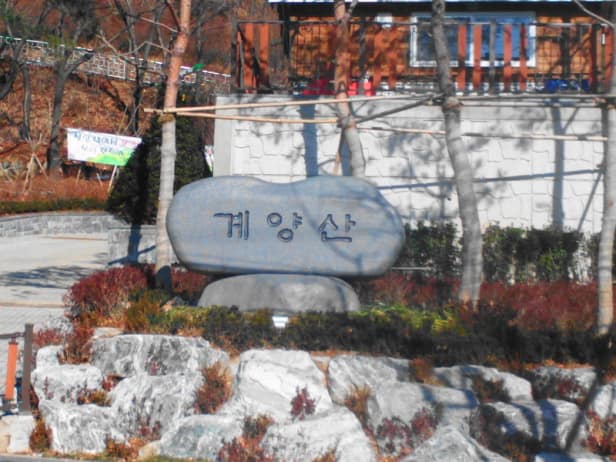
Gyeyang Mountain (also called MT. Gyeyang, Mount Gyeyang, Gyeyang San or 계양산) is located in northern Incheon in the Gyesan-dong area of Gyeyang-gu. It stands 395m above sea level and is officially Incheon’s highest mountain. It is a very popular hiking trial and not just with people people from the Incheon & Seoul areas but people from all over South Korea enjoy climbing it.
The Mountain is a pretty easy climb and depending on which trail you take only takes about an hour to reach the summit (2 hours round trip), while other trails can take close to 2 hours (4 hours round trip). There are nice views over Incheon and as well as the more countryside area of northern Incheon.
After climbing the Gyesan-dong and neighboring Imhak-dong have plenty of restaurants to enjoy (although most are Korean style) as well as hiking and regular stores.
Location and Links
The best and easiest way to get to Gyeyang Mountain (계양산) is via subway. If you go to Gyesan Station (Incheon Line One) and then take either exit a or b and walk up the hill and to the foot of the mountain.
Also here are a couple of useful links about Gyeyang Mountain (계양산):
* Office of Gyeyang-Gu Page – Includes information on hiking trails as well as travel advice in English
Hiking in South Korea is possible during the winter months but difficult, the best times to hiking Gyeyang Mountain (계양산) or any other in Korea is from March to November.
I have found several new trails to conquer Gyeansan.
from Gyean station on the Airport railroad, go to the right and then to the left and follow the stream path until you come to the Gyeansan mountain trailhead (with map)
from there you can take multiple trails to the top of the mountain, or around the mountain. The trail to the top ends up with a lot of stairs.
the trail around the mountain eventually leads to the Gyeansan Rose garden which is very pretty this time of year. there is also a nice Buddhist temple there.
Dining Options for Western Expat Bars in Incheon
For dinner, you can either take a bus or a taxi to Bupyeong market station. There is a great burger joint there. There is also an expat bar called Woodstock that has friendly English speaking waitresses. Great place to end a hike.