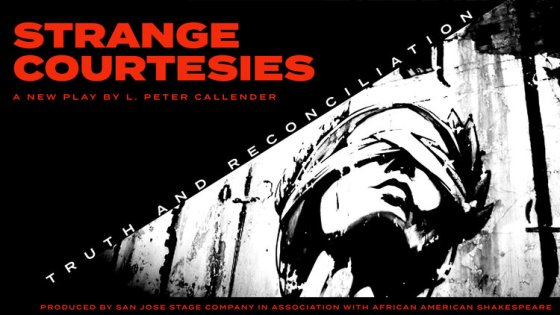
Strange Courtesies Extended Until March 8thCritics love STRANGE COURTESIES – Check out review in THEATRESTORM! I
|
|||||||||||||||||||||||||||||||||||||||||||||||||||||||||||||||||||||||||||||||||||||||||||||||||||||||||||||||||||||||||||||||||||||||||||||||||||||||||||||||||
Update:
Still streaming until Wednesday, March 4th, 2021
Review: Very gripping drama based on the Truth and Reconciliation Commission’s work in South Africa. One of the perpetrators of atrocities is attacked on the street by the brother of one of his victims. He finds himself in the hosptial being tended to by the sister of one of his victims. He confessed to her that he has been taken over the spirit of the dead man.
Strange Courtesies

San José Stage Company will hold a world premiere of “Strange Courtesies”, a play about the South Africa Truth and Reconciliation Commission starting my friend, Robert Henry Sicular. The play will be available live streaming only from February 27 to March 3rd. The cost is $40.00.
Author’s note:
Robert Sicular is my best friend. I have known him since first grade or almost 60 years. During that time, he has only worked as an actor, part of what he calls the 1% club – those people who make a living only by acting.
Please check out the play. I will update this later with my review.
Robert’s email follows:
My Friends!
I hope everyone is doing well!
I just wanted to let you know about a play that I have the pleasure of acting in A Virtual World Premiere! Yes, online and recorded remotely, it is a moving and important piece that I know will be a very popular production when the theaters open up again – and may it be soon!
The play is Strange Courtesies, streaming On Demand February 27th (this Saturday) through March 3rd (next Wednesday). Written and directed by L. Peter Cullender, it is produced by the San Jose Stage Company in association with the African American Shakespeare Company. Set in Post-Apartheid South Africa, it is a tale of a family and a society confronting loss, uncertainty, and reconciliation in troubled times. It is about the power of truth and the power of love and the power of forgiveness. Produced with an outstanding cast and technical team it will stay with you and spur many a discourse. It’s entertaining, too!
For tickets and more info. please go to San Jose State company world premier of “Strange Courtesies”
See you there. Aloha.
Roberto
Strange Courtesies, WORLD PREMIERE

Written and Directed by L. Peter Callender
FEBRUARY 27 – MARCH 3, 2021
Presented in association with African American Shakespeare Company
Community Partner
Nirvana Soul Coffee
TRUTH AND RECONCILIATION
A virtual World Premiere in collaboration with African American Shakespeare Company.
Citizens of South Africa are confronting a painful past of the apartheid era through the Truth and Reconciliation Commission. STRANGE COURTESIES explores the potential restorative power of truth-telling, the significance of sympathetic witnesses, and the tasks of both perpetrators and bystanders in the TRC process. Can dignity be restored to victims and their families while offering a basis for individual healing, and promoting the reconciliation of a divided society?
GET TICKETS
For instructions on how to stream Strange Courtesies click here
CAST
Tshiwela Maangani* as Nomusa Kwanzi
Biko Eisen-Martin* as Robert Seybold
Jamey Williams as Jonny Emanuel Kwanza
Marjorie Johnson* as Zenzile Kwanzi
Robert Sicular* as Howard Arthur Prinsloo
Adam Green as Zachariah Kwanzi
*Member Actors Equity Association
CREATIVE TEAM
DIRECTOR | L. PETER CALLENDER
STAGE MANAGER | ALLISON F. RICH*
VIDEO DESIGN & EDITING | DERRICK SCOCCHERA
CHOREOGRAPHY | DEVIN PARKER SULLIVAN
SOUND DESIGN | IMRSV SOUND & BERKELEY SOUND ARTISTS
POSTPRODUCTION SOUND | IMRSV SOUND
SOUND SUPERVISOR | JACOB BLOOMFIELD-MISRACH
RERECORDING MIXER | JONATHAN ANDERSON
COSTUME DESIGN | MADELINE BERGER
DRAMATURG | LETICIA LASWELL RIDLEY
KEY ART | CAITLIN ELIZABETH
MEDIA
San Jose Stage Company
490 South 1st Street,
San Jose, CA, 95113,
For more on the TRC, please see the following Wikipedia article. I edited the theater section to include this production. the complete Wikipedia article is here
Wikipedia Summary:
The Truth and Reconciliation Commission (TRC) was a court-like restorative justice[1] body assembled in South Africa after the end of apartheid.[2] Witnesses who were identified as victims of gross human rights violations were invited to give statements about their experiences, and some were selected for public hearings. Perpetrators of violence could also give testimony and request amnesty from both civil and criminal prosecution.
The TRC, the first of 1003 held internationally to stage public hearings, was seen by many as a crucial component of the transition to full and free democracy in South Africa. Despite some flaws, it is generally (although not universally) thought to have been successful.[3]
The Institute for Justice and Reconciliation was established in 2000 as the successor organization of the TRC.
Creation and mandate[edit]
The TRC was set up in terms of the Promotion of National Unity and Reconciliation Act, No. 34 of 1995, and was based in Cape Town. The hearings started in 1996. The mandate of the commission was to bear witness to, record, and in some cases grant amnesty to the perpetrators of crimes relating to human rights violations, as well as offering reparation and rehabilitation to the victims. A register of reconciliation was also established so that ordinary South Africans who wished to express regret for past failures could also express their remorse.[4]
The TRC had several high-profile members, including Archbishop Desmond Tutu (chairman), Alex Boraine (deputy chairman), Sisi Khampepe, Wynand Malan, and Emma Mashinini.
Committees[edit]
The work of the TRC was accomplished through three committees:
-
The Human Rights Violations Committee investigated human rights abuses that occurred between 1960 and 1994.
-
The Reparation and Rehabilitation Committee was charged with restoring victims’ dignity and formulating proposals to assist with rehabilitation.
-
The Amnesty Committee considered applications from individuals who applied for amnesty by the provisions of the Act.
Process[edit]
Public hearings of the Human Rights Violations Committee and the Amnesty Committee were held at many venues around South Africa, including Cape Town (at the University of the Western Cape), Johannesburg (at the Central Methodist Mission), and Randburg (at the Rhema Bible Church).
The commission was empowered to grant amnesty to those who committed abuses during the apartheid era, as long as the crimes were politically motivated, proportionate, and there was full disclosure by the person seeking amnesty. To avoid the victor’s justice, no side was exempt from appearing before the commission. The commission heard reports of human rights violations and considered amnesty applications from all sides, from the apartheid state to the liberation forces, including the African National Congress.
Numbers[edit]
The Commission found more than 19,050 people had been victims of gross human rights violations. An additional 2,975 victims were identified through the applications for amnesty. In reporting these numbers, the Commission voiced its regret that there was very little overlap of victims between those seeking restitution and those seeking amnesty.[5]
A total of 5,392 amnesty applications were refused, granting only 849 out of the 7,111 (which includes the number of additional categories, such as “withdrawn”).[6]
Significance and impact[edit]
The TRC’s emphasis on reconciliation was in sharp contrast to the approach taken by the Nuremberg Trials and other de-Nazification measures. The reconciliatory approach was seen as a successful way of dealing with human rights violations after political change, either from internal or external factors.[citation needed] Consequently, other countries have instituted similar commissions, though not always with the same scope or the allowance for charging those currently in power.
There are varying opinions as to whether the restorative justice method (as employed by the Truth and Reconciliation Commission) is more or less effective than the retributive justice method (which was used during the Nuremberg Trials). In one survey study,[7] the effectiveness of the TRC Commission was measured on a variety of levels:
-
Its usefulness in terms of confirming what had happened during the apartheid regime (“bringing out the truth”)
-
The feelings of reconciliation that could be linked to the Commission
-
The positive effects (both domestically and internationally) that the Commission brought about (i.e., in the political and the economic environment of South Africa).
the End
The differences in opinions about the effectiveness can be attributed to how each group viewed the proceedings.
In the study by Orlando Lentini, the opinions of three ethnic groups were measured in this study: the British Africans, the Afrikaners, and the Xhosa.[7] According to the researchers, all of the participants perceived the TRC to be effective in bringing out the truth, but to varying degrees, depending on the group in question.
The differences in opinions about the effectiveness can be attributed to how each group viewed the proceedings. Some viewed them as not entirely accurate, as many people would lie to keep themselves out of trouble while receiving amnesty for their crimes. (The commission would grant amnesty to some with consideration given to the weight of the crimes committed.) Some said that the proceedings only helped to remind them of the horrors that had taken place in the past when they had been working to forget such things. Thus, the TRC’s effectiveness in terms of achieving those very things within its title is still debatable.*