note: submitted to Rogue Valley Times for possible publication
audio clip
poem version
Wagontire Oregon 1973
In 1973, I embarked on a road trip with my father. We left Berkeley, heading toward Yakima, where my father owned a summer cabin. As a college professor, he enjoyed the luxury of July and August off, and our dysfunctional family spent those summers together in the mountain cabin from 1968 to 1978. Our annual pilgrimage was both a trip to hell and a journey back.
My father and I shared a wanderlust—a love for exploring new places. This trip turned out to be one of our best. Surprisingly, we got along, which was unusual given our typically tense relationship. We were vastly different, but during this journey, we became friends..
We drove east along Highway 395, entering the high mountain desert of eastern Oregon. The road stretched ahead, almost deserted. Then we saw the sign: Wagontire, Oregon, 100 miles ahead. We counted down the signs, mile after mile, as dusk settled around us. We speculated Wagontire must be a giant truck stop—an oasis in the middle of nowhere.
Interspersed with the Wagontire signs were Burma Shave signs. Highway 395 was one of the last highways to still have these signs, which had been phased out in most places by 1966 or so.
Burma shave signs were written in rhyming couplets or quatrains cowboy poetry style, ending with the tag line Burma Shave. Here are two examples:
“Shaving brushes
You’ll soon see ’em
On a shelf
In some museum
Burma-Shave”
“Within this vale
of toil
and sin
your head grows bald
but not your chin–use
Burma-Shave”
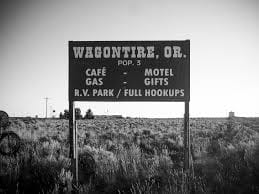
We counted down the miles until at last we pulled into town. But when we pulled into town, reality struck. There was nothing but a gas station, a motel, and a cafe. Last gas for 100 miles, according to the highway sign. I chatted with the owner, who was the sheriff, fire chief, and owner of the only business in town. The sign outside read: “Welcome to Wagontire, Oregon. Population: 200,000 sheep, 10 dogs, two and one half humans..”
Curiously, I asked who was the half-human, and the sheriff replied, “My idiot son.”
I did not know it, but this was my last big solo road trip with my father. We drove to and from the cabin a few more times, last time in 1984, but this trip was special and one I will always remember. Mainly because my dad and I finally became “friends” during this trip and got along great. Unfortunately, that moment did not last, and we soon re-entered our difficult relationship, but during that trip, we got along famously.
2016 Revisiting Wagontire
Fast forward to 2016. My wife and I drove through eastern Oregon as part of an epic cross-country trip—31 states, 100,000 miles in three months to celebrate my retirement from 27 years of serving the country in the U.S. Foreign Service working overseas in 10 countries. We thought it was time to see America.
We followed Highway 395, revisiting the memories of my trip with my father 40 years earlier. But Wagontire had changed. The signs were gone, the motel abandoned, and the town reduced to ruins—a ghost town.
As we reflected on Wagontire and other “nothing burgs,” we pondered the heart of Trump’s forgotten America—the flyover country that often escapes our attention.
Reflections on my visit to Wagontire, Oregon, in 1973 and 2016.
He was a college professor
And had July and August off
And we spent our summers,
Every summer from 68 to 78
In that mountain cabin,
and hanging with my Uncle
who had inherited the family
apple farm in Yakima.
Our whole dysfunctional family
Our annual trip
to hell and back
And we did not
get along at all.
We decided to drive
through Eastern Oregon
Just my Father and me.
Just for the hell of it
The rest of the family
was already there,
My father and I shared a travel lust
Loved to go to new places
One of the few things we shared.
This was one of our best trips
We actually got along
Which was unusual.
Normally our relationship
Was fraught with tension
As we were so different.
We left Klamath Falls
A real noting burg in those days
And headed east along Highway 395.
As we entered the
desert of Eastern Oregon
America’s Outback lands
We entered a different world
High mountain desert
Almost no one on the road
Then we saw the signs
Wagontire Oregon
100 miles ahead
99 miles
98 miles
intersperse with the signs
were Burma Shave signs
one of the last highways
to have these cowboy poetry
advertisements
Just a few examples
for those who have never
seen these lost Americana signs
common from 1915 to 1975
Shaving brushes
You’ll soon see ’em
On a shelf
In some museum
Burma-Shave
Within this vale
of toil
and sin
your head grows bald
but not your chin – use
Burma-Shave
We counted down the signs
Mile after mile
Wagontire
Burma shave add
Wagontire
Burma Shave
every mile
counting down
.
As we drove
into the gathering dusk,
We speculated that Wagontire
Must be a giant truck stop
An oasis in the desert
In the middle of nowhere,
We pulled into town
Nothing but a gas station
Motel and cafe
We stopped
Last gas for 100 miles
According to the highway sign
In the morning
We chatted with the owner.
He was the sheriff, fire chief
rancher and Owner
of the motel gas station.
The only business in town
And the only place open
For one hundred miles.
I noticed a sign outside
“Welcome to Wagontire, Oregon
Population 200,000 sheep.
and two and one half-humans.”
I asked the sheriff
“Who is the half-human?”
He said,
“My idiot son.”
And we left
200 miles
We finally
left Eastern Oregon.
2016
In 2016, my wife
and I drove
through Eastern Oregon.
As part of our epic
Cross-country trip
to celebrate my retirement
from the U.S. Foreign Service.
31 states
10,0000 miles
in three months.
On the way
from Medford, Oregon
to Yellowstone,
We drove along
Highway 395,
40 years since
my trip with my father.
The signs for
Wagontire were gone
as were the Burma Shave signs.
As we drove through the town
The motel was abandoned
Nothing there at all.
The motel was in ruins
Just another ghost town.
And that sign was gone too
Just a small sign saying,
Wagontire, Oregon.
We speculated about wagon tire
And all the other nothing burgs
We drove through that summer.
Heart of Trump’s
Forgotten America
Fly over country.
background info on Burma Shave commercials by Microsoft Co-Pilot
Certainly! Burma-Shave was an American brand of brushless shaving cream, but it became even more famous for its unique advertising campaign. Let me share some interesting details and a few delightful Burma Shave poems with you:
History of Burma-Shave:
Introduced in 1925by the Burma-Vita company in Minneapolis, it was initially known for a liniment made from ingredients sourced from the Malay Peninsula and Burma.
Seeking wider appeal, they launched the Burma-Shavebrand of brushless shaving cream along with a clever advertising program.
At its peak, Burma-Shavewas the second-highest-selling brushless shaving cream in the US.
Unfortunately, sales declined in the 1950s, and in 1963, the company was sold to Philip Morris. The iconic roadside signs were removed at that time.
These witty and memorable poems left a lasting cultural impact, reminding us of a bygone era when highways were dotted with clever signs and a touch of humor. 🚗🌟
Background Info on Wagontire Oregon from Microsoft Co-Pilot
Wagontire, an unincorporated community in Harney County, Oregon, lies along U.S. Route 395. The name itself is intriguing—it conjures images of a remote outpost in the vast Oregon landscape.
Here are some fascinating details about Wagontire:
Origin of the Name:
The community was named after the nearby Wagontire Mountain.
Despite its modest size, the name carries a sense of adventure and history.
Historical Context:
In the late 1970s, Wagontirewas home to just two people: William and Olgie Warner.
The Warners owned a property that included a gas station, café, motel, general store, and an RV park.
Across the road from these buildings was Wagontire Airport, where planes would taxi across the highway and refuel at the gas station.
The signs outside humorously declared: “Welcome to Wagontire, Oregon. Population: 2½ humans, 10 dogs, 200,000 sheep.”
Changing Times:
Fast forward to 2016, and Wagontirehad transformed.
The signs were gone, the motel abandoned, and the town reduced to ruins—a ghost town.
It became a symbol of the heart of forgotten America, the flyover country often overlooked by travelers.
Education:
Wagontire falls within Suntec School District 10(Suntec School, grades K-8) and Harney County Union High School District 1J (Crane Union High School).
Wagontire—a place where time stood still, where echoes of the past whisper across the desert landscape. 🌵🚗
1: Geographic Names Information System 2: United States Topographic Map 3: Moyer, Armond; Moyer, Winifred (1958). The Origins of Unusual Place-Names. Keystone Pub. Associates, p. 137. 4: Monroe, Bill (December 14, 1997). “Under the Desert Sky: Solitude for Sale.” The Oregonian. : Weber, first (July 11, 1993). “Everyone Stops At Wagontire (Pop. 2).” The New York Times. : Frazier, Joseph B. (April 2, 2000). “Life Takes on a Slow Pace in Wagontire.” Albany Democrat-Herald.
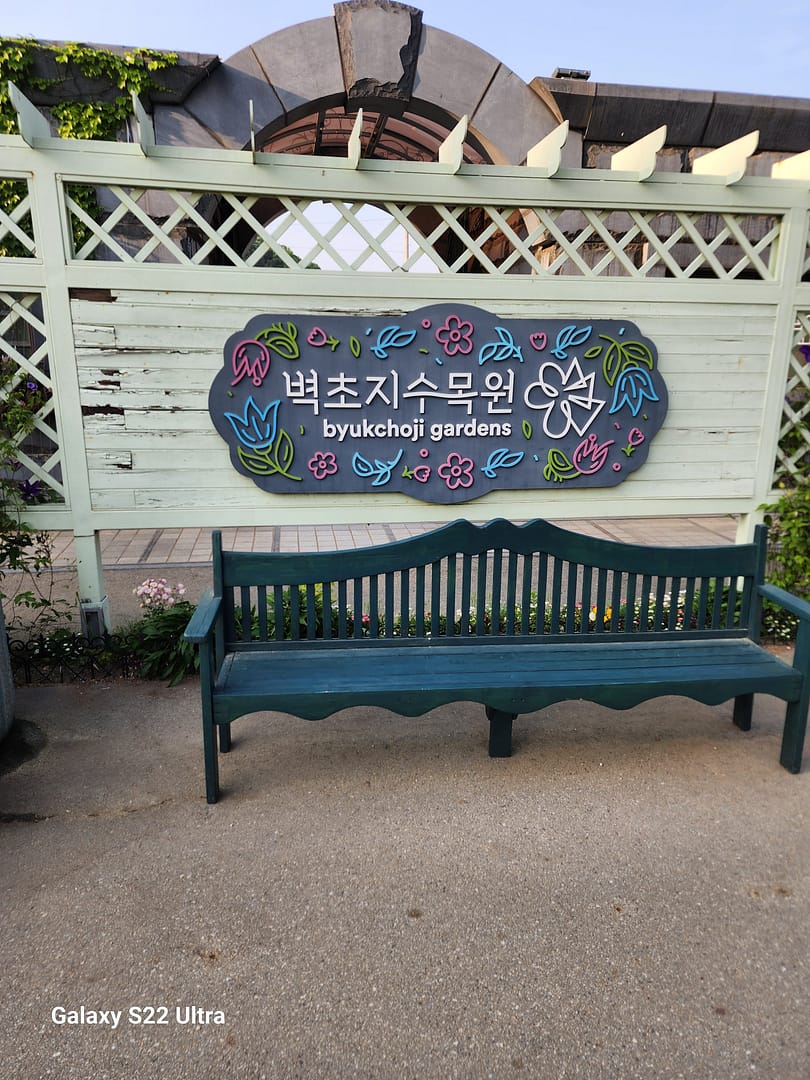
Byukchoji garden is a wonderful, beautiful botanical garden located in Paju County north of Seoul and not too far from the DMZ. It spans over 130,000 square meters and has a mixture of Eastern and western themed gardens divided into six thematic areas – Sensational, Mythical, Mindful, Breathtaking, Adventurous, and Freedom. There is a decent coffee shop, bakery and restaurant on site. There is also a nice art gallery showing pictures of famous botanical gardens from around the world and photos of the gardens taken by visitors.
There is also a garden shop with flowers and plants for sale. At the entrance gate, be sure to pick up the useful bilingual (Korean and English) guide map. It takes about an hour to walk around and truly appreciate the gardens. There is a very nice lotus pound in the center–the lotus flowers are in bloom in mid to late summer. The park is especially pretty in the Spring and Fall season.
Transportation options
To visit Byukchoji Garden from Seoul, you have several transportation options:
Note: to get there from Camp Humphreys take the GTX train from Pyeongtaek station, get off at Yongsan Station, got to Seoul station, then either take the subway or bus. The total trip should take about two hours. The park entry closes at 6 pm. The cost is quite modest, about 9,000 won (US$ 7) per person.
To get to First Garden using public transportation, you can follow these steps:
From Camp Humphreys take the GTX line from Pyeongtaek station to Yongsan Station, then take the subway to Seoul station, take the Airport Express train one stop to Bangkok station then the Gyeongi Jungang subway and get off at Unjeong station and take either the bus or taxi. Total travel time is about two hours. The park is open until 9 pm seven days a week and has several restaurant options on site.
Subway: Take the Gyeongi Jungang subway line and get off at Unjeong Station.
Alternatively, taking a taxi from Unjeong Station to First Garden is also a convenient option, especially if you’re traveling in a group of 3-4 people. The taxi fare is approximately 10,000 won1.
The cost is also 9,000 won or US$7).
For more information, see the following:
The Paju Byukchoji Gardens, also known as The Botanical Garden BCJ, is one of the famous breathtaking tourist attractions in South Korea, which was founded in 1965. This garden is located in the village of Changman-ri in Paju’s Gwangtan Township. The BCJ Gardens is spread over a vast 130,000 square meters with the polyphony of Eastern Gardens and Western Gardens as its main theme. This is also one of the K-Dreamland staples.
Apart from that, the Garden is sorted into 6 amazing themes: Sensational, Mythical, Mindful, Breathtaking, Adventurous, and Freedom. As the name suggests, each themed portion of the Garden gives you a blissful experience.
Sensational Tour
The Sensational part of the garden greets you first as soon as you enter the BCJ Botanical Garden. This part of the garden has the majestic Queen’s Garden, which is surrounded by Wildflowers, potted herbs, and shrubs that look dramatically beautiful. The pine tree-lined grove is also a beautiful display to savor your eyes.
Mythical Tour
As you go through the tree-lined lane, you will find the Mythical area that is enclosed in Marley Castle’s gilded gates of Paju Byukchoji Gardens. This area covers some of the ancient sculpture gardens of Greece and Italy. Also, you can find a few sculptures that are done in honor of the Greek God Apollo and Italian artist Michaelangelo.
Mindful Tour
Then comes the Mindful-themed area, which is mostly covered by green natural forested paths, you will also find a nicely constructed wooden bridge over a pond which is one of the attractions of this area. The most captivating thing is the Waterfall in this area, which will comfort your eyes and release the tension from your body with its enchanting presence.
Breathtaking Tour
Right after the Waterfall comes to the Breathtaking area, and as the name suggests, it is truly a breathtaking sight. The wooden walkway on the Byukchoji Pond is just an amazing scene and bridge to walk upon, with many flowers in the pond. Needless to say, this is the pinnacle of BCJ Gardens.
Adventurous Tour
The Adventurous area is quite an adventure for kids, as it mainly consists of a birch forest playground and other things which attract kids to play in; other than that, there isn’t much to explore here.
Freedom Tour
Moving on to the final themed area Freedom. This part of the garden is filled with flower-covered arches, grassy fields, and a road completely dedicated to the harmonious reunification of North and South Korea.
European and Asian-style gardens are the main attraction that brings people from various parts to have a look and enjoy the moment. The main highlight of these gardens is that it is good for kids and also for the people around the place to spend a good day with their loved ones. They also provide Wheelchair accessibility at the entrance for the disabled, which is a plus point.
Timings and Entry Fee
The Paju Byukchoji Gardens is open every day from 9 am-7 pm. To enjoy this beautiful garden at a slow pace, you need at least 3hrs, so make sure you are on time. And the tourists who arrive after 6 pm are basically out of luck as the ticket sales close at 6 pm. The adult ticket is 9.500 KRW.
European and Asian-style gardens are the main attraction that brings people from various parts to have a look and enjoy the moment. The main highlight of these gardens is that it is good for kids and also for the people around the place to spend a good day with their loved ones. They also provide Wheelchair accessibility at the entrance for the disabled, which is a plus point.
Timings and Entry Fee
The Paju Byukchoji Gardens is open every day from 9 am-7 pm. To enjoy this beautiful garden at a slow pace, you need at least 3hrs, so make sure you are on time. And the tourists who arrive after 6 pm are basically out of luck as the ticket sales close at 6 pm. The adult ticket is 9.500 KRW.
I have tried white water rafting a couple of times in my life. Once or twice in the Boy Scouts, once in West Virginia during foreign service training, and twice now along the Rogue River in southern Oregon. I have also gone tubing along the Natches and Yakima rivers as a child and tried canoeing, and rowing while I was in the Boy Scouts.
rogue river 2
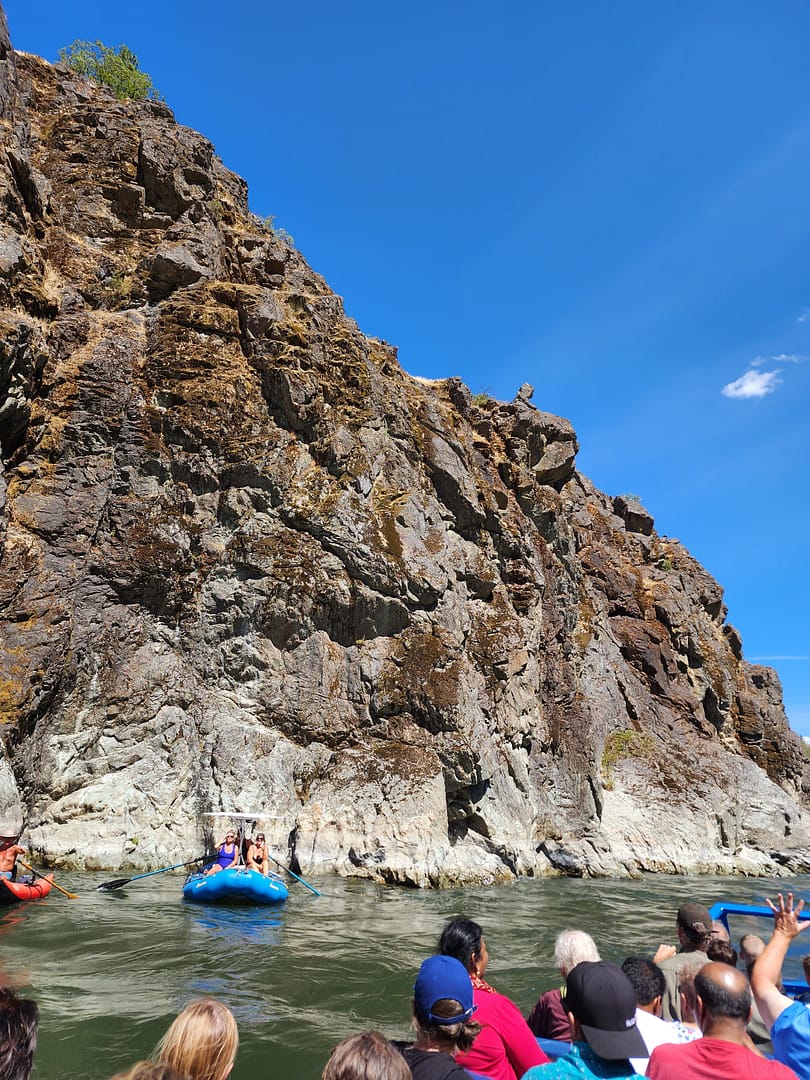
Among these various boating escapades, the Rogue River experience was the best. There are several jet boat/white water rafting outfitters. The best is the Hellgate Jetboat excursions company based out of Grants Pass.
Grants Pass is a cute river town about ninety minutes north of the Oregon/California border, (one hour from Ashland, Medford, or Jacksonville) perhaps three hours from Portland, six hours from Seattle, and perhaps 10 hours from SF. Grants Pass has a lot of wineries nearby and some decent craft beer breweries in town and one artisanal whiskey maker, Sundance Disterly located next to the Hellgate company offices.
rogue 3
There are four or five different routes you can take. We did the two-hour excursion which takes you down the Hellgate Canyon hence the name of the outfitters. There is also a brunch and dinner option and a four-day excursion as well.
rogue 4We found the price was quite reasonable 35$ per adult with the military/senior discount figured in, and a suggested gratuity to the boat pilot of $5.00 per member of your group, so we paid $20 for the five of us.
The Hellgate story, As one of the United States’ first jet boat companies, Hellgate Jet boat Excursions has run adventures through the wild and scenic Rogue River for over half a century – all while actively working with our local Parks Department. to enhance the …
Early Hudson’s Bay Company hunters and trappers, following the Siskiyou Trail, passed through the site beginning in the 1820s. In the late 1840s, settlers (mostly American) following the Applegate Trail began traveling through the area on their way to the Willamette Valley. The city states[9] that the name was selected to honor General Ulysses S. Grant‘s success at Vicksburg. The Grants Pass post office was established on March 22, 1865.[10] The city of Grants Pass was incorporated in 1887.[11]
Grants Pass, along with Medford and Ashland was an unofficial “sundown town“, which actively warned Black and other non-white people to leave town before sunset or face violence and harassment. Although there was no documented law of the racist policy, it was enforced locally via residents and signage.[13][14]
Geography
Grants Pass is located in the Rogue Valley; the Rogue River runs through the city. U.S. Route 199 passes through the city and joins Interstate 5. The city has a total area of 11.03 square miles (28.6 km2), of which 10.87 square miles (28.2 km2) is land and 0.16 square miles (0.41 km2) is water.[15]
These are my reflections on Oregon. I have been to Oregon many times over the years. My father was a college professor at SF State, and we spent our summers at the family cabin near Mt. Ranier and winters too. I quit going to the cabin with my family when I was in college. We kept the cabin in the family until my mother sold it after my father passed away in 1985. Uncle-in-law managed the family’s fruit farm near Yakima until he died in the early nineties.
On the way to and from Yakima, we frequently stayed in Medford. Later in 1990, I bought a property in Medford, two duplexes, and a house. We still have the duplexes which we renovated in 2017, We sold the house at the market peak in 2007 My brother was going to move to Oregon and manage our properties for us but his plans fell through so we were stuck with the properties which provided good income once we paid off the mortgages back in 1996 or so.
The plan was to spend our summers in Oregon with side trips to Northern California, Portland, Seattle, and Las Vegas.
COVID put a stop to that and we finally got back after three years. We are back on our summer plan. Unfortunately, our tenant trashed our furnished apartment, so we had to change our original five-week road trip to two weeks – Oregon Coast, Portland, Seattle, Yakima, and Bend including a side trip to Crater Lake, and then a trip down Highway one to the Bay Area and stay in the Bay Area for about a week – with an optional trip to Las Vegas, Arizona, and Utah provided the heat is less than 105 every day. Right now, with temperatures over 120, it is simply too dangerous to drive.
Ashland
Ashland is a nice college town and the home of the Oregon Shakespeare Festival, one of the oldest Shakespeare festivals in the Western United States. We usually try to take in a show when we are in the area. The University has an award-winning English literature department due to its long-standing connection to the festival. There are lots of trendy restaurants and bars in the city. During the winter it is a base for people going to Mt. Ashland for skiing.
The city is the home of Southern Oregon University (SOU) and the Oregon Shakespeare Festival (OSF). These are important to Ashland’s economy, which also depends on restaurants, galleries, and retail stores that cater to tourists. Lithia Park along Ashland Creek, historic buildings, and a paved intercity bike trail provide additional visitor attractions.
Ashland, originally called “Ashland Mills”, was named after Ashland County, Ohio, the original home of founder Abel Helman, and secondarily for Ashland, Kentucky, where other founders had family connections. Ashland has a council-manager government assisted by citizen committees. Historically, its liberal politics have differed, often sharply, from much of the rest of southwest Oregon.
Oregon Shakespeare Festival 75th anniversary banner
The Oregon Shakespeare Festival has grown from a summer outdoor series in the 1930s to a season that stretches from February to October, incorporating Shakespearean and non-Shakespearean plays at three theaters.[42] The OSF has become the largest regional repertory theater in the United States.[14]
The Oregon Cabaret Theater features musicals and comedies throughout the year.[43] Opened in 1986, the dinner theater occupies a former First Baptist Church built in Mission Revival style.[44] The Ashland Independent Film Festival, which shows international and domestic films of almost every genre, takes place each April in the Varsity Theatre downtown. About 90 films are shown during the five days of the festival.[45] In 2009, Ashland was the setting for the film adaptation of Gaman’s Coraline.[46]
The Oregon Center for the Arts at Southern Oregon University focuses on academic programs including creative arts (art, emerging media, and creative writing), music, and theater. Affiliated with the center is the Schneider Museum of Art, which has rotation exhibitions of works featuring professional contemporary artists. Also affiliated with the center are chamber music concerts, a Shakespeare institute, a piano series, and other art-related events.[47]
The annual Ashland New Plays Festival (ANPF) is a nonprofit organization that encourages playwrights to develop new work through public readings. Each year, the ANPF holds an international competition that winnows hundreds of submissions to four plays that are read to live audiences by professional actors during a five-day festival in October
Ashland Co-Op is a great natural foods store in Ashland. They used to pre-covid have a great make-your-own sandwich bar. My favorite was their loaded BLT.
Sam Adams, favorite sandwich
Was the make it your own sandwich
Served at the Ashland, Oregon, Co-Op
A modified BLT sandwich on Gluten free bread
Cheese, roast beef or pastrami, bacon
Sprouts, lettuce, tomatoes, dill pickles, peppers
Mayo, mustard, ketchup
Just heaven in every delicious bite
Lithia Park
Lithia Park in Ashland is a great park that follows Lithia Creek. It was designed by the NCY and Golden Gate Park designer Olmstead.
Lithia Springs
Lithia Springs is a small hot springs resort just north of Ashland. It has been operating as a spa since the 1880’s.
Within the hub of downtown sits Lithia Park, Ashland’s crown jewel. Lithia is a 100-acre vista of emerald lawns, pickleball courts, a sand-pit volleyball court, the Swim Reservoir at the …
Lithia Springs Resort in Ashland, Oregon. Low Online Rates – Book Today! Lithia Springs Resort in Ashland, Oregon. 2165 W Jackson Rd. Book Now.
Astoria
Astoria is a town at the mouth of the Colombia River about an hour from Portland. I went Salmon Fishing there with my dad when I was 16. It has a nice Lewis and Clark museum as this was the farthest extent of their legendary trip in the 1810s.
Astoria is a port city and the seat of Clatsop County, Oregon, United States. Founded in 1811, Astoria is the oldest city in the state and was the first permanent American settlement west of the Rocky Mountains.[6] The county is the northwest corner of Oregon, and Astoria is located on the south shore of the Columbia River, where the river flows into the Pacific Ocean. The city is named for John Jacob Astor, an investor and entrepreneur from New York City, whose American Fur Company founded Fort Astoria at the site and established a monopoly in the fur trade in the early 19th century. Astoria was incorporated by the Oregon Legislative Assembly on October 20, 1856.[1]
Bend is a hip town about an hour southeast of Portland on the edge of the Oregon high mountain desert, it is the mecca of artisanal spirits, beer, and Kombucha.
There is a good museum called the Oregon High Desert Museum which is worth a visit. There is also an Oregon Cascade scenic bypass, a 66-mile drive through the Cascades that I am looking forward to driving.
Bend is a city in and the county seat of Deschutes County, Oregon, United States. It is the principal city of the Bend Metropolitan Statistical Area. Bend is Central Oregon’s largest city, with a population of 99,178 at the time of the 2020 U.S. Census, up from 76,693 at the time of the 2010 U.S. Census, and 52,029 at the … See more
Here the Coos River enters Coos Bay on the Pacific Ocean. The city borders the city of North Bend, and together they are often referred to as one entity called either Coos Bay-North Bend or Oregon’s Bay Area.[7] Coos Bay’s population as of the 2020 census was 15,985 residents, making it the most populous city on the Oregon Coast. Oregon’s Bay Area is estimated to be home to 32,308 (Coos Bay Census County Division).[8]
Crater Lake National Park
i have been to Crater Lake at least ten times in my life. It is always impressive. We tried to go to Crater Lake, but our car had other ideas. Fortunately, a good Samaritan came along and helped out. We went the next day. And a good day touring the park. We stopped off at the Oregon Natural Bridge just before entering the park. That was very impressive.
Write a Naani poem. A Naani consists of 4 lines, and the total lines consist of 20 to 25 syllables.
Klamath Falls, Oregon
Klamath Falls (/ˈklæməθ/KLAM-əth) is a city in, and the county seat of, Klamath County, Oregon, United States. The city was originally called Linkville when George Nurse founded the town in 1867. It was named after the Link River, on whose falls the city was sited. The name was changed to Klamath Falls in 1893.[5] The population was 21,813 at the 2020 census. The city is on the southeastern shore of the Upper Klamath Lake located about 246 miles (396 km) northwest of Reno, Nevada, and approximately 17 miles (27 km) north of the California–Oregon border.
Logging was Klamath Falls’s first major industry.
We drove back through Klamath Falls, which is a dying city, not that prosperous looking. There is an airbase there as well as the Oregon Institute of Technology but overall, the city seems to be depressed economically speaking. There are two dams on the Klamath river which are scheduled to be removed and the whole river re-wildered next year or so. There is a small downtown business district that has seen better days.
Central Point
Central Point is a small community north of Medford near the airport and COSTCO. There is an industrial zone on the west side of the city that abuts the west Medford industrial zone. I went there frequently when we were doing the epic remodeling of our four Medford units in 2016; We go there almost every day to go to COSTCO but have not explored the rest of the city.
Table rock mountains are two Messa mountains north of Medford that are great places to hike. But during the summer it is best to go in the morning as it often gets about 100 degrees in the late afternoon.
Upper Table Rock and Lower Table Rock are two prominent volcanic plateaus located just north of the Rogue River in Jackson County, Oregon, U.S. Created by an andesitic lava flow approximately seven million years ago and shaped by erosion, they now stand about 800 feet (240 m) above the surrounding Rogue … See more
Starting approximately 40 million years ago in the middle Eocene, a braided river system called the “Ancestral Rogue River” flowed through the… See more
Agate Desert Park
Another great little park north of Medford, famous for natural agates.
Eagle Point is a small-town northeast of Medford. It is on the Rogue River and is a popular staging area for river rafting trips. There are several award-winning golf courses there.
It is also settling for some reason for most of my horror stories where I construct an eldritch Lovecraftian haunted mansion that Sam Adams of the Cosmos Institute inherits.
Eugene in the University of Oregon campus town. It reminds me of Berkeley and Boulder -both college towns. It has a good co-op that had great sandwiches back in the day.
Roseburg is another little town on the rouge river. There are lots of wineries nearby. But what it is known for is Oregon’s wildlife safari which is worth a visit.
It is also the northernmost extension of the Northern California climate zone and the southernmost extension of the Pacific Northwest climate zone. Once you go north you enter into the Pacific Northwest climate zone.
Roseburg is a city in the U.S. state of Oregon. It is in the Umpqua River Valley in southern Oregon and is the county seat and most populous city of Douglas County. Founded in 1851, the population was 23,683 at the 2020 census, making it the principal city of the Roseburg, Oregon Micropolitan Statistical … See more
Jacksonville is a historical 19th-century Gold Rush town. A lot of people don’t know that Oregon had a gold rush and silver rush as well – just not as well known. And there are working wines to this day. The town reminds me of Old Town Alexandria and old towns across the country, including downtown Medford, Bend, and Old Town Sacramento.
It is a popular retirement community. Ten miles to Medford, and Ashland.
Lots of nice restaurants and classic bed and breakfast country inns, and easy access to wineries.
The Brit festival has an amazing lineup for a minor out-of-the-way music festival. They attract a lot of acts who add on a night at the Brit Festival which is becoming a big thing to their Portland, Eugene of Sacramento bookings.
We just missed Diana Ross
We saw Big Toad and the Monsters and Blues Travelers. Both were pretty good. Big Todd was a bit more mainstream rock, blues travelers remind me of The Grateful Dead, Phish, and Rush, with similar style and fanatical fan base. The lead singer is a great blues harmonica player.
Phoenix
Phonex Oregon is a suburb of Medford just south of the city. It has Home Depot and a few other big box stores and a few wineries and truck stop and RV parks. It was heavily damaged in the 2020 fire.
The area was settled in about 1850 by brothers Hiram and Samuel Colver. Samuel Colver laid out the town in 1854. Early residents included Milton Lindley, who operated a sawmill that provided timbers in 1855 for a blockhouse as well as a flouring mill owned by Sylvester M. Wait. For a time, the settlement was known locally as Gasburg after a talkative employee in the kitchen serving the mill hands. Wait, who was an agent for the Phoenix Insurance Company of Hartford, Connecticut, assigned the official name, Phoenix, to the community and, in 1857, to its post office. Waitsburg, Washington, was later named after Wait.[6]
2020 fire
On September 8, 2020, much of Phoenix, along with neighboring Talent and parts of Medford and Ashland, were destroyed by the Almeda Drive Fire.[7][8][9][10] On September 11, 2020, authorities said they were preparing for a mass fatality incident.[11] On September 11, it was reported that 600 homes and 100 commercial buildings have been destroyed by the Almeda Drive Fire,[12] but on September 18, that number was updated to 2,800.[13] Officials stated that the Almeda Drive Fire was human-caused.[12] On September 11, a man was arrested for arson, for allegedly starting a fire that destroyed multiple homes in Phoenix and merged with the Almeda Drive Fire.[14] A separate criminal investigation into the origin point of the Almeda Drive Fire in Ashland is ongoing.[14]
Portland
The biggest city in Oregon and a very hip and trendy town. Center of Oregon’s Asian, African-American, Hispanic, and LGBTQ communities. Because Oregon does not have a sale tax and Washington does not have an income tax, many savvy retirees live in Vancouver, Washington just across the river from Portland, and do the bulk of their shopping there. Portland is one of the few cities that still has a vibrant shopping center near downtown. It also has the world’s largest bookstore – which I will visit on my next trip, several innovative universities including Lewis and Clark and Reed, as well as Portland State and Oregon’s sole medical university the Oregon State Medical University which has dental, both oriental medicine, western medicine, Physical therapy and nursing schools. 80 percent of the State lives within the metro area, which has the only real mass transit in Oregon. It also has one of the best urban park systems in the world, great local beer and Kombucha breweries and hundreds of nearby wineries, and of course lots of cannabis shops everywhere. It is about an hour’s drive to Bend and an hour’s drive to the coast, and four to five hours to Medford.
Named after Portland, Maine,[11] which is itself named after the English Isle of Portland, the Oregon settlement began to be populated in the 1840s, near the end of the Oregon Trail. Its water access provided convenient transportation of goods, and the timber industry was a major force in the city’s early economy. At the turn of the 20th century, the city had a reputation as one of the most dangerous port cities in the world, a hub for organized crime and racketeering. After the city’s economy experienced an industrial boom during World War II, its hard-edged reputation began to dissipate. Beginning in the 1960s,[12] Portland became noted for its growing liberal and progressive political values, earning it a reputation as a bastion of counterculture.[13]
The city operates with a commission-based government, guided by a mayor and four commissioners, as well as Metro, the only directly elected metropolitan planning organization in the United States.[14][15] Its climate is marked by warm, dry summers and cool, rainy winters. This climate is ideal for growing roses, and Portland has been called the “City of Roses” for over a century.[16]
P. Talent, an East Tennessee native who settled in Oregon in the 1870s, platted the city in the 1880s. He wanted to name it Wagner but was overruled by postal officials, who preferred Talent, dropping one of the L’s. The post office opened at this location in 1883. Earlier names for the settlement were Eden District and Wagner Creek.[5]
On September 8, 2020, roughly a third of Talent, along with neighboring Phoenix and parts of Medford and Ashland, were destroyed by the Almeda Drive Fire.[6][7][8][9] On September 11, 2020, authorities said they were preparing for a mass fatality incident.[10] As of September 11, 600 homes and 100 commercial buildings have been destroyed by the Almeda Drive Fire,[11] but on September 18, that number was updated to 2,800.[12] Officials stated that the Almeda Drive Fire was human-caused.[11] On September 11, a man was arrested for arson, for allegedly starting a fire that destroyed multiple homes in Phoenix and merged with the Almeda Drive Fire.[13] A separate criminal investigation into the origin point of the Almeda Drive Fire in Ashland is ongoing.[13]
White City
White City is a small but upcoming city. It is based on a World War 11 Army camp that closed down in the 50s. There is a big regional Veterans hospital center and because of that has drawn a lot of military retirees to the valley.
There is a rumor that the city was called White City and was supposed to be a whites-only city. It was the center of KKK activity between 1880 and 1940. In any event it has the largest minority population in the Rogue Valley due to the relatively inexpensive rents.
Oregon is mostly white about 80 percent but there are a lot of Hispanics and Asians in Portland a thriving African American community of 80 percent lives in the Portland Willamette Valley down to Eugune and Salem the State Capitol.
Indian Casinos
There are numerous Indian casinos in Washington, Oregon, and Northern California, and over the years I have lost money in many of them. This summer we will visit at least two. An Indian Casino is planned for Medford, opening perhaps in 2025. The nearest casinos to Medford are about an hour or two northwest and southwest of the city along the coast.
Indian History
The Indian tribes of Oregon and California were almost wiped out in the Indian wars of the 19th century. Most of the tribes were forced to move to Idaho or Oklahoma. The remaining tribes struggled with getting Federal and State recognition, benefits, etc. Almost all of them have been recognized by now. Many of the tribes are teaching their language and culture and tribal communities have come back from near death. Many of them have become wealthy due to casinos and the decisions by most tribes of giving every tribal member a monthly stipend and full scholarships for college and tech institutions. Many tribal members live off their stipends, which depending upon the tribe can be quite generous as they usually tax the casinos about 10 percent of their income stream, returning it all to the benefit of the tribes, and investing a lot of it as well…
Southern Oregon has emerged as a major winery region with over 125 between Roseburg and Ashland. Most are in the Applegate Valley west of 1-5 and west of Jacksonville and Medford. Some are nearer Roseburg-Grants Pass. There are a number in a town near Ashland, Jacksonville, Medford, Phoenix, and Talent. Southern Oregon is also a craft beer town and an kombucha town. and there are lots of farmers markets and organic groceries in town including several 24/7 groceries. There are cannabis shops everywhere now.
Owned by friends of our friends. They have a good menu as well as wine tasting and they often have live music. Three swans live on the lake. And a goose who was raised with the swans and thinks he is a swan. The winery also has cottages for rent.
Oregon Poems
Wagontire Oregon
1973
In 1973, I went on a road trip With my father
We left Berkeley to go to Yakima Where my father had a summer cabin
He was a college professor And had July and August off
And we spent the summers Every summer from 1968 to 1978 Our whole dysfunctional family
Our annual road trip to hell and back
As we did not get along at all
We decided to drive through Eastern Oregon
Just my father and me Just for the hell of it
The rest of the family was already there
in Washington waiting for us
My father and I shared a travel lust One of the few things we shared
This was one of our best trips We got along
Which was unusual Normally our relationship
Was fraught As we were so different
We left Klamath Falls A real nothing burg in those days
And headed east along Highway 395 As we entered the desert of eastern Oregon
We entered a different world High mountain desert
Almost no one on the road
nothing on the radio
but country music
and talk radio from KGO in SF
my father and I bonded Learned a lot about his past
What he liked And did not like
He hated country music But loved news radio
And we talked about politics And life in general
Just a father and son Enjoying a rare
Father-son Bonding moment
We usually did not get each other
I inherited too much Of my Mother’s wild Irish personality
To suit his dour Norwegian Germanic personality
Then we saw the sign
Wagontire Oregon
100 miles ahead Burma shave
We counted down the signs Miles after miles As we drove into the gathering dusk
along with the wagon tire countdown
were other signs last gas for x miles
and the Burma Shave roadside signs
with their classic cowboy poetry slogans
which in 1975 were already
becoming a thing of the past
had not seen those since this road trip
but on this road they still had them
every mile Burma Shave signs
We speculated that Wagontire
Must be a giant truck stop In the middle of nowhere
And we drove on
Counting down the signs
Listening to dreadful country music And endless political news
Wagontire 100 miles ahead
And we drove on Counting down the signs
Listening to dreadful country music And endless political news
Wagontire 100 miles ahead ……………………………………..
Burma Shave
Wagontire 1 Mile ahead Last Chance Gas, Food, lodging next gas 200 miles Welcome to Wagontire, Oregon
Population 2 ½ humans 10 dogs, 50,000 sheep
We pulled into the town
Nothing there but a gas station Motel and café
We decided to stop
Last gas for 200 miles According to the highway signs
In the morning We chatted with the owner
He was the sheriff, the fire chief The owner of the motel, gas station
The only business in town
And the only place open For two hundred miles
Until the next town
John Day I believe
I asked the Sherriff Say, who is the ½ human?
My idiot son!
And we left.
200 miles later We finally left Eastern Oregon
2016
In 2016 my wife and I drove through Eastern Oregon
As part of our epic cross-country trip
first time for her in Eastern Oregon Idaho, Montana Wyoming and many other states
last time I had visited was during my epic road trip with my father summer of 1973
10,000 miles 31 states
in three months to celebrate my retirement
from the US Foreign Service
On the way from Medford
to Yellowstone We drove along Highway 395
The signs for Wagontire were gone And we drove through the town
The motel was abandoned
Nothing there at all
And that sign was gone too
and the Burma shave signs long ago
faded into lost Americana
On the radio Nothing but country
Right-wing talk shows And Christian radio
I said I suppose the idiot son Never took over the business
And we speculated about Wagontire And all other nothing burgs
We drove through that summer
Heart of Trump’s America True fly-over country
Travels with my Father
Prose Poem Version
I grew up in Berkeley, California in the 60s and 70s, graduating from high school in 1974. My father was a local politician, college professor, and economist who served in DC under President Kennedy and Johnson. He and I did not get along that much, he was a distant aloof person hard to get to know, although I admired him and agreed with him on political issues for the most part. He was a moderate democrat which in Berkeley made him a conservative a curse word in the hyper-partisan Berkeley political scene.
One thing we did share was the love of travel and road trips. My father had inherited a summer cabin near Yakima, Washington, and from an early age to when I was 20, I spent most summers in the cabin with my father, my mother, my brothers, and my sister and visiting my uncle and his family. We were a dysfunctional family, always bickering and did not get along at all. Our road trips were fun actually despite our dysfunctional family dynamics.
We made several memorable trips over the years. We drove across the country twice from DC to California both times taking the northern route and stopping off in Yakima before returning to California. Along the way stopping off at Yellowstone, Grand Teton, etc. On one trip we went through Canada stopping off in Montréal, Toronto, Calgary, the Canadian Rockies, and Vancouver. We were 90 miles from the Alaskan border and my father decided we were not going to go to Alaska although we all begged him to do so. It took me almost 50 years before I finally got to Alaska, on a cruise, and I thought Meh was overrated and not for me. But still, I would have liked to have seen it when I was 11 years old.
One summer we drove just my father and me to Yakima and we drove through eastern Oregon just for the hell of it. We drove down a lonely country highway dubbed the loneliness highway in America that started in Nevada and goes through eastern Oregon and Eastern Washington the Nevada and Oregon sections are among the least densely populated areas in the United States. We started noticing signs for Wagon Tire, Oregon, with signs like 99 miles to Wagon Tire’s last services for 200 miles. 99 98 97 every milepost had two signs to Wagon tire and a Burma Shave sign. Burma Shave signs were a feature of the American West from 1920 to 1974 when the interstate highway system ended most roadside billboard advertisements, and the Burma Shave company ceased as an independent company the Burma Shave billboards were cowboy poetry at its best three to five short tanka like advertisements like
Drivers, You must remember this Driving fast Kills you fast
Burma Shave
When we got there, we found a run-down motel/gas station, cafe, and general store. We spent the night; we were the only customers as it was mid-week. We had noticed a sign-out front
“Welcome to Wagon tire
Population
30,000 sheep 20, 000 cows 10,000 pigs 5,000 chickens Thousands of bears, coyotes, deer, elk, and antelope two and one-half people
We asked the owner who had identified himself as the owner, fire chief, sheriff, and landlord what the sign, two and one-half people meant. He said,
“Oh me, my wife, and my idiot son, that’s the half person.”
In 2016 when I drove across the country with my wife to celebrate retiring from the foreign service we drove through Wagontire, which entire was now a ghost town with signs for sale. I wonder if anyone bought the store? And whether anyone lives there anymore. In any event, the idiot son never carried out the family business.
Travels with My Father Free verse
I grew up in Berkeley California My father was a local politician, college professor,
we did not get along that much he was a distant aloof person hard to get to know,
although I admired him and agreed with him on political issues
One thing we did share was the love of travel and road trips.
My father had a summer cabin near Yakima, Washington, and from an early age to when I was 20
I spent most summers in the cabin with my father, my mother, my brothers, and my sister and visiting my uncle and his family.
We were a dysfunctional family, always bickering and did not get along at all.
Our road trips were fun actually despite our dysfunctional family dynamics.
One summer My father and I drove through eastern Oregon just for the hell of it.
We drove down Highway 395 dubbed the loneliness highway in America
the Nevada and Oregon sections are among the least densely populated areas in the United States.
Outside of Klamath Falls As we entered Oregon High desert outback
We started noticing signs for Wagon Tire, Oregon, with signs like
99 miles to the Wagon tire last services for 200 miles. 99 98 97 every milepost had two signs a sign to Wagon tire and a Burma Shave sign.
Burma Shave signs were a feature of the American West from 1920 to 1974 when the interstate highway system ended most roadside billboard advertisements,
and the Burma Shave company ceased as an independent company
the Burma Shave billboards were cowboy poetry at its best
three to five short tanka like advertisements like
“Drivers, You must remember this Driving fast Kills you fast
Burma Shave”
When we got there we found a run-down motel/gas station, cafe, and general store.
We spent the night. we were the only customers as it was mid-week.
We had noticed a sign-out front
“Welcome to Wagon tire
Population
30,000 sheep 20, 000 cows 10,000 pigs 5,000 chickens Thousands of bears, coyotes, deer, elk, and antelope 2 and one-half people
We asked the owner who had identified himself? as the owner, fire chief, sheriff, and landlord
what is the sign, two and one-half people meant.
He said,
“Oh me, my wife, and my idiot son, that’s the half person.”
In 2016 when I drove across the country with my wife to celebrate retiring from the foreign service
we drove through Wagontire, which was now a ghost town with signs for sale.
I wonder if anyone bought the store? And whether anyone lives there anymore. In any event, the idiot son never carried out the family business.
Note: according to Wikipedia there are still a few people living in Wagon Tire. When we drove through in 2016 it sure looked like a Ghost town.
Wagontire is an unincorporated community in Harney County, Oregon, United States, along U.S. Route 395.
The community was named after the nearby Wagon Tire Mountain. From 1986 to at least 1997, Wagon Tire was home to just two people: William and Olgie Warner. The Warners’ property included a gas station, cafe, motel, general store, and r… Wikipedia · Text under CC-BY-SA license
BING AI seems to think that Wagontire might be a Ghost town but as far as I know, it is not yet listed on the state list of ghost towns.
Burma-Shave was an American brand of brushless shaving cream, famous for its advertising gimmick of posting humorous rhyming poems on small sequential highway roadside signs.
Burma-Shave was introduced in 1925 by the Burma-Vita company in Minneapolis owned by Clinton Odell. The company’s original product was a liniment made of ingredients described as having come “from the Malay Peninsula and Burma” (hence its name).[1] Sales were sparse, and the company sought to expand sales by introducing a product with wider appeal. the Burma Shave signs were written in cowboy poetry style three lines with Burma Shave as the fourth tag lines.
The signs were everywhere as the automobile era commenced. The last signs disappeared with the opening on the interstate highway system which banned outdoor billboards.
Seattle UW Blues
I have a long history
with the city of Seattle
dating back to my grandparents
who met there at UW
and my father who attended UW
and became a student leader
fighting to integrate the University
I first visited the city
when I was a young man
when we spend the summer
in Yakima
where we had a family home
decades later I visited the city
before I went to the Peace Corps
Before I went to the Peace Corps
then my wife and I lived there
for four years
while we were attending graduate school
at the University
and we fell under its seductive spell
living and Breathing Seattle
falling in love again
with the city
we left the city
and traveled the world
came back twice
once to take and pass the foreign service
oral exam
and once decades later
to take a cruise to Alaska
and found that the city
had changed in many ways
but the old Seattle remained
and I wanted to come back
and now my nephew lives there
adding another element to our family’s
ongoing Seattle family history
why I had been there before
I cannot say, but this much I do know
Seattle remains a part of me
and I a part of its history
Because of You, I’m In A Seattle Kind Of Mood
Because of you, I’m in a Seattle kind of mood
When I look out my window
And see the rain drops gently falling all around
And I feel that special Seattle kind of chill
In my bones
I think of you with a Seattle kind of mood
In the morning
Wherever I am in this crazy world if I see raindrops
Gently falling all around
Blue mood dissolves in the rain’s gentle mist
And I cry out with all my heart
Because of you
I am in a Seattle kind of mood
As I walk down the street
In distant foreign lands
Whether I am in Bangkok, Taipei, Tokyo, or Seoul
New York, Moscow, Rome, or San Francisco
Whether I am in India, China, Thailand, or Europe
Whenever I feel the rain’s gentle embrace
I get into that Seattle kind of mood
Seattle, a Seattle kind of mood
Fresh Salmon sizzling over a hickory smoke fire
Ivar’s clam chowder
And Red Hook Ale Pike Place market
Bums in Pioneer Square
And angry hippies preaching in Red Square
Yuppies drinking downtown
Geeks in Redmond
Making the world safe
For the Microsoft King
And the Mariners lose again
While the Huskies dream of Rose Bowls to come
And everywhere rain falls down
oh yeah
A Seatt1e kind of mood
Because of you
I get into that Seattle kind of mood
In the morning
As I fight the horrendous traffic
And breathe in deadly, killer air
I cough, cough, and remember
The green, green air of Seattle
And because of you,
I get into that Seattle kind of mood
Seattle, Seattle, kind of mood
The Huskies are number one in my heart
While the Mariners are always last in the nation
But what the hell
I’m in a Seattle kind of mood
I sit in the International District
Eating Dim Sum and drinking Ballad bitter
Watching the crowds dodge the ever-present raindrops
Seattle Kind of mood
As I wake up each day in crazy foreign lands
I hear the falling raindrops calling me home
Oh why did you leave me they cry out
In a Seattle sort of voice
Whispering in the gently falling rain
Seattle, Seattle kind of mood
And so my Dear
Wherever I roam in this wide planet of ours
From here to entreaty
And beyond
To the red plains of Mars
Whenever I hear the gentle patter of raindrops
I’ll get into that Seattle kind of mood
And dream of spending eternity with you
Watching the Seattle rain
Gently falling on our bumbershoots
As we walk down the beach hand in hand
Digging the gooey ducks while drinking Rainier Ale
All because of you
I’ll always be in the Seattle kind of mood
Medford Beckons
Once boring, humble Medford Oregon
and I have a long history
dating back to my childhood
when we would drive through there
often spending the night
back and forth to Yakima
from our family home in Berkeley
with my father during our summer vacations
Medford back in the day
was a sleepy little town
but the biggest town around
Ashland was more famous
but Medford grew on me
decades later my wife
Decades later my wife
and I drove through there
as we yo-yo up and down
the coast going from Seattle
where we were graduate students
and Berkeley to visit my family
we bought five pieces of property
in Medford in 1990
and were absentee landlords
for almost thirty years
coming back every few years
finally coming back in 2016
renovating the property
and now we are spending
our summers there
and preparing to become
Oregonian residents
Medford humble boring Medford
has become a trendy place
we have become part of Medford
and Medford is part of our hearts and soul
I am now an Oregonian
complete with a beard, no ties, and Western shirts
and my love affair with this humble city
will continue to grow
as my life winds down
in Medford city of my soul
Yakima Dessert Blues
Yakima, Washington
The ancestral home of my father’s family since 1920
Kept alive in my family’s history
Went back and forth like a Yo-Yo between Yakima
and the Bay area, mostly when I was a young man
In 2019, I visited the ghosts at my father’s grave
I did not realize how much Yakima had not changed
Ever since I was a child I thought that Yakima
Simply was too much of a desert outpost
Even then I knew why my father had led the town
Rarely did I think that my father would want to return
That he did over and over until the day he died
But for me, the Yakima of my childhood no longer remained
The lesson learned from all of this is Yakima remains in my heart
Until the day I die, I know that my family’s history in Yakima
Even now Yakima the desert town of my father will not be
Remains a foreign outpost and is not anymore for me
The Lighthouse of Whispers
35
Sam Adams, a paranormal researcher For the Cosmos Institute in Berkeley
Received reports Of a mysterious event In Brandon, Oregon Along the coast
A mysterious lighthouse Appeared one night Flashing red lights
Several locals went inside To investigate And came out different
Sam and his team Arrived and talked To everyone in town
But no one wanted To say what Was going on
They went to the lighthouse And found inside a gateway
With a sign
“Gateway to other worlds Enter at your own risk For madmen only.”
Saying,
“what the hey”
They entered the gateway Came back differently too.
Joining the rest of the town As members of the alien Hive mind.
Sam wrote back Nothing to see here Just an empty old lighthouse.
Soon other mysterious lighthouses Caves and buildings appeared Everywhere.
As the body snatchers Spread out Infecting the whole world.
Until there were only A few feral humans Hiding from the hive mind.
Check out the new prompt in “The Writer’s Cramp” – write the best story or poem in 24 hours or less and you will win 10,000 GPs AND a Merit Badge from me!!
” WINNER AND NEW PROMPT DUE SATURDAY MAY 21″ 16 hours 25 minutes 45 seconds Today’s prompt comes from Chatbot <insert spooky music here>
In a small coastal town, a mysterious lighthouse suddenly appears overnight. Its beacon shines with an otherworldly glow, captivating the locals. As people begin to investigate, they discover that the lighthouse holds a secret power. Write a story about this enchanted lighthouse.
The title of your static item must be: The Lighthouse of Whispers
Growing up
In Berkeley
My family seldom went out
For a meal together
My Father and Mother
Depression babies
Were extremely frugal
Not wanting
to waste money.
Once in a while
Though particularly
On our family road trips,
We would enjoy a meal together
One of our best meals ever
Was in an Italian restaurant
In the town of Medford, Oregon
On the way to Yakima, Washington
To go to our summer cabin
In the woods
A two-day road trip
From our family home
In Berkeley, California.
We ordered pasta pesto
Combo Pizza with all the meats Lemon ice cream
And the first time
I ever cappuccino
They ran out
Of everything
Late at night
In a small town.
An hour later
It all came together
And was one
Of our best times
Together.
A rare event
For a dysfunctional family
On the road.
Today’s winner is:
This Task (E)
Searching for that needle in a haystack.
#2295842 by Dave (929)
New Prompt: Use in your poem or story – BOLD or colorize for tomorrow’s judge:
An Italian restaurant
pasta pesto
lemon ice cream
cappuccino
Use food as your genre.
The Mystery of Sam Adams’s Death Writers’ Cramp
38
Sam Adams was a paranormal detective
For the Cosmos Institute in Berkeley, California
A real-life X files funded by black CIA money
Their mission explaining the unexplainable
Explaining the paranormal
Exposing hoaxes and fraudulent claims
Of the supernatural
One day his uncle died and left him
An old haunted house in Eagle Creek, Oregon
A small southern Oregon town
That Sam had grown up in.
He had not been back
In decades as he had grown up
In a dysfunctional family
Spoke to his siblings once a year
His father and mother have long gone.
In the house, they found the dead body
Of his distant eccentric uncle
Who left beside his body,
A letter, his will, and the infamous Neromicron
A book bound in scarlet leather.
The letter ended,
“Turn to page 666, and recite the chants
The truth will set you free.”
He started chanting
A spinning scarlet portal appeared
The grim reaper walked through.
Sam Adams asked him
“What happened to my uncle”
The grim reaper said
“He got what was coming to him
As all who summons us to do.
Be prepared to meet your maker
For judgment day is at hand”.
Sam spends the night
At the mansion where his uncle had left him
Sorting through his stuff.
The next morning a crater
Was found where the house had stood.
And his notes left behind
The scarlet leather bond Necromicron
Solved the mysteries of his uncle’s death
And his disappearance.
On Dec 1st, 1887, the first Sherlock Holmes story, “A Study in Scarlet”, appeared in print.
Write a poem or story in which:
* The narrator/POV character is a detective (or his assistant)
* A mystery is solved by the end of the piece
* One of the clues used to solve the mystery is scarlet
One of your genres must be MYSTERY
NB: The mystery can be ‘traditional’ (e.g. solving a murder), more light-hearted (who stole my socks?), or even more abstract (figuring out the cause of galaxies’ redshift).
Evil Spirit Haunts Oregon Town
In an old, haunted house
Along the Oregon coast
An evil spirit emerges
Unleashing a tidal wave
Of terror in the town
Ripping off
the torn curtains in the house
fallen mask fall off
as madness descends
on the unsuspecting town.
Please select “Ghost” as one of your genres.
A strange Place Writing com
Sam Adams was a paranormal researcher for the Cosmos Institute based in Berkeley, California. They considered themselves the real X files and worked for various governmental and other institutions. No story was too outrageous. They believed that the truth was out there-really out there. They mostly uncovered hoaxes, scams, and grifts, but once in a while, they uncovered things that could not be explained. These x files made great stories, and Sam and his buddies were dreaming of writing a movie based on their exploits.
One of the strangest events they ever encountered took place in the small Oregon town of Eagle Creek outside of Medford, Oregon, 20 miles north of the California border. Sam Adams had grown up there and had family in the area.
One day he heard that his Uncle had died and left him some property, an old, abandoned farmhouse rumored to be a haunted house where cultists conducted secret rites.
He went to Oregon with his two workmates, Maria Kim and Jason Lee, who were a couple, and his best friends. They got to town, met Sandra the realtor, got the key, and went to the house at sunset. The realtor told them,
“I’ve lived here all my life, but that is a strange place you inherited. Be careful.”
They got out and looked around
Sam said,
“This is a strange place.”
They decided to spend the night in town, but Sam wanted to stick around a bit longer so Maria and Jason went to find Oregon beer, wine and kombucha, and food, and they would dine al fresco in the park down the street.
When they got back shortly after sunset, they found the house and Sam was missing. There was just a big hole in the ground where the house had stood.
Prompt for 8/15 Write a story that includes the Line, “I’ve live here all my life.”
Prompt for 8/14
Write a story that includes the line: “This is a strange place.”
Jason Lee the Fashion Violator
37 lines
Jason Lee was a man
Born without the fashion gene
Born without a fashion clue
Did not understand fashion.
In his mind, the best male fashion was
the Northwest grunge look
Well-worn khaki, plaid Pendleton shirt
boots, and perhaps a bolo tie.
He often thought
That the irony of his life
Was that he married a fashionista.
Proving that opposites do indeed attract.
His wife, Maria Lee
Tried repeatedly to change his fashion sense,
Tried to make him look nice
Taught him basic color coordination.
He resisted but over time
He gradually become
A bit more fashioned aware
Even spent years wearing a suit and tie.
She threw out his horrid ties
Which made him angry
He loved his garish bugs bunny ties.
But when they retired
and they move to Oregon
from the halls of power in DC,
He told her that he would never wear a suit again,
Going back to the Oregon lumberjack look
Khaki or Jeans, boots or sneakers, plaid Pendleton shirt.
complete with a scraggly beard.
She merely smiled at him,
Finally resigned herself
to her fate as the wife of a man
who would always
be a walking fashion violation.
Favorite Cheese PSH
My favorite cheese
Has always been Tillamook
cheddar cheese
My father turned me
On to it
When I was a young lad
Once during our annual
Migration from Berkeley
To Yakima
During the summer vacation
Season
When we drove to the family cabin
And stayed almost two months
Just my father,
My mother
My two brothers
My sister
Our whole dysfunctional family
Forced to be together
For the summer
It was hell on earth
But the road trip
To and from
Was and adventure
One year we drove
Up the Oregon coat
And we stopped
At the Tillamook creamery
And did the tour
Learned how they made
Their famous cheese
And ice cream
Tillamook cheese
Is made in Tillamook, Oregon
A small town
Along the Oregon coast
The cheese is dark yellow
Comes in two flavors
Sharp and regular
I prefer the sharp.
It has a delightful aroma
And is among the most
Favorable of cheeses
I have ever eaten.
And it has an aftertaste
That lingers in your mouth
For several minutes
As you savor
The aroma, the taste
And the texture
Taking you to cheese
heaven
I was perhaps 13
At the time
And interested
In everything
Learned a lot
About cheese
That visit
But the most important thing
Was I learned
That was my favorite cheese
Tillamook. Cheese.
The end of the year
We drove to Bookings on the Oregon Coast
We had a pleasant drive through the mystic fog shrouded Redwoods.
The gathering gloom of the dark woods foretold my dismal mood
Slept soundly to the sound of the ocean.
The super moon light filled
the beach outside our window
with an eerie light all night long.
As we slept people walked the beach
Enjoying the full moon
And the unusually warm weather
Setting off fireworks at midnight
In the morning I went for a nice walk along the beach
and thought about the year that was.
As the waves pounded the shore
I was filled with calmness
Enjoying the morning calm
And the unusually warm weather
Thinking that the storm is coming
That perhaps we are in the end of our days
With the political storms threatening us all
Yet the ocean reminded me
This too will pass
And we will endure
Until the end of our time
On earth
The ocean waves soothed my soul
And I prepared to drive back through the mystic redwoods
Back to my home
And the peaceful ocean waves
Reminded me
the end of my life
Comes closer to my door
published in Former People
Oregon Demon Cat
evil cat
The demon cat
Lived in Medford Oregon
The demon cat was a big black cat
His eyes were filled with demonic energy
He stared at you
Looking into your very soul
Filled with anger, and hatred
For the entire human race
He seemed at times
To be not from this planet
Perhaps an alien species
Studying the human race
Or perhaps he came
Form hell itself
The demon cat loved to torment visitors
For some reason he hated the man’s daughter
The cat would stare at her from his perch
Down the hall from the old man
Then he would run at her
Screaming like an escaped banshee
Straight out of hell
She told her dad
Either the cat goes
Or I go
He said
See you later
The demon cat smiled
At the small victory
And she left the house
With the demon cat
Screeching good bye
I am a member of Earth First, based in Seattle. We decide that we will do one action per month to radically change the environment and generate publicity for our efforts and gain recruits.
After much discussion, we decide to liberate all the animals being used for testing at UW medical school and in other labs in the city and to free the animals in Zoo. We would take the animals out to the woods outside of town and let them run free.
We plan our attack with great care and we strike with military precision in the middle of the night one week and liberate 5,000 animals. We release the animals and film them on U Tube. The U-Tube goes viral.
The animals run free and soon establish themselves in the forests near Seattle. The Tigers and lions soon breed and become established eating deer and other animals. The monkeys move into the city and the City of Seattle soon becomes their home. The monkeys do very well and even survive the winter.
They soon become a tourist attraction. The zoo is closed down as they can’t afford to round up the animals who have all gone native. The UW Medical School denied that they were engaging in animal testing so we publish their secret research online.
It is a great victory for Earth First. Other animal liberation actions take place across the country.
Within five years monkey troops have become established throughout the US. Lions and Tigers have also flourished eating deer and helping to keep deer populations in check. There were isolated lion and tiger attacks on humans but for the most part, the lions and tigers stick to deer meat.
Other animals also flourished – Elephants take to the Central Valley and most of the African animals we had released were released into the Central Valley which became known as America’s Serengeti.
The wild animals become a huge tourist attraction.
Ft. Ashland
Novel
First Three Chapters
Chapter One Best Day of Sam’s Life Ends as Worst Day of His Life
Sam Adams was having the best day of his life, he had made love to Maria for the first time since he had met her a few weeks ago and felt he had met his soul mate. They stayed up until midnight when the world ended, and the worst years of their lives began.
Sam Adams was a tenured professor at Southern Oregon State University teaching English literature. He had been at the University for five years and had just gotten tenure. Sam was 35 years old. He had grown up in Berkeley, California, and gotten his BA in English literature at CAL.
Sam had gone on for a Ph.D. at Bowling Green University in Ohio where he did his Ph.D. thesis on “End of the World Fiction”. had divided the genre into five basic scenarios, “Nuclear War”, “Zombie Apocalypse,” “End of Power, Oil or other critical infrastructure”, “alien invasion” or other natural disasters – climate change, super volcanoes, new ice age, meteor collision, etc. His favorite though was “nuclear war” because he felt that was the most likely to occur, his least favorite was “zombie apocalypse” which he felt was too far-fetched. Climate change was also a good one to study because it was beginning to take shape in real life. The others were “black swan events, ” civilization-ending but unlikely to ever occur.
In these scenarios, 90 percent of humanity dies within three months as no one was prepared for the collapse of civilization. Only a few smaller communities would survive intact. Any town bigger than 30,000 would end up with most people dead, with a ruthless warlord in charge of the remaining people who would be virtual slaves. He had just finished writing Ft. Ashland which was his vision of how Ashland could survive the end of the world. The Police chief, the Mayor, and the President of the University loved the book. They were all part of Sam’s weekly poker party and had all agreed to be beta readers for his first novel, “Ft. Ashland.” The Police Chief appointed Sam to be chair of the citizen’s emergency action planning committee and had asked him to map out various scenarios for consideration by the town council at next month’s council meeting. The council would review the various plans and scenarios and adopt the official joint-city-University EAP. The country director for Emergency planning would be there as she was on the committee. They planned to adopt a similar countrywide plan based on the Ashland prototype. Sam had based his plans on both the official DHS-recommended state and local planning documents as well as his review of the Emergency planning literature as well as SF stories. He thought that many of the post-world war stories were quite relevant and he incorporated ideas from the best of the literature. Sam would reveal the various plans and then direct the first city-university joint emergency planning drill where they would walk through various scenarios. Little did Sam know he would have to carry out the drill in real life.
But that was fate Sam thought later that eventful night. Someone was looking out for him and the town he was sure. Sam did not believe in guardian angels. He had grown up in a secular family. His mother had grown up in a Southern Baptist fundamentalist church and had fled home from Arkansas in the dust bowl. She was part Irish, and part Cherokee and pure witch as Sam often thought as she was psychic and mad. But in a good way, although she later developed Alzheimer’s and spent the last few years of her life in an assisted living facility. His father had grown up in a stern Lutheran family in Yakima, Washington. He was of German, Scandinavian, and French background.
Sam was enjoying living in Ashland which he had visited as an undergraduate to see the Shakespeare plays. He had been hired by the English Department to modernize their curriculum which had been heavily focused on Elizabethan literature as many of the students and faculty were associated with the Festival in one manner or another and they had become well known as one of the best English Departments for that sort of literature. Sam and his colleague Jonathon Goodman, who was from Nigeria, had been told to develop classes on contemporary literature. Sam taught SF, Fantasy, Thriller, Mystery, and contemporary literary literature. He also taught the creative writing program.
Maria, his new finance, was also 35 years old. She had grown up in India and was from Goa, most people assumed she was Hispanic or Portuguese because of her name, Maria Francesca De Lopez, and her looks. Her father was the son of a Portuguese colonial administrator who married a local woman and stayed on after India took over Goa. They were due to arrive in town in a few weeks as Maria and Sam had just announced their marriage. Sam had to agree to convert to Catholicism and to have a church wedding followed by a honeymoon in Goa, his first trip to his fiancé’s native country. And Sam knew that she believed in Guardian angels. She had told him that on his first date when they had a passionate debate about religion. Sam had expressed his doubts and his reservations about Christianity, and she had defended her faith. At the end of the night, they reached an agreement. Sam would be welcome to attend Church or not. She would go every Sunday for mass. She would respect his atheistic heathen ways if he respected her Catholic ways. If they had a child, the child would be told that he can make up his mind whether to be a believer or not. They would raise their child in church but on their 18th birthday would make their case to their child. The child would then choose, and they would respect the child’s opinion on the matter.
Maria had moved to town last year to accept a position at the local hospital as director of Emergency services. She had just graduated from the University of Washington and had served in a hospital in Portland getting her residency completed so she knew that she wanted to be in Oregon. Her cousin ran the local Indian restaurant and had invited her to come down to Ashland. When she got there, she found that there was an opening as the ER director at the Asante Community Hospital, the biggest and best hospital in Ashland, and she took the position. Sam had gotten to know her through his work on the Emergency Planning Committee (EPC) which he co-chaired with Maria. Maria also loved his story, “Ft. Ashland” but thought that it was a bit too pessimistic.
That night they had gone to see a play at the Oregon Cabaret as the festival had just ended. It was a few weeks before Thanksgiving, just before Veterans Day. And next to the end of the hunting season. Although Ashland was a “blue city”, large parts of Oregon were “red states” especially up in Medford. And even in Ashland there were a lot of hunters, and some of the students disappeared to go hunting as well.
Maria had finally agreed to spend the night together with him and had accepted his proposal of marriage made at the Taj Indian Cuisine. The owner, Samuel Lopez Gomez, was a distant cousin of Maria. Maria had hinted that she thought that Sam was going to propose and wanted to surprise him with a traditional Goa dinner. The restaurant was known through the Indian community in Southern Oregon as the only place to go for traditional Goan food as all the other restaurants served the more common Moghul or North Indian fare and the Indian Kitchen in Medford served South Indian food as well as the stereotypical North Indian fare. The Taj served both Maharashtra, Gujarat, southern Indian style food and their specialty, Goan food – as well as the expected North Indian fare.
After dinner, Sam called Samuel over to the table and told him,
“I think it is only fitting that you serve as a witness since you are Maria’s cousin’s brother. And Sam dropped to his knees and said,
“Maria Francesca De Lopez Gomez, will you marry me, Samuel Joseph Adams?”
“ Of course.”
And they went to the Oregon Cabaret to see “She Loves Me”.
They walked home from the theater in the rain and snow (early for snow) to their cottage on B and First Street down the street from the Ashland Co-op and just a few blocks from the theaters.
Maria told Sam
“Let’s call it a night. Tomorrow let’s plan our life together. I think we both know we are the one for each other and let’s pledge to each other that we will always remember this night, and always remember the love that we feel right now and that we will always be there for each other. I think we both know we are the one for each other and let’s pledge to each other that we will always remember this night, and always remember the love that we feel right now and that we will always be there for each other until death does us apart. “
“Okale dokoli honey bun.”
“Wait. Are you going all Ned Flanders on me? I always thought of you as more of a Homer Simpson guy and I would be your Marge.”
“Whatever.”
“Nope. We cannot ever use the phrase “whatever or dismissive language. You as a professor of English should know that words matter.”
“Okay, no whatever. Can I respond?”
“Only if it is said lovingly.”
“Okay. I am asking you a second time, just to be sure you have not changed your mind. Will you, Maria Francesca Lopez De Gomez from Goa marry me, Samuel Jacob Adams, from the People’s Republic of Berkeley?”
“That’s more like it. But I already said yes
But, let’s have some champagne and watch let’s watch the news for a bit. I want to see what happened at the Peace talks. I have a bad feeling about this.”
Chapter Two CNN Broadcasts the End of the World
CNN and the global media live-streamed the end of the world. The world as we knew it ended in a fiery nuclear war that engulfed the entire world killing half the population of the world within the first month of the attacks, and within one year more than 75 percent of mankind was killed. The remainder of humanity hunkered down in small heavily fortified towns scattered in the more rural areas of the world as the major metropolitan cities were all wastelands. The new dark ages began that morning.
The whole world watched in horror as the events spun out of control. It started a few weeks before Thanksgiving, early November. The North Koreans had kept up the pressure on the President as they saw he was becoming more and more unstable with the political scandals threatening to overwhelm his administration.
The attack by the North happened without warning early in November. The North Koreans had announced that they would join five-party talks in Beijing in early November. The U. S. Secretary of State and the Foreign Ministers of North Korea, China, Russia, and Japan were all in attendance. The President of China chaired the meeting. As the meeting began, the North Korean foreign minister rose to make his opening statement. He announced that the North Koreans had made a grave decision. He announced that the high command had just approved a nuclear attack on the U.S.
CNN Announcer: “This is Jake Smith, CNN Beijing Bureau Chief with Breaking news from the last chance peace conference. The North Korean Foreign minister has just announced during the opening session of the five-party last chance for peace talks in Beijing that they had launched a nuclear attack against the U.S. targeting the mainland. Going to his remarks now.”
FM Lim Taewoo: “The dotard Trump and his hapless minions have brought this upon themselves. We have said we would be open to discussions to end the conflict peacefully because we do not desire this war. But dotard Trump and his senile henchmen have continued to provoke us by flying their bombers into our airspace. We told them that this was our final warning. But they did not listen to us. So, the war is on them. “
He turned to his South Korean counterpart,
“We have launched a great patriotic war of unification and our artillery are turning Seoul into a sea of fire even as we speak. And we have launched missiles against Japanese targets, and U.S. military facilities in both South Korea, Japan, and Guam as well as in the U.S., mainland. The South Korean government can stop the attacks by agreeing to a total surrender to the Korean People’s liberation army right now.”
The U.S., Japanese, and South Koreans demanded the right to respond.
“The U.S. condemns these cowardly attacks and you must know that you are your leadership have just committed national suicide. We will retaliate at once and know out your artillery and your offensive weapons. Then we will attack North Korean military assets and let there be no doubt if any North Korean missiles reach the U.S. we will destroy North Korea.”
The Secretary turned to the Chinese President and said, “Considering the North Korean actions we demand you join us, Japan, South Korea, and Russia in condemning this attack and that you dismiss the proceedings for the rest of the day and provide us and our colleagues access to secured communications, so we can all check in with our respective capitols to coordinate our responses.”
FM Park Changsu from South Korea spoke next. He said,
“The Republic of Korea will destroy you arrogant bastards and you will not survive the war. We will never surrender to you and will fight you until every North Korean soldier is killed. There is nothing more to be said.”
FM Harshiro Watanabe from Japan spoke last.
“It is unfortunate that it has come to this. But Japan too will never surrender and will fight to the last man, woman, and child to defend Japan. We are ordering bombers to begin bombing North Korean targets in conjunction with our American and South Korean allies. We and the South Korean and U.S. forces will not send ground forces into the north if the Chinese and Russians agree to do so and agree that once hostilities ceased we will reconvene and discuss forming a unified Korean government.”
The Russian FM spoke up,
“The Russian government also condemns the actions of the North Korean regime but also notes that President Trump bears some responsibility for his reckless comments and provocative actions. Nonetheless, we will assist in any way we can including sending armed forces into the North and we will coordinate with the US, Japanese, Chinese, and South Koreans regarding bombing targets. Might I suggest that we after consulting with our respective capitols reconvene to discuss immediate next steps?”
President Xi looked at the assembled diplomats and made his closing comments:
“Indeed, Secretary Moore, the PRC condemns the reckless actions of the North Korean government and asks that they pull back their attacks and cease all hostilities. We also ask that the U.S. not attack North Korea if the North Koreans withdraw their attacks. If the missiles reach the U.S., obviously the U.S. would have the right to respond but the PRC will not tolerate any incursion by ground troops by the U.S., Japan, or South Korea into the North Korean territory. If ground forces are needed to restore order, Russia and China will do in consultation with the South Koreans, the Japanese, and the United States. This concludes today’s formal meeting. We will resume a meeting with just the FMs and military leaders of South Korea, Japan, China, the U.S., and Russia regarding terms of engagement and coordinating air strikes. And we remind everyone that neither China nor Russia will tolerate coalition ground forces north of the DMZ.
We remain ready to resume peace talks if it proves useful. And FM Watanabe after hostilities cease and order had been restored in the North we will not only host a peace conference, we will also hold a war crimes tribunal. And of course, we will support the creation of a unified Korean state. In the meantime, please follow our aides who will escort you to secure communication channels. “
CNN Announcer: “We have breaking news. NORAD has just confirmed that the U.S. appears to be under cyber-attack. The Hoover Dam and Colombia river dams have all burst. All airports appear to have lost power. And traffic management systems across the country are failing. Our local affiliate in Las Vegas is showing the dam bursting.
CNN Las Vegas: Yes, Jim. As you can see from our helicopter coverage the dam has burst and a wall of water 500 feet high is flooding down the river heading towards Las Vegas and Phoenix. It is expected to hit in less than twenty minutes, and power is out all over Las Vegas. Thousands of people are trapped in high rises across the city and as you can see the entire city is black. There is a mandatory shelter-in-place drill = meaning if you can get out of town and into the nearby mountains do so, if not, go to the highest floors of the nearest high rise. The casinos are all operating on emergency power and have announced that they will be giving out free food and booze if they can and free rooms for anyone who needs shelter. Everyone is being directed to floors about 20 floors (the flood waters will hit the 15th floor). The hope is that the high rises will remain to stand, but no one knows for sure.
CNN HDQ: This is Jake Smith, with a breaking announcement. NORAD has announced that there are hundreds of incoming nuclear missiles coming from North Korea, China, and Russia. The Chinese and Russian government has just informed the US that rogue elements in their government are behind the attacks and are joining North Korea in the attack on the U.S. President Putin and President Li have condemned the attacks and are trying to recall as many of the missiles as they can. NORAD has confirmed that the North Koreans took out most of the electric grid in the West in a cyber-attack. And the New York Stock market is under a cyber-attack as well. FEMA estimates that half the country is without power or water and they believe it may be months before water and electricity can restore. We are breaking to Vice Preside Brown who is announcing to the nation.
“My fellow Americans. Today is perhaps the darkest day in recent history. The North Koreans have attacked the U.S. aided by the Russians and the Chinese. As many of you have long suspected, our president, President Johnson has been showing signs of Alzheimer’s, and therefore considering the crisis we are facing, we felt that he should step aside and let more experienced and steadier hands deal with the consequences of the attack. During this crisis, I ask that you keep Donald and his family in your prayers. His heart was in the right place, but it was clear that he would not be able to handle this crisis anymore. And so, under the provisions of the 25th amendment, he has been removed from power and I am now your President.
As your president, my first responsibility is to ensure your safety. To that end, we will keep broadcasting from this undisclosed location if we can. We have evoked the emergency broadcasting notification system, but cable news channels can and will continue broadcasting as long as they can. All other programming will be suspended during the duration of this crisis.
We urge you if you are in one of the 25 cities on the following list to hunker down and prepare for a nuclear attack which will commence in less than ten minutes. Do not look at the bomb bursts and stay underground if possible. Stay home or at your office. Once you receive the all-clear go home and take care of your loved ones, and your neighbors. Remember that we are all Americans and we will survive this.
We have authorized retaliatory strikes against the targets in North Korea, China, and Russia targeting where the missiles were launched, and we have targeted Pyongyang, North Korea. We are not targeting Moscow or Beijing now as we believe that rogue elements in their governments were behind the attacks. The Presidents of Russia and China have assured us that they will find the culprits and deal with them. And they are prepared to help in the recovery.
We have attempted to shoot down some of the incoming missiles and have succeeded in knocking down some of them. But we are prepared to take a direct hit. The cities that we believe are targeted include NYC, Boston, Philadelphia, Baltimore, DC, Atlanta, Miami, Chicago, Indianapolis, Denver, Kansas City, Dallas, Houston, San Antonio, Las Vegas, Phoenix, Los Angeles, San Diego, San Francisco, Sacramento, Portland, and Seattle. And most air force bases and army bases across the country are potential targets. We are concentrating our anti-missile defenses on protecting these cities, and DC. The entire cabinet and top leadership of the Senate and House are en route to this location which will serve as the central nexus of the recovery efforts. However, once the bombs have hit, the federal government will be short-staffed, so local towns will have to cope the best that they can.
We urge people to be calm, to share resources, and to fight to maintain law and order and to preserve our civilization. That is all. God bless America and keep us strong. We will overcome this with God’s help.
CNN announcer breaks in:
NORAD has just informed us that there are incoming nukes that are about to detonate causing an EMP blast that will knock out the remaining pow….
CNN goes dead as does the EMB system.
Chapter Three Watching the Planes Go Down
It was 1:30 am. Just as the power went off there was a blinding flash of light like the most intense lightning storm ever experienced and then moments later everything electric, – cars, computers, microwaves, blenders, and lights blew out with an intense blue spark and fires broke out all over town.
Thus, began the worst year of their life.
Sam immediately knew what needed to be done. He had just finished writing an SF story about the end of civilization after watching Jericho and realizing that story was way too optimistic. The reality was that an EMP could wipe out industrial civilization for over a thousand years. This was more like the Fall of Rome or the novel, “Dying of the Light”. Same knew because he had done his Ph.D. on post-nuclear war fiction and had just finished writing, Ft Ashland, and also just finished writing the EAP for the City of Ashland and the University.
Sam swore.
“God Damn the President, and Kim Jong-un. WW111 has just started and ended just as I predicted.
Within a week all law and order would break down and armed gangs would rule. Ashland being a compact small town with a liberal reputation, would be a prime target for the criminal elements largely based in Medford and White City, 15 miles up the road. To prevent that fate, Sam knew that they would have to dust off the EMP that he and Maria had just drafted based on his novel and his research. Fortunately, the major, the University President, and the Police Chief, his poker-playing buddies, had all read his novel and were big fans.
Sam turned to Maria,
“We had better go and see the Police Chief. Afterward, you need to get to the hospital. All the medicines in the refrigerators will go bad within days. Call Joe in the History department in the morning. He is a sort of expert on early modern civilizations. He may have some ideas as to how to jury rig an ice box system to keep the essential medicines cold enough. And then let’s get your cousin over so we can figure out how to preserve the frozen foods in the restaurants. “
And they walked out the door into the changed new post-nuclear world.
The first thing that Sam and Maria noticed as they stepped outside into the post-EMP world after the blast was how quiet and dark it was. All the lights had blown out, all the vehicles had stalled, and a few scattered fires had started, but the snow was putting them out. Some people were out on the street and Sam and Maria told their neighbors what they suspected had happened.
George and Samantha lived next door. George was with the festival as an actor, his wife worked in the front office. They had been here for five seasons and had re-up for a six-season. The actors stayed one to three seasons then move on. The Oregon Shakespeare Festival, like most professional theaters, rotated actors and tech staff every year to give fresh talent and fresh ideas. George was from England and his wife Samantha was from Barbados. They met working the cruise ship entertainment circuit which was also common in the theater world as those gigs paid well and gave well free room and board and cruising. What not to like thought Sam to himself.
“So, Sam, I know you’ve researched all this. What are you thinking happens next?”
“Well, come with me to meet Police Chief Chuck and Mayor Joe. If the Mayor is asleep, we will have to wake him up. Go to the theater. It might be difficult to perform in the dark! But what happens next is up to us. If we all pull together and drop everything else and concentrate on three core tasks, collecting food and setting up community kitchens, starting community gardens sprouts for now, hunting as well; and building a Fort around the town to keep out predators including humans, we might survive with most people alive as we are just small enough to be viable. Medford is already history although gangs might take over and enslave the population. Portland is too big to survive. SF Los Angeles. Sacramento, Oakland, San Jose, and San Diego are gone by now. According to the news just before the bombs fell those cities, and most major metro areas and military bases have been or will be nuked. The only ones near here are Portland and the Klamath Falls reserve air base. We might be okay as Oregon is just too insignificant a target compared to the target-rich California and Washington State.
The food will go bad in seven days. No new food will arrive, and the growing season is over, we won’t have fresh food except for sprouts and indoor lettuce until June. Looters will get most of the canned goods, but no one will cook without power unless they have a pre-1960 stove or wood stove. Gas stoves won’t work as the gas distribution systems and water systems also depend upon computer circuits which are all fried. There may run water for a while as the water systems may be okay but eventually, toilets will fail. I’d give that about six months sooner if we have a cold winter which we will due to nuclear winter.
In any urban area over 50,000 people will have 90 percent of the population starve to death, eaten by animals, including lions, tigers, and cheetahs, – they will escape soon from the wildlife parks, and zoos across the State, -cougars, wolves, coyotes, feral dogs, vultures, and eagles and bears. The dogs are going to go bad within a week and join up with coyotes and wolf packs. Cats are going to go feral but probably not attack humans. The animals are going to attack deer, cattle, and horses. Which means they are going off the same game that we need to hunt.
And cannibal gangs will soon form and prey upon survivors. Or people will die of falling out or die of disease or freeze to death. We can avoid that fate if we all pull together today. Join me in convincing the Mayor and police chief.”
“Sam, stop it. You are scaring me. Can’t be that bad.”
“George, it is going to be a lost worst up in Medford. By this time tomorrow armed gangs are going to take over the city, within a few days they will be coming out of the way. We had better be ready.”
“Sam seems to me that we can start by piling up old cars and buses and then building fencing and posts behind it.”
“George, I knew your past as a construction contractor would prove useful. The acting not so much. We must think that we are back in 1400 or perhaps 700 ads with the Fall of Rome. The dark ages have started.”
A crowd had formed about 20 people were milling around listening to Sam and George discuss the unfolding situation.
Just then there was a flash of blinding light to the East towards Klamath Falls where there was a reserve air base. Sam yelled at everyone inside my house now.
Everyone ran inside. Sam told everyone
“Okay. That was Klamath Falls being hit by a nuke. Fortunately, between here and there are high mountains so we might be okay. Hard to know. We need some of the scientists at the University to tell us. So, here’s the deal. George and I are going to get the mayor and police chief. We will bring them here for an emergency management committee meeting. Marisa will take volunteers to the hospital to get stretchers and ER supplies then divide up into teams. One team will go to the crash site north of town, one south of town, and another team will hit the freeway entrances, north, and south. Look for survivors. Take them to the armory which we will set up as an emergency shelter. Someone wakes up the management and opens it up and someone organizes emergency bedding supplies, water, and food. We may have injuries and may have refugees. For now, we won’t turn people away, but in a few days, that will change once we have the Fort set up.
George on the way to getting the mayor and police chief let’s sketch out how we will build the Fort where the barricades will go first and what we need to do to build it fast and ugly at first then over time make it a fortress surrounding the core downtown and the University districts. And someone goes to find Joe Turner the history buff. He will know what to do. We need his expertise.”
Joe had arrived. He was a big burly fellow, a college football player at CAL who had gone back to graduate school after his two years in the NFL did not pan out. But he had the funds to pay for graduate school. He studied at Bowling Green and was a classmate of Sam’s. His Ph.D. was on 17th-century technology in the colonial era. Sam and Joe had talked about EMP effects when Sam was writing his book. He had done his research and told Sam,
“Sam, I figured you could use me. So, it is the EMP we talked about?”
“Hacking first I think then EMP and nukes. Seems that Klamath has been hit by a nuke but probably no other nukes except for the Bay Area, Sacramento and Portland, Seattle, and Los Angeles. There should be massive forest fires starting but the snow and rain will put them out soon enough. More worried about Medford burning up. We also need the fire crew to put out the fires that have started. But the snow and rain should help prevent a massive fire. Joe come with me we must get the Police Chief and the Mayor to call a mandatory town hall meeting.”
Joe went on,
“Well Sam, folks. We are going to have to go through the town and pull together pre-1960 stoves, refrigerators, radios, TVs, and lighting fixtures. I may be able to get some solar power and wind power and hydropower up and running in a few weeks so once those are ready we can set up the pre-1950’s stoves and refrigerators. In the meantime, we can put food outside and medicine outside in bear and raccoon-proof containers that will have to be in the trees or on the rooftops. And we can set up some emergency ice boxes as well. That should last us until Spring time when we can restore power to the University and the downtown corridors. We have to re-wire everything and set up solar and wind power systems. Fortunately, if the solar panels were not installed they should work, they are low-tech. The computer gizmos won’t work but we might be able to do a workaround. The wind turbines may be a problem as they tend to have computer gizmos but some of the engineering chaps can figure that out. “
They soon divided up into emergency teams and went their separate ways. Sam was proud that his towns folks so far, were doing what he knew needed to be done. But Sam also knew that what he was going to propose the next day would be resisted by half the town folk who will naively feel that they just need to wait for the Federal or State government to organize recovery operations. Sam knew that they had about five days max to prepare for an invasion of armed bandits from Medford as the food ran out. If they weren’t ready it would be game over and Sam did not want to be a slave or killed by bandits or cannibals or wild animals. Or starve to death. Sam knew what had to be done.
Chuck the police chief saw Sam and welcomed him, George, and Joe Turner to the station.
The Police Chief, Chuck Conners, was a career law enforcement guy. He was in his late 40’s and well built, muscular guy. He had served as the police chief for five years. Before joining the Ashland police, he had been a policeman in SF. He had served five years in the military as an MP and had done rough service including interrogating prisoners. He was married to Lisa Marie and had two adult children. Jack was in the military and likely to make it for life. Maria was a struggling actress. His parents were elderly, and he worried about them a lot. Sam, George, and Joe Turner were great friends, sharing a passion for SF movies and books, and avid poker players. They played almost every Friday night at Sam’s house.
The mayor was on his way. Sam offered to host the emergency action team at his house and they all agreed. Joe Turner had been mayor for five years. He was a medium height medium build average looking white guy, the most remarkable thing about him was his remarkableness. He was planning on running for Congress when the fall hit and changed his plans. He and Sam had become fast friends when Sam first arrived.
When the mayor arrived, Sam told them what they had already done.
“Okay, let’s do this. Sam, George, and Joe, I am deputizing you right now as deputy sheriffs and you will have full authority under the law. We are going to find Tom Strange who is the armory manager. He lives a few blocks over. If I know Tom, he may already be at the armory and opening it up. He is a man of action and a good egg. Let’s go and find him. I will send a couple of my officers to the two crash sites and to the two freeway entrances to meet up with the volunteers and escort survivors to the armory. After that, we will go to your house. Joe, can you figure out how to make coffee and food for 30 people without power?”
“I sure can. Let’s do that at the armory. I can rig up a makeshift kitchen fire out back, but I need a few volunteers. How about I put a few of the refugees to work building a kitchen so we can have hot food by 9 am and coffee of course. Sam, can we swing by your house and get supplies first?”
“Sure. “
They walked back to his house, put together emergency food rations including coffee, and went to the armory which had a fully stocked kitchen as they hosted all sorts of events there including community pancake breakfasts etc. On the way, they collected more volunteers. Everyone turns to Sam as everyone in town knew of his book and his service on the EAP committee. Most thought that he was a bit eccentric, but everyone realized that between Joe and Sam, the town had a fighting chance of survival.
Tom was waiting for them and had opened the armory. There were about 25 people their volunteers setting up cots, blankets, and emergency food and water ratios. Joe spoke up,
“I need about six people to go out back with me and set up an emergency fire pit kitchen. We will start brewing up coffee and making eggs and pancakes. We have plenty of paper plates for now. Someone will have to wake up the Safeway manager and get them to donate more supplies. We expect the whole town to show up sooner or later. Fortunately, most of the tourists are gone for the season and some of the residents as well are out of town. So, we are down to about 20,000 people vs. 30,000 during the tourist season. We are going to have a town hall at noon and the EAP will start meeting as soon as we can get them coffee and breakfast. Later we will need to get those pre-50 stoves up and running once we get some power but that is not today’s problem. So, let’s go.”
Sam, George, Chuck, and Joe Brown the Mayor sat down and begin mapping out the details of the EAP following a written copy that the Major had printed out before the power failed.
“Sam, this is the worst-case scenario, isn’t it?”
“Yep. Joe. End of civilization as we know it.”
the Haunted House in Eagle Point
Sam Adams was a paranormal researcher for the Cosmos Institute in Berkeley, California. He had grown up in Eagle Point, Oregon, a small community just north of the town of Medford, twenty miles from the California border.
When he was growing up there stood an old mansion on the north end of town. The mansion was rumored to contain secret doorways to other worlds. The owner of the mansion was Eugene Small, a retired English professor who had taught at Southern Oregon University and worked as an advisor to the Oregon Shakespeare Festival before Alzheimer’s caused him to retire at age 60. He became a hermit held up in the house where he was rumored to conduct secret Satanic rituals involving animal sacrifices. He had a small stable containing horses, cattle, pigs, dogs, and cats.
When Sam first worked at the Cosmos Institute, he became interested in the rumored satanic rituals being conducted at the small old mansion which was down the street from where he had grown up. He called up his father one day and talked to him about the rumors surrounding the old mansion. His father told him that Eugene had not been seen in over a month and strange ghostly figures were walking about the property and urged Sam to come up and take a look as part of his job.
Sam told his boss about the strange cooccurrences she authorized him to return home to investigate it. When he returned home, he found that the mansion, the stable and Mr. Small had all mysteriously vanished in the night leaving behind an empty crater.
Sam reported the case as inconclusive and went back to the Institute.
He walked along the lonely coast picking up shells and thinking about life. He came upon an eagle feather on the beach and looked up and saw the eagle looking at him. He imagined that the eagle was blaming humanity for destroying the world. He screamed at the eagle “don’t blame me for the misdeeds of the human race. I am the last human alive so leave me alone.”
The eagle screeched and flew off looking for breakfast. Soon he came upon a gruesome sight. He saw a fellow survivor who had somehow survived the zombie flu-fighting for his life against a pack of feral dogs. Sam chased the dogs off throwing rocks at them. The man thanked him and joined him for breakfast in a new abandoned cabin. They thought about the end of humanity, and the revenge of the natural world. The wildlife was resurgent everywhere. The few humans left huddled together trying to survive the collapse of the old-world order. They went back out to the world walking the beach. They saw a pride of lions chasing down a deer. They shot at the lions who ran off snarling into the woods. They came to another abandoned cabin and prepared to spend the night. They heard a commotion and saw another survivor walking down the beach towards them. They joined her and had dinner together. That was the moment that Sam Adams realized that although the world might have ended, he was still somehow alive.
One November afternoon, at about 5 pm, Sam Adams, a white man in his late
The 60s was doing his usual daily walk in Lithia Park in Ashland, Oregon. Sam had retired to
Oregon after serving in the U.S. government as a diplomat for many years. He had grown up in
Berkeley but had visited Ashland over the years. He and his wife, Linda, were big fans of the
Shakespeare festival. Linda was worried that Sam was showing signs of Alzheimer’s but Sam
was not worried. He told Linda every day he would always remember how to find his way back
to her. They had been married for 45 years. They met on a bus in South Korea when Sam was
teaching there for the US Army before joining the State Department. Linda Lee was from Korea. It
was love at first sight and they got married two months after meeting.
Since retirement they were inseparable, but Sam often went for his walks alone. He would walk deep into Lithia Park following Lithia Creek upriver until he came upon his favorite bench and sat there a while. The bench was a simple wooden bench, surrounded by Japanese Maple trees which were in the full-color display that afternoon. It was a pleasant spot and Sam had been going there every day for almost two years.
Soon, as usual, he was lost in thought, dreaming of his past life, thinking of his past loves, thinking dark thoughts preparing mentally for the coming end times of his life. Sam had a premonition that death was stalking him and that his time was near. He never told his wife that because he did not want to worry her. But he had insisted that they had gotten their estate plan completed, and he felt ready to go any day now.
Sam had plenty to think about – he and Linda had had an eventful life. He had lived in over ten countries around the world and traveled to 50 states. After retiring he became a blogger and worked on that off and on. But lately, he felt that time was slipping away from him. As he sat on the bench, meditating on his past life, something strange occurred. The bench woke up and spoke to Sam.
“Sam, how are you doing? An old friend of mine. Delighted that I can speak with you.”
Sam looked around and could not find out where the voice was coming from but realized that the chair had spoken to him. Sam laughed and said,
“Well, chair if you can speak tell me what you know.”
The chair spoke of Sam’s life and of the life of others in the community that Sam knew. The chair said he knew everything that occurred in the lives of the people that sat on his bench. And the trees knew too as did the cosmic cat and even the squirrels knew. But people, well they just did not know how to listen to nature and the world around them. In a way, it was too bad because the bench had so much wisdom to implant.
Sam and the bench began talking. Soon a black cat appeared. He said that he was a cosmic cat as most cats are. Cats, he explained, are special creatures – not originally from this planet and descended from great warriors that crashed and landed on Earth millions of years ago.
Humans as alien freaks or as annoying pests so often dismissed cats. But cats were man’s best friend. And all cats had a sixth sense about death. They knew when it was time to go. The cat said the Grimm Reaper was coming to Sam’s place that night and that Sam would be gone the next day.
Sam said,
“Cosmic cat, do you know what will happen to me? Will I go to Heaven or Hell? Is there a heaven or a hell?”
“Sam, that is beyond my pay grade as they say. I do know that life continues after death but heaven and hell I don’t know much about. It is different for us cats. We come back to life again, and can’t seem to escape our karmic fate. Humans will then move on to the next level of existence and we will never see them again. Oh, here is the Grimm Reaper himself.”
The Grimm Reaper walks up to Sam and introduces himself. The Grimm Reaper was a handsome man dressed in all-black clothes, with a black hat and tie on. He said that he is just part of an army of Grimm Reapers and was breaking protocol to talk with Sam. He was so impressed that Sam had developed the ability to talk to animals, trees, and the cosmic bench that he had a deal to make.
Sam intrigued said,
“what’s the deal?”
I will give you one more month to live but you let me into your life like in the moviI always Black. Always wanted to try that. At the end of your life, God may grant me my wish to be a mortal for a few years. Here’s how it is going to play out. I will introduce myself as your long-lost son from an affair long ago. You will welcome me into your life and Linda will eventually accept me as your son as well.
Every day we will come back here and continue our conversation. At the end of the month, you will go on to the other world and I will stay behind as your son and stay with your wife to comfort her until it is her time to go and then you will be reunited. For you are special true soul mates and will be together forever. Do we have a deal?”
Sam said, “Sure.”
The bench smiled, the cat was happy, and the squirrel came down from the tree after getting assurances that the Cat would not eat him that day and congratulated him as well. The Maple Tree finally spoke and blessed the deal as well.
As night deepened, he turned slowly towards home, accompanied by the Grimm Reaper who decided to call himself Joe Black, and the cosmic cat.
He said goodnight to the cosmic bench in the park, acknowledging that he would be back
same time, the same station, day after day until Joe released him from this mortal world.
Smooth Re-entry to the U.S. – Reflections On re-entering the U.S.
This is the first of a series of blog postings I will write this summer
Upcoming Road Trip
This summer I will spend three months in the U.S. – one month in DC, one month in Oregon, then a five-week road trip to Washington State, California along the coast, Arizona and Utah. We are showing my 13-year-old Korean niece her first trip to the US. It will be my first trip to Joshua Pine NP, Bryce Canyon, and Zion National Parks. Since we will have three drivers we should be able to cover lots of ground per day. All told about 5,000 miles in five states in five weeks. Including an obligatory visit to Disneyland, Universal Studios,
Touring 14 National Parks And Lake Tahoe
We will tour
Bryce Canyon, Crater Lake, Death Valley, Grand Canyon, Mt. Rainier, Kings Canyon, Lake Tahoe, Joshua Tree, Mohave, Pinnacles National Park, Redwoods, Yosemite, Sequoia, Lassen Volcano, and Zion National Park. First time to visit Bryce Canyon, Joshua Tree and Zion for me.
Touring 12 cities and California and Oregon Coasts
And touring the following cities – Bay Area, Bend, Eugene, LA, Las Vegas, Reno, Portland, Seattle, and the California and Oregon coasts.
Back to the Travel Plan
Four years ago, the plan was to spend the Summer in the US, fall and spring in Korea, and winter in SE Asia and the Caribbean., and at least one new country or region of the US per year.
COVID screwed that up for us and millions of people, so we are finally getting back to the retirement travel plan.
Travel Plans for the Rest of the Year
For my birthday in October, I will do a European tour, celebrating my birthday in Paris, then in the winter spend some time in SE Asia, Hawaii, and Guam, then in the Spring do a trip to Japan and maybe China, and then next summer spend the summer touring the East Coast with my in-law including Boston, NE, NYC and a road trip to Florida and Chicago.
Starting in DC drive to New George NP then the Blue Ridge Parkway visiting the Shenandoah NP, Great Smokies, Congaree NP SC, Cape Hatteras NC, then Georgia and Florida visiting Jacksonville, Tampa St Petersburg including the Dali art Museum, Orlando, Disney World, Cape Kennedy, Miami, the Everglades, Key west and taking a seven-day cruise to the Caribbean including USVI BVI, St Martins, Guadalupe, Martinique, Barbados, St Lucia, St Vincent, and Grenada then driving back through Arkansas, Kentucky, and Tennessee including a Bourbon trail bus tour for one day then hitting Pittsburgh and returning to DC optional day trip to Eastern Shore via Annapolis, then Philadelphia, NYC four nights Boston Four Nights, NE, Maine Arcadia NP, then Quebec, Montreal, Toronto, Chicago three days, Indianapolis then Indiana Sand Dunes NP, Cleveland, Cuyahoga NP, Oberlin, Pittsburgh and returning to Washington.
Optional Michigan, Wisconsin, and Minnesota added to trip, after Chicago before returning home for four more days including Isle Royal NP in Michigan UP.
Leaving Korea was fast and efficient.
Give your passport, fingerprint, and photo and voilà you can leave = no need to speak to an immigration officer. I think over time, they will eliminate the need to fingerprint and do it as the US does now, just a photo taken linked to your passport. And they, too, got rid of all paperwork leaving and entering other than showing your passport, residence card, or E-visa approval.
Re-Entry To The US – Surprisingly Easy, Efficient, Friendly, And Very Quick Ten Minutes To Clear Immigration From Deplaning
Entering the U.S. used to be quite an ordeal. Long lines, surly, unfriendly immigration officers, military police dogs everywhere.
About five years ago, the US immigration services, and border inspectors worldwide upgraded their entry procedures, making them much more efficient and friendly. On this last trip, we sailed through immigration. We walked up, they took our picture, confirmed our identity, and welcomed us back to the US with a smile. Since there are no more long lines, both the passengers and the immigration officers are much more relaxed and friendly. And they got rid of the stupid customs declaration form and all paperwork. All told, it took ten minutes from deplaning to entering the airport past security. And the security lines at the airport seem to be moving a lot faster.
AI-Powered Systems Using Photo Recognition Speeds Things Up
What makes this all happen is new AI-powered software and facial recognition. The AI system confirms your identity through the photo taken and then tells the officer either a green light – yellow light or red light. If it flashes yellow or red (only visible to the officer) you will be questioned and probably let in, if it flashes red, you will be sent to secondary for further questioning, and possible denial of entry. 95 percent of entries are now green, four percent yellow, with only one percent having a red light.
I hear that secondary inspections are much more friendly than they used to be. Under the Trump era secondary inspections were a Kalka-like experience, no doubt generating a lot of potential enemies of U.S. style police state travel restrictions.
US more expensive, Fear of Crime, Gun Violence Everywhere, Hyper Partisan Divides Everywhere
on the negative side, everything in the US seems a lot more expensive than before, but people are still going out to restaurants and shops. But fewer visits amid the real fear of mass gun shootings, and crime everywhere.
Downtown DC is in the midst of a building boom as apartments and condos are going up all over the place and the population is booming. The inner suburbs are booming the outer suburbs as well not so much. Traffic seems less and the metro and buses are less crowded.
Fear of crime is everywhere although greatly exaggerated by the sensationalist media.
And the hyper-divided state of US politics is taking a toll on the U.S.
Unfortunately, the corrosive nature of U.S. politics will not get any better soon.
Good to be back in the land of my birth.
US travel is on the rebound—here’s why
Updated
The global pandemic almost declared doomsday and got #new_normal trending. Some made coffee and baked bread; some upskilled themselves, while some took a chill pill. Gratefully, it’s 2023 now, and the menace of a virus is not impending like it used to be. As the world recovers and restrictions ease, experts predict a significant rebound in travel globally. And that said, US leisure travel is also expected to rebound strongly post-pandemic this year.
Way.com researched current travel landscape statistics and what’s fueling the country’s rebound of leisure travel.
Canva
Current travel landscape statistics: An overview
Updated
The US Travel Association predicts that, for the first time since the COVID-19 epidemic, overall domestic trips in 2023 will exceed that of 2019. Around 2.38 billion domestic travel is on the table for the US in 2023, an increase of 70 million over 2019. This number is expected to include 440 million business trips and 1.94 billion vacation travels.
While domestic leisure travel increased by 30 million in 2022 compared to 2019, the delayed recovery of corporate travel kept the annual total from rising above 2.25 billion. Predictions indicate that in 2024, the number of domestic business trips will exceed that of 2019, reaching 470 million, while the number of domestic leisure trips will top 2 billion.
Liu, Shanhong. “Infographic: A Recovery Curve for International Visitor Spending in the US.” Statista Infographics, May 10, 2023.
What are international visitors spending in the US?
Updated
Spending on foreign travel is expected to recover strongly after the COVID-19 epidemic. The US Travel Association predicts it will hit 141 billion US dollars in 2023. And travelers prefer online platforms to book and plan their trips. According to research by Oxford Economics, more than twice as many international tourists used online platforms even in 2019.
However, in 2020 and 2021, overseas tourists still favored using online booking platforms. Booking.com and similar services have gained widespread popularity among foreign travelers because of their convenience and the fact that they are available in languages other than English.
What is fueling the rebound of leisure travel in the US?
Even though the travel sector is having a slow recovery post-pandemic, it still holds a glimmer of hope. And here are some factors that are contributing to the expected resurgence of leisure travel in the US:
A significant drop in the infected rates: With an increasing number of people vaccinated, the risk of contracting and spreading the virus is significantly reduced. As a result, travelers feel more confident about venturing out and exploring new destinations.
Ruled out travel restrictions: Governments are gradually easing travel restrictions and reopening their borders. This allows travelers to plan trips without the uncertainty and limitations they faced during the height of the pandemic.
Possible redemption for travel bugs: After months of lockdowns and restrictions, people long for new experiences and a change of scenery. The desire to create lasting memories through travel is stronger than ever, fueling the demand for leisure trips.
Influence of social media: The post-pandemic travel landscape is witnessing the emergence of new trends and preferences among travelers. Domestic travel has surged, with people exploring lesser-known destinations and hidden gems previously overshadowed by popular tourist hotspots. When it gets shared on social media, it ignites many travel enthusiasts to explore those gems of places.
Global shift on physical and mental well-being: The pandemic has highlighted the importance of nature and outdoor activities for physical and psychological well-being. Travelers are seeking destinations that offer opportunities for hiking, camping, beach outings, and wellness retreats that promote relaxation and rejuvenation.
Sustainable travels: The pandemic has raised awareness about the impact of travel on the planet and local communities. Travelers increasingly opt for sustainable and responsible tourism practices, such as supporting eco-friendly accommodations, participating in community-based tourism initiatives, and respecting local cultures and ecosystems.
What is the future of leisure travel in the US?
There will possibly be significant shifts in store for leisure travels in the US post-pandemic era, like:
More integration of technology: Technology will play an essential role in enabling contactless experiences, such as touchless check-ins and digital health passports. The use of self-service kiosks, mobile apps, and other forms of technology to improve the travel experience is expected to show up.
More emphasis on eco-friendly vacations: The trend toward eco-friendly and sustainable vacationing has got uphill. Businesses will emphasize green traveling, responsible tourism, and community outreach to develop a more sustainable and inclusive travel sector.
Taking account of shifting consumer expectations and preferences: To tend to the customer’s needs, the travel industry must adjust to their evolving tastes and standards. When planning a trip, customers typically look for accommodations that meet their needs concerning convenience, cleanliness, security, and reputation.
Bottom line
As the travel industry starts to return, the leisure travel market in the United States is set to make a big comeback. With the way things are now, travelers clearly desire to reconnect with the rest of the world and go on a discovery trip within their own country. At this point, all have an exciting chance to plan their next adventure. And such travel can pull up the economy as well. So, what’s stopping you? Pack your bags and set out for an experience!
This storywas produced byWay.comand reviewed and distributed by Stacker Media.
Liu, Shanhong. “Infographic: US Leisure Travel Expected to Rebound Strongly Post-Pandemic.” Statista Infographics, May 19, 2023.
On Travel next Three Months taking a break from weekly blogging
I am off to the States for three months starting tomorrow and will not be updating my blog as frequently, but will still try to blog every week. First stop will be DC where I hope to get up to the New Goerges NP the newest NP which was recently rated as the best NP by a travel magazine.
then it is off to Southern Oregon for a month including a trip to Crater Lake, Redwoods, Lassen Volcano NP, then driving to the Bay Area along highway one then a week there, a week driving to LA and checking it and San Diego, then the Grand Canyon and Yosemite, Kings Canyon, Sequoia NP and perhaps Zion and Bryce Canyon NP’s as well. We will be traveling with my Brother-in law, his wife and their teenage daughter. It will her first trip to the U.S.
I will be back in Korea in September and resume regular blogging then.
I recently moved to the Hyundai Hometown apartments in Janggi dong and have been enjoying daily walks along the ARA golden water canal.
Overall, I am very impressed. It is a great recreational asset for Gimpo County.
I do have a few suggestions for improvements.
Extend it
Extend it on the southern (eastern) end all the way to the Han River linking it to the Han River park system. It is only half a mile away from the river.
Extend it on the northern (western) end all the way to Gimpo Lake, also only a half a mile away. This may be more feasible, as the area is not as heavily built up as is the southern/eastern end.
Allow Fishing
Stock it with fish and allow fishing at designated areas where you can also sell fishing supplies and have restaurants available to grill freshly caught fish. Also stock with turtles and frogs. You can charge a small fee to cover the cost of maintaining game fish.
Have goats eat the weeds
Have goats eat the weeds throughout.
Extend hours of boating, add in kayaks and canoes
Extend the hours of the boat until midnight, also add in kayaks and canoes to the mix.
Have bike and scooter rentals available
Have places to rent bikes and scooters.
More shade trees
Plant more shade trees, particularly in the section next to the boat house which is pretty barren.
Extend the Restaurant district
Extend the restaurant district further north and east,
Install Vending Machines
Install vending machines for drinks throughout the park.
Free Umbrellas
Have free umbrellas throughout the park.
Link to Other Trails in Gimpo, and along the Han River, to Create a Cross Gimpo Trail System
While the first two items might be too expensive, the other items should be inexpensive and will help in maintaining the park. For the fishing, you can charge 10,000 won to use the fishing facilities. That should defray the extra costs.
Thanks
Jake Cosmos Aller
Retired U.S (Diplomat, State Department (Foreign Service Officer)
Updated information below on Yeongjaecheon stream based on a Kindle booklet about the stream.
Over the last decade, Korea has build hundreds of stream bed parks throughout Seoul and Korea. There are great places to take a walk, to observe wild life, to enjoy nature in the city. There is some information in English on these parks but not enough. For those readers in Korea, please feel free to send me info on other stream bed parks, so I can update this from time to time.
The most famous one is the one that started it all. Cheongjejon in down town Seoul.
Formerly polluted and covered with an elevated road since 2005, this stream has been cleaned up and made into an Art and nature walkway through the heart of Seoul.
Suggested Duration:1-2 hours
It is the prototype perhaps of stream restoration.
SEOUL, South Korea For half a century, a dark tunnel of crumbling concrete encased more than three miles of a placid stream bisecting this bustling city.
The waterway had been a centerpiece of Seoul since a king of the Choson Dynasty selected the new capital 600 years ago, enticed by the graceful meandering of the stream and its 23 tributaries. But in the industrial era after the Korean War, the stream, by then a rank open sewer, was entombed by pavement and forgotten beneath a lacework of elevated expressways as the city’s population swelled toward 10 million.
Today, after a $384 million recovery project, the stream, called Cheonggyecheon, is liberated from its dank sheath and burbles between reedy banks. Picnickers cool their bare feet in its filtered water, and carp swim in its tranquil pools.
The restoration of the Cheonggyecheon is part of an expanding environmental effort in cities around the world to “daylight” rivers and streams by peeling back pavement that was built to bolster commerce and serve automobile traffic decades ago.
Environmentalists point out other benefits. Open watercourses handle flooding rains better than buried sewers do, a big consideration as global warming leads to heavier downpours. The streams also tend to cool areas overheated by sun-baked asphalt and to nourish greenery that lures wildlife as well as pedestrians.
After its opening in 2005, hundreds of thousands of people have visited the new stream with friends and family.Credit…Jean Chung for The New York Times
Some political opponents have derided Seoul’s remade stream as a costly folly, given that nearly all of the water flowing between its banks on a typical day is pumped there artificially from the Han River through seven miles of pipe.
Golden Waterway In Gimpo
My favorite though is the Golden Waterway in Gimpo north of Kimpo airport, close to Janngi station on the new Gold Line. The Gyeonggi and Gimpo tourist promotors have dubbed this “the Venice of Korea”. Not quite, but still quite nice.
Iit is a 5.9 long walk way along a stream that used to be an open sewage dump back not too long ago. It is lined with trees, flowers, beaches, and quirky public art. The northern end is pretty boring though. The central and southern end is very nice.
It is lined with restaurants and cafes, and has a boat house where you can rent boats to go out on the water. The cost is 20,000 per hour. a popular boat choice is the moon boat, which is a boat shaped like a crescent moon that is ideal for a couple to take out on the water. There are also family boats and paddle boats for individuals. There are also bikes for rent.
[4K] Beautiful evening walk along Laveniche March Avenue in Gimpo Korea Tour 김포 한강신도시 장기동 라베니체 저녁 걷기
안녕하세요 Seoul Walker 입니다.
오늘은 경기도 김포한강신도시에 위치한 라베니체 마치 에비뉴의 저녁을 함께 걸어봅시다. 깨끗해진 공기 만큼이나 아름다운 노을을 계속 볼 수 있기를 희망합니다.아침 7시, 당신을 위한 새로운 영상이 공개 됩니다.
당신의 새로운 아침, 그리고 오후 저녁 저의 영상을 보며 한결 여유로운 하루의 시작과 마무리가 되었으면 하는 바램입니다. 최대한 다채롭고 흥미로운 영상을 즐기실 수 있도록 노력하겠습니다.영상이 마음에 드셨다면 좋아요, 구독, 알림 설정 부탁드립니다.
그럼 오늘도 행복한 하루 되세요!
Hello all my friends, I’m Nathan from Seoul Walker.
Today, let’s walk together at Laveniche March Avenue in Hangang River New City, Gimpo, Gyeonggi-do.
Ravenice March Avenue is a themed canal street created by Venetian motifs on a total of 33,000 m² waterfront commercial areas in total of 26 parcels around the golden waterway, which is an artificial waterway in the Han River New City of Gimpo, Gyeonggi Province. It is a commercial facility.
Other Streams in Seoul
Jungnangcheon (Stream)
Jungnangcheon stream is the biggest contributor to the Hangang River. It starts at Yangju-si, Gyeonggi-do, joins with the Cheonggyecheon stream, and curves around Geumho-dong, Seongdong-gu until it finally flows under the Bridge of Gangyeonbuk-ro and into the Hangang river.
Hongjecheon (Stream)
Hongjecheon (Stream) begins at Bukhansan (Mountain) and runs for 11.1km through Jongno-gu and Mapo-gu. The stream is named after the Hongjewon, an official building where Chinese envoys were received. Once dried up and neglected, the stream was revived under Seoul’s ‘No Dry Streams’ project. Within two short years clean water was once again flowing through both Hongjecheon (Stream) and Cheonggyecheon (Stream).
Yangjaecheon Stream and Tancheon Stream are two tributaries of the Hangang River.
Yangjaecheon (Stream)
Update: there is a nice booklet available on Kindle called Gangnam Style by Kyungsuk Oh, all about Yongjaecheon stream. They recommend starting at Hangyegul station on the Orange line. At the end of the stream, it flows into the Tancheon stream and then into the Han River. When you get to the Tancheon stream, there is a nice cafe street called Cafe Street or Metasequia Street lined with eateries. if you keep going along the Tangcheon stream, you enter into the Han river park system, or you could follow the Tancheon stream bed park back towards the mountains.
Yangjaecheon (Stream) originates from Gwanaksan (Mountain) and Cheonggyesan (Mountain). The 15.6km stream flows across Gwacheon and into the Gangnam district in Seoul until it joins up with the Hangang (River). The stream flows across Dogok-dong and Gaepo-dong in the district of Gangnam, and is a popular spot with locals for its well-paved pedestrian and cycling paths. It is a pleasant patch of green in a concrete jungle. Many Seoulites visit the stream for relaxation and to spend a day being closer to nature.
Tancheon Stream is another one of the Hangang’s tributaries.
The stream is 35.6km long and starts in the city of Yongin in GyeongGi Province and ends at the Hangang River in Gangnam-gu, Seoul.
* Subway Line 3, Maebong Station, Exits 3 & 4 (5 mins on foot)
* Subway Line 3 & Bundang Line, Dogok Station, Exits 3 & 4 (5 mins on foot)
Hanyeoul Stream, is a tributary of the Hangang River.
The stream is 18.5km long and flows from Gwacheong in GyeongGi Province to the southern part of Seoul. The stream’s name is derived from the area in Seoul it flows through, Yangjae-dong.
Visit Songdo Central Park
Find a pleasant oasis along the water in this large, bustling city. Canoe, ride a bike, relax on the lawn or visit rabbits and deer.
Stroll along the peaceful promenade of Songdo Central Park and view sculptures and animals. Here pretty grassy spaces border a manmade waterway while skyscrapers tower nearby. Completed in 2009, the stylish city park has become a landmark of the large city of Incheon in South Korea’s northwestern region.
In 2001, Incheon began creating Songdo International Business District on mostly reclaimed land. The multi-functional space offers residents a pleasant and sustainable place for home, work, school and leisure. The 101-acre (41-hectare) park is an integral part of the overall design. Join residents and other visitors using this vast green space and exploring the cultural institutions surrounding the park.
One highlight of the park is the seawater canal symbolizing the rivers of Korea flowing to the West Sea. Cruise along the canal under your own power in a canoe with sun umbrellas or on a comfortable water-taxi or small cruise boat.
Gaze at and visit some of the futuristic buildings surrounding the park. Tri-Bowl, with the appearance of a bowl resting on water, has cultural event spaces. The Songdo G-Tower’s diagonal lines and atriums provide a stunning setting for the offices of IFEZ (Incheon Free Economic Zone) Authority. Visit the building’s 29th-floor Sky Garden for views across the city.
Most of the streams passing through Suwon originate on Gwanggyosan or other nearby peaks. Since Suwon is bounded to the east by other hills, the streams, chiefly the Suwoncheon (and one notable tributary being the Jungbocheon), flow southwards through the city, eventually emptying into the Yellow Sea at Asan Bay. The entirety of Suwon is drained in this manner
Busan, Korea
surrounded by water
like San Francisco
Busan is my favorite Korean city. It remains me of the San Francisco Bay Area where I am from.
I first went to Busan when I was in the Peace Corps, when I had friends visiting me from the States. Then I went again when I was teaching for the U.S. Army in 1982. I last went there about ten years ago and stayed with a Korean friend and had a whirlwind tour ,but did not get to see the city as much as we would have liked.
We had a week to use up a discounted travel coupon. One thing I like about the city is that it reminds me of the SF Bay area, and it is a very colorful dynamic city. Has some of the best seafood in the country. It is a very creative city, lots of Korean movies and TV series have been filmed here and lots of actors and singers are from here.
They have their way of doing things. Including their brand of Soju (hint: not very good in my humble opinion, worth trying but packs a vicious hangover). We decided we want to go back and spend more time in Busan soon and not wait another ten years!
gwanalli beach scene 3
Monday, May 16, 2022
We arrived in Busan on the KTX train at 4 pm and checked into the hotel. Then we went to Jagalchi fish market for dinner and to walk around. We walked back to the station, which took about an hour. Along the way, we saw parts of the Gujke market and the Lotte mall. We had a decent sashimi dinner and tried the local soju.
Tokoyo Inn Hotel
We stayed at the Tokoyu Inn Hotel – a Japanese business traveler budget hotel. It is very efficiently run. The rooms are small but very efficiently laid out with great Fungshi according to my wife who is into that sort of thing. The breakfast is adequate and included. They are very rigid about check-in and check-out procedures. The staff speak passable English and Japanese as well. The clients were a mixture of Korean, Japanese, and Europeans. The location can’t be beaten right across from the KTX station. There are five branches in Busan, Tokoyu 1 and 2 near the train station, two in Haeundae, and one other location.
Chinatown Shanghai Street Across From Busan Station
Load more ATTACHMENT DETAILS china-town-mural-busanChina town gate china-town-gate-busan-1-rotated.jpg
The oldest Chinese community in Busan is called Shanghai Street, right across from Busan station. There is a traditional gate to Chinatown on the main road running past the train station. Shanghai street is still the center of the Chinese community. There is an overseas Chinese elementary school in Chinatown. Back in the day it was run down a bit but has been spiffed up a bit and is now a tourist attraction. The signs are all in English, Korean, Chinese, Tagalog, and Russian since it is next door to Texas Street which is now mostly catering to Filipinos and Russians. The tourist info center here has nice exhibits on the history of the area and the staff were very helpful.
Busan’s Chinatown only consists of a long street in front of Busan Station (where you can take the KTX). This place is very… special I would say.
Texas Street Across the street from Busan Station
texas street busan
A notorious red-light district – catering to sailors and foreign tourists -upgraded a bit. Used to have a lot of American tourists but now has a lot of Russians and Filipinos.
Sep 4, 2020 … I wasn’t expecting to see Texas Street in Busan. It isn’t uncommon to see cutesy-themed streets or villages in Korea and we’ve come across …
Choryang Traditional Market
choryang public artchoryang-stream-busan-rotated.jpgLoad more
choryang-street-scene-busan-
Choryang traditional market is one of the oldest traditional markets in the city. It is located just north of Texas Street. On the other end of the market, the Choryang stream has been restored. The stream bed leads up to a Buddhist temple at the top of the hill.
By any standards, this is a relatively small market. It’s where locals go marketing and eating. It has anything from fresh fish to clothes and street food on sale …
TRADITIONAL KOREAN MARKET TOUR of Choryang Shijang ???? Busan Day 2. Welcome back to our Busan series! It’s Day 2 and we’re checking out a traditional …
Include Shopping in your Choryang Market tour in South Korea with details like location, timings, reviews & ratings. Get contact details & maps for shopping …
Nov 15, 2019 … Busan’s vitality is best captured in markets BUSAN — The port city of … also known as Choryang Street for Foreigners, or Texas Street, …
Busanjin Market is an indoor shopping mall with hundreds of small shops selling clothes, textiles, and souvenirs at reasonable prices. It’s one of the best …
이바구가 머꼬?
Choryang Ibagu-Gil Road Exit 7 Busan Station Between Chinatown and Texas Street
There are five history walks -along the Ibagu-Gil roads that go up into the hills.
We did the Choryang Ibagu-Gil trail. The trail starts opposite the train station, heading north just past Texas street. Choryang Ibagu-Gil. All the pathways are illustrated by yellow trail markers with the English words Story Land. The locals don’t seem to know where anything is or care and certainly are unaware of the history.
There are lots of small houses crammed in along the narrow road. There are some more modern buildings as well. A very colorful area – the area was largely settled by war refugees after the Korean war. You can get the brochures at the KTX tourism info stand. Make sure you pick up both the English and Korean brochures
The trail is about 3 k long but is pretty steep. The signs are sparse but there – look for yellow signs with English words Story Telling on them.
It starts walking by the old Namseon storage area – the first modern warehouse in Korea then goes by the first hospital (Baekwhajee) which has been transformed into a bookstore and retail building, preserving much of the old hospital grounds. Damage Gallery and Dong-gu insamul mural on the side of the elementary school depicts famous people from the neighborhood, including the famous signer Cho, Youngpil. Then there are 168 steps and the monorail to the top of the hill. The monorail was closed the day we went. There is also an old 19th-century Church with photos of the original missionary founders on the wall. There is an observatory Kim min-bu observatory which had great views we stopped by. There were a few more places of interest we did not visit including Ibabu Gongakso studio where performances take place, Jangjiryeo Naun center Ibagu center which supports residents in the area, Café Choryang, Yuchi-hwan Post box which commemorates a famous poet from the area (Cheongmu Yuchi-hwan and Kkakomak guest house at the top of the road.
Korea-Japan Exchange Road 1 k
Another walk takes you past the Sejeong dong Japanese-style houses along the Korea-Japan exchange street. There is a traditional tea house there called the Munwha Gongan Seojong
Horangi Ibagu-Gil Road Beomil station line 1 exit 7 2.6 K
Start at the Hyundai Department store which has a signboard outside listing the nearby sites to see. The path crosses over the “friend” bridge near the old Samil theater, then goes through the Beomil Golmok market, there is a stone monument for the Hongcheon stone bridge that crosses the Hongcheon stream bed. In the old days, there were lots of tigers (호랑이horangi ) in the area, hence the name of the road. The Beomil Golmok market used to be famous for sign making and that is commemorated in the market, then goes by the former Samil Gomu which was a rubber factory under the Japanese and later the center of the shoe industry, the factory burned down in 1980. There are signs commemorating the woman workers of the shoe factories. Along the way, murals are depicting the famous movie theaters that once dotted the area (all long closed) the road goes by the Dangsan’s memories observatory commemorates the people of the neighborhood, which was largely settled by North Korean refugees during the Korean war, there is a repatriated compatriots village where a lot of Koreans returned from Japan after the war and settled in the neighborhood. There is a “horangi” (tiger) rest area after the village before you make the final climb to the top of the road. The road passes by Rev. Moon Sung-Myeong’s first church, and the area is sacred to the “Moonies” unification church. The top of the hill is called Anchang Horangi village which is where a lot of factory workers settled and is still a blue color neighborhood and finally a shrine to Christal Beckman a famous missionary who was a beloved figure in the neighborhood.
Lee Jae-Seob’s Viewpoint Beomil Station line 1 exit 7 and 9.46 K
This path goes from a famous gallery to an observatory with a nice view walking through another traditional neighborhood. The gallery and observatory commemorate the famous Busan artist Lee Jung-Seob.
Other notable streets in the area include Jwacheon Dong furniture street and Joban’s specialized street market.
Busanpo-Gaehanggado Road Jwacheon Station line 1 exit 5 28 k
This is a 28 k walk that starts at Jungsan park Jwacheon station exit 5 line one and ends at Jaesongdae park passing through colorful old neighborhoods such as Maechuki village, Jeongjung altar which commemorates General Jeong Bal and other military people who died during the Imjin war invasion of Busan, and passes by Busanjin Ilsin Woman’s school which was the first woman school in Busan, and later the center of resistance against the Japanese, General An Young bok memorial which celebrates Busan’s opening, and resistance to the Japanese occupation of Dokdo, and the Busapo Gaehangado road ends with 190 step stairway but there is an elevator next to it. The view from the top is they say worth the trip but we did not have time to go.
From the outer fortress of Busanjinseong to Jeonggongdan Altar, Ilsin Girls’ School and Busanpo Opening Cultural Center, Busanpo Gaehanggado Road that …
Busanpo Gaehanggado Road. Ilsin Christian Hospital → Memorial Monument for Reverend McKenzie → Jeonggongdan Altar → Rev. Dr. Gelson Engel Memorial Hall …
Explore Choryang Ibagu-Gil Road when you travel to Choryang. Read Expedia’s guide to find out everything you need to know about visiting Choryang Ibagu-Gil …
Choryang Story The Way: ibagu gill(road) – See 61 traveler reviews, 115 candid photos, and great deals for Busan, South Korea, at Tripadvisor.
부산 자갈치시장 Jagalchi Market Jagalchi Station Line 1
jaljaci-market- lobster
On our first night in town, we went to the Jalgalchi fish market. It is a very colorful place. Most active in the morning when the fisher people come back from fishing and they auction off the fish to retailers and restaurants. You can buy your fish and take it to a restaurant where they will prepare it or buy it at the restaurant. We opted for the latter. We had a decent Sashimi dinner and tried the local Soju. The price was quite reasonable – we spent $60.00 for two people including soju. This area has not changed that much since I was last there years ago, and even 42 years ago. It has been cleaned up a bit, there are parking garages nearby, a big Lotte mall, the subway stop, and another shopping mall but it looks and feels much like it did back in the day.
Jagalchi Market, located on the seaside road in Busan’s Jung-gu, is Korea’s largest seafood market, selling both live and dried fish. After the Korean War, …
Jagalchi consists of countless stalls in alleys that run towards the main market building. everyone is selling live fish and every other seafood you can think of…
haeundae-sand-castle-Load more ATTACHMENT DETAILS hauendae-beach-scene-2- haeundae-beach-scene-8-sand-castel-1-
id=”attachment_8934″ align=”alignleft” width=”225″] Load more
ATTACHMENT DETAILS
haeundae-sand-castle-[/caption]
Haeundae is the biggest and most famous beach in Busan. Lots of high-end hotels and restaurants in the area. There are budget hotels around as well.
We spend the whole afternoon wandering around the Haeundae beach area. We got there during the sandcastle contest and saw all the sandcastles that were built for the festival. We went to the traditional sashimi street and had a good meal there. We went to Sealife aquarium which was a bit pricey at $30.00 but I suppose worth it in the end.
Haeundae has a population of about 423,000, the most populous district of Busan with 11.6% of the city population, and covers an area of 51.44 km² (19.86 s
Gwangalli beach is the beach that locals go to and is not as overwhelmed as Haeundae can be. It is also a more inexpensive place to stay as there are lots of budget hotels and villas for rent behind the main beach road. The back alleyways are filled with coffee shops, cafes, and restaurants and are a colorful area.
We had dinner in the famous sushi sashimi row street which a local placard claim is the largest collection of sashimi restaurants in the world. We had a decent meal for about $60.00.
This beach is located about 20 minutes from Busan’s overcrowded and overhyped Haeundae Beach in Suyeong-gu. This beach is less glamorous, but just as fun and …
35, Centum Nam-daero, Haeundae-gu 1F, Shinsegae Mall Centum City, Busan 48058 South Korea. 1.2 miles from Gwangalli Beach. Experiences from $800.
Millack Fish Street and Waterside Park
We had a nice talk while walking about Millack Fish street and waterside park which is just to the north of Gwangalli and south of Haeundae. There is a trail connecting the two beaches.
There is a long-range plan to link all the coastal beaches in the Busan Gyeonsan region through a bike/hiking trail.
We had a nice sashimi dinner again for about $30.00 per person.
yongdusan-park-Busan-wooden-deer-1-rotated.jpg June 1, 2022
Art Galleries in BusanDepartment Stores in BusanFactory Outlets in BusanFlea & Street Markets in BusanShopping Malls in BusanSpeciality & Gift Shops in …
Today, we invite you to the Millak-dong Cafe Street, which is quite close to the … Gwangalli Beach and is one of the most recognizable tourist sites in Busan, …
Head to Busan’s most popular beach for a day of swimming, building sandcastles, and … homeware and souvenirs, and sample typical Korean street food at this …
Busan Beomeosa Temple (범어사(부산)) beomunsa station line one exit five transfer to bus number 90. The bus stop is down an alleyway from the station and runs every 20 minutes.
I last saw Beomunsa back in 1982.
I stayed two nights in Dondae hot springs then went to the Pusan Fortress (lookup name in Korean) and Beomunsa temple. Had to take local buses everywhere as there were no subways in Busan back then.
Beomunsa is one of the oldest temples in Korea dating back to the late 7th century during the Shilla dynasty.
The temple was very impressive back then and has been further restored since then. It is one of the temple stay temples – always wanted to do that but that like many things has been put on hold by COVID.
Load more ATTACHMENT DETAILS beomeosa-temple- beomeosa-temple-
For more information see
ps://en.wikipedia.org/wiki/Beomeosa”>
Beomeosa – Wikipedia
Beomeosa is a head temple of the Jogye Order of Korean Buddhism in Cheongnyong-dong, Geumjeong-gu, Busan, South Korea. Built on the slopes of Geumjeongsan, …
Beomeosa Temple is located on the eastern side of Geumjeongsan Mountain, a famous mountain in Busan. It was founded by monk Uisang in 678, the 18th year of …
meosa is a Seon meditation-based temple, a place where people can meditate and clear their minds. Through meditation, all pointless and distracting thoughts …
This is a very fine Buddhist temple located in the hills around Busan. It is nice in the fall because of the orange and red colors of the trees. It is a …
Beomeosa Temple. Along with Haeinsa Temple in Hapcheon and Tongdosa Temple in Yangsan, it is one of three Yeongnam temples. In addition, it serves as one …
Dongdae Hot springs 동래온천 metro line one ochcheong station
One of the joys of travel is the occasional random encounters with memorable characters. We ran into an old Korean lady in front of the map. The map was next to a tourist stamp machine. The idea was you would wander about and collect stamps at each of the items listed. The items would be next to a sign depicting the area’s attractions. We walked about the area but did not do the stamp. The lady told us about the stamp and she said that she had found everything but one item and complained that none of the locals had a clue about where things were.
There are outside the train station two maps on the opposite side of each other with contradictory information about the area. There is a restored stream bed park I want to check out (I love the stream bed parks all over Korea – something that Korean should be proud of having accomplished and promote a lot more) we walked about the hot spring area which is closed down due to COVID but I assume will be re-opening in due course. We can see what it might have been back in the day.
There was good signage in English about the attractions of the area. I did see a sign in English for a local hotel that got lost in translation.
Why not stay in the Dream motel where your dreams are killers. ( attached photo here).
When I stayed there back in the day, it was a much more low-key area. Now there are lots of high-rise apartments and the train station as well, and English language signs and the aforementioned tourist stamps kiosks.
There are are a number of other hot springs in the Busan area. The most famous are in Haeundae, and Taedongdae. I want to go back and check them out once COVID is finally over.
dongnae-hot-spring-public-art-1-Load more ATTACHMENT DETAILS dongnae-hot-springs-public-art-
Donglai Hot Spring is a good place for vacation and leisure. The hot spring is very natural. There are also swimming pools and very luxurious hotels. The resort …
The water temperature in the Dongnae hot springs fluctuates between 45 and 60 degrees celsius (113 and 140 degrees Fahrenheit). Hot springs offer several …
Dongdae Oncheong-cheon metro line one ochcheong station
As you may know, I am a big fan of the restored stream bed parks all over Korea. We did not get to this one but it is a nice one particularly when the Cherry trees are blooming. For my next trip to Busan! For more information see the following:
Oncheon-cheon is a tributary of the Suyeong River [ko] in Busan, South Korea. It was previously known as the Seocheon or Dongnaecheon. … The Oncheon Stream Park along the banks o…
Busan #tour #springBusan’s central Oncheoncheon Stream flows from Geumjeong-gu (district) through Yeonje-gu and Dongnae-gu to the …
Suyeong River Walk
We drove by on the bus. The river has been restored and is lined on both sides with bike and walking paths and restaurants nearby. Worth a stop next time I am in town.
Suyeong-gu was created in 1995 following its separation from Nam-gu. It is the border in the North-East by the Suyeonggang River. The name ‘Suyeong’ came from …
Suyeong River is a 6.1 mile (14,000-step) route located near Dongnae-gu, Busan, South Korea. This route has an elevation gain of about 0 ft and is rated as …
Suyoung River Walk is a 5.2-mile (12000-step) route located near Busan, South Korea. This route has an elevation gain of about 91.8 ft and is rated as easy.
Nakong River
This is the main river in Busan and is one of the largest rivers in Korea. It is the center of the freshwater eel fishery industry and is a place I want to visit someday. It is lined with bike paths and walking paths that eventually reach Seoul. It is one of the four river projects that was controversial ten years ago.
The Nakdong River or Nakdonggang (Korean pronunciation: [nakt͈oŋgaŋ]) is the longest river in South Korea and passes through major cities such as Daegu and …
Songdo Beach 송도해수욕장… nearest subway is Nampo Line one.
Transportation tip:
To get to either Songdo or Deadongdae you can catch the bus at Nampo station on the number one line or from Pusan station as well. We took bus 30 to Songdo and did the cloud walk trail on Amnan mountain. From there to Songdo beach you can take the cable car or you can take the bus, or you can walk along two bike/walking paths one on top of the hill, the other along the water. It is about a 4 k walk. We took the bus after walking the cloud bridge. We got there by mistake. But it was a nice walk and view.
Then we went to Songdo and walked about the beach. We saw signs all along of massive development coming to the area. There is an old ally way that is lined with restaurants, but most are being torn down to build luxury high-rise apartment buildings. There are several American and Western hotels in the area as well.
Songdo is the oldest public beach in Korea, it opened in 1913. But in the late 80, it entered a period of decline due to storm damage the cable car was shut down and the beach was badly eroded. The city government started a massive campaign to restore the beach and they have included restoring the cable car that goes across the beach.
But now that property developers have moved in, all the small restaurants that lined the back alleys will be replaced. In a few years, it will look and feel like Heunundae.
We had a decent fish lunch. We ate Gulbi (semi-dried fish) stew for 30 dollars.
amsan-park-cloud-walk-busan-1
songdo-beach-cable-cars-busan-r
songdo-beach-cloud-walk-busan
songdo-beach-waterfall-busan
songdo-beach-waterfall-2
d=”attachment_9008″ align=”alignleft” width=”225″] Load more
ATTACHMENT DETAILS
lunch-songdo-beach-busan-r[/caption]
street-poetry-songdo-beachSsong
Songdo Street poetry
by Chungwon Lee
The sea is people’s favorite place
the mountian is people’s favotire place too
How nice it would be
if the sea and mountain are seated together
and if there are bright moon and cool stars
Don’t you agree that place
I fall in love with this place when I arrive at the park. I started around noon time from Songdo beach. I walked to Busan National Geopark, where the …
Songdo Beach is more popular with residents than other touristic beaches of Busan such as Haeundae or Gwanganli. If you prefer a comparatively quiet beach, Songdo …
Things to Do near Songdo Beach; Songdo Cable Car · 98 Reviews. Songdokeibeulka 171 Songdohaebyeon-ro, Busan 49269 South Korea; Songdo Skywalk · 127 Reviews. 129&nbs…
Songdo Beach is 800 meters long and 50 meters wide. The average water level is 1~1.5 meters. It is located 3 kilometers from Busan’s Jagalchi Market and was …
Songdo Beach is a man-made beach in Busan, South Korea. … It was created in 1913. … The name “Songdo” (the Island of Pines) was given due to the thick pine …
Jul 13, 2020 … Songdo Beach was the first public beach in Korea, so a sign te
Taejongdae
We took the bus to Taejongdae from Songdo. Took about 45 minutes. We saw a lot of Busan along the way. We went through a working-class neighborhood and then crossed the bridge to the Yeongdo island. The island is hard to get to from the rest of Busan, there is no subway nearby. The road is narrow and I am sure that traffic will be bad during commutes.
There are several institutions out on the island, the Busan Coast Guard facility is there, there is a Korean Maritime University that trains people to work in the merchant shipping field, and several Buddhist temples. It is also where foreign cruise ships used to dock and no doubt will come again as COVID continues to recede. There is also a coastal walk all along the coast which I would love to do someday.
There is also a hot springs area closed down due to COVID.
The highlight is Taejongdae Park at the southern tip of the island. We took the tram-train around to the various sights. Great views from the observatory, and the lighthouse. There are two small Buddhist temples on the mountain.
The trail around the mountain is about 5 k long and is not too difficult a trail.
Coming back we found a bus that took us back to Pusan station in about 30 minutes.
Load more ATTACHMENT DETAILS taedongdae-sign-busan-rotated.jpgtaejongdae-map
Taejongdae is a natural park of Busan with magnificent cliffs facing the open sea on the southernmost tip of the island of Yeongdo-gu. Taejongdae was named after …
Jan 5, 2014 … Established in 1967, Taejongdae is a beautiful seaside park. The island Taejongdae sits upon is a natural barrier protecting the Busan port so …
Jun 28, 2019 … Busan’s Nampo-Dong is the easiest point from downtown Busan to get to Taejongdae, and you can get off at the Nampo subway station on Line 1 and take …
The multicolored rocky coast boasts its beauty formed by years of crashing waves. We’re talking about Taejongdae Park at the southern end of Yeongdo, Busan.
Haedong Youngjungsa Temple
On our last full day in Busan, we took a long bus ride (bus 1001) through Busan from the train station to Haedong Yungjunsa temple. We found that in Seoul the buses are often faster than the subway and you can see a lot of the city from the bus. The bus took us through many neighborhoods and we saw a lot from the bus including Centrum towers, the BEXCO conference center, large shopping malls, and the Lotte World amusement park.
We got off and had a great seafood lunch again for about $30.00 per person, then we walked to the Haedong Yungjunsa temple which is the only Buddhist temple near the ocean. It bills itself as the most beautiful temple in Korea and that is not an exaggeration. It is a very impressive place with spectacular ocean views. Then we took the bus back to enjoy the bus tour.
haedong-yonggunsa-temple-3-rotated.jpg June 1, 2022
Load more ATTACHMENT DETAILS haedong-yonggunsa-temple
Showing 93 of 2677 media items Load more ATTACHMENT DETAILS haedong-yonggunsa-temple haedong-yonggunsa-temple
Seongjong Beach
We wanted to check out this beach but ran out of steam. It is not as developed or trendy as the other beaches but people say it is worth stopping off. Avanti cove is nearby where there is a big Hilton beach hotel, and further up the coast are smaller beaches Ligawan beach, and Imgna beaches. I will hit those on my next trip!
The beach is great for swimming during the summer months, and it is full of places to eat and dine and have coffee with friends all year round. It is very open …
Songjeong Beach, known as one of the three major beaches of eastern Busan alongside Haeundae and Gwangalli, is a popular family vacation destination thanks to …
Imnang Beach 임랑해수욕장
Imnang beach is another beach I wanted to check out but ran out of time. It is located close to Songeon beach and the Lotte World amusement park. There is a Hilton beach resort at the beach.
Summer is the sea and the sea in Busan, but this beach is not known to outsiders yet. Imnang Beach is the beach loved by the people of Busan and considered …
“The sea here is very clear, reflecting the blue sky and white clouds, the sandy quality of the beach is also very soft, stepping on it is very comfortable, …
Jul 1, 2018 … The official website of Busan Metropolitan City. Find information about the city government, news, events, residents, and business, …
Yongdusa Park 용두산
Nampo Line One
On our last day in Busan, we had a few hours to kill before catching the train back. We went to Yongudsa Park Busan’s equivalent of Seoul’s Namsam park or Incheon’s Jayu park. The park features Busan’s tower but it was closed on Mondays. the park is best reached by the escalator that runs to the park near the BIF Shopping mall behind Nampo station.
The park has two quirky things about it. First, there are wooden statues of deer everywhere.
And the trees all have poems on them.
There is also a statue of Admiral Yi – who saved Busan during the Imjin invasions.
Showing 100 of 2684 media items Load more ATTACHMENT DETAILS yongdusan-park-Busan-Admiral-Yi-statueATTACHMENT DETAILS yongdusan-park-Busan-buddha–rotated.jpg JuLoad more ATTACHMENT DETAILS yongdusan-park-Busan-President-Parks-
&
Showing 104 of 2688 media items Load more ATTACHMENT DETAILS yongdusan-park-Busan-waterfal yongdusan-park-Busan-wooden-deer-1-rotated.jpg June 1, 2022
Tree Poem my translation
I should not allow myself
to surrender to another’s feelings
I should not allow myself
to lose myself
in another’s thoughts
lose myself
in another expectations
without me
my Life is meaningless
Yongdusan Park is a park located in Jung-gu, Busan, South Korea. The 120-meter-high Busan Tower is located here. Yongdusan Park. Yongdusan Park at night.
The symbolic 120m high Busan Tower is located at Yongdusan Park, together with Admiral Yi SunSin Statue, Dragon Sculpture, Bell of the Citizens & Flower …
Busan sightseeing tours often include a stop at the park, along with other attractions such as Gamcheon Culture Village, Gukje Market, Jagalchi Fish Market, and …
If Haeundae is the hot spot of east Busan, Nampo-dong is the most popular place in central Busan. Yongdusan Park is a leading landmark of Busan frequented …
Chongyang Waegwan
As we left the park, we walked through a historic district Chongang waewan which was the only authorized trading post between Japan and Korea in the 16th to 19th centuries. The exact location is marked on a placard and map but nothing else remains.
Load more ATTACHMENT DETAILS Choryang-waegwan-historical-marker.
As some of you know, I have been living in Yeongjongdo, Incheon since I retired from the U.S. Foreign Service in 2016. Incheon reminds me of Oakland and the East Bay. It is next to a more famous city but has its own quirky charms and is more of a blue collar working class city than its more famous neighbor, Seoul.
Incheon does indeed have its charms. One of the more colorful neighborhoods is Chinatown conveniently located across the street from the terminus of the Seoul-Incheon subway line number one. (i.e. about an hour from downtown Seoul).
Incheon has had a large Chinese presence since 1880, when it was the first open port city in Korea’s history. Incheon’s Chinatown at one time was a run-down section of the city, but in recent decades has been reborn as a colorful vibrant ethnic neighborhood filled with great, inexpensive Chinese restaurants and cultural attractions.
We recently had an opportunity to re-visit it and came across impressed with the progress made in restoring the area, which is now a wonderful place to visit.
Walmido
A visit to Incheon would not be complete without a visit to Walmido which is located near to Chinatown. One tip though is eat at the restaurants that are a few blocks from Walmido itself – the food is much better and much cheaper than Walmido which is a bit on the expensive side.
Jjajangmeyon Museum
Among the highlights of our visit was our visit to the Jjajangmyeon museum.
Jjajangmeyon is one of the staples of Korean cuisine. Chinese immigrants in Incheon invented it in the 1880’s and it soon spread out across Korea and Northeastern China, and now the world. Jjajangmeyeon consists of noodles in black bean sauce and is delicious and still quite a bargain. When I first came to Korea in 1979, it was 500 won per serving, now it is about 8,000 to 9,000 won per serving (about 8 US$). Apparently, there are five to six different Jjajangmyeon dishes available in Korea.
We had some of the best Jjajangmyeon down the street from the museum, which sadly, does not sell it at the museum. The museum was quirky and quite informative but lacked much English language signage.
chinatown 1
Jajangmyeon Museum
43 China town-ro, Bukseong-dong 3(sam)-ga, Jung-gu, Incheon, South Korea
+82 32-765-0571
Jayu Park
We then walked through Chinatown and up the hill to Jayu (Freedom) park where we saw the famous statue of McArthur at the top of the hill which has killer views of Incheon Harbor. We also saw the US Korean monument erected in 1982 to celebrate 100 years of official US Korea relations.
Jayu Park, or park of Freedom, has held its name ever since October 3, 1957, when a statue of General McArthur, who led the Incheon Amphibious Landing Operation during the Korean War, was erected at the summit of Mt. Eungbongsan. The park offers spectacular views of downtown Incheon and its surrounding mountains, the port, and the sea.
Incheon Chinatown, Incheon – Jayu Park. Photo by Eduardo M. C. Freedom Park is easy to get to from both Seoul and Incheon. The park can be accessed through Incheon Station on the No. 1 Line (dark blue line) through Exit No. 1. Outside the station, and immediately visible is a large stone gate with a decidedly Chinese design.
From this park, you can view some parts of downtown, harbor facilities, freight boats of various sizes entering and leaving Incheon Port, and the whole ocean. Jayu Park’s hilltop location gives it a vantage point for enjoying Incheon’s surrounding ocean scenery, Wolmido is also visible from the highest spot. It is the home of the Seokjeong Pavilion …
Jayu Park Hotels Flights to Incheon Things to do in Incheon Car Rentals in Jayu Park Incheon Vacation Packages. Jayu Park. Packages; Stays; Flights; Jayu Park. Choose one or more items to build your trip: Choose one or more items to build your trip: Stay added. Flight added. Add a car. 1 room, 2 travelers. Travelers.
Incheon’s Freedom Park (also called Jayu Park) celebrates the end of the war. In a prominent place, you’ll find a statue of General Douglas MacArthur, who remains a hero in South Korea for leading the amphibious attack that liberated Incheon. This area has always been a park—during the Japanese occupation, it also held a shrine—so there …
Jayu Park is an urban park located in Incheon, South Korea. It is seen as the city’s marquee public park. Known as Freedom Park in English, it is located on a bluff overlooking the city’s harbor. Prominently placed is a statue of the Korean War officer Douglas MacArthur, whose amphibious assault liberated the city. The park also houses several other statues, a small zoo, and a memorial to …
Jayu Park was interesting to me. I found it to be a celebration of American-Korean relations. There is the centennial monument of Korea-US relations, as well as a statue commemorating the successful landing of the UN Forces at Incheon during the Korean War led by famed five-star U.S General Douglas MacArthur.
Jayu (Freedom) Park is a park near the city’s port. The statue of General Douglas MacArthur, as well as a memorial to the centennial anniversary of U.S. and Korean relations, is located there. Chinatown is Korea’s only official Chinatown, located across from Incheon Station near Jayu Park.
Fairy Tale Village
We walked back down through Fairyland village where all the houses are painted as if in various fairylands like wonderland and Oz. A very colorful street indeed.
The Fairy TaleVillage of Incheon was a project of renovation of Incheon after the area of this village was left stagnated due to people moving out. The renovation of this area of Incheon consisted basically in the painting and decoration of the area with fairy-tale themed things.
Songwoldong Fairy TaleVillage is a few blocks of streets decorated with murals depicting some popular fairy tale characters with a good portion of them violating copyrights. With cars parked along the streets, a good portion of the murals are blocked. There are a handful of okay photo spots but the entire area just looks tacky.
인천광역시 중구 동화마을길 38 (송월동3가) 일대 | 38, Donghwamaeul-gil, Jung-gu, Incheon. From Incheon Station exit 1, go through Chinatown entrance gate and walk straight, turn left at the end of the road, walk straight about 300m to reach the Fairy TaleVillage. The colourful village was inspired by classic fairy tales from …
yeon. That should give you an idea of what you’ll find there. Though authentic Korean-Chinese food is available, authentic Chinese food is more difficult to come by.
Incheon’s Chinatown: A Brief History
When Chinese immigrants crossed the ocean for work, this district was founded in 1883, around the same time as the Incheon Port opened. Incheon was designated as a Ching Dynasty extraterritoriality, and the ‘Incheon Chinese Society’ was established soon after. There were over 1000 Chinese residents in the area by 1900.
More than 50,000 overseas Chinese and second and third generations of early Chinese settlers now live in the region. The city, however, fell into disrepair for a time and had a high level of poverty before the government saw an opportunity to develop the country’s only official “Chinatown,” which is now a bustling area and one of Incheon’s most popular tourist destinations. Incheon’s Chinatown is on everyone’s top ten list of things to do in Incheon, and for a good reason: it’s a lot of fun.
What to See and Enjoy in Incheon’s Chinatown
When approaching Chinatown from the subway station, the first thing you’ll notice is the lovely gold and red Pai fang, or traditional Chinese gateway. Junghwamun, Seolinmun, Inhwamun, and Hanjungmun are the names of four Paifangs in Chinatown. When you walk the streets and circle in and out, you’ll be able to see them all.
The Massive Entry Gate to Peru
chinatown 2 jpg Incheon-chinatown-1.j
Chinatown can be located directly across the subway station and welcomes all tourists. Chinese people used to stand at the gate and give prayers in the late 1800s, and locals claimed the gate kept ghosts at bay.
Wiseondang is the only Chinese-style temple/shrine left in Korea. It was built in 1893 and featured a vibrant mural on its yellow exterior walls. Within the temple, remember to be respectful of the inner shrine area and refrain from photographing it.
Samgukji Mural Street
This 150-meter-long street is lined with murals depicting the Three Kingdoms tale. It’s a look at the Chinese fables you’ve probably heard about, depicting the heroes of the time. Murals and street art can be found all over the city, but this is one of the most common.
A couple of blocks later when the street dips, go left up the hill towards Chemulpo Club, a handsome house built in 1901 where Incheon’s first foreigners plotted their exploits.
Sam Adams one night
Met some space aliens
In the Cosmos Bar.
The first inter-planetary bar
Located in Berkeley, California
A known hangout for UFO nuts
And assorted true believers,
Where the sign
proudly proclaims
Aliens drink for free.
The alien asked Sam
To explain humanity
To them.
Sam said,
Sure. Here’s what makes us human
We are evolved from tribal apes
From distant Africa.
Conditioned by our God
Created in his image
According to his will.
We believe in family values
Except for when do not
Believe in such values.
More importantly than anything else
Is the search for love and happiness,
Few of us ever met our soul mates
We are always looking for the one
The one that will make us complete,
The aliens smiled, Said,
Well, that was interesting
But there is one thing
We can agree on,
You earth people
Sure are crazy
The craziest species
In the known universe.
But you make the best brew
And the best coffee
And play the best blues
In the universe.
Sam said,
Thanks, I’ll drink to that.
Last but not least, here is today’s prompt (optional, as always). It’s based on Faisal Mohyuddin’s poem “Five Answers to the Same Question.” Today, I’d like to challenge you to write your poem that provides five answers to the same question – without ever specifically identifying the question that is being answered.
Dew Drop inn
Sam Adams Met His Fate
Sam Adams
Often thought that his life
Truly began on September 7, 1982
When he met his Dreamgirl
Who walked out of his dreams
He has been having it since 1974
She walked out of his dreams
Into his life
Two months later
She became his wife.
Sam thought
When she became his mate,
That was the date
He had met his fate.
April 18—April 18 Prompt: “Stop! In the name of love, before you break my heart!”—write a poem where love turns everything around somehow, or stops a course of action, or stops everything!
Based on my true love story. See “Dreamgirl” postings on my web page, Dreamgirl re-published
It all began in Berkeley, California
In the springtime of 1974
One fateful afternoon
I was sleeping in my high school Physics class.
I looked up and saw a tall,
beautiful Asian woman
standing there looking at me.
She was the most beautiful women
in the universe to me
I screamed out, who are you?
She disappeared
as if she was beamed
away from my dream.
I knew that someday
I would meet the girl
In the dream.
Little did I know
I would have to wait until 1982
Starting that month
I began having the same dream
Month and month and month.
Always the same.
She was saying something
in a strange language.
Then one day.
I had the dream
and knew that
She was in Korea.
So, I chose to go
to Korea
In the Peace Corps,
Somehow knowing
That I would meet her there.
One day
A year after the Peace Corps ended
A month before I planned
to leave to return
to the U.S. for graduate school.
That morning early in the morning
I had the last of these dreams.
This time I understood her.
She said, “Don’t worry.
We’ll meet soon.”
That evening
As I was getting off the bus
To go to my class
I saw getting off the bus
The girl in my dream.
It was she!
I was speechless.
I did not know what to do.
Throughout the evening
I ran into her several times.
Finally, I was introduced to her.
I muttered some lame excuse
About wanting to find a Korean tutor
and got her number.
The next day she came to the gate
At my base where I was teaching
ESL to Koreans
She said that she
had to speak with me.
I told to wait in the library
for about an hour,
and I would cancel the class
and meet her then.
We went out for coffee.
She told me that she was madly
in love with me
And simply had to have me.
I told her I felt the same way.
I proposed five days later,
And got married one month later.
Does she believe this story?
She claims she does not believe it
Because it is impossible to be true.
But I know that there
are other worlds and other times.
In a past life
We must have been together somehow.
And our love was so strong
That it crossed over the barrier
of time and space.
She found me in 1974,
But it took until 1982
For us to meet.
And it has been 36 years
Since we met in the physical sphere
Or 45 years since the dream began.
And I still recall the dream
And meeting her.
I had no choice
When I met her
We were fated to be together,
Until the end of this lifetime
And the next and the next.
April 18, 2022: Poetry Writing Prompt – jake Aller
This poetry writing prompt submitted by jake Aller:
Write a poem about a premonition of something that would happen in your life, that came true. What was the premonition? How did it occur? How did it come true?
Example: I dreamt of meeting my wife eight years before I met her. I knew that the dream was a premonition of a future event. and in that case, my dreams did indeed come true.
We the People Will Wake Up Soon
gun
We the people someday soon
Will wake up and demand
That the government and society
Stop the gun carnage in our streets
Enough, no more gun madness
The people have had enough,
The NRA and their stooges
Will continue to insist
That the solution to gun violence.
Is more guns for everyone
Only then can we be free
From the fear of constant violence.
The only solution is for everyone
To be armed to the teeth
With the latest weapons of war.
Then we will all be afraid
Of each other
And no one will take a chance,
That the other will pull out
A gun to end their dispute.
The people have had enough
They are sick and tired
Of the constant fear.
And they don’t buy the NRA lies
Anymore.
In short,
It is time for the people
To stand up,
And demand an end
To the gun violence
In our streets.
Politicians are a craven lot
If the public speaks loud enough
They will do something
To shut them up.
Until that happens
Every day
We will watch
Another day of massive gun incidents.
Just ten more
This easter weekend alone
as I wrote this poem.
For today’s prompt, take the phrase “We (blank),” replace the blank with a word or phrase, make the new phrase the title of your poem, and then, write your poem. Possible titles might include: “We the People,” “We Want It Now,” “We in the Royal Sense,” and/or “We vs. Wii.”
“Don’t fall in love with me”
Sam Adams told his latest flame
Maria Lee
Whom he met at the Cosmos Club
In Bangkok, Thailand
She was a drop–dead gorgeous
Korean woman on the lam
From her husband
She smiled demurely
And said
“Don’t worry I won’t fall in love again
Already done that thing once is enough
But I could use a little loving
If that is okay by you.”
“Sure,” Sam Adams said.
Falling in love with her
Despite his spider–sense
Tingling red alert.
Today’s featured online journal is The Cortland Review, which has published nearly ninety issues over more than twenty years. In their newest issue, I’ll point you to Justin Janisse’s “Missing You, Expensively” and Grace Q. Song’s “Birthday.”
And now for our daily (optional) prompt! Today’s challenge is to write a poem that starts with a command. It could be as uncomplicated as “Look,” as plaintive as “Come back,” or as silly as “Don’t you even think about putting that hot sauce in your hair.” Whatever command you choose, I hope you have fun ordering your readers around.
Good Golly, Ms. Molly Rhyming Poem
Good Golly, Ms. Molly
Good golly
Ms. Molly
Let’s have some folly
And go to Bali
Or Raleigh
Someplace holly
strong>Where we can get jolly
Eating a tamale
Or a Canali.
April 19—Write a silly rhyming poem!
PSH prompt
Three poems about our times Legal
Three poems about our times Medical
Three poems about our time’s Energy
One the legal system faces challenges
In this day and age
Of fear of crime
Crime and punishment
Is everywhere
Hanging and lynching
No longer just historical terms
Judge and jury form the basis
Of our Legal systems
Based on Lies and truth
And justice is not free
Those that have money
Have justice
Those that do not
Face constant injustice
Two Medical Fears Abound
Every day I am afraid
Afraid I might get
The big Alzheimer’s
That took my mother
And my father-in-law
The dreaded cancer
That killed my father
And his father
Dementia that haunted my mother
Fibromyalgia that fills me with constant pain
Three Energy Blues
wind-turbine-11
The world needs energy
Needs renewable energy
Needs to get beyond
carbon-based energy
that is destroying the world
needs to end fracking
needs to end nuclear power
needs to seek the energy
of the future.
Look up an industry completely foreign to you. This could be anything: medical, timber, steel, tech/IT, cosmetics, coatings, pharmaceuticals, office supplies, etc. Pick one and generate a list of industry-specific jargon using a minimum of twenty-five words.
Pick three different industries, so your list is a minimum of 75 words (or phrases, phrases are okay). Write a poem that uses 1 word or phrase per line for the duration of the poem, however long you choose to make it. Mix industries! Write the poem in multiple parts!
This is a time-consuming exercise, but it’s a wonderful one because it so frequently spawns more than one poem, and the exercise is great at pulling writers out of their respective comfort zones.
Writers com
Writer’s Digests What’s Out There – Secret Societies
In Frederick Tennyson’s Atlantis (1888), an ancient Greek mariner sails west and discovers an inhabited island which is all that remains of the former kingdom.
Sam Adams, an old man
Recently returning to his hometown,
Was walking in the Berkeley Hills.
Ended up at Tilden Park
Where he had been hiking
Ever since he was a child.
He was hoping to getaway.
From all the turmoil,
The dismal news of the day
The constant chattering on his TV.
He was often lost in thought
Thinking back on his favorite books
Re-reading the classics
Of his youth.
He loved the Chronicles of Narnia
Often thought
That Narnia was real
That Oz was real
And that Middle earth
Happened as well.
And Harry Potter
Existed in an alternate universe
He imagined finding
Portals to other worlds.
While lost in thought
He came upon an unusual site
An open door in the air
With a note
Narnia is calling you.
He laughed having thought
About Narnia reality
All week long.
He jumped through the portal
Sam Adams disappearance
Remained a mystery.
April 20—Book report—subtly (or overtly) incorporate a book report or response into a poem about something else. (If you name the book, avoid spoilers!)
I like to start my day with a hot cup of coffee
I pound down the coffee
First thing I do every day as the dawning sunlight
Lights up my lonesome room
Yeah, but not just a simple cup of java Joe, but God damn coffee
I mean, – we are talking about an alcoholic, all speed ahead, always hot, always fresh, always there when I need it, angry, attitude talk to the hand Ztude, bad, bad assed, beats breaking, beatnik, bluesy, bitter, bitchy, bombs away, capitalistic, caffeinated up the ass, cinematic, communistic, Colombian grown, Costa Rican inspired, Cowabunga to the max, crazy assed, devilishly angelic, divine, divinely inspired, dyslexic, epic, extreme vetting, evil eye, expensive, erotic vision inducing, Ethiopian coffee house brewed, euphoric, freaky, freazoid, foxy, Frenched kissed, French brewed, funkified, foxy lady, graphic, GOD in my coffee, with Allah, Ganesh, Jesus, Kali, Buddha, Christians, Durga, Hindus, Mohamed, Jesus and Mo and their friend, the cosmic bar maid, Sai Babai, Shiva, Taoists, Zoroastrians, drinking my god damned coffee in Hell; growling, gnarly, happy, hard as ice, Hawaian blessed, high as a kite, hippie, hip, hipster, hip hoppy, hot as hell yet strangely sweet as heaven, jazzy, jealous, Kerouac approved, kick ass, kick my god damn ass to Tuesday, kick down the doors and take no prisoners, grown in the Vietnam highlands by ex Vietcong, Guatemalan grown, kiss ass, illegal in every state, imported from all over the god damn world, insane, lovely, loony, lonely, lonesome, malodorous mean old rotten, motherfucking, nasty, narcotic, never whatever, never meh, never cold, not approved by the CIA, not approved by DHS, not approved for human consumption by the FDA, not your daddy’s sissified corporate cup of coffee, NOT DECAFE coffee, not your Denny’s truck driver weak as brown water cup of fake coffee, not your establishment friendly cup of coffee, Not your FBI coffee, Not FAKE Herbal coffee substitute, but a real cup of coffee, not your farmer brothers dinner crap, not made in America for Americans, not safe for work, not your Starbucks average expensive overpriced crappy corporate chain cup of coffee, Not pretentious, Not White House approved, not State Department safe, nuclear, Not Patriotic, operatic, Peets’s coffee approved, paranoid, pornographic, psychotic, pontific, politically aware, rapping, rhyming, right here, right now in River city, rock and roll up the Yazoo, sad, sadistic, sarcastic, sassy, satanic, schizoid, shitting, silly, sexy, smarmy, smelly, smooth, snarky, snarling, stupid, stinking, sweet as honey, sweat inducing, symphonic, Trump can’t handle this coffee, vengeful, Wagnerian, wicked, with nutmeg and cinnamon swirls, with a hint of stevia, with a hint of vanilla, with a hint of rum, with a hint of whisky, with a hint of cherry, with a hint of fruit overtones, with a hint of drugs spicing up the coffee, spendific, speeding, splendid, superior accept no substitutes, survived the Vietnam war, the Iraq war, the Afghan war, the first and Second Korean war, World War 11, the war on poverty, the war on drugs, the war on black people, the sexual revolution, Soulful as a summer’s night in MOTOWN- James Brown approved, TOP approved, Berkeley approved, the coffee that Jimmy Hendrix drank before he died, the coffee that Elvis drank on his last breakfast, the coffee that Barry White crooned as he drank his cup of coffee – and the coffee that made the white boy play stand up and play that funky music, the coffee that made Jonny B Goode play his guitar, and made Jonny bet the devil his soul after he drank his morning cup of righteous coffee and the coffee that make the Rolling Stones Rock and Roll, the coffee your mother warned you against drinking, the coffee that Napoleon drank when he became the Emperor of all Europe, the Coffee that Beethoven drank when he wrote the Ninth symphony, the coffee that Mozart drank as he wrote his last symphony, the coffee that Lincoln drank before he was killed, the Hemingway drank before he killed himself, the coffee that started the 60’s, and ended the 20th century, the coffee that Lenin drank as he plotted revolution, the coffee that Hitler and Stalin drank with FDR as they divided up the world after World War 11, the cup that JFK drank before he was blown away, the coffee Jerry drinks while driving in cars with random celebrities and political figures, the coffee that Jon Stewart drinks before he goes on an epic take down of some foolish politico, the cup of Arabic coffee that Sadaam drank the day he was executed, the coffee that GW and Cheney drank when they bombed Baghdad, the Indian cup of coffee that Bid Laden drank before 9-11 and just before the seals blew his ass to hell, the cup of coffee that Tiger Woods drank with his mistresses while playing a 3, 000 dollar round of golf at Sandy Lane golf course in Barbados, the last legal drug that does what drugs should do, the cup of coffee that Obama drank when he became President, Vietnamese, Vienna brew, wacky, whimsical, Whisky Tango Foxtrot, wild, weird, wonderful, WOW, Yabba dabba doo! Yada Yada yada Zappa’s favorite cup of cosmic coffee, and Zorro’s last cup of coffee, Good to the last drop rolled into one simple cup of hot coffee
As I pound down that first cup of coffee
And fire up my synaptic nerve endings with endless supplies
Of caffeine-induced neuron enhancing chemicals
I face the dawning day with trepidation and mind-numbing fear
I turn on the TV and watch the smarmy newscasters in their perfect hair
Lying through their teeth about the great success the government is having
Following the great leader’s latest pronouncements
I want to scream and shoot the TV
And run outside
Shouting “Stop the world.
I want to get off this fucking crazy planet”
The earth does not care a whit about my attitude
It merely shrugs and moves around the Sun
In its appointed daily run
And I sit down
The madness dissipates a bit
And enjoy my second cup
Of heaven and hell
In my morning cup of Joe/
And now for today’s (optional) prompt. Today, I’d like to challenge you to write a poem that anthropomorphizes a kind of food. It could be a favorite food of yours, or maybe one you feel conflicted about. I feel conflicted about Black Forest Cake, for example. It always looks so pretty in a bakery window, and I want to like the combination of cherries and chocolate . . . but I don’t. But how does the cake feel about it?
PSH prompt
To Friends I Have Lost Along The Way
If you have been around
As long as I have
More than 66 years
On this planet,
You would no doubt
Lost a few friends
Along the way
And family members too.
I recall all my friends
Who have left this mortal plane
Spending way too little time
in my life.
I recall Demel Tucker
My high school black friend
From the debate team
Who died of AIDS
All alone in the end.
I remember Jon Weber
My Austrian born college roommate
Who died of prostate cancer
At age 45,
We had lost touch
Over the years
Last saw him
In the 80s.
I recall Paul Simon
Who shared the visa line
With me in Korea
Went out for a walk
One morning
Did not come back.
I mourn Chris Richards
My boss in Bangkok, Thailand
We were due to have lunch
When he died of an heart attack
That morning.
I recall Julian Bartley
My boss in Seoul
Died in the terrorist bombing
In Kenya.
I recall Judy
From my days in Mumbai
Died suddenly too soon.
I recall my sister Inga
Who died of a mysterious illness
When she turned 45.
I recall my mother
Who died of Alzheimer’s
And my father
Who died of cancer.
And there were many more
And sadly, many more
Will join them
Before I leave this mortal plane.
The curse of getting old
I suppose.
This poetry writing prompt submitted by Joan Fingon:
Prompt word: remembrance
In this exercise, focus on writing about a specific loss of a loved one or dear friend, recent or from your past. What is the essence of your loss and how might you express and honor their memory? What did the individual mean to you?
To inspire your writing be guided by these words as an example…
I grew up in Berkeley, California, and Washington DC, and went to College in Stockton, California. After college, lived five years in Korea as a Peace Corps volunteer and teaching ESL. I returned to the US to Seattle for graduate school. Afterward, I joined the Foreign Service where I lived and worked in over ten countries. I retired and lived in Korea and the west coast.
What is the greatest thing about the place you call home?
I live in Youngjando island, South Korea near the Incheon Airport. I live in a garden city. There is a magnificent park – the world peace forest behind my house and a nice mountain to hike in. Over 300 restaurants are within walking distance of my house. There are five beaches ten minutes’ drive away, Incheon is nearby as is Seoul.
What turns you on creatively?
Almost all my work starts with a dream. I don’t dream dreams; I dream movies, filled with action, sound, music, smells many times in a completely different world. I have been writing a dream journal for many years. I write five to ten dreams per day, saving them as stand-alone flash fiction, and also write one to ten poems per day.
What is your favorite word, and can you use it in a poetic sentence?
One of my favorite words is my own portmanteau scumbaggery which I define as the actions of a ”Scumbag”.
The scumbaggery Of Texas Senator Ted Cruz Utterly confounds
What is your pet peeve?
Racism, sexism, homophobia, bigotry, right-wing nutcases, left-wing zealots, Christian holy rollers, gun violence, police misconduct, anti-Asian hate crimes, hate crimes, America Firsters, QAnon conspiracy theorists, neo-Nazis, White Supremacists, Proud Boys, Boogaloo Bois, and the Oath Keeper militia, etc. I don’t like ”gangsta rap”, “heavy metal”, or “country music”. I am a pragmatist and don’t care about ideological correctness.
What defines Jake Cosmos Aller?
I grew up in Berkeley and DC. I lived all over the world, visiting 45 countries and all 50 states. I served my country as a foreign service officer, and Peace Corps volunteer and taught ESL and government overseas. But what is more important than anything is that I married the girl of my dreams who became my wife 40 years ago.
John (“Jake”) Cosmos Aller is a novelist, poet, and former Foreign Service officer having served 27 years with the U.S. State Department serving in over ten countries including Korea, Thailand, India, Antigua, Barbados, Dominica, Grenada, St Lucia, St. Kitts and Nevis, St. Vincent and the Grenadines, and Spain. He has traveled to over 50 countries, and 49 out of 50 states. He speaks Korean, Thai, Spanish and studied Chinese, Hindi and Arabic.
Where is my home? Where do I belong?
I really don’t know, always moving on to another place
Moved every other year it seems the last 45 years
Traveled to 49 states, 45 countries, drove across the U.S. six times
Lived in Berkeley, Yakima, Stockton, Seattle, Alexandria, DC, Oregon, Korea, Thailand, India, The Eastern Caribbean, and Spain
Where do I belong? Where is my home?
Neither here nor there, nowhere and everywhere
And so is that my rambling man’s fate
Never to really belong anywhere at all
Dark Dangerous Thoughts
dark dangerous thoughts
An old man wakes up
Confronting the dark dangerous thoughts
The demons of the night
That haunt his dreams
And his life
He looks out at the dawning sun
And his sleeping wife
And realizes that it will be all right
And dismisses the demons of the night
Back to their caves in his mind
And he gets up
To take the dawning day
In Search of America
Hitchhiking Tales
hitch hikers
When I was young and foolish
Broke and stubborn
I hitchhiked across the USA
Started in Salt Lake City
Where my greyhound bus pass
Was stolen
The station manager
Could have helped me
But refused to do so
Threaten to call the cops
When I grabbed my bags
Without the stolen tags
I said
Go ahead
But I am so out of here
Wondered about Salt Lake City
Went to a bar
Found I had to buy my booze
Next door
And they would mix it for me
Had to order food too
After a bloody Mary
And a burger
I walked about town
Saw the Mormon Temple
Finally about 3 pm
It was time to hit the road
Did not look back
Ended up in Cody Wyoming
Got a room shower
Steak beer
Using my rapidly depleted cash
Spent 25 dollars
Money really went far
Back in those days
A band of professional
Communist agitators
Gave me a ride
To Des Moines
Lots of weed, booze
And politics later
Got off the road
Slept outside
Next day
A beautiful woman
Drove me to near Chicago
In a red mustang
Might have been
The girl in the song
Took it easy
Digging her vibe
She invited home
But was not sure
If her estranged husband
Would welcome me
So I being foolish
And inexperienced with women
Did not go to her place
And always regretted
That I had lost
My chance that day
Then on to Chicago
Several rides later
Visited friends
Hit the road again
A series of uneventful rides
With truckers
And others
And a week later
I ended in New York City
Slept along the way
In cars
In truck stops
In highway rest stops
Always moving
Always going
None stop talking
And lots of free weed
And beer
And conversation
One more memorable ride
Occurred outside Albany
On my return to Chicago
A middle age creepy looking man
Picked me up
In a brand new Cadillac
He was he said a dynamite deliverer
For the Mafia
Went to various places
To blow up shit
He hated a lot of people
Particularly hippies from California
And Jewish people
Looking at me to confirm
That I was both
I told him that I lived in New York
And had never been to California
And although I might look Jewish
As I what was called back in the day
A “Jewfro”
I was not Jewish
Many years later I discovered
That I am indeed part Jewish
But then I did not know
And I felt a bit of strategic information
Might keep me alive
Then I realized that he was just jiving with me
And we relaxed
And he pulled out some weed
And beer
And we mellowed out
But I believe that he really was with the mob
Perhaps not a dynamite dealer
A real made Italian made mafia member
By Chicago
I had enough
I called my Dad
Told him what had happened
Wanted a ticket home
And he sent me a ticket
And 500 dollars
And I went home
I told him I would tell him
My tales someday
But never did
I learned so much
About my fellow Americans
And the strange vibe
That was 1975
And now it is too late
But I wanted to finally
Tell the world
I am a bus rider
That makes me unusual
For a white male
From an upper middle class family
Our people are not bus riders
Though some are subway riders
Bus riders are other people
The poor, minorities, immigrants
People who don’t drive
Because they are blind
Or have a DUI
And in my case
I don’t drive
Because I have bad vision
And bad coordination
Just never got the hang
Of the whole driving thing
Fortunately for me
My wife does the driving
But I still take the bus
From time to time
I rode the AC buses in Berkeley
As a child
Line 67, line 51, line 43 F bus
Rode them long before BART came along
And afterwards as well
As an adult seldom rode the bus
But when I did so
I was always impressed
By the sheer diversity
Of the bus riding property
Hundreds of languages
All sorts of sexual orientation
Some were white
Most were not
Most of my fellow passengers
Were nice enough
Some were friendly
And some were lost
In their own thoughts
And a few
Were scary looking dudes
With the look
Of someone who had done time
And were capable of more violence
I also rode the bus
In Seattle as a graduate student
A lot of fellow UW students
And the usual immigrants
Minorities etc
And some white people
Commuting
And in DC
Over the years
I rode a lot of buses
Mostly to and from the metro
But I got to know
And love the DC buses as well
I also took the greyhound bus
Across the country
Several times over the years
All over the U.S.
From Bay Area to Stockton
From Bay Area to Clear Lake
From Bay area to NYC
NYC to DC
All over the USA
Taking the Greyhound
Was always an adventure
Met a lot of interesting people
As people on long distant bus rides
Tend to open up and talk
To pass the time away
Overseas I took the bus
All over
In India, in Barbados
In Spain and in Korea
The Korean buses
For many years
Were difficult for foreign visitors
As the signs were all in Korean
Most have signs
Now in English, Chinese and Korean
And are much more foreigner friendly
Riding the bus
In America
Allows one access
To the underbelly of American society
The poor, the marginalized
The immigrant communities
That many middle-class white people
Just never see
And for that reason
I am glad
That I am a bus rider.
David Mason is an old friend of mine. He first came to Korea in the early ’80s as did I. He went to the Yonsei Korean language program, got his MA there, and has made a career of teaching and writing about all things Korea. He has numerous books on his site on Korean shamanism (he is one of the experts) and Buddhism.
Everything on this website is under my Copyright
2001-2021, except as-indicated. Please do not
use anything from it in any way without written
permission from the author via Email.
At the San-shin-gak of Biseul-san
Nam-jijang-sa Temple south of
Daegu City, Autumn 1999. Photo
by my old friend Kwon Soon-il.
Seondo Korean Daoism — the International Institute for Sundo
Taoist Cultural Research, led by Master Kim Hyeong-mun.
AKA Kuksundo [Guk-seondo] Daoist practices — very interesting stuff.
See my listing of Korea’s 40 most sacred places on
Martin Gray’s excellent Sacred Sites of the World
website, on this page about Korea.
For plenty of information on and beautiful photos of the
world’s holy pilgrimage destinations, get his excellent
book: Sacred Earth: Places of Peace and Power.
Please donate towards the maintenance
and improvement of this free website —
if you feel you have gotten something
good from viewing it — even a few
dollars helps with the monthly bills…
I finally had a chance to visit Songdo’s Central Park in Incheon, Korea. It is loosely modeled after NYC’s Central Park. It features a lake and even has a herd of deer. We had lunch at Gyeongbokgun a fake palace. We were apprehensive that it would be a tourist trap, but the food was quite good, as was the service and the view of the lake,We had the bulgogi special only 50 dollars for the two of us. Then we went for a walk in the park. Next time we visit we will walk down to see the deer and maybe go for a boat ride. The nice thing about it is is located across the street from Costco so it easy to combine with a shopping epedition to Costco. it is only a15 drive from my house so we will defintiely visit more often.
Update:
On my latest visit, we walked about 4 miles and saw most of the park.It is bigger than originally meets the eye. Lots of variety. the Deer exhibit and some of the flower gardens are closed due to COVID restrictions. There is also a dog park where the dogs can run free and we watched some younger dogs racing each other. That was fun free entertainment.
there are art exhibits as well as the Incheon urban history museum to explore. Someone said that was worth visiting. there is also a Jjagyemeun musem and a Korean immigration museum to explore in the rennovated China Town district.
Chongha international city has a central park along a lake that I want to explore soon.
Songdo Central Park is a public park in the Songdo district of Incheon, South Korea. The park is the centerpiece of Songdo IBD‘s green space plan, inspired by New York City‘s Central Park.[3] Central Park is a public zone in the center of Korea’s first international city, covering 101 acres (41 hectares); the park covers almost 10% of Songdo IBD’s total area.[4] It serves to connect to various civic and cultural destinations by providing a seawater canal that refreshes itself every 24 hours.[5] The park also displays sculpture and artwork such as the swooping neofuturistic metallic architecture of the Tri-Bowl.[6]
The park has become popular with families in Songdo and Incheon, and draws day-visitors from the Seoul area. The forested area in the park also fills with daytime tents and campers on weekends. A patio on the east side of the park has cafes and small restaurants, and canoes are available for rental. A water-taxi service crosses the lake for transportation and tourism.[7]
there is a herd of deer in a forrest part of the park. there is also a controversal public art display showing three young boys urinating in the lake.
Gyebogun is a restored fake palace with three resturants – Korean, Chinese and Japanese and a coffee shop that overlooks the lake. there is also an Hanock hotel – the Ambassador hotel but we did not check it out.
Several scenes of the 2012 Gangnam Style music video by Psy were filmed in Songdo Central Park. First, there was a scene in the underground parking lot. This was where Psy had a dance battle with Yoo Jae-suk, who was wearing a yellow suit. In addition, there was another shot taken in the elevator of the same building. There Noh Hong-chul thrust his pelvis while Psy was rapping below him as the elevator door closes.[8]
Yeongjongdo, the island where the Incheon Airport is located has lots of things going on besides the airport. Here are some of my favorite spots. We have been living here off and on since 2016 and over time it has gotten a lot nicer a place to live. The traffic is not too bad, the air is the cleanest in the region and there are so many Restaurants from around the world walking distance from my house.
And Seoul is about an hour away by subway or driving.
Intro to the city (internet article)
Yeongjong International City Accelerating the Speed for Sustainable Growth
Yeongjong International City, (formerly called Airport New City) which is growing into a global tourism and leisure city with its amazing natural environment, is recently drawing attention with various pieces of good news. The development of international tourist attractions in relation to the Incheon International Airport has gone into full swing, starting with the existing large-scale resort complex projects. At the same time, the infrastructure for the convenience of the citizens and visitors is also being rapidly built.
Han sang Dream Island
– Location: Jungian-dong, Jung-gu, Incheon Metropolitan City
– Site : 3.32 million ㎡
– Investment Amount: KRW 2.0321 trillion from the private sector
– Completion: 2022 (Scheduled)
– Details: waterpark, aquarium, luxury hotel, shopping mall, education and research facilities, and theme park
Groundbreaking Ceremony for Han sang Dream Island Held
On June 24, the groundbreaking ceremony for Han sang Dream Island was held at Lotte Hotel Seoul. More than 200 participants attended the ceremony, including the IFEZ General Director Yoo Byeong-Yoon, Chairman Kim Hee-choul and Vice Chairman Jo Guang-hui of Industry and Economy Committee of Incheon Metropolitan Council, and businessmen and investors from home and abroad. The ceremony was followed by the groundbreaking celebrating luncheon at Gyeongwonjae Ambassador Incheon in Songdo International City, attended by Deputy Mayor for Economic Policy of Incheon Metropolitan City Heo Jong-sik, the World Federation of Korean Association of Commerce, and the project implementers.
The Hansang Dream Island project involves a large-scale capital investment into the site and building construction. Therefore, the critical success factor is to secure the capital from the private sector for investment. Against this backdrop, the investment seminar for invited investors was also held on the groundbreaking ceremony day.
The Hansang Dream Island is a project to develop international marine tourism spots in the large area formed by the reclamation of soil dredged from the sea to maintain the sea level of Incheon Port. In the 3.32 million ㎡ site, an area 1.1 times Yeouido, the capital from the private sector, KRW 2.0321 trillion will be invested by 2022 and a waterpark, aquarium, luxury hotel, shopping mall, education and research facilities, and a theme park will be established.
The IFEZ expects that the establishment of the Hansang Dream Island will trigger production worth approximately KRW 15 trillion and creation of 18,000 jobs, contributing to the vitalization of local economy. At the same time, it is expected that the construction will contribute to the job creation of Incheon area, increase in tax revenue, attraction of foreign investment, and expansion of attracting tourists.
Development Project
for Yongyu·Muui,
Yeongjong International City
Yongyu Ocean View
Location: San 70-1 Eurwang-dong, Jung-gu, Incheon, Korea
Project Expenses: KRW 264.8 billion
Details: hotel, condominium, park, etc.
Completion: 2020 (scheduled)
Muui Solaire Resort Complex
Location: Muuido and Silmido, Jung-gu, Incheon, Korea
Project Expenses: KRW 1.5 trillion
Details: hotel, waterpark, ocean theme park
Completion: 2022 (scheduled)
Muui LK
Location: San 349, Muui-dong, Jung-gu, Incheon, Korea
Project Expenses: KRW 190 billion
Details: private villas, convention hall, condominium, etc.
Completion: 2020 (scheduled)
Eurwangsan Mountain IFUS Hill
Location: 77-4, Eurwang-dong, Jung-gu, Incheon, Korea
Project Expenses: KRW 230 billion
Details: Korean-style Hollywood theme park
Completion: 2024 (scheduled)
Paradise City
Building Tourism Hub in Northeast Asia by Clustering Complex Resorts
Construction has started for large-scale clustered resorts with a casino, shopping mall, and convention facilities in Yeongjong International City, according to schedule. The city is now ambitiously working to realize its vision to become an international tourist destination, as popular as Singapore, Macao, and Las Vegas.
Paradise City, an integrated resort opened in 2017, will expand its accommodation facilities, exhibition halls and theaters by 2022, investing an additional KRW 500 billion. The resort currently has 711 guest rooms in luxurious condition, convention facilities, and a casino. Approximately 2.5 million visitors have come to Paradise City as of July 2019.
Inspire Integrated Resort Project, the largest project in Korea, is also attracting intensive attention. Inspire, the project owner, will invest approximately KRW 1.8 trillion for the 1st phase to establish three hotel buildings (1,256 rooms), Inspire Dome, an arena, and shopping malls to open. Then, KRW 6 trillion in total will be invested to develop a 6-star hotel, a theater, and a casino for foreigners in the site of 4.37 million ㎡.
In Midan City, the 2nd phase development for Caesars Korea (high-rise residential and office-tel building) has passed the first stage of licensing, the landscape deliberation, with conditions, driving momentum for project implementation. With the implementation, a housing facility for 1,098 households and an arcade in the scale of 4 basement floors and 33 ground floors will be built in Midan City.
When these integrated resorts of Caesars Korea and Inspire are respectively opened three integrated casino resorts, including Paradise City, will be established in Yeongjong International City, creating more than 20,000 new jobs. The city is expected to become the largest integrated resort city in Northeast Asia.
Inspire Integrated Resort
Caesars Korea Integrated Resort
MOU Signed for On-demand Public Transportation in
Yeongjong International City
Enjoy Upgraded Quality of Life by Continuously
Established Infrastructures
Comment: delayed will probably open late 2022 a year behind schedule due to COVID pandemic travel collapse.
Incheon Metropolitan City and Hyundai Motors consortium signed an MOU for on-demand public transportation in Yeongjong International City on June 21. Based on this, the Hyundai Motors will introduce the MoD service that operates vehicles according to the demand of passengers, based on the cutting-edge AI, in collaboration with Hyundai AutoEver to dramatically increase the efficiency in system operation.
The MoD service is an innovative mobility service with an algorithm that calculates the optimal path and vehicle arrangement by the entering the points of departure and destination via a smartphone application, enabling a vehicle to be arranged to the nearest bus stop. This will dramatically decrease the waiting time of users.
In addition, a hospital-level medical institute opened in Yeongjong International City to meet the increasing demand for medical services. On July 15, in Jungsan-dong of Yeongjong International City, Yeongjong International Hospital of Sungse Medical Foundation was opened. Yeongjong International Hospital has a 37-bed ward, internal medicine, orthopedics, neurosurgery, pediatrics, radiology, outpatients clinic, surgery room, rehabilitation center, and endoscopy center.
At present, Yeongjong International City has clinics, dentist clinics, oriental medicine clinics (48 in total), and one nursing hospital. Yeongjong International Hospital is the first hospital-level medical institute with 30 to 100 beds, in Yeongjong International City. The IFEZ expects that the opening of Yeongjong International Hospital will be the beginning of quality medical service for the citizens of Yeongjong International City who had undergone inconveniences in medical service. In addition, the IFEZ plans to make diversified efforts to attract a general hospital in Yeongjong International City.
Yeongjong International Hospital, the First Hospital-level Medical Institute in
Yeongjong International City
A hospital-level medical institute opened in Yeongjong International City. This will upgrade the quality of medical service in the region.
Restaurants
There are six restaurant districts on the island. Most are located either in Yeongjongdo International City (formerly called Airport New City) where I live, along a new Café Street in Yeongjongdo International city, in Sky City, near the beaches or near the airport.
There are a number of resturants across the street from the Unseo railroad station, on both sides of the station, many are in the Howard Johnson building or near by.
on street outside Howard Johnson. Several other coffee shops provide good breakfasts and coffee. there is also a waffle place and and baskin robbins ice cream on the same street, and an burger joint. there is also a 24/7 vending self service cafe across the street. Joe ‘s sandwich is down the street but I was underwherelmed.
60, Gonghang-ro 424beon-gil, Jung-gu IBC Dawoo Sky World #110
one of the two expat bars in town. the other, the Cinder bar, is also located near the airport as well as in Songdo which has a number of expat western hangouts.
The megamax theater has a decent buffet restaurant. There are a few other decent buffet resturants near by.
Café street – located on the left side of the road across the station have number of new trendy resturants and cafes.
Park Terrace
Located in the newly developing café street is a decent western style restaurant.
Mushroom stew restaurant
There is a decent restaurant in Café street that specializes in Mushroom dishes.
Sushi/sashimi joints
The island is famous for seafood and there are sashimi and sushi resturants near Unseo station, and near the beaches.
Vietnamese resturants
There are number of Vietnamese resturants near Unseo Station and in Sky city.
Burger resturants
There are number of burger joints near Unseo station, café street and Sky city. There is a Burger King in Sky City, and a Mc Donald’s.
Costco is located in Songdo International city, about ten miles from Howard Johnson.
Lotte Supermarket and Power Mart are the biggest groceries both located near Unseo station and in Sky city.
Paris Bagatelle has a number of resturants on the island.
Kalbi and Bulgogi resturants are all over the island. Gokiro in Howard Johnson is our favorite.
Gimpo resturants are everywhere as well. Sooyori is the best one, not too far from the Howard Johnson.
24/7 resturants
Pre-covid there were a lot of 24/7 resturants. There are a few still open and one presume they will gradually re-open as the pandemic eases.
Airport resturants – there are a number pre-security as well as post security. The usual mixture of western and Korean style places.
Coffee shops are of course everywhere. Starbucks has a number of outlets including one across from Unseo Station.
Chicken resturants are also everywhere. Our favorite is Pradak chicken located near Starbucks. They all deliver.
Beaches
Explore the Hidden Spots in Yeongjongdo Island
by Trazy.com
Yeongjongdo Island is an island at the west coast of Incheon, and it is concentrated with airport logistics, travel, and tourism. Although it’s not a widely known tourist destination, there are many hidden spots where you can have a wonderful time with your family and friends!
Now, let’s dive into the hidden must-visit spots of Yeongjongdo Island!
Masian Beach
Masian Beach is located near Incheon International Airport, and it is where you can fall in love with the beautiful West Sea! This beach is unique in that you can experience both wetland and sandy beach at the same time. From Masian Beach, you can see Silmido Island, which was the filming location of the famous fact-based Korean movie ‘Silmido (2003)’. Walking along Masian beach will make you feel relaxed and peaceful.
Masian Bakery
Address: 155 Masiran-ro, Jung-gu, Incheon
Opening Hours: Everyday 10:30am~21:00pm (Break Time 14:00pm~17:00pm)
Opening hours are subject to change.
One of the must-dos at Masian Beach is to stop by Masian Bakery and enjoy the incredible ocean view at the cafe. Masian Bakery is popular for its delicious delicacies, and it has the wonderful spot where you can appreciate the best sunset view. There is also a photo zone where you can take a picture of the sign ‘I ♡ Masian’ just like ‘I ♡ New York’!
Incheon Bridge is the longest bridge in Korea at 21.38km that connects Songdo International Business District and the Incheon International Airport. It’s a perfect place to fall in love with spectacular ocean scenery and you can see the beautiful dazzling lights at night. The light color changes every season and turns into a special color on special days, such as Valentine’s Day (Pink), Thanksgiving Day (Orange), and Christmas (Red, Pink, Green).
If you want to get to know more about Incheon Bridge, stop by Incheon Bridge Exhibition Center that displays the consturction process of this beautiful bridge. On the 4th floor, there is Incheon Bridge Observatory, where you can appreciate the stunning view of the bridge.
Simply book hassle-free 1 day tour from Seoul to fully enjoy Yeongjongdo Island in a day. Round-trip transportation, English-speaking staff, entrance to Incheon Bridge Exhibition Center, and 1 drink at Maisan Bakery are all included!
[Photo Credits]
– Incheon Tourism Organization Official Website
– Masian Bakery Official Instagram
There are three beaches on Yongchongdo. Eurwangi, Maisan and Wangsan beaches. You can get to the beaches from the airport via the Maglev train getting off at Youngju station – the ARA train runs there on the weekends and holidays. These are the closest beaches to both Seoul and Incheon and are quite crowded during the summer season and weekends all year long. There are lots of good seafood restaurants near the beaches and plenty of places to stay.
Eurwangni Beach (을왕리해수욕장)
15, Eurwang-ro 13beon-gil, Jung-gu, Incheon
인천광역시 중구 을왕로13번길 15 (을왕동)
From the airport, take bus 302 or 306 Gate 2A (1F) and get off at Eurwangi Beach, the bus goes to the rest of the beaches as well. There are also buses from Unseo station as well.
Muido, So Muido and Silmido are islands near to Yongchongdo. You can get to the islands by taking a bus from the airport, or from the Yongju maglev stop. The Airport railroad goes to Youngju on weekends and holidays.
There are hotels and Korean style resorts near bridge and at the beach, there are huts for rent. There are restaurants near the ferry terminal and at the beach, but the selection is limited to Korean seafood.
When you enter the island there is a trailhead that takes you to the top of island – and you can walk the entire island in about four hours. The trail is very pretty and not too steep.
Near the bridge to the island is a Korean tourism information stand. The people there are very helpful, speak good English and have lots of maps and guides in English and can also tell you about the ferries to the other islands. Well worth a stop. You should stock up on tourism information here if you are going to the outer islands as once you get there is very little English language signage or English speakers on the islands. They are open until 6 pm most days.
Address
310-11, Daemuui-ro, Jung-gu, Incheon
인천광역시 중구 대무의로 310-11 (무의동)
Type
Seasides/ Beaches/ Islands
Inquiries
1330 Travel Hotline: +82-2-1330
(Korean, English, Japanese, Chinese)
For more info: +82-32-760-7114
Information
Introduction
Muuido Island is located in Jung-gu, Incheon which is not far from the mainland but is only accessible by ferry. Nearby are two smaller islands, Silmido Island and Somuuido Island. In olden times, small boats were used to go from Muuido Island to Somuuido Island but the two islands are currently connected by a bridge so visitors can reach Somuuido after a 10-15 minute walk. Muuido Village Bus (maeul bus; 마을버스) takes people from Keunmuri Dock (큰무리선착장) to Gwangmyeonghang Port (광명항). To enjoy the beauty of Somuuido Island fully, Muuibadanuri-gil 8 Course is a must-visit path, taking around 1 hour and giving stunning views of the East Sea vista. Two beaches, Hanagae Beach and Silmi Beach are famous beaches in Muuido Island. One interesting thing in Silmi Beach is that people can walk to Silmido Island at low tide. Hiking up Horyonggoksan Mountain (호룡곡산) and Guksabong Peak is also available on Hanagae Island.
The trail head to Horyonggoksan Mountain (호룡곡산) and Guksabong Peak can be found at bridge entrance to the island and also near So Muido and at Hangagae beach as well. The round trip takes about three hours, and the trail is well marked but only in Korean. Go up the stairs and at the top turn right to access the main trail head.
So Muido is a nice spot for a walk as well. Take the bus to the end of the island and walk across. There are places to stop and eat in So Muido. The walk to the top of the mountain is a nice walk takes about an half an hour to reach the top. There is a private beach on the way back to town.
Silmido
Silmido island is the site of a secret military base where they trained commandos going undercover into North Korea. They closed the base in the 80’s and a Korean K drama was filmed at the island. The island has a resort where one can stay but there are not much there not even restaurants. Still the beach is nice but a bit deserted. You can walk across to Silmido at low tide, at high tide it becomes a separate island.
Shindo, Modo and Jangbo islands
신도, 모토, 장보도
sindo, moto, jang bodo
Shindo, Modo and Jangbo Islands located near Incheon International Airport are great places to get away from Seoul or Incheon for that matter. These three islands are near Yongchongdo. You need to take a ferry to reach them. The ferry ride to Jangbo the biggest of the islands takes about an hour. The ferry runs every hour on the hour the last ferry back leaves about 6 pm. You can catch the ferry at Sammok quay.
삼목 부두
sammog budu
There are buses from the airport and from Unseo station to the ferry terminal.
Modo island is connected to Shindo island. You can easily walk around both Modo and Shindo in an hour or two. There are places to eat and spend the night, but Jangbo island is the biggest of the three and has the best facilities, beaches, restaurants, and walking biking trails.
Jangbo Island
The island is located one hour and 40 minutes from Seoul. To get there take airport express train from Seoul Station and get off at Unseo station and then transfer to a bus going to Sammok wharf in Yeongjong Island, Incheon. The ferry from there takes 40 minutes. The last ferry back leaves at 6 pm. There are plenty of places to stay near the beaches which are a short walk from the ferry terminal. This is also a popular place to camp as there are camping grounds near the ferry terminal. There is a mountain hiking trail that follows the ridge line all over the island and is a great hike. If you go to Jangbong island, it is worth stopping off at Shindo and Modo islands first and take a walk. A number of K dramas have been filmed on these islands.
More info from Visit Incheon web page follows:
Coastal Trail connecting Sindo Island, Sido Island and Modo Islands
Come to the triplet islands and have a bike tour around them for a fantastic ride along the shoreline. The triplet islands are very well known as one of the best spots in Korea for a bike tour. Come down to the Sinsimodo Islands for a safe and pleasant bicycle touring. Take a boat at Sammok Quay in Yeongjongdo Island. You will get to Sindo Island Quay in about 10 minutes. The three islands of Sindo Island, Sido Island and Modo Island are all connected by bridges, so you can tour all of them in a day. You can rent a bike on the island. There are only a few cars on the road, thus the island is recognized as one of the best places for bike riders.
Sindo Island Pureun Beonmal, a designated traditional agricultural village
The name Sindo Island (literally “the island of trust”) has come from the fact that its residents are conscientious and innocent. It is in this context that the salt produced in the island is called jinyeom (literally “genuine salt”). As the island have mud flats, salt evaporation ponds, and rice paddies, visitors can enjoy everything they can expect from the country’s rural area in Sindo Island Pureun Beotmal designated by the government as a traditional agricultural village.
Sinsido Island Yeondogyo Bridge
Sindo Island is connected to Sido Island by a bridge. The name of Sido Island has come from the legend that troops of the Joseon Dynasty practiced archery in Manisan Mountain with targets set in Sido Island (“an arrow island”). The island is also called “Salseom (‘sal’ also means an arrow in Korean).” Given the actual distance between the two locations, the story is hardly credible, but the idea is intriguing enough. Sido Island has been filming locations for popular TV dramas such as “Full House” and “Sad Love Story” because of the harmony between its slow slope hills and the sea.
Sugi Beach, the filming location of ‘Full House’
Sugi Beach in Sido Island was the filming location for the popular TV series called ‘Full House.’ You can see a few islands in the distance. The beach is covered with quality and beautiful white sands. Main characters in the TV drama series often spent time together here. Who would not have fallen in love with each other in such a beautiful environment?
Simodo Island Yeondogyo Bridge
Sido Island and Modo Island are connected by a bridge. Believe it or not, you can get to a totally different island in just a few minutes. The name Modo Island comes from the word ttiyeom (‘tti’ refers to King cogongrass). The legend says that fishermen in the region once complained that his fish net only had grass instead of fish. ‘Mo’ in Modo Island means ‘grass’ in Chinese.
Baemikkumi Sculpture Park
Baemikkumi Sculpture Park is located on Baemikkumi Beach in Modo Island. The ‘Baemikkumi’ (the local dialect meaning a hole in the bottom of a ship) has come from the fact the beach is as flat as the bottom of a ship. The beach is also famous for a sculpture park featuring a number of surreal erotic sculptures. Blue water, white sand, and dreamlike sculptures blend well with one another. The sculpture park has become a reason to many for a visit to Modo Island.
The Sinsimodo Islands, a paradise for bike enthusiasts
Together, the Sinsimodo Islands are small but pretty places to visit. Most notably, as they are connected, the Sinsimodo Islands will sustain the fame of a paradise for bikers in the West Sea for a long time to come.
Wolmido Island (월미도), located roughly 1km off the coast of Incheon, has since become part of the mainland with the creation of a new highway. The name Wolmido Island comes from the shape of the island as it resembles the tail of a half moon. Thanks to its location near Seoul and the convenient transportation, many people visit here during weekends.
The Culture Street starts with Doodle Pillar, and continues onward to Meeting Square, Arts Square, Performance Square, Good Harvest Square, and several other notable highlights. Throughout these areas, spontaneous performances are performed, and street artists can draw for you on the spot. Moreover, many cafes and seafood restaurants are lined along the coast so you can enjoy coffee or fresh seafood while viewing the sea.
A must-see attraction on Wolmido Island is “Play Hill.” It’s not as large as other theme parks in Korea, but the Apollo Disco and the Viking rides are truly thrilling. If you’re not into rides, the Apollo Disco ride is still fun just watching. You can also get on a cruise to look around the island.
Comment: this is of course the location of the most famous battle during the Korean war.
The island has a large park that had been a Korean military base and was only opened to the public since the turn of the century. The Park is worth a long walk. The views are spectacular from the top.
The amusement park is a bit hooky in my opinion, but still worth a stop and a photo. The waterfront is nice to stroll along but the restaurants there are way overpriced.
Jayu freedom park is near Wolmido and features a giant statue of General Mc Arthur and is also worth a visit.
There is a club that has Halloween decoration all year long and that is worth a picture. There are also statues and public art everywhere. And of course, coffee shops, beer pubs etc.
About 100 US dollars per person for a sashimi dinner with drinks. The best sea food restaurants are a few blocks away from the waterfront area, and dinner for two will set you back about 40 dollars including soju.
The Korean government opened a maglev train around Wolmido for the Asian games. But after the games ended the maglev train was disconnected. In my opinion they missed an opportunity and should have extended it to Songdo and the airport as getting to Songdo from the airport is a big of a long subway ride.
Finally, Wolmido has a Korean tourism information stand. The people there are very helpful, speak good English and have lots of maps and guides in English and can also tell you about the ferries to the other islands. Well worth a stop. They are open until 6 pm most days.
To reach Wolmido, get off at the Incheon station on the Seoul-Incheon subway line. Take a bus to Wolmido or a taxi. It is not far from the station. Another fun way to get there is to take the ferry from Yongchongdo (airport island). The ferry runs every 30 minutes and is a five minute ferry ride. The last ferry is at 6:00 pm.
Gerang Mountain in Incheon (계양상)
This mountain is the biggest mountain in Incheon but hiking up to the top is not too difficult. Takes about one to two hours to reach the top and back down. There are lots of side trails as well. The spring and fall colors are magnificent. Lots of nice wildflowers as well. The mountain links to several other mountains in central Incheon. There is a nice old fortress at the top of the mountain. There are plenty of Korean restaurants at the bottom of the mountain.
The closest subway to Gyeansan (giei_iaŋ_saŋ) is Gyeyang subway on the Incheon subway line 1. You can transfer from the Airport express railroad coming from the airport or from downtown Seoul.
*
Introduction of Mt. Gyeyang
With its altitude of 395m, Mt. Gyeyang is the guardian and holy mountain that represents Incheon. From the beginning of B.C. to the end of the 19th century, the city of Gyeyang was moved from the south of Gohyeon-eup in the Three Kingdoms Period having Mt. Gyeyang at the center and then to the northern and eastern direction. Until its transfer to the southern direction in Bupyeong-dohobueup during the Joseon Period, the city was developed through the capital transfer that was conducted for 6 times. At the peak of the eastern ridge in Mt. Gyeyang, there is Gyeyang Mountain Fortress that was built during the Three Kingdoms Period. Also in the south, Jungsimseong Castle, which was constructed in the 20th year of King Gojong (1883) with the participation of the residents in Bupyeong Village in preparation for defending the coast, is stretched along the ridge of Jingmaei Hill. According to the change of the place name, Mt. Gyeyang was called as Sujuak in Suju of the Goryeo Period and Mt. Annam during Annam-Dohobu. Since the period when this mountain was called as Mt. Gyeyang in the period of Gyeyang-dohobu, it has been called by its present name. This mountain was once called as Mt. Anam and Mt. Gyeongmyeong.
The name of Mt. Gyeyang was originated from the naturally grown Japanese Judas-tree and Korean box trees. Mt. Gyeyang was selected as the first urban natural park of Incheon city on Jan. 8, 1944 (Gyeyang Park) and since then, it became the No. 1 Municipal Park.
88, Gyesansae-ro, Gyeyang-gu, Incheon, 21067, Rep. of KOREA 82-32-551-5701
Copyright ⓒ 2015 Gyeyang Incheon. All Right Reserved.
Office of Gyeyang-Gu Page – Includes information on hiking trails as well as travel advice in English
Sorae Pogu
111-200, Nonhyeon-dong, Namdong-gu, Incheon, South Korea
This is the second largest seafood market in Incheon and specializes in crab, lobster, octopus, and shellfish freshly harvested from the nearby harbor. The boats come back laden with fresh seafood early in the morning. The place is happening all day long. You can buy your food at the market and then take it to nearby restaurants where they will prepare it for you and sell you soju and beer to wash it down. A very Korean experience!
More info on the port from Visit Incheon web site
Incheon Port was opened to the international community in 1883 through which western civilization came. Sorae Port has served as an important fish market for the Incheon region for more than 60 years after a small-scale fish market was formed in the wake of the Korean War (1950-1953) as war refugees caught shrimps and sold salted shrimps in an open market. Now the fish market at the port is across a railway bridge which has been remodeled as a pedestrian-exclusive bridge.
The market is particularly famous for shrimp, salted fish and blue crabs. In addition to such fresh seafood, you can enjoy fish stand owners’ generosity and seagulls flying overfishing boats and the fish market against a blue sky. The port plays host to festivals of fleshy prawn and blue crabs, whose freshness and taste are recognized nationally, attracting crowds of people from various areas of the country. Come to Sorae Port to smell the sea and feel the sky while touring a dynamic fish market and enjoying fresh seafood of your choice.
Yeonan Pier Yeonan Pier is home to various important facilities such passenger terminals, Marine Square, the Fish Market Complex, the Raw Fish Restaurant Street, the Seawater Bath Street, Cruise Port, and Namhang Wharf. It is a popular weekend getaway place not only for residents of Incheon but also for tourists from other areas of Korea. For instance, the Fish Market Complex which more than 500 stores call home attracts a crowd of people wanting to buy a variety of fresh and salted fishery goods. The Raw Fish Restaurant Street is home to large-scale raw fish restaurant towns like the Raw Fish Department Store run by Incheon Fisheries Cooperative Association and the Yeonan Raw Fish Plaza. Visitors can enjoy diverse seafood dishes at affordable prices.
Yeonan Pier is also known for blue crabs. Female crabs are popular in spring while male crabs are delicious in autumn. Most notably, blue crabs caught around Yeonpyeongdo Island are highly regarded for the eggs and meat filling the shells completely.
This mountain is the biggest mountain in Incheon but hiking up to the top is not too difficult. Takes about one to two hours to reach the top and back down. There are lots of side trails as well. The spring and fall colors are magnificent. Lots of nice wildflowers as well. The mountain links to several other mountains in central Incheon. There is a nice old fortress at the top of the mountain. There are plenty of Korean restaurants at the bottom of the mountain.
The closest subway to Gyeansan (giei_iaŋ_saŋ) is Gyeyang subway on the Incheon subway line 1. You can transfer from the Airport express railroad coming from the airport or from downtown Seoul.
*
Introduction of Mt. Gyeyang
With its altitude of 395m, Mt. Gyeyang is the guardian and holy mountain that represents Incheon. From the beginning of B.C. to the end of the 19th century, the city of Gyeyang was moved from the south of Gohyeon-eup in the Three Kingdoms Period having Mt. Gyeyang at the center and then to the northern and eastern direction. Until its transfer to the southern direction in Bupyeong-dohobueup during the Joseon Period, the city was developed through the capital transfer that was conducted for 6 times. At the peak of the eastern ridge in Mt. Gyeyang, there is Gyeyang Mountain Fortress that was built during the Three Kingdoms Period. Also in the south, Jungsimseong Castle, which was constructed in the 20th year of King Gojong (1883) with the participation of the residents in Bupyeong Village in preparation for defending the coast, is stretched along the ridge of Jingmaei Hill. According to the change of the place name, Mt. Gyeyang was called as Sujuak in Suju of the Goryeo Period and Mt. Annam during Annam-Dohobu. Since the period when this mountain was called as Mt. Gyeyang in the period of Gyeyang-dohobu, it has been called by its present name. This mountain was once called as Mt. Anam and Mt. Gyeongmyeong.
The name of Mt. Gyeyang was originated from the naturally grown Japanese Judas-tree and Korean box trees. Mt. Gyeyang was selected as the first urban natural park of Incheon city on Jan. 8, 1944 (Gyeyang Park) and since then, it became the No. 1 Municipal Park.
88, Gyesansae-ro, Gyeyang-gu, Incheon, 21067, Rep. of KOREA 82-32-551-5701
Copyright ⓒ 2015 Gyeyang Incheon. All Right Reserved.
Office of Gyeyang-Gu Page – Includes information on hiking trails as well as travel advice in English
Sorae Pogu
200, Nonhyeon-dong, Namdong-gu, Incheon, South Korea
This is the second largest seafood market in Incheon and specializes in crab, lobster, octopus, and shellfish freshly harvested from the nearby harbor. The boats come back laden with fresh seafood early in the morning. The place is happening all day long. You can buy your food at the market and then take it to nearby restaurants where they will prepare it for you and sell you soju and beer to wash it down. A very Korean experience!
More info on the port from Visit Incheon web site
Incheon Port was opened to the international community in 1883 through which western civilization came. Sorae Port has served as an important fish market for the Incheon region for more than 60 years after a small-scale fish market was formed in the wake of the Korean War (1950-1953) as war refugees caught shrimps and sold salted shrimps in an open market. Now the fish market at the port is across a railway bridge which has been remodeled as a pedestrian-exclusive bridge.
The market is particularly famous for shrimps, salted fish and blue crabs. In addition to such fresh seafood, you can enjoy fish stand owners’ generosity and seagulls flying overfishing boats and the fish market against a blue sky. The port plays host to festivals of fleshy prawn and blue crabs, whose freshness and taste are recognized nationally, attracting crowds of people from various areas of the country. Come to Sorae Port to smell the sea and feel the sky while touring a dynamic fish market and enjoying fresh seafood of your choice.
Yeonan Pier Yeonan Pier is home to various important facilities such passenger terminals, Marine Square, the Fish Market Complex, the Raw Fish Restaurant Street, the Seawater Bath Street, Cruise Port, and Namhang Wharf. It is a popular weekend getaway place not only for residents of Incheon but also for tourists from other areas of Korea. For instance, the Fish Market Complex which more than 500 stores call home attracts a crowd of people wanting to buy a variety of fresh and salted fishery goods. The Raw Fish Restaurant Street is home to large-scale raw fish restaurant towns like the Raw Fish Department Store run by Incheon Fisheries Cooperative Association and the Yeonan Raw Fish Plaza. Visitors can enjoy diverse seafood dishes at affordable prices.
Yeonan Pier is also known for blue crabs. Female crabs are popular in spring while male crabs are delicious in autumn. Most notably, blue crabs caught around Yeonpyeongdo Island are highly regarded for the eggs and meat filling the shells completely.
Ansa city has two stream bed parks. the ansa canal and the Ansa lake. Both are worth a future visit. Ansa city is the most multi-cultural city in Kroea and there is now a multi-cultural resturant district which has Indian, Nepalese, Vientamese, Russian, Uzbek, Mongolia, Thai and other resturants available. Worth a trip some day.
Gimpo has a number of streams and rivers running through the city that are unnamed and undeveloped but have walking paths. Worth a future trip some day.
8/4/2021 Updates
I found a few more stream bed parks hope to explore some day.
Cheongha International City
Cheongha International City has a nice lake park similar to Songdo Central Park.
There is a stream bed that flows through most of the city, lined with biking paths but not otherwise really developed.
Yongin City
Yongin City has a nice river side park that flows through the city. Part of the stream flows through the Yongin Recreational forest which is pretty large area. It also has Tanjeon stream that flows ultimately into the River in Seoul passing through much of Gangnam district.
7/25/2021 Updates:
Dongkook University Stream Bed
I discovered another stream bed park in Seoul. It runs from Namsan Mountain through the Dongkook (Buddhist University) campus and is about a 3 kilometer mini-stream bed park lined with benches. Very pleasant looking. Easily assesible via subway, located on the road to the Namsan tunnel.
Pusan
Nakong River and DaeDaepo beach
DaeDaepo beach is located at the estuary of the Nakong river, just 8 k from downtown Busan. There is a nice walking trail along the river as well. You can get to it by subway get off at sinpyeong station or take bus number 2 or 98 from Busan station.
Ilgwan Beach near the Icheon River in Gyesang County
another beach near a river head is Ilgwan beach in Gyesang county. It is located where the river flows into the Icheon port. the nearest subway is Donghae line exit 1 then a five minute walk. or take local bus number 180, 182, or 188 and get off at ilgwang beach stop.
Suyeong River trail and Gwangalli Beach, Busan
at the end of the Suyeong River trail you will find a nice beach, Gwangalli beach. to get there take subway line 2 to Gwanggan or Geumyeonsan Station and walk about five minutes.
Songpa Trail opens 21 k long course along three streams
Korea Times: July 8, 2021
When thinking of Songpa District in Seoul, images of large apartment complexes and skyscrapers may come to mind. But the district’s network of walking trails, named Songpa Trail or Songpa Dullegil in Korean, is a hidden treasure of the area, created along four streams flowing through its landscape.
Songpa has had three walking courses along Seongnae and Jangji streams as well as the Han River, and the district office opened another one recently along Tan Stream, which had been off-limits for the last 51 years.
Now with the trail along the Tan Stream added, a 21.2-kilometer-long circuit has been created.
“We wanted to create walking paths or parks that residents can access in five minutes from their home and relax at any time,” said Park Sung-soo, head of Songpa District Office.
Each course of Songpa Trail has different things to see and enjoy, including a rice farming experience center, bird observatories, cherry blossom roads, a forest playground for children and Jamsil Hangang Park.
The circular course take walkers to attractions in the district such as Mongchon Earthen Fortress, Seokchon-dong Ancient Tombs, Bangi Wetland and Lotte World Tower.
A bird is spotted on Seongnae Stream, one of three streams surrounding Songpa District, Seoul. Courtesy of Yim Hong-soon
“Walking along rivers, lakes, and wetlands, you can also find ecological resources that are usually found in the countryside, such as kestrels, white-necked plovers and otters,” Park said.
Not everything has gone well for creating the trail since the basic plan to refurbish the Tan Stream section was prepared in October 2018.
Public access to the Tan Stream section had been restricted due to embankments and roadways. In addition, the area was designated as an ecological conservation area in 2002 for rare birds and endangered species.
Since announcing the plan, the district office underwent briefing sessions for residents twice, and consulted experts in environmental science, birds and landscaping. Through this process, it sought ways for residents to use the trails while preserving nature.
An entry into the Tan Stream Course of Songpa Trail in Songpa District, Seoul. Courtesy of Songpa District Office
“We sought to create a nature-friendly walking path without damaging the conservation area,” Park said.
So in the Tan Stream section, bicycles are prohibited, nighttime access is restricted and streetlamps give off weaker light, in order to protect the birds and amphibians in the area.
Residents’ voluntary participation in the creation of the trail is also notable, with those in 15 neighborhoods of the district organizing groups named Guardians to protect the environment of the streams.
The district office said it is preparing various events for residents, including a walking marathon and autumn foliage festival. Ecological exploration programs will also be prepared especially in the newly opened Tan Stream course.
Park said he plans to continue linking the Songpa Trail with other tourist attractions, traditional markets and shops to revitalize the local economy.
“We will make Songpa Trail as a place where visitors can have unique memories, and residents can enjoy a quality daily life,” he said.
Seongnae Stream Songpa
Tan Stream Songpa
Jangi Stream Songpa
Songpa-gu is a districtof Seoul, South Korea. Songpa is located at the southeastern part of Seoul, the capital of South Korea. Songpa is also the largest population district with 647,000 residents, in Seoul. This had been called Wirye, when it was the first capital of Baekje. Songpa is generally referred to as a part of Greater Gangnam Area along with Gangnam District and Seocho District.
Songpa plans to extend Tan stream bank alongside Songpadaero as traffic volume on the street is expected to increase. Songpa will also ease traffic by constructing a road linking Wiryeseong gil to Seongnae stream, and by connecting the unconnected section under Olympic Bridge.
Songpa District will link four nearby streams (Han River, Seongnae stream, Jangji stream and Tanstream) to one another through the dubbed Waterway Project. Songpa will be a unique island-like district when Waterway Project is completed by 2012, which is aimed at building Songpa an eco-friendly district where water, nature and human being are …
“Songpa District is a pleasant and beautiful area with nearby lake and streams.” Songpa District will link four nearby streams (Han River, Seongnae stream, Jangji stream and Tan stream) to one another through the dubbed Waterway Project. Songpa will be a unique island-like district when Waterway Project is completed by 2012, which is aimed at building Songpa an eco-friendly district where water, nature and human being are harmonized with one another. Nature Eco Network is a 27 km long forest with a willow volley and a reserve of wild lives. In Walk Network, people can sense Songpa’s history and culture while taking a walk, and feel the fresh air when riding a bicycle on Bicycle Network. The Seokchon lake, which was generated from the Han River as the result of the multiple purpose development of Jamsil in the 1970s, had been averted by the residents because of a nasty smell, in spite of the fact that it’s the only lake in the downtown of Seoul. The smell came from water pollution from concrete materials. But, in the 2000s, it was reborn as the real rest area where attract the visitors of 20,000~30,000 on weekdays, over 50,000 on weekends and are the nests for animals and plants including aquatic plants. And, this is the result of the development project for the natural ecology park. On June, 2005, Sungnae-chun was also resuscitated as a beautiful river through the development project for the ecology river. It was a dried river due to the low volume of water flow during the 1970s~the 1980s. But in 2009 it was selected as ‘the most beautiful 100 rivers in Korea’ by Land, Transport and Maritime Affairs. If the four rivers in ‘waterway’ are the main artery, a streamlet is a vessel. Songpa District developed a streamlet alongside South Beltway (1.5 km from Ogeum intersection ~ Olympic Park intersection ~ Seongnae Stream), easing hot island phenomena and reclaiming water at the same time.
“Rent a bicycle and return it at any among 300 rental sites.” Songpa has a free bicycle rent system called “Songpa Public Use Bike” or SPB, the nation’s first of its kind, in which members of the system rent a bicycle free of charge 24 hours from 300 self-rental sites located every 300 meters away from one another. With a SPB membership card, one can rent a bicycle and return it at any site among 300 in Songpa. SPB system upgraded Korea’s bicycle culture for sure.
“There are free bicycle rental houses on the 101.81km long bicycle road.” Songpa made a huge success in initiating a handful of systems relating bicycle that other municipal governments rush to benchmark. There are four free bicycle rental houses on the 101.8 km long bicycle road. Anyone with an identification card can rent a bicycle free of charge. The system plays a role in saving transportation costs and promoting bicycle riding at the same time. There is a “Home-visiting bicycle repair” in Songpa, a system designed to relieve repair expense. Under the system, mechanics visit Songpa-gu offices, schools and apartments so that residents do not have to go too far to repair their bicycles.
“Songpa District has as many as 140 parks, the largest number among municipal districts in Seoul and has the highest green zone rate in Seoul.”
A third of the total Songpa area is green zone: 10.98k㎡ or 32.4% of Songpa area is green zone, the highest rate among municipal districts in Seoul. Songpa District has as many as 140 parks, also the largest number in Seoul. Each park has its own theme like a flower or a plant reflected by residents’ opinion. The theme of Geon-neomal Park in Garak-dong is a rose, while Baekto Park is a wild flower park. The theme of Macheon Park is a royal azalea and Jamsil Park’s main theme is aquatic plant. In these parks, diverse flower festivals and events including Royal Azalea Festival, Rose Festival, Garden Balsam Dyeing Festival, Eco Culture Class, Wild Plants Operation and Aquatic Plant Exhibition are held every year.
There are cherry blossom roads alongside of Seongnae stream and Jangjicheon stream. As the trees were donated by Songpa residents and are planted by them, each tree has a name tag of the donator and is taken a good care by them. Songpa led its people to voluntarily take part in preserving the environment in the district.
Letter to NPS
Updated letter to NPS and updated photos for Cheongjecheon streambed park and updated to provide information on additional streambed parks incuding streams at Camp Humphreys and Yongsan military bases.
Letter to National Parks Director, Minister of Tourism, and KT
One of the little-known gems of Korean tourism is all the great river parks and stream bed parks throughout Korea. Getting information on these parks in English is frustrating, only a few of them have any information in English. There are no English language maps available online and very little information. The stream bed parks and river parks are managed by local and provincial governments. Some have extensive facilities; many have no facilities other than a walking/bike trail.
I believe it is time for the Korean National parks service to take over managing these stream bed and river parks for the benefit of all Koreans, hence they would be a welcomed addition to the national park service. Promoting them to the national park service would also promote them in both the local and international media.
Once the park service takes it over, they should standardize services across the river/streambed parks.
There should be a web page on these river and stream bed parks in a standard format, including history, trail map, nearby attractions (with links), and transportation/directions (in Korean and target language). The rest of the national parks should also be listed in the same manner. The web page and the KNP web page should be in multiple languages but at the very least in Korean, English, Chinese, Japanese, Russian, Vietnamese, Thai, Hindi, and Spanish. The transportation section should always be in Korean and the target language. The web page should also link to the national forest park, provincial and city parks, and hiking trails throughout the country. The goal should be one web page with information on all the outdoor recreational activities available in Korea. And they should all follow the same format.
Each river/streambed park should be stocked with fish, turtles, and frogs. Fishing should be encouraged. The fish stocked should consist of Korean trout, water ell, and other indigenous fish. Harvesting of frogs should be legal, but not turtles.
Each river/streambed park should be lined with restaurants, cafes, coffee shops, fishing supply shops, bike, and boat rental places with views of the river and stream. The restaurants would grill fish and frogs caught in the river and stream.
Each park would have signs and maps in four languages (Korean, English/Chinese/Japanese) throughout the park. The langague could be taken off the web page to be consistent throughout the system.
The parks would be free and open 24/7. there would be sufficient lighting and ccv cameras everywhere to deter criminal conduct.
boats, bikes and fishing equipment would be available for rent at an affordable price.
boating should be allowed on the deeper streams. and water taxi/ferries could be run along the deepest streams and tributaries of the river and up and down the Han river. Revenus from opperations of the water taxi and ferry service would be split between the companies and the park service.
The model should be the Golden waterway in Gimpo.
Rental income should be devoted to the maintenance of the park. Any extra income would be sent to the NPS general maintenance fund.
Each river/stream bed park should have a citizen advisory committee consisting of representatives of the businesses in the park, and nearby citizens. The committee should advise the park service of issues related to that park and should sponsor clean the park drives once a quarter and offer volunteer conservation activities. local schools should adopt a river or streambed park and carry out conservation activities and nature study programs in the river/streambed. Nearby busineses should also be encoruaged to adopt a river/streambed park and encourage volunater consdervation projects in the parks. representative of the school and firms adopting a park would of course serve on the advisory committee This model could be extended to every park in the country.
For those streambed parks in Seoul and elsewhere they should be extended to run into the Han River. Those in Incheon should either run into the Han River or the west sea. All other streambed parks should be extended so they flow into the nearest big river.
The Han River Park system should be extended to the headwaters of the Han River. a similar walking/bike trail system should be extended to all the major rivers in Korea. All the river trails should be linked to each other and to the nearby streambed parks as part of the national river walk trail system.
The should be annual marathon races along with the bigger stream and river parks.
Even if the NPS does not upgrade these river/streambed parks into the newest national park, the NPS should at least upgrade their web page as discussed above.
Finally, these parks could be admistered as “wild Rivers” following the sucess of the National Wild Rivers Act in the U.S. which created a framework for preserving wild rivers as special parks under the purview of the National Park Service. A similar act protects natural beaches across the country.
end letter
will post an update if i get any response.
Updated information below on Yeongjaecheon stream based on a Kindle booklet about the stream.
Over the last decade, Korea has build hundreds of stream bed parks throughout Seoul and Korea. There are great places to take a walk, to observe wild life, to enjoy nature in the city. There is some information in English on these parks but not enough. For those readers in Korea, please feel free to send me info on other stream bed parks, so I can update this from time to time.
The most famous one is the one that started it all. Cheongjejon in down town Seoul.
Formerly polluted and covered with an elevated road since 2005, this stream has been cleaned up and made into an Art and nature walkway through the heart of Seoul.
Suggested Duration:1-2 hours
It is the prototype perhaps of stream restoration.
SEOUL, South Korea For half a century, a dark tunnel of crumbling concrete encased more than three miles of a placid stream bisecting this bustling city.
The waterway had been a centerpiece of Seoul since a king of the Choson Dynasty selected the new capital 600 years ago, enticed by the graceful meandering of the stream and its 23 tributaries. But in the industrial era after the Korean War, the stream, by then a rank open sewer, was entombed by pavement and forgotten beneath a lacework of elevated expressways as the city’s population swelled toward 10 million.
Today, after a $384 million recovery project, the stream, called Cheonggyecheon, is liberated from its dank sheath and burbles between reedy banks. Picnickers cool their bare feet in its filtered water, and carp swim in its tranquil pools.
The restoration of the Cheonggyecheon is part of an expanding environmental effort in cities around the world to “daylight” rivers and streams by peeling back pavement that was built to bolster commerce and serve automobile traffic decades ago.
Environmentalists point out other benefits. Open watercourses handle flooding rains better than buried sewers do, a big consideration as global warming leads to heavier downpours. The streams also tend to cool areas overheated by sun-baked asphalt and to nourish greenery that lures wildlife as well as pedestrians.
After its opening in 2005, hundreds of thousands of people have visited the new stream with friends and family.Credit…Jean Chung for The New York Times
Some political opponents have derided Seoul’s remade stream as a costly folly, given that nearly all of the water flowing between its banks on a typical day is pumped there artificially from the Han River through seven miles of pipe.
gw3jpg
gw5]
My favorite though is the Golden Waterway in Gimpo north of Kimpo airport, close to Janngi station on the new Gold Line. The Gyeongi and Gimpo tourist promotors have dubbed this “the Venice of Korea”. Not quite, but still quite nice.
.
it is a 5.9 long walk way along a stream that used to be an open sewage dump back not too long ago. It is lined with trees, flowers, beaches, and quirky public art. The northern end is pretty boring though. The central and southern end is very nice.
It is lined with restaurants and cafes, and has a boat house where you can rent boats to go out on the water. The cost is 20,000 per hour. a popular boat choice is the moon boat, which is a boat shaped like a crescent moon that is ideal for a couple to take out on the water. There are also family boats and paddle boats for individuals. There are also bikes for rent.
[4K] Beautiful evening walk along Laveniche March Avenue in Gimpo Korea Tour 김포 한강신도시 장기동 라베니체 저녁 걷기
안녕하세요 Seoul Walker 입니다.
오늘은 경기도 김포한강신도시에 위치한 라베니체 마치 에비뉴의 저녁을 함께 걸어봅시다. 깨끗해진 공기 만큼이나 아름다운 노을을 계속 볼 수 있기를 희망합니다.아침 7시, 당신을 위한 새로운 영상이 공개 됩니다.
당신의 새로운 아침, 그리고 오후 저녁 저의 영상을 보며 한결 여유로운 하루의 시작과 마무리가 되었으면 하는 바램입니다. 최대한 다채롭고 흥미로운 영상을 즐기실 수 있도록 노력하겠습니다.영상이 마음에 드셨다면 좋아요, 구독, 알림 설정 부탁드립니다.
그럼 오늘도 행복한 하루 되세요!Hello all my friends, I’m Nathan from Seoul Walker.
Today, let’s walk together at Laveniche March Avenue in Hangang River New City, Gimpo, Gyeonggi-do.Ravenice March Avenue is a themed canal street created by Venetian motifs on a total of 33,000 m² waterfront commercial areas in total of 26 parcels around the golden waterway, which is an artificial waterway in the Han River New City of Gimpo, Gyeonggi Province. It is a commercial facility.
Other Streams in Seoul
Jungnangcheon (Stream)
Jungnangcheon stream is the biggest contributor to the Hangang River. It starts at Yangju-si, Gyeonggi-do, joins with the Cheonggyecheon stream, and curves around Geumho-dong, Seongdong-gu until it finally flows under the Bridge of Gangyeonbuk-ro and into the Hangang river.
Hongjecheon (Stream)
Hongjecheon (Stream) begins at Bukhansan (Mountain) and runs for 11.1km through Jongno-gu and Mapo-gu. The stream is named after the Hongjewon, an official building where Chinese envoys were received. Once dried up and neglected, the stream was revived under Seoul’s ‘No Dry Streams’ project. Within two short years clean water was once again flowing through both Hongjecheon (Stream) and Cheonggyecheon (Stream).
Yangjaecheon Stream and Tancheon Stream are two tributaries of the Hangang River.
Yangjaecheon (Stream)
Update: there is a nice booklet available on Kindle called Gangnam Style by Kyungsuk Oh, all about Yongjaecheon stream. They recommend starting at Hangyegul station on the Orange line. At the end of the stream, it flows into the Tancheon stream and then into the Han River. When you get to the Tancheon stream, there is a nice cafe street called Cafe Street or Metasequia Street lined with eateries. if you keep going along the Tangcheon stream, you enter into the Han river park system, or you could follow the Tancheon stream bed park back towards the mountains.
Yangjaecheon (Stream) originates from Gwanaksan (Mountain) and Cheonggyesan (Mountain). The 15.6km stream flows across Gwacheon and into the Gangnam district in Seoul until it joins up with the Hangang (River). The stream flows across Dogok-dong and Gaepo-dong in the district of Gangnam, and is a popular spot with locals for its well-paved pedestrian and cycling paths. It is a pleasant patch of green in a concrete jungle. Many Seoulites visit the stream for relaxation and to spend a day being closer to nature.
Tancheon Stream is another one of the Hangang’s tributaries.
The stream is 35.6km long and starts in the city of Yongin in GyeongGi Province and ends at the Hangang River in Gangnam-gu, Seoul.
* Subway Line 3, Maebong Station, Exits 3 & 4 (5 mins on foot)
* Subway Line 3 & Bundang Line, Dogok Station, Exits 3 & 4 (5 mins on foot)
Hanyeoul Stream, is a tributary of the Hangang River.
The stream is 18.5km long and flows from Gwacheong in GyeongGi Province to the southern part of Seoul. The stream’s name is derived from the area in Seoul it flows through, Yangjae-dong.
Visit Songdo Central Park
Find a pleasant oasis along the water in this large, bustling city. Canoe, ride a bike, relax on the lawn or visit rabbits and deer.
Stroll along the peaceful promenade of Songdo Central Park and view sculptures and animals. Here pretty grassy spaces border a manmade waterway while skyscrapers tower nearby. Completed in 2009, the stylish city park has become a landmark of the large city of Incheon in South Korea’s northwestern region.
In 2001, Incheon began creating Songdo International Business District on mostly reclaimed land. The multi-functional space offers residents a pleasant and sustainable place for home, work, school and leisure. The 101-acre (41-hectare) park is an integral part of the overall design. Join residents and other visitors using this vast green space and exploring the cultural institutions surrounding the park.
One highlight of the park is the seawater canal symbolizing the rivers of Korea flowing to the West Sea. Cruise along the canal under your own power in a canoe with sun umbrellas or on a comfortable water-taxi or small cruise boat.
Gaze at and visit some of the futuristic buildings surrounding the park. Tri-Bowl, with the appearance of a bowl resting on water, has cultural event spaces. The Songdo G-Tower’s diagonal lines and atriums provide a stunning setting for the offices of IFEZ (Incheon Free Economic Zone) Authority. Visit the building’s 29th-floor Sky Garden for views across the city.
Most of the streams passing through Suwon originate on Gwanggyosan or other nearby peaks. Since Suwon is bounded to the east by other hills, the streams, chiefly the Suwoncheon (and one notable tributary being the Jungbocheon), flow southwards through the city, eventually emptying into the Yellow Sea at Asan Bay. The entirety of Suwon is drained in this manner
Manisan Stream
Manisan in Gangwha Island has a delightful stream running through the mountain. the trail follows the stream for the first mile or so.
Updated List of Korean Stream Bed Parks
I found a few more Korean Streambed parks to explore someday.
there is a long canal stream bed park in Camp Humphreys called Canal walk. it is a jogging and bike path that runs throughout the base. Right now it is pretty baren with not much shade as it is brand new but over time the trees will grow and it will become a nice place to take a walk when you on base.
Yongsang Stream
There is an old stream bed that runs through Yongsan base lined with tall trees. Hopefully the authorities will keep it as they turn the base into a grand park.
Kwangwhamoon stream
there is a small stream underneath Kwangwhamoon and I understand though I might be wrong, that they are going to restore it as part of the transfromation of Kwangwhamoon into a grand plaza. Hope they do and link it to Chongjecheon or Hongcheon both of which are nearby. That would be nice.
Comment: This poem and the following poem,”I am the Snake” retells the story of Eve from the point of view of the Snake, whom I have always thought has gotten a bad rap. End Comment
Eve was in the garden
Talking with Mr. Snake
Her new best friend
She was complaining about Adam
And about the management
Of the garden
The snake suggested she eat
The forbidden fruit
She said
“But the man
Said that I can not eat
That fruit
It is forbidden.”
“Yeah, that is what the man said
That is what he does not want you
To experience
The man and Adam
Are in on it together
I heard that Adam
Will eat the apple tonight
But you need to get there first
Do you trust me, Eve ?”
“Of course, Mr. Snake.”
“So, you know what to do.”
Eve ate the apple
Called Adam over
Told him to eat the apple
While the Snake chanted
“Eat the Apple
Eat the forbidden fruit
Set yourself free.”
And so, Adam ate the apple
And joined Eve
In knowing everything
God came down
Banished them from the garden
Telling them
“Well, you made the bed
You will have to sleep in it
Go away
You disgust me
Humans…..”
“And Satan
You won your bet
You damn Snake.”
Here is an earlier poem, along the same theme.
I am the Snake
I be just a snake
Slithering in the woods
Looking for a place
To lie down in the sun
And rest my weary bones
And soak up some cosmic rays
And chill out a bit
Nothing but a snake
But boy am I a snake
I am the snake
That your mother warned you about
Yeah, baby, I am that snake
And I am ready to get into some trouble
Looking for some Eve to tease
Looking for some babe to temp
With my snake oil smarmy bs
Lounge lizard lines
So, I be sitting there
Minding my own business
When I spy here
The new kid on the block
That Eve babe
And boy is she a babe
Has an ass so fine,
It makes my eyeballs hurt
Just starting at her
And her breasts
So divine
God knew what he was doing
When he made that Eve babe so fine
Adam man he is a wimp
Don’t know how lucky he is
To have the eve babe
And my snake thing gets snaky
And I decide I have to have
Some of that Eve action
So, I slither and slather
Put on my cool bad ass
Ray Bans
So, cool it hurts
And bust a move
Make my entrance
To the Eve Babe
I say
“Hey babe.”
She says “hi, there Mr. Snake.”
I say,
‘Is that the tree of life?”
She said
“Yes, it is forbidden.”
I say
“Yeah
Who told you that shit?
The old man in the house?
Man, what does he know?
He just the care-taker.
I am the real deal
And I know this shit,
Yes, I do,
So, babe, it is like this
Eat this fruit
And you will have the key to eternity
All you got to do
Is eat the damn fruit
It is calling you
Babe, I got what you want
And I got what you need
All you got to do
Is eat this damn fruit
So babe, hurry up
I got places to go
People to see
Things to do
I be a busy snake
You know
It Ain’t easy being me
I am the King Snake
And I am so bad
It hurts
My eye balls to look
At my shiny face
So, babe
Make a decision
She says
“I don’t know, man.”
I say,
“Yeah babe
I know
But you know I love you
Old snaky loves you
And only wants what’s best
And hey you know
That Adam guy
What a loser
I mean,
I am so much more a man
Than that sorry assed wimp of a man
You know what I mean
My jelly bean?”
She smiles
And I knew I had her
And I thought of my reward
From that Satan dude
Man, he is a mean mother
With cajoles the size of the devil
Shit don’t want to be on his bad side
So, I had to close the deal
I had to get the lady to bite
And then I would get my reward
Might even get a piece
Of that Eve action
“Hey babe
I got what you need
I got what you want
All you got to do
Is eat this fruit
And then we will see
Whether you can handle
The snake King.”
She smiles
Oh so sweetly
The last smile of innocent youth
And I had her
She takes the fruit
And eats it
Cosmic alarm bells go off
God knows and Satan too
God stops me
Bans me from the premises
Sends me back to hell
And I slither and slather away
Dreaming of my revenge
When I will slip up on Eve’s ass
And bite her in the butt
And oh yeah
I could do a lot more
with that cosmic butt
Can’t wait for that shit
So, I slither and slather
And hiss
and move on down the road
I knew that I would get my award
And my revenge
Dora The Intergalactic Explorer written by: Jake Cosmos Aller @Jakecaller Dora the intergalactic explorer Is traveling to the…
DORA THE INTERGALACTIC EXPLORER
Dora the intergalactic explorer
Is traveling to the strangest planet
of all the known worlds
she is traveling incognito
with a video crew
making a documentary
the planet earth
is known as a planet
of intelligent monkeys
not much is known
about them
as very few
have ever been there
the inhabitants are described
as blood thirsty insane creatures
ruled by hidden sexual and political passions
following incomprehensible
religious dogmas following Gods
that clearly do not exist
the inhabitants are just on the verge
of developing intergalactic travel
and the galactic empire
is worried that they will be driven
to try to conquer the rest of the universe
driven by their needs to impose
their religious dogma
everywhere in the world
the planet is divided into large tribal groups
governed by corrupt elites
corrupt businesses destroying the planet
in pursuit of profit
and the locals are little more
than wage slaves
barely making a living
addicted to alcohol, drugs, gambling
pornography and illicit sex
and their main land
is ruled by a clearly delusional madman
intent on poking a fight
with all his alleged enemies
Dora assumed the appearance
of a character from TV
and will pose as a journalist
trying to make sense
of it all
but she was afraid
that she if found out
could face the worst consequence
her ship crash lands
and she is outside
the capitol
of the non empire empire
called the United States of America
Dora gets her crew together
and walks into the city
staring at all the strange sights
as the monkeys go about
their daily activities
she stops at a restaurant
tries the coffee
the chief drug of choice
and is instantly addicted
wow no wonder
these people are crazed
she tries the local booze
and smiles
perhaps she could
become an intergalactic merchant
introducing the world
to the galaxy
her thoughts are interrupted
as a mad man armed
with weapons of war
bursts in and starts shooting
yelling at people
and she is shot dead
the authorities
are shocked
when they recover the body
and realize
that she is not a human
as she reverts other original
form
sort of a giant feline like creature
two legs and arms
and clearly from an advanced
civilization given her gear
what was she doing
no one knew
as all the aliens
died in the gun blaze
the world is shocked
at what had happened
and fearful that the aliens
were coming to invade
their world
the galactic senate
decides to contain
the humans
declaring them
a threat to the global civilization
and the humans vow
to discover the secrets
of interstellar travel
and travel to her land
to enter into business arrangements
and spread the one truth faith
to the heathen space aliens
thus ended Dora’s excellent adventure
in the crazed world at the edge
of known civilization
Where is my home? Where do I belong?
I really don’t know, always moving on to another place
Moved every other year it seems the last 45 years
Traveled to 49 states, 45 countries, drove across the U.S. six times
Lived in Berkeley, Yakima, Stockton, Seattle, Alexandria, DC, Oregon, Korea, Thailand, India, The Eastern Caribbean, and Spain
Where do I belong? Where is my home?
Neither here nor there, nowhere and everywhere
And so is that my rambling man’s fate
Never to really belong anywhere at all
In Search of America Hitchhiking Tales written by: Jake Cosmos Aller When I was young and foolish Broke…
hitchhiking tales jpg
HITCHHIKING TALES
When I was young and foolish
Broke and stubborn
I hitchhiked across the USA
Started in Salt Lake City
Where my greyhound bus pass
Was stolen
The station manager
Could have helped me
But refused to do so
Threaten to call the cops
When I grabbed my bags
Without the stolen tags
I said
Go ahead
But I am so out of here
Wondered about Salt Lake City
Went to a bar
Found I had to buy my booze
Next door
And they would mix it for me
Had to order food too
After a bloody Mary
And a burger
I walked about town
Saw the Mormon Temple
Finally about 3 pm
It was time to hit the road
Did not look back
Ended up in Cody Wyoming
Got a room shower
Steak beer
Using my rapidly depleted cash
Spent 25 dollars
Money really went far
Back in those days
A band of professional
Communist agitators
Gave me a ride
To Des Moines
Lots of weed, booze
And politics later
Got off the road
Slept outside
Next day
A beautiful woman
Drove me to near Chicago
In a red mustang
Might have been
The girl in the song
Took it easy
Digging her vibe
She invited home
But was not sure
If her estranged husband
Would welcome me
So I being foolish
And inexperienced with women
Did not go to her place
And always regretted
That I had lost
My chance that day
Then on to Chicago
Several rides later
Visited friends
Hit the road again
A series of uneventful rides
With truckers
And others
And a week later
I ended in New York City
Slept along the way
In cars
In truck stops
In highway rest stops
Always moving
Always going
None stop talking
And lots of free weed
And beer
And conversation
One more memorable ride
Occurred outside Albany
On my return to Chicago
A middle age creepy looking man
Picked me up
In a brand new Cadillac
He was he said a dynamite deliverer
For the Mafia
Went to various places
To blow up shit
He hated a lot of people
Particularly hippies from California
And Jewish people
Looking at me to confirm
That I was both
I told him that I lived in New York
And had never been to California
And although I might look Jewish
As I what was called back in the day
A “Jewfro”
I was not Jewish
Many years later I discovered
That I am indeed part Jewish
But then I did not know
And I felt a bit of strategic information
Might keep me alive
Then I realized that he was just jiving with me
And we relaxed
And he pulled out some weed
And beer
And we mellowed out
But I believe that he really was with the mob
Perhaps not a dynamite dealer
A real made Italian made mafia member
By Chicago
I had enough
I called my Dad
Told him what had happened
Wanted a ticket home
And he sent me a ticket
And 500 dollars
And I went home
I told him I would tell him
My tales someday
But never did
I learned so much
About my fellow Americans
And the strange vibe
That was 1975
And now it is too late
But I wanted to finally
Tell the world
Of my hitchhiking tales
In search of America 1975
Also published in “On the Road” by the Poet Magazine in 2020, and in Outlaw Poetry, in 2019.
BUS RIDES IN AMERICA’S UNDERBELLY
bus jpg
written by: Jake Cosmos Aller
the Bus – Travels Through America’s Underbelly
I am a bus rider
That makes me unusual
For a white male
From an upper middle class family
Our people are not bus riders
Though some are subway riders
Bus riders are other people
The poor, minorities, immigrants
People who don’t drive
Because they are blind
Or have a DUI
And in my case
I don’t drive
Because I have bad vision
And bad coordination
Just never got the hang
Of the whole driving thing
Fortunately for me
My wife does the driving
But I still take the bus
From time to time
I rode the AC buses in Berkeley
As a child
Line 67, line 51, line 43 F bus
Rode them long before BART came along
And afterwards as well
As an adult seldom rode the bus
But when I did so
I was always impressed
By the sheer diversity
Of the bus riding property
Hundreds of languages
All sorts of sexual orientation
Some were white
Most were not
Most of my fellow passengers
Were nice enough
Some were friendly
And some were lost
In their own thoughts
And a few
Were scary looking dudes
With the look
Of someone who had done time
And were capable of more violence
I also rode the bus
In Seattle as a graduate student
A lot of fellow UW students
And the usual immigrants
Minorities etc
And some white people
Commuting
And in DC
Over the years
I rode a lot of buses
Mostly to and from the metro
But I got to know
And love the DC buses as well
I also took the greyhound bus
Across the country
Several times over the years
All over the U.S.
From Bay Area to Stockton
From Bay Area to Clear Lake
From Bay area to NYC
NYC to DC
All over the USA
Taking the Greyhound
Was always an adventure
Met a lot of interesting people
As people on long distant bus rides
Tend to open up and talk
To pass the time away
Overseas I took the bus
All over
In India, in Barbados
In Spain and in Korea
The Korean buses
For many years
Were difficult for foreign visitors
As the signs were all in Korean
Most have signs
Now in English, Chinese and Korean
And are much more foreigner friendly
Riding the bus
In America
Allows one access
To the underbelly of American society
The poor, the marginalized
The immigrant communities
That many middle-class white people
Just never see
And for that reason
I am glad
That I am a bus rider
NOTE FROM THE AUTHOR:
Based on my experiences riding the bus all over the world from 1968 to 2018.
Updated information below on Yeongjaecheon stream based on a Kindle booklet about the stream.
Over the last decade, Korea has build hundreds of stream bed parks throughout Seoul and Korea. There are great places to take a walk, to observe wild life, to enjoy nature in the city. There is some information in English on these parks but not enough. For those readers in Korea, please feel free to send me info on other stream bed parks, so I can update this from time to time.
The most famous one is the one that started it all. Cheongjejon in down town Seoul.
Formerly polluted and covered with an elevated road since 2005, this stream has been cleaned up and made into an Art and nature walkway through the heart of Seoul.
Suggested Duration:1-2 hours
It is the prototype perhaps of stream restoration.
SEOUL, South Korea For half a century, a dark tunnel of crumbling concrete encased more than three miles of a placid stream bisecting this bustling city.
The waterway had been a centerpiece of Seoul since a king of the Choson Dynasty selected the new capital 600 years ago, enticed by the graceful meandering of the stream and its 23 tributaries. But in the industrial era after the Korean War, the stream, by then a rank open sewer, was entombed by pavement and forgotten beneath a lacework of elevated expressways as the city’s population swelled toward 10 million.
Today, after a $384 million recovery project, the stream, called Cheonggyecheon, is liberated from its dank sheath and burbles between reedy banks. Picnickers cool their bare feet in its filtered water, and carp swim in its tranquil pools.
The restoration of the Cheonggyecheon is part of an expanding environmental effort in cities around the world to “daylight” rivers and streams by peeling back pavement that was built to bolster commerce and serve automobile traffic decades ago.
Environmentalists point out other benefits. Open watercourses handle flooding rains better than buried sewers do, a big consideration as global warming leads to heavier downpours. The streams also tend to cool areas overheated by sun-baked asphalt and to nourish greenery that lures wildlife as well as pedestrians.
After its opening in 2005, hundreds of thousands of people have visited the new stream with friends and family.Credit…Jean Chung for The New York Times
Some political opponents have derided Seoul’s remade stream as a costly folly, given that nearly all of the water flowing between its banks on a typical day is pumped there artificially from the Han River through seven miles of pipe.
Golden Waterway In Gimpo
GW 1
gw3jpg
gw5]
My favorite though is the Golden Waterway in Gimpo north of Kimpo airport, close to Janngi station on the new Gold Line. The Gyeongi and Gimpo tourist promotors have dubbed this “the Venice of Korea”. Not quite, but still quite nice.
.
it is a 5.9 long walk way along a stream that used to be an open sewage dump back not too long ago. It is lined with trees, flowers, beaches, and quirky public art. The northern end is pretty boring though. The central and southern end is very nice.
It is lined with restaurants and cafes, and has a boat house where you can rent boats to go out on the water. The cost is 20,000 per hour. a popular boat choice is the moon boat, which is a boat shaped like a crescent moon that is ideal for a couple to take out on the water. There are also family boats and paddle boats for individuals. There are also bikes for rent.
[4K] Beautiful evening walk along Laveniche March Avenue in Gimpo Korea Tour 김포 한강신도시 장기동 라베니체 저녁 걷기
안녕하세요 Seoul Walker 입니다.
오늘은 경기도 김포한강신도시에 위치한 라베니체 마치 에비뉴의 저녁을 함께 걸어봅시다. 깨끗해진 공기 만큼이나 아름다운 노을을 계속 볼 수 있기를 희망합니다.아침 7시, 당신을 위한 새로운 영상이 공개 됩니다.
당신의 새로운 아침, 그리고 오후 저녁 저의 영상을 보며 한결 여유로운 하루의 시작과 마무리가 되었으면 하는 바램입니다. 최대한 다채롭고 흥미로운 영상을 즐기실 수 있도록 노력하겠습니다.영상이 마음에 드셨다면 좋아요, 구독, 알림 설정 부탁드립니다.
그럼 오늘도 행복한 하루 되세요!
Hello all my friends, I’m Nathan from Seoul Walker.
Today, let’s walk together at Laveniche March Avenue in Hangang River New City, Gimpo, Gyeonggi-do.
Ravenice March Avenue is a themed canal street created by Venetian motifs on a total of 33,000 m² waterfront commercial areas in total of 26 parcels around the golden waterway, which is an artificial waterway in the Han River New City of Gimpo, Gyeonggi Province. It is a commercial facility.
Other Streams in Seoul
Jungnangcheon (Stream)
Jungnangcheon stream is the biggest contributor to the Hangang River. It starts at Yangju-si, Gyeonggi-do, joins with the Cheonggyecheon stream, and curves around Geumho-dong, Seongdong-gu until it finally flows under the Bridge of Gangyeonbuk-ro and into the Hangang river.
Hongjecheon (Stream)
Hongjecheon (Stream) begins at Bukhansan (Mountain) and runs for 11.1km through Jongno-gu and Mapo-gu. The stream is named after the Hongjewon, an official building where Chinese envoys were received. Once dried up and neglected, the stream was revived under Seoul’s ‘No Dry Streams’ project. Within two short years clean water was once again flowing through both Hongjecheon (Stream) and Cheonggyecheon (Stream).
Yangjaecheon Stream and Tancheon Stream are two tributaries of the Hangang River.
Yangjaecheon (Stream)
Update: there is a nice booklet available on Kindle called Gangnam Style by Kyungsuk Oh, all about Yongjaecheon stream. They recommend starting at Hangyegul station on the Orange line. At the end of the stream, it flows into the Tancheon stream and then into the Han River. When you get to the Tancheon stream, there is a nice cafe street called Cafe Street or Metasequia Street lined with eateries. if you keep going along the Tangcheon stream, you enter into the Han river park system, or you could follow the Tancheon stream bed park back towards the mountains.
Yangjaecheon (Stream) originates from Gwanaksan (Mountain) and Cheonggyesan (Mountain). The 15.6km stream flows across Gwacheon and into the Gangnam district in Seoul until it joins up with the Hangang (River). The stream flows across Dogok-dong and Gaepo-dong in the district of Gangnam, and is a popular spot with locals for its well-paved pedestrian and cycling paths. It is a pleasant patch of green in a concrete jungle. Many Seoulites visit the stream for relaxation and to spend a day being closer to nature.
Tancheon Stream is another one of the Hangang’s tributaries.
The stream is 35.6km long and starts in the city of Yongin in GyeongGi Province and ends at the Hangang River in Gangnam-gu, Seoul.
* Subway Line 3, Maebong Station, Exits 3 & 4 (5 mins on foot)
* Subway Line 3 & Bundang Line, Dogok Station, Exits 3 & 4 (5 mins on foot)
Hanyeoul Stream, is a tributary of the Hangang River.
The stream is 18.5km long and flows from Gwacheong in GyeongGi Province to the southern part of Seoul. The stream’s name is derived from the area in Seoul it flows through, Yangjae-dong.
Visit Songdo Central Park
Find a pleasant oasis along the water in this large, bustling city. Canoe, ride a bike, relax on the lawn or visit rabbits and deer.
Stroll along the peaceful promenade of Songdo Central Park and view sculptures and animals. Here pretty grassy spaces border a manmade waterway while skyscrapers tower nearby. Completed in 2009, the stylish city park has become a landmark of the large city of Incheon in South Korea’s northwestern region.
In 2001, Incheon began creating Songdo International Business District on mostly reclaimed land. The multi-functional space offers residents a pleasant and sustainable place for home, work, school and leisure. The 101-acre (41-hectare) park is an integral part of the overall design. Join residents and other visitors using this vast green space and exploring the cultural institutions surrounding the park.
One highlight of the park is the seawater canal symbolizing the rivers of Korea flowing to the West Sea. Cruise along the canal under your own power in a canoe with sun umbrellas or on a comfortable water-taxi or small cruise boat.
Gaze at and visit some of the futuristic buildings surrounding the park. Tri-Bowl, with the appearance of a bowl resting on water, has cultural event spaces. The Songdo G-Tower’s diagonal lines and atriums provide a stunning setting for the offices of IFEZ (Incheon Free Economic Zone) Authority. Visit the building’s 29th-floor Sky Garden for views across the city.
Most of the streams passing through Suwon originate on Gwanggyosan or other nearby peaks. Since Suwon is bounded to the east by other hills, the streams, chiefly the Suwoncheon (and one notable tributary being the Jungbocheon), flow southwards through the city, eventually emptying into the Yellow Sea at Asan Bay. The entirety of Suwon is drained in this manner
Manisan Stream
Manisan in Gangwha Island has a delightful stream running through the mountain. the trail follows the stream for the first mile or so.
Manisan is a mountain in Incheon, South Korea. It is situated in Ganghwa County and is the highest peak on Ganghwa Island. Manisan has an elevation of 469.4 m (1,540 ft).[1] There is a popular hiking trail to the summit; at the summit is Chamseongsdan, an altar where Dungun (the founding father of Korea) performed ritual ceremonies.
Manisan is the highest peak in Ganghwa island. It is a legendary mountain where Dungun the founder of Korea came to the earth. The park signs are all in Korea.as is the map. There are four routes, blue, yellow, red, and purple. The blue route is the shortest route to the top. The first part of the trail is along an asphalt road following Manisan creek through an old-growth forest. The blue trail branches off to the left and from that point on is a dirt trail, a trail with steps, and some scrambling up rocks. There is a rail all the way so that helps. The elevation gain is steep at times. At the top of the mountain there is a nice sky bridge trail to view points. The view is spectacular.
There is a camp ground on the other side of the mountain where the red and purple trails originate. The round trip is about two and one half hours and is about a 4-mile round trip. One could make it a loop by taking the yellow course back down the mountain.
Chamseongsdan was closed for renovation. However, there is a replica at the foot of the mountain where the occasional ritual are still held.
Near By Resturants
There are several restaurants at the bottom of the mountain. One served a great belt fish menu.
Manisan is a mountain in Incheon, South Korea. It is situated in Ganghwa County and is the highest peak on Ganghwa Island. Manisan has an elevation of 469.4 m (1,540 ft). There is a popular hiking trail to the summit; at the summit is Chamseongsdan, an altar where Dangun (the founding father of Korea) performed ritual ceremonies.
Chamseong-dan altar, Mt. Mani-san, Ganghwa-do Island The “Demon Expelling Mountain” is the most sacred site on Ganghwa Island of Incheon City, relatively quite famous throughout the nation. There is an ancient stone shrine on its highest peak (469m, the Chamseong-dan [Truly Holy Altar], that commands a wide view of the Yellow Sea.
Manisan Mountain (Ganghwa Island) is a 3.4 mile heavily trafficked loop trail located near Seo-gu, Incheon, South Korea that features a great forest setting and is rated as moderate. The trail is primarily used for hiking, walking, and nature trips and is accessible year-round. Length 3.4 miElevation gain 1,459 ftRoute type Loop
One funny thing about this mountain is that it would be just about as easy to visit on a layover as it would be from anywhere else on the Korean peninsula. Manisan is by far the closest 100 summits mountain to Incheon International Airport! At least, it’s close as the crow flies. Manisan is not exactly on the way anywhere – it’s on Ganghwa island! If you actually do the aforementioned airport plan, one-way transit will take you nearly two hours (bus 9000 from the airport, connecting to bus 700-1 in Yangcheon – if you’re curious!). The trip is a little longer from Incheon. Take the orange, Incheon line 2 metro to Majeon station and then catch the 700-1 bus for just over two hours (starting from downtown Incheon). From Seoul, navigate your way to Yangcheon by bus or subway (different depending on your starting point – but aim for Gurye station on the brown line 9) – then catch bus 700-1. Seeing the theme? Bus 700-1 runs to the Hwado bus terminal, just north of Manisan. A few other bus…
Oct 20, 2012 · One of three sacred Korean mountains, Manisan is located on Ganghwa Island on the west coast. It’s less than an hour from Incheon airport, and connected by two bridges to the mainland.
The Manisan Mountain is a mountain located on the Ganghwa-do mountain range. The Ganghwa-do mountain range is located in Incheon, South Korea. This mountain is 496.4 meters over sea level. It is also the tallest mountain in this mountain range.
Dec 03, 2014 · Manisan stands at 469 meters (or 1539 feet) above sea level, and it offers two hiking paths. We took the tougher route, the Stairway Path. As you can guess from the name, there were a lot of stairs, as is quite common with hiking in Korea, but this mountain is definitely worth the work.
Jul 05, 2010 · Ganghwado (Ganghwa Island) is Korea’s fifth largest island. Its strategic west sea location, in the estuary of the Han River, has resulted in an immensely important role in Korean history. Wars, kingdoms, sacrifices, temples, UNESCO world heritage sites… a lot has happened here.
With the primary fortifications protecting the Joseon capital of Seoul from foreign invasion, Ganghwa Island was the site of several 19th-century punitive expeditions.The mass execution of Catholic French missionaries and Korean converts under the ministry of the Heungseon Daewongun in the mid-1860s led to a French invasion in 1866 which held the island for several weeks, although the …
Manisan Mountain (Ganghwa Island) is a 5.5 kilometer heavily trafficked loop trail located near Seo-gu, Incheon, South Korea that features a great forest setting and is rated as moderate. The trail is primarily used for hiking, walking, and nature trips and is accessible year-round.
Length5.5 kmElevation gain445 mRoute typeLoop
Manisan Mountain (469m) is one of three sacred 3 mountains in Korea, with two hiking paths that lead to an altar and temple on the summit.
You begin to ascend as soon as you leave the parking lot, then it’s pavement, stairs, and “carpet” as you make your way to the peak. There’s an ancient alter at the top.
Where to Listen to Podcasts
I have a small request to make. I want to expand my followers on all my platforms. So if you have not signed up yet for this blog, or followed me on intraframe, Twitter, Pinterest, Tumblr, or Bloglovin or listened to my podcast on Spotify please do so now.
I recently moved to the Hyundai Hometown apartments in Janggi dong and have been enjoying daily walks along the ARA golden water canal.
Overall I am very impressed. It is a great recreational asset for Gimpo county.
I do have a few suggestions for improvements
Extend it
Extend it on the southern (eastern) end all the way to the Han River linking it to the Han river park system. It is only an half a mile away from the river.
Extend it on the northern (western) end all the way to Gimpo lake, also only an half a mile away. This may be more feasible as the area is not as heavily buldt up as is the southern/eastern end.
Allow Fishing
Stock it with fish and allow fishing at designated areas where you can also sell fishing supplies and have resturants available to grill freshly caught fish.
Have goats eat the weeds
Have goats eat the weeds throughout
Extend hours of boating, add in kayaks and canoes
Extend the hours of the boat until midnight, also add in kayaks and canoes ot the mix.
Have bike and scooter rentals available
Have places to rent bikes and scooters.
More shade trees
Plant more shade trees particularly in the section next to the boat house which is pretty baren.
Extend the restaurant district
Extend the restaurant district further north and West.
Install vending machines
Install vending machines for drinks throughout the park.
Free umbrellas
Have free umbrellas throughout the park.
While the first two items might be too expensive, the other items should be inexpensive and will help in maintaining the park. For the fishing, you can charge 10,000 won to use the fishing facilities. That should defray the extra costs.
Thanks
Jake Cosmos Aller
Retired U.S (Diplomat, State Department (Foreign Service Officer)
Review Julia’s American style Diner ARA canal, Gimpo near Jaangi station, gold line
******
Julia’s American style diner near the ARA canal, Gimpo near the Jaangi stion on the gold line advertises itself as an American style family diner. And that is just what it is.
We had the full brunch – bacon, bangers, beans, eggs, hashbrowns, toast, tomato slices, for 14,000 KW ($11.53 US) plus Americana coffee 2000 ($15.00) for a total of $15.00 per person or 28,000 KW ($30,00) total.
The food was great, just perfect and the coffee was great too. The portions were generous and the price was quite reasonable. This was billed as an American brunch but it was more of a British brunch what with the beans and British style bangers (sausage) included.
We are definitely going to come back. Next time we will try the pancake and split the brunch.
They also have steak, burgers, pasta, French fries. and risotto and Korean style fried rice omelet on the menu.
The deco is also diner style as is the overall ambience.
It is conveniently located just steps from the canal coming from the canal turn left at the Mega coffee shop on the left hand side of the canal and walk up. It is about a mile and half from Jaangi station on the gold line or by bus in Jaangji station. Get off and walk down the canal (turning right) cross over when you see Mega coffee and turn left up the steps.
In short, I highly recommend this restaurant. Some other American style resturants near by include the following (Trip advisor list) disclaimer: I have not yet dined at any of these but hope to do so soon and will post reviews as I get to them. Stay tuned for that.
Updated information below on Yeongjaecheon stream based on a Kindle booklet about the stream.
Over the last decade, Korea has build hundreds of stream bed parks throughout Seoul and Korea. There are great places to take a walk, to observe wild life, to enjoy nature in the city. There is some information in English on these parks but not enough. For those readers in Korea, please feel free to send me info on other stream bed parks, so I can update this from time to time.
The most famous one is the one that started it all. Cheongjejon in down town Seoul.
Formerly polluted and covered with an elevated road since 2005, this stream has been cleaned up and made into an Art and nature walkway through the heart of Seoul.
Suggested Duration:1-2 hours
It is the prototype perhaps of stream restoration.
SEOUL, South Korea For half a century, a dark tunnel of crumbling concrete encased more than three miles of a placid stream bisecting this bustling city.
The waterway had been a centerpiece of Seoul since a king of the Choson Dynasty selected the new capital 600 years ago, enticed by the graceful meandering of the stream and its 23 tributaries. But in the industrial era after the Korean War, the stream, by then a rank open sewer, was entombed by pavement and forgotten beneath a lacework of elevated expressways as the city’s population swelled toward 10 million.
Today, after a $384 million recovery project, the stream, called Cheonggyecheon, is liberated from its dank sheath and burbles between reedy banks. Picnickers cool their bare feet in its filtered water, and carp swim in its tranquil pools.
The restoration of the Cheonggyecheon is part of an expanding environmental effort in cities around the world to “daylight” rivers and streams by peeling back pavement that was built to bolster commerce and serve automobile traffic decades ago.
Environmentalists point out other benefits. Open watercourses handle flooding rains better than buried sewers do, a big consideration as global warming leads to heavier downpours. The streams also tend to cool areas overheated by sun-baked asphalt and to nourish greenery that lures wildlife as well as pedestrians.
After its opening in 2005, hundreds of thousands of people have visited the new stream with friends and family.Credit…Jean Chung for The New York Times
Some political opponents have derided Seoul’s remade stream as a costly folly, given that nearly all of the water flowing between its banks on a typical day is pumped there artificially from the Han River through seven miles of pipe.
Golden Waterway In Gimpo
GW 1
gw3jpg
gw5]
My favorite though is the Golden Waterway in Gimpo north of Kimpo airport, close to Janngi station on the new Gold Line. The Gyeongi and Gimpo tourist promotors have dubbed this “the Venice of Korea”. Not quite, but still quite nice.
.
it is a 5.9 long walk way along a stream that used to be an open sewage dump back not too long ago. It is lined with trees, flowers, beaches, and quirky public art. The northern end is pretty boring though. The central and southern end is very nice.
It is lined with restaurants and cafes, and has a boat house where you can rent boats to go out on the water. The cost is 20,000 per hour. a popular boat choice is the moon boat, which is a boat shaped like a crescent moon that is ideal for a couple to take out on the water. There are also family boats and paddle boats for individuals. There are also bikes for rent.
[4K] Beautiful evening walk along Laveniche March Avenue in Gimpo Korea Tour 김포 한강신도시 장기동 라베니체 저녁 걷기
안녕하세요 Seoul Walker 입니다.
오늘은 경기도 김포한강신도시에 위치한 라베니체 마치 에비뉴의 저녁을 함께 걸어봅시다. 깨끗해진 공기 만큼이나 아름다운 노을을 계속 볼 수 있기를 희망합니다.아침 7시, 당신을 위한 새로운 영상이 공개 됩니다.
당신의 새로운 아침, 그리고 오후 저녁 저의 영상을 보며 한결 여유로운 하루의 시작과 마무리가 되었으면 하는 바램입니다. 최대한 다채롭고 흥미로운 영상을 즐기실 수 있도록 노력하겠습니다.영상이 마음에 드셨다면 좋아요, 구독, 알림 설정 부탁드립니다.
그럼 오늘도 행복한 하루 되세요!Hello all my friends, I’m Nathan from Seoul Walker.
Today, let’s walk together at Laveniche March Avenue in Hangang River New City, Gimpo, Gyeonggi-do.Ravenice March Avenue is a themed canal street created by Venetian motifs on a total of 33,000 m² waterfront commercial areas in total of 26 parcels around the golden waterway, which is an artificial waterway in the Han River New City of Gimpo, Gyeonggi Province. It is a commercial facility.
Other Streams in Seoul
Jungnangcheon (Stream)
Jungnangcheon stream is the biggest contributor to the Hangang River. It starts at Yangju-si, Gyeonggi-do, joins with the Cheonggyecheon stream, and curves around Geumho-dong, Seongdong-gu until it finally flows under the Bridge of Gangyeonbuk-ro and into the Hangang river.
Hongjecheon (Stream)
Hongjecheon (Stream) begins at Bukhansan (Mountain) and runs for 11.1km through Jongno-gu and Mapo-gu. The stream is named after the Hongjewon, an official building where Chinese envoys were received. Once dried up and neglected, the stream was revived under Seoul’s ‘No Dry Streams’ project. Within two short years clean water was once again flowing through both Hongjecheon (Stream) and Cheonggyecheon (Stream).
Yangjaecheon Stream and Tancheon Stream are two tributaries of the Hangang River.
Yangjaecheon (Stream)
Update: there is a nice booklet available on Kindle called Gangnam Style by Kyungsuk Oh, all about Yongjaecheon stream. They recommend starting at Hangyegul station on the Orange line. At the end of the stream, it flows into the Tancheon stream and then into the Han River. When you get to the Tancheon stream, there is a nice cafe street called Cafe Street or Metasequia Street lined with eateries. if you keep going along the Tangcheon stream, you enter into the Han river park system, or you could follow the Tancheon stream bed park back towards the mountains.
Yangjaecheon (Stream) originates from Gwanaksan (Mountain) and Cheonggyesan (Mountain). The 15.6km stream flows across Gwacheon and into the Gangnam district in Seoul until it joins up with the Hangang (River). The stream flows across Dogok-dong and Gaepo-dong in the district of Gangnam, and is a popular spot with locals for its well-paved pedestrian and cycling paths. It is a pleasant patch of green in a concrete jungle. Many Seoulites visit the stream for relaxation and to spend a day being closer to nature.
Tancheon Stream is another one of the Hangang’s tributaries.
The stream is 35.6km long and starts in the city of Yongin in GyeongGi Province and ends at the Hangang River in Gangnam-gu, Seoul.
* Subway Line 3, Maebong Station, Exits 3 & 4 (5 mins on foot)
* Subway Line 3 & Bundang Line, Dogok Station, Exits 3 & 4 (5 mins on foot)
Hanyeoul Stream, is a tributary of the Hangang River.
The stream is 18.5km long and flows from Gwacheong in GyeongGi Province to the southern part of Seoul. The stream’s name is derived from the area in Seoul it flows through, Yangjae-dong.
Visit Songdo Central Park
Find a pleasant oasis along the water in this large, bustling city. Canoe, ride a bike, relax on the lawn or visit rabbits and deer.
Stroll along the peaceful promenade of Songdo Central Park and view sculptures and animals. Here pretty grassy spaces border a manmade waterway while skyscrapers tower nearby. Completed in 2009, the stylish city park has become a landmark of the large city of Incheon in South Korea’s northwestern region.
In 2001, Incheon began creating Songdo International Business District on mostly reclaimed land. The multi-functional space offers residents a pleasant and sustainable place for home, work, school and leisure. The 101-acre (41-hectare) park is an integral part of the overall design. Join residents and other visitors using this vast green space and exploring the cultural institutions surrounding the park.
One highlight of the park is the seawater canal symbolizing the rivers of Korea flowing to the West Sea. Cruise along the canal under your own power in a canoe with sun umbrellas or on a comfortable water-taxi or small cruise boat.
Gaze at and visit some of the futuristic buildings surrounding the park. Tri-Bowl, with the appearance of a bowl resting on water, has cultural event spaces. The Songdo G-Tower’s diagonal lines and atriums provide a stunning setting for the offices of IFEZ (Incheon Free Economic Zone) Authority. Visit the building’s 29th-floor Sky Garden for views across the city.
Most of the streams passing through Suwon originate on Gwanggyosan or other nearby peaks. Since Suwon is bounded to the east by other hills, the streams, chiefly the Suwoncheon (and one notable tributary being the Jungbocheon), flow southwards through the city, eventually emptying into the Yellow Sea at Asan Bay. The entirety of Suwon is drained in this manner
I have a small request to make. I want to expand my followers on all my platforms. So if you have not signed up yet for this blog, or followed me on intraframe, Twitter, Pinterest, Tumblr, or Bloglovin or listened to my podcast on Spotify please do so now.
Former People Will Publish “Lone Foreigner Hiking the Seoul City Walls”
“Hi Jake, I would like to publish “Lone Foreigner Hiking the Seoul City
Walls”? Is it still available? And do you have an author photo to go
with your work?”
Lone Foreigner Hiking the Seoul City Walls
Hiker
A Lone foreign male hiker
In the hills above the city
Hiking along the ancient Seoul City walls
500 years after the founding
Of the city in 1492
Balancing his walk
Amid the boulders
The winter is coming
Soon he thinks
And finishes his hike
Heading to a bar
To sake his thirst
Some soju, and bulgogi
Will do the trick
He thinks to himself
Just another day
In the life
Of an unknown nameless
Foreigner in the city
Of Seoul
Part of the ten million
Naked stories
In the big city
Former People published three of my poems, “New Years Visit to the Oregon Coast”, ‘Indian Casino Thoughts” and “Casino Thoughts”
Oregon coast
New Years Visit to the Oregon Coast
The end of the year
We drove to Bookings on the Oregon Coast
We had a pleasant drive through the mystic fog shrouded Redwoods.
The gathering gloom of the dark woods foretold my dismal mood
Slept soundly to the sound of the ocean.
The super moon light filled
the beach outside our window
with an eerie light all night long.
As we slept people walked the beach
Enjoying the full moon
And the unusually warm weather
Setting off fireworks at midnight
In the morning I went for a nice walk along the beach
and thought about the year that was.
As the waves pounded the shore
I was filled with calmness
Enjoying the morning calm
And the unusual warm weather
Thinking that the storm is coming
That perhaps we are in the end of our days
With the political storms threatening us all
Yet the ocean reminded me
This too will pass
And we will endure
Until the end of our time
On earth
The ocean waves soothed my soul
And I prepared to drive back through the mystic redwoods
Back to my home
And the peaceful ocean waves
Reminded me
the end of my life
Comes closer to my door
Indian Casino Thoughts
Indian casino Fun
Indian casinos seem to be everywhere
I have stopped off here and there
In rural enclaves across the land
The Indian casinos run by the mob
For the benefit of the tribes
The Indian’s revenge on the White man
For stealing their land
Is to steal their money
One gamble at a time
And make them pay
For the crimes they committed
Almost always have a welcome mat
To teach the ignorant visitor
Something about their lost culture
With words in the native languages
Words that would be illegal to have spoken
Not so long ago
As the genocide against the tribes
Was in full force
Nowhere worse than in Oregon
And northern California
Along the foggy coastal lands
Where the final solution
Almost worked
The survivors
Such as they are
Operate dismal dark depressing casinos
Here and there in the rural countryside
Along the coast
And in the hinterlands here and there
Most barely making any money
There are so many gambling joints
Across the land
And the Indians are being screwed
Out of their gambling riches
By the big gaming consortiums
That run the casinos
In the reservations
And across the land
And I wonder
Just how much money
Have these Indian casinos
Stolen from the elderly pensioners
And other fools that flock to their premises
Their neighbors in these small towns
Where the Indian casino
is the only joint open
For business
Where to listen to Podcast, please follow me on social media platforms
I have a small request to make. I want to expand my followers on all my platforms. So if you have not signed up yet for this blog, or followed me on intraframe, Twitter, Pinterest, Tumblr, or Bloglovin or listened to my podcast on Spotify please do so now.
A quick email to let you know that FAITH has just been released. With 234 contributions from 151 poets in 36 countries, and 30 states in the US; published in two volumes, FAITH is probably one of the largest and most significant international collections of poetry on the theme of faith ever published. From the simple and uncomplicated, to the complex and thought-provoking, this is an amazing anthology featuring some amazing poetry.
Please support us by buying a copy; they are not expensive and every copy we sell goes towards keeping THE POET going. Also, if you are a member of any faith, spiritual or religious group, please tell them about this title too, and if you are a writer or editor for any faith publications, please try to feature this title in your publication. Uniting writers and poets worldwide on such an important topic is essential during these difficult and challenging times. Thank you!
CALL FOR SUBMISSIONS
The subject of our next SUMMER 2021 anthology is FRIENDS & FRIENDSHIP.
You can write about anything to do with friends and friendship; school friends, work friends, best friends, brief friendships, life-long friends, the friendship of someone special or significant, soulmates, things you have done for your friends in the name of friendship, or what they have done for you, the meaning and value of your friends and their friendship, the support of your friends is challenging and difficult situations or circumstances … the sky is the limit with this topic.
DEADLINE midnight (GMT) 30th June 2021. Publication July 2021.
Please click on the below link for submission guidelines:
Note: Look for my contribution. The Poet as some of you may recall, published my Hitchiking tales in their epic masterpiece “On the Road”. in 2020. So they are two for two and I hope three for three. I have a number of poems about friendship to fine-tune and submit. End Note
LASTLY – because of the time it took compiling FAITH, we are a bit behind with getting new interviews and articles online (of which we now have quite a few!). Thank you for your patience, but now FAITH is completed, we will set upon the task of catching up with everything as quickly as we can!
Keep writing everyone, and stay SAFE!
Robin – Editor and publisher.
THE POET – Devoted to showcasing and publishing amazing poetry from around the world. No matter what your background and experience; whether a poet laureate with many titles to your credit or a first-time poet exploring the creative use of words, structure, ideas, and expression, we at THE POET embrace and welcome all poets, everywhere.
Original Posting
The Poet will publish ‘Buddha Cat, and Meeting God in a Lake” in their Faith Anthology
Hope you’re well and staying safe. Sorry for the delay; have only just started to look at FAITH!
I enjoyed reading all your submissions but I can’t add them all into the anthology, even though they follow each other, so I’ll add: MEETING GOD IN A LAKE and BUDDHA CAT OF EDSALL ROAD.
Here are six poems for your consideration for your on faith anthology.
Meeting God in a Lake
Cosmic Cat from Berkeley
Meeting God in Bombay
Cosmic Dog From Goa
Buddha Cat from Edsel Road
These have been published, most recently in Hypertext in 2020.
The Poet Magazine previously published some of my “on the road” poems in their “On the Road Anthology in Summer 2020. They published “Hitchiking Tales”, ” Back of the Bus,” and ‘Cross Country Travels, Part One”.
Meeting God in a Lake
god
In my 64 years around the sun
I encountered God four times
At least I thought it was God
But could never be sure
The first time I met God
I had taken magic mushrooms
And had gone to a lake
And soon was tripping inside my head
Lost in inner space
Zoning out tuning in
Dropping down the proverbial rabbit hole
And then in the middle of my madness
I felt oneness with the universe
My body melted away
And I joined the universe
All boundaries dropped away
And I knew that the universe was alive
and I was part of the Cosmos
And the Cosmos was part of me
And I wondered at that moment
If I was face to face with God
I asked God to reveal himself to me
And nothing happened
Just laughter as the whole universe
Burst into laughter
And the madness began to fade
And I slowly came down from the high
And became aware of myself
And I was no longer one
With the universe
I felt profoundly moved by the experience
Felt that I had achieved perhaps nirvana
Or felt the presence of God
The feeling faded over time
And my quest to find God resumed
But I knew that I would never again
Come so close to the divine essence
Of the very Universe
Buddha Cat of Edsall Road
evil cat
I had another encounter
With the divine recently
Another Cosmic cat perhaps
Perhaps not
Who knows what cats are
Are they aliens
From another dimension
Or was he channeling God ?
I called him the Buddha cat
For the cat loved
Sitting in a meditative pose
Not moving
Just starting at me
With his soulful deep eyes
Boring into my soul
Exploring all my secret thoughts
The Buddha cat does not move
Does not react, as he is so deep
Into his interior mediation
Truly in tune with the cat universe
And the cosmos as well
The Buddha cat
Seems to be one with God
One with Buddha, Allah, Ganesh
And the billion names of God
Known and unknown
The Buddha cat can teach us all
About the art of meditation
As he zones inward
And loses his soul
Joining the cosmos
And becoming the Buddha cat
The Buddha cat
Lives in a modest Town house
In a modest suburb
The Buddha cat reminds us all
To look for God in the everyday
All around us
If we but have eyes
To see God everywhere
I have a small request to make. I want to expand my followers on all my platforms. So if you have not signed up yet for this blog, or followed me on intraframe, Twitter, Pinterest, Tumblr, or Bloglovin or listened to my podcast on Spotify please do so now.
20210415 Scars just published a Down in the Dirt issue collection book with material from you!
Hi there from Down in the Dirt – we wanted to let you know that Scars
Publications released a collection book of the January-April 2021 issues
from Down in the Dirt magazine. Since your material (writing/artwork)
APPEARS in these issues, that means your material appears in this issue
collection book, and we wanted to let you know about this brand-new issues
collection book is titled “Excerpts from the Plague Years”!
And you can find this book any time at Scars in MULTIPLE locations. Now it
is linked on the main page at http://scars.tv, and it appears at the top
of the list of choices on the books link (one click away from the main
page, or also directly at http://scars.tv/books/) as well as at the top of
the “CD Books Sale” link (direct link http://scars.tv/sale/) at Scars!
Also, by the end of the business week this week, the database with your
accepted writings should also (when you go to your accepted writings) have
a link to this collection book that your writing is in, so people can find
links to this collection book on your writing pages in the writings
section of http://scars.tv (at http://scars.tv/cgi-bin/framesmain.pl?writers)...
Links for ordering this collection book appears on all of the links above,
and will also appear in the writings section too, so any of your writing
in this collection book will also see a link to this collection book in
the writings section too!
Currently these books are available directly through the Amazon affiliate
printer in the U.S., the U.K. and to Europe – and even to Japan and
Australia, and it ships to India too! (the above link is for U.S. orders.)
So check out the Scars Publication links to see what material of yours
appears in these collection books, and if you’d like, order a copy today
(I hear they make great gifts!), and again, thank you for being a part of
the Down in the Dirt community!
If you for any reason have difficulty sending emails to this address, you
can (in emergencies only) send your questions/emails to Janet Kuypers
through facebook, or directly to janetkuypers at gmail dot com.
Enjoy the 2021 magazine collection book from Scars Publications and Down in the Dirt magazine, with the January-April 2021 magazine issues titled “Excerpts from the Plague Years”.
The author names in this listing appear as they are listed in magazine issue/books. For writings that appear in issues, the titles of their writing do not appear on this web page, but all of the names are linked to the individual issue/book that actually contains the material.
To know exactly what is included in this collection book, view the listing below. All author entries are listed in this collection book as they are listed in magazine issue/books.
April 30 In Search of America 1975 – Hitch hiking Tales
hitchhikers
When I was young and foolish
Broke and stubborn
I hitchhiked across the USA
Started in Salt Lake City
Where my greyhound bus pass
Was stolen
The station manager
Could have helped me
But refused to do so
Threaten to call the cops
When I grabbed my bags Without the stolen tags
I said
Go ahead
But I am so out of here
Wondered about Salt Lake City
Went to a bar
Found I had to buy my booze
Next door
And they would mix it for me
Had to order food too
After a bloody Mary
And a burger
I walked about town
Saw the Mormon Temple
Finally about 3 pm
It was time to hit the road
Did not look back
Ended up in Cody Wyoming
Got a room shower
Steak beer
Using my rapidly depleted cash Spent 25 dollars
Money really went far
Back in those days
A band of professional
Communist agitators
Gave me a ride
To Des Moines
Lots of weed, booze
And politics later
Got off the road
Slept outside
Next day
A beautiful woman
Drove me to near Chicago
In a red mustang
Might have been
The girl in the song
Took it easy
Digging her vibe
She invited home
But was not sure
If her estranged husband
Would welcome me
So, I am being foolish
And inexperienced with women
Did not go to her place
And always regretted
That I had lost
My chance that day
Then on to Chicago
Several rides later
Visited friends
Hit the road again
A series of uneventful rides
With truckers
And others
And a week later
I ended in New York City
Slept along the way
In cars
In truck stops
In high way rest stops
Always moving
Always going
Non stop talking
And lots of free weed
And beer
And conversation
One more memorable ride
Occurred outside Albany
On my return to Chicago
A middle age creepy looking man
Picked me up
In a brand-new Cadillac
He was he said a dynamite deliverer
For the Mafia
Went to various places
To blow up shit
He hated a lot of people
Particularly hippies from California
And Jewish people
Looking at me to confirm
That I was both
I told him that I lived in New York
And had never been to California
And although I might have looked Jewish
As I what was called back in the day
A “Jewfro”
I was not Jewish
Many years later I discovered
That I am indeed part Jewish
But then I did not know
And I felt a bit of strategic information
Might keep me alive
Then I realized that he was just jiving with me
And we relaxed
And he pulled out some weed
And beer
And we mellowed out
But I believe that he really was with the mob
Perhaps not a dynamite dealer
A real made Italian made mafia member
By Chicago
I had enough
I called my Dad
Told him what had happened
Wanted a ticket home
And he sent me a ticket
And 500 dollars
And I went home
I told him I would tell him
My tales some day
But never did
I learned so much
About my fellow Americans
And the strange vibe
That was 1975
And now it is too late
But I wanted to finally
Tell the world
While reading Charles Bukowski poetry
On the metro ride home
Listening to Buddha bar music
On my oh too hip IPod
I begin to see myself as I was
Over 30 years ago when I was merely a bit player
A minor character in a Charles Bukowski poem
A wild young underemployed intellectual
Hanging out in dismal bars and dives all over Asia and California
Hanging with disreputable women and drunks and drinkers
And characters out of his kinds of haunts
A mad poet bard of the underground
A drunken poet in a drunken bum show
That nightly played in his head
Then one day I met the women of my dreams
And went down a different path
A long slow path to respectability
And now 30 years later
I am no longer a wild man
I am still a poet at heart
But I am now also a bureaucrat
In a button down suite
Doing the people’s business
Working for the Government
I’ve become the Man
Sometimes I wonder
Would I have been better off
Going down that another path
Would I have ended up
Somewhere else
Doing something else
Would I have been as happy
Would I have been as successful?
There is no answer that satisfies
The longing in my heart
For that wild thing
That still lurks beneath
It’s civilized cover
And I know that I am still
A mad poet at heart
Railing against the injustice of the world
As I work day by day in the belly of the great beast of State
I recall the ancient Chinese saying,
“Confucian during the day while Taoist rebel at night”
Playing out in my head and nightly dreams
In the true American Upper class patrician tradition
I close the book and look out the window
Get off the train, and walk slowly home
And realize I had no choice
But to take the path that I’ve trodden on
And so I put aside my misgivings
And say goodbye to my “Bukowskian”desires
For another night of domestic contentment
Was it worth it all to take the conventional path
And not take the bohemian road to hell and back
I look at my wife and realize
I had no choice, had no choice
But to follow her to the ends of the earth
And beyond by her side as we walked our path
Of shared destiny
Goodbye Charles Bukowski wherever you are
May I meet you in a bar in the next life
And figure out where we should have gone
I like to start my day with a hot cup of coffee
I pound down the coffee
First thing I do every day as the dawning sun
Lights up my lonesome room
Yeah, but not just a simple cup of java Joe, but a God damn snarling sarcastic smarmy cup of coffee
I mean, – we are talking about an alcoholic, all speed ahead, always hot, always fresh, always there when I need it, angry, attitude talk to the hand Ztude, bad, bad assed, beats breaking, beatnik, bluesy, bitter, bitchy, bombs away, capitalistic, caffeinated up the ass, cinematic, communistic, Colombian grown, Costa Rican inspired, Cowabunga to the max, crazy assed, devilishly angelic, divine, divinely inspired, dyslexic, epic, extreme vetting, evil eye, expensive, erotic vision inducing, Ethiopian coffee house brewed, euphoric, freaky, freazoid, foxy, Frenched kissed, French brewed, funkified, foxy lady, graphic, GOD in my coffee, with Allah, Ganesh, Jesus, Kali, Buddha, Christians, Durga, Hindus, Mohamed, Jesus and Mo and their friend, the cosmic bar maid, Sai Babai, Shiva, Taoists, Zoroastrians, drinking my god damned coffee in Hell; growling, gnarly, happy, hard as ice, Hawaian blessed, high as a kite, hippie, hip, hipster, hip hoppy, hot as hell yet strangely sweet as heaven, jazzy, jealous, Kerouac approved, kick ass, kick my god damn ass to Tuesday, kick down the doors and take no prisoners, grown in the Vietnam highlands by ex-Vietcong, Guatemalan grown, kiss ass, illegal in every state, imported from all over the god damn world, insane, lovely, loony, lonely, lonesome, malodorous mean old rotten, motherfucking, nasty, narcotic, never whatever, never meh, never cold, not approved by the CIA, not approved by DHS, not approved for human consumption by the FDA, not your daddy’s sissified corporate cup of coffee, NOT DECAFE coffee, not your Denny’s truck driver weak as brown water cup of fake coffee, not your establishment friendly cup of coffee, Not your FBI coffee, Not FAKE Herbal coffee substitute, but a real cup of coffee, not your farmer brothers dinner crap, not made in America for Americans, not safe for work, not your Starbucks average expensive overpriced crappy corporate chain cup of coffee, Not pretentious, Not White House approved, not State Department safe, nuclear, Not Patriotic, operatic, Peets’s coffee approved, paranoid, pornographic, psychotic, pontific, politically aware, rapping, rhyming, right here, right now in River city, rock and roll up the Yazoo, sad, sadistic, sarcastic, sassy, satanic, schizoid, shitting, silly, sexy, smarmy, smelly, smooth, snarky, snarling, stupid, stinking, sweet as honey, sweat inducing, symphonic, Trump can’t handle this coffee, vengeful, Wagnerian, wicked, with nutmeg and cinnamon swirls, with a hint of stevia, with a hint of vanilla, with a hint of rum, with a hint of whisky, with a hint of cherry, with a hint of fruit overtones, with a hint of drugs spicing up the coffee, spendific, speeding, splendid, superior accept no substitutes, survived the Vietnam war, the Iraq war, the Afghan war, the first and Second Korean war, World War 11, the war on poverty, the war on drugs, the war on black people, the sexual revolution, Soulful as a summer’s night in MOTOWN- James Brown approved, TOP approved, Berkeley approved, the coffee that Jimmy Hendrix drank before he died, the coffee that Elvis drank on his last breakfast, the coffee that Barry White crooned as he drank his cup of coffee – and the coffee that made the white boy play stand up and play that funky music, the coffee that made Jonny B Goode play his guitar, and made Jonny bet the devil his soul after he drank his morning cup of righteous coffee and the coffee that make the Rolling Stones Rock and Roll, the coffee your mother warned you against drinking, the coffee that Napoleon drank when he became the Emperor of all Europe, the Coffee that Beethoven drank when he wrote the Ninth symphony, the coffee that Mozart drank as he wrote his last symphony, the coffee that Lincoln drank before he was killed, the Hemingway drank before he killed himself, the coffee that started the 60’s, and ended the 20th century, the coffee that Lenin drank as he plotted revolution, the coffee that Hitler and Stalin drank with FDR as they divided up the world after World War 11, the cup that JFK drank before he was blown away, the coffee Jerry drinks while driving in cars with random celebrities and political figures, the coffee that Jon Stewart drinks before he goes on an epic take down of some foolish politico, the cup of Arabic coffee that Sadaam drank the day he was executed, the coffee that GW and Cheney drank when they bombed Baghdad, the Indian cup of coffee that Bid Laden drank before 9-11 and just before the seals blew his ass to hell, the cup of coffee that Tiger Woods drank with his mistresses while playing a 3, 000 dollar round of golf at Sandy Lane golf course in Barbados, the last legal drug that does what drugs should do, the cup of coffee that Obama drank when he became President, Vietnamese, Vienna brew, wacky, whimsical, Whisky Tango Foxtrot, wild, weird, wonderful, WOW, Yabba dabba doo! Yada Yada yada Zappa’s favorite cup of cosmic coffee, and Zorro’s last cup of coffee, Good to the last drop rolled into one simple cup of hot coffee
As I pound down that first cup of coffee
And fire up my synaptic nerve endings with endless supplies
Of caffeine induced neuron enhancing chemicals
I face the dawning day with trepidation and mind-numbing fear
I turn on the TV and watch the smarmy newscasters in their perfect hair
Lying through their teeth about the great success the government is having Following the great leader’s latest pronouncements
I want to scream and shoot the TV and run out side Shouting
“Stop the world.
I want to get off this fucking crazy planet”
The earth does not care a whit about my attitude
It merely shrugs and moves around the Sun
In its appointed daily run
And I sit down
The madness dissipating a bit
And enjoy my second cup
Of heaven and hell
In my morning cup of Joe
On the night of the blood-red super full moon
I sat in an evil, depraved godforsaken bar
Drinking drams of demented, fermented dream dew
Washed down by endless rounds of whiskey
rum, tequila, vodka, soju and of course beer
drinking with my buddies the Jack Daniels Gang
Drinking my way to Hell and beyond
Just as fast as I could
twenty damn drinks too sober
Just an unhinged lunatic
Dreaming of howling at the full moon
Watching the world walk by
Looking at all the fine-looking babes
Walking by the street
Thinking wild, erotic thoughts
Of endless wild libertine passions
When into the bar
That din of cosmic depravity
Walked the most beautiful women
In the Universe
So wild, so free
So wonderfully alive
I did not know what to do
As this vision of delight
Sauntered through the bar
In a skin-tight leather pant
Looked so fine
That my eyeballs hurt
And finally, I had to say something
So, I gathered up my manly courage
And walked up to her
And she looked at me
And instantly bewitched my soul
With a devilish grin
I lost all reason
And became a raving lunatic
Unhinged lunatic
Howling at the blood red full moon
Foaming at the mouth
A wild, free werewolf
Howling at the lunatic light
Of the blood red blue full Moon
I retired from the US State Department in 2016 and chose to retire in Korea where my wife has family members. She also retired from service in the U.S. military. We bought an apartment in Yeongjongdo, the island that houses the Incheon International airport.
I am happy living in Yeongjongdo, it is truly one of the nicest communities in Korea. Peaceful, not too much traffic, cheaper than living in Seoul, great restaurants, shopping, including being close to COSTCO in Songdo, access to the beaches and mountains and close to the airport and easy to get into town by subway or driving. And it is becoming more cosmopolitan every day.
The Korean government has grandiose plans for the Yeongjongdo island – the home of the Incheon international airport.
They want to turn it into another Singapore.A more realistic option would be to turn it into the equivalent of the Hamptons, the fabled weekend getaway in NYC for the elite of the establishment.
Yeoungjongdo is well positioned to play such a role already.It is easy to get away from Seoul about a hour train ride from most parts of the city and with the expansion of the train service and lowering the excessive bridge toils due to come into effect this year it will be much easier to get away to the islands for the weekend and for several weeks during the summer months.
With the building of bridges to Muido (completed) Jangbo, Shindo, and Ganghwa islands in the works, the whole island could become a great get away for the elite and middle class of Seoul alike.
There are lots of restaurants, good shopping and hotels, great beaches, nice mountains, fresh air, good schools and affordable nice housing everywhere and it now has an international vibe – already becoming another Itaewon, the fabled international enclave in Seoul.
With the expansion of the MAGLEV train around the island transpiration will become even easier.
With the opening of the Casino resorts it will become a very popularweekend designation particularly if the Korean government figures out a way to let Koreans gamble – my suggestion let Koreans gamble once a week (for a 24 hour pass)with a lost limit of 500$ per visit.That will draw enough local residents to make the casino’s profitable but minimize the harmful effects of expanded gambling.
Finally the Korean government should market Yeoungjondo as the Hamptons of the East – enough people would get the reference to make that a popular add.And rename Unseo neighborhood as the New Itaewon and promote it as such. And another slogan could be come to Yeongjondo the best kept secret of Korea.These adds should run in all the major media outlets in the US especially in theNYT and Washington Post, CNN, WSJ etc and other international markets as well. and of course a sign at the airport “Welcome to Yeongjongdo Your Gateway to Korea”
If the Korean government does this it will have tremendous economic and social benefits for the residents of Yeongjongdo islands, as well as increase tourism to Korea.
In Search of America 1975 – Hitchhiking Tales by Jake Cosmos Aller
April 30
In Search of America 1975 – Hitch hiking Tales
When I was young and foolish
Broke and stubborn
I hitchhiked across the USA
Started in Salt Lake City
Where my greyhound bus pass
Was stolen
The station manager
Could have helped me
But refused to do so
Threaten to call the cops
When I grabbed my bags
Without the stolen tags
I said
Go ahead
But I am
so out of here
Wondered about Salt Lake City
Went to a bar
Found I had to buy my booze
Next door
And they would
mix it for me
Had to order food too
After a bloody Mary
And a burger
I walked about town
Saw the Mormon Temple
Finally about 3 pm
It was time
to hit the road
Did not look back
Ended up in Cody Wyoming
Got a room shower
Steak beer
Using my rapidly
depleted cash
Spent 25 dollars
Money really went far
Back in those days
A band of professional
Communist agitators
Gave me a ride
To Des Moines
Lots of weed, booze
And politics later
Got off the road
Slept outside
Next day
A beautiful woman
Drove me to near Chicago
In a red mustang
Might have been
The girl in the song
Took it easy
Digging her vibe
She invited home
But was not sure
If her estranged husband
Would welcome me
So I being foolish
And inexperienced with women
Did not go to her place
And always regretted
That I had lost
My chance that day
Then on to Chicago
Several rides later
Visited friends
Hit the road again
A series of uneventful rides
With truckers
And others
And a week later
I ended in New York City
Slept along the way
In cars
In truck stops
In high way rest stops
Always moving
Always going
None stop talking
And lots of free weed
And beer
And conversation
One more memorable ride
Occurred outside Albany
On my return to Chicago
A middle age
creepy looking man
Picked me up
In a brand new Cadillac
He was
he said
a dynamite deliverer
For the Mafia
Went to various places
To blow up shit
He hated a lot of people
Particularly hippies
from California
And Jewish people
Looking at me to confirm
That I was both
I told him
that I lived in New York
And had never been
to California
And although
I might looked Jewish
As I had
what was called
back in the day
A “Jewfro”
I was not Jewish
Many years later I discovered
That I am indeed part Jewish
But then I did not know
And I felt a bit of
strategic misinformation
Might keep me alive
Then I realized
that he was just
jiving with me
And we relaxed
And he pulled
out some weed
And beer
And we mellowed out
But I believe
that he really
was with the mob
Perhaps not a dynamite dealer
A real made Italian
made mafia member
By Chicago
I had enough
I called my Dad
Told him what had happened
Wanted a ticket home
And he sent me a ticket
And 500 dollars
And I went home
I told him I would tell him
My tales some day
But never did
I learned so much
About my fellow Americans
And the strange vibe
That was 1975
And now it is too late
But I wanted to finally
Tell the world
Of my hitchhiking tales
In search of America 1975
In the summer of 2016
We drove across the country
Just the wife and me
10,000 miles
31 states
Three months on the road
I now know
why people don’t live
In South Dakota
Hot, dry dusty
Windy as hell
Black Hills are nice
But after seeing Mt. Rushmore
There is not much left to do
Rapid City did not impress me
Nor did Sioux Falls
Lost money in Deadwood
And wall drugs
Well the free water was nice
But it is a nothing town
In a nothing state
On the edge of the badlands
And the Sioux reservation
There is a reason the Indians live there
No one else wanted the land
And they are warehoused there
So I drove through Rapid City
And thought that it is the heart of Trump Land
The land of the forgotten
The left behind
Just another nothing burger of a State
In the middle of nowhere
Truly flyover country
Wagontire, Oregon
1973
April 6 Wagontire
In 1973, I went on a road trip
With my father
We left Berkeley to go to Yakima
Where my father had a summer cabin
He was a college professor
And had July and August off
And we spent the summers
Every summer from 1968 to 1978
Our whole dysfunctional family
Our annual road trip to hell and back
As we did not get along at all
We decided to drive through Eastern Oregon
Just my father and me
Just for the hell of it
The rest of the family was already there
My father and I shared a travel lust
One of the few things we shared
This was one of our best trips
We got along
Which was unusual
Normally our relationship
Was fraught
As we were so different
We left Klamath Falls
A real nothing burg in those days
And headed east along highway 395
As we entered the desert of eastern Oregon
We entered a different world
High mountain dessert
Almost no one on the road
Then we saw the sign
Wagontire Oregon
100 miles ahead
99 miles ahead
98 miles ahead
97
96
95
We counted down the signs
94
93 92
91
90
88
87
86 85
84
83
82
81 80
79
78
77
76
75 74
73
72
71
70
Miles after miles
69 68 67
66 65
64
63
62
61
60 59
58
57
55
54
53 52
51
50
49
48
47 46
45
44
43
42 41
40
39
38
37
36 35
34
33
32
31
As we drove into the gathering dusk
We speculated that Wagontire
Must be a giant truck stop
In the middle of no where
30
29
28
27
26
25
24
23
22
21 20
19
18
17
16 15
14
13
12
11
10
8
7
Gas up ahead
Next gas 150 miles ahead
Dad made an executive decision
We are spending the night
It was about 8 pm
We had been on the road
Since 9 am that morning
6
5
3
2
1
Welcome to Wagontire
Population 2 ½ humans
dogs
20 thousand sheep
We pulled into the townNothing there but a gas station
Motel and cafe
In the morning
We chatted with the owner
Joe Wilson who was my father’s age
My father had the natural ability
Of a politician to talk to almost anyone He was the sheriff, the fire chief
The owner of the motel, gas station The only business in town and the owner of a ranch as well Which was his real business he said
Inany event it was only place openfor over 100 miles I asked the Sherriff Say who is the ½ human?
My idiot son!
and we left.
200 miles later
We finally left Eastern Oregon
2016
In 2016 my wife and I drove through Eastern Oregon
As part of our epic cross country trip
10,000 miles
31 states in three months
On the way from Medford to Yellowstone
We drove along highway 395
The signs
for Wagon Tire was gone
And we drove through the town
The motel was abandoned
Nothing there at all
And that sign was gone too
The town had turned
into one of Oregon’s ghost towns
and Oregon has more ghost towns
than any other state in the country
mostly in Eastern Oregon desert
which has one of the lowest
population densities
in the entire world
1 person per square mile
I said I suppose the idiot son
Never took over the business
And we speculated about Wagon Tire
And all other nothing burgs
We drove through that summer
Heart of Trump’s America
True fly over country
Back of the Bus
Many years ago
When I was a foolish young man
I took a greyhound bus trip
Just to see the country
I was trapped
In the back of the bus
Where the young
And restless souls
Gathered together
And drank illegally
And smoked weed
Also illegally
We stayed there
Until Winnemucca
Where I got off
And found my bus pass
Had found another owner
And I went to Salt Lake City
Still trapped in the back of the bus
the Bus – Travels Through America’s Underbelly
I am a bus rider
That makes me unusual
For a white male
From an upper middle class family
Our people are not bus riders
Though some are subway riders
Bus riders are other people
The poor, minorities, immigrants
People who don’t drive
Because they are blind
Or have a DUI
And in my case
I don’t drive
Because I have bad vision
And bad coordination
Just never got the hang
Of the whole driving thing
Fortunately for me
My wife does the driving
But I still take the bus
From time to time
I rode the AC buses in Berkeley
As a child
Line 67, line 51, line 43 F bus
Rode them long before BART came along
And afterwards as well
As an adult seldom rode the bus
But when I did so
I was always impressed
By the sheer diversity
Of the bus riding property
Hundreds of languages
All sorts of sexual orientation
Some were white
Most were not
Most of my fellow passengers
Were nice enough
Some were friendly
And some were lost
In their own thoughts
And a few
Were scary looking dudes
With the look
Of someone who had done time
And were capable of more violence
I also rode the bus
In Seattle as a graduate student
A lot of fellow UW students
And the usual immigrants
Minorities etc
And some white people commuting
And in DC
Over the years
I rode a lot of buses
Mostly to and from the metro
But I got to know
And love the DC buses as well
I also took the greyhound bus
Across the country
Several times over the years
All over the U.S.
From Bay Area to Stockton
From Bay Area to Clear Lake
From Bay area to NYC
NYC to DC
All over the USA
Taking the Greyhound
Was always an a adventure
Met a lot of interesting people
As people on long distant bus rides
Tend to open up and talk
To pass the time away
Overseas I took the bus
All over
In India, in Barbados
In Spain and in Korea
The Korean buses
For many years
Were difficult for foreign visitors
As the signs were all in Korean
Most have signs
Now in English, Chinese and Korean
And are much more foreigner friendly
Riding the bus
In America
Allows one access
To the underbelly of American society
The poor, the marginalized
The immigrant communities
That many middle-class
white people
Just never see
And for that reason
I am glad
That I am a bus rider
Cross Country Road TripsPart One
I have driven across the country
Five times in my life
Most recently in the summer of 2016
My wife and I drove an epic 10,000 mile road trip
31 states in three months
To celebrate my retirement from the State Department
We started in DC Drove to Florida,
stopped in Virginia, and Georgia
Staying at military bases Along the way
Finding food always a problem
As outside of the metro areas
Few people really knew
How to serve gluten free food
And most of the food we ate
Was pretty ghastly indeed
Finally hitting Tampa
Where we became a resident
And stayed a week
Checking it out
As a potential retirement destination
Finally it was time to move on
We drove through Florida
Seeing some real poor rural towns
In the outback of Florida
We saw a lot of rural poverty
Throughout our trip
As much of the country
We found resembled
We found resembled
A third world backwater
Shocking to see
How far the country
Has declined
Outside the big metro areas
We stayed in Tallahassee one night
Not that impressed
Then Birmingham, Alabama
Also not that impressed
Ended up in Hot Springs Arkansas
Two nights
Lost money gambling of course
Then on to Little Rock
And saw the Clinton Museum
Little Rock was a nice town
But not a place for us
And on we went
Arkansas, Mississippi
Missouri flew by
What we could see
From the freeway
Was nothing but rural poverty
Oklahoma welcomed us
With hundreds of Indian casinos
With Hundreds of Indian casinos
But we drove on
And stayed outside of Oklahoma city
Had some decent BBQ
Next day
Drove all day
Through Texas
Thinking of the country classic
Dear god drove 800 miles
Still stuck in Texas
And ended up
In Armadillo Texas
Had great texmex there
Drove by the grand canyon
Of Texas but did not stop
But did not stop
And on to New Mexico
Where we enjoyed two nights
Checking out the sights
Made famous in Breaking Bad
Gambling of course
And eating at the oldest
Restaurant in America
Tried New Mexican wine
Not for the faint of heart
Then on to Arizona
Stopped of in Winslow
To take a picture
Of the guitar player
And the red mustang
Where the song take it easy
Plays all day long
24/7 tribute
Finally we went to Las Vegas
Stayed a few days
Visiting friends
Gambling a lot
Deciding that Las Vegas
Also would not be
Our retirement destination
We then drove
To Reno
Spend the night
Lost more money
Not too impressed
Drove Through the Nevada desert
Drove through the Nevada desert
Right by area 51
Stopped by the area 51 alien brothel
Looked at all tourist alien things
Did not buy anything though
Saw by the edge of the road
Area 51 fencing and armed patrols
Everywhere
Hiding whatever they are hiding
Spend the night in Tonopah
Lost money
Snowing in the morning
The next day
The next day
We decided to drive
All the way to Medford Oregon
350 miles
Through some beautiful mountains
Worth a future trip to Lassen volcano
Then past Mt. Shasta
And on to Medford along I-5
We felt we were going home
And perhaps Medford
Would be our final home
But we had to go back in two months
But that is another epic poem
Yet to be written
On the Road
Volumes 1& 2
With over 250 contributions, from 121 poets in 28 countries, and over two volumes, ON THE ROAD is probably one of the largest international anthologies of travel poetry every published! For further details go to OUR COLLECTIONS in the website’s menu, and click on the links. If you have contributed to this collection, you can download a free pdf copy by going to AUTHOR’S COPIES in the menu, using the password AuthorCopies
Our NEXT theme is: A NEW WORLD: Rethinking our lives post pandemic. You can write about anything and everything to do with living and life after the pandemic, real or imagined! Go to CONTRIBUTE at the website for full details, submission guidelines, deadline etc. Please also share this with your fellow poets, and give them an opportunity to have their words published too.
Further themes for 2020/21 will be announced shortly, but will include: Space, Bereavement & Loss and Addiction.
We would now like to add more interviews to the website. Recent interviews include…
An interview with Bahrain-based Bengali writer, journalist and poet Vaijayantee Bhattacharya.
Tales of the Exiles in One’s Own Nation: An Interview with Kashmir born novelist, storyteller, poet and filmmaker Siddhartha Gigoo.
A comprehensive interview with American poet Linda Imbler.
An interview with S’busiso Manqa, a South African born poet, author and film-maker.
If you are a poet, either unpublished and just setting out on your journey with words, or already established and published, and fancy answering some email questions about your life as a poet, and what motivates and inspires you to write, please email us.
ONLINE BOOKSHOP…
Lastly, we will shortly be setting up an online bookshop where poets featured on our website and in our quarterly collections can promote and market their titles. Full details will follow separately.
Summer 2020 theme: ON THE ROAD
Volumes 1 & 2
With over 250 contributions, from 121 poets in 28 countries (Australia, Bahrain, Brazil, Canada, England, France, Germany, Greece, India, Israel, Kurdistan, Malawi, Malaysia, Malta, New Zealand, Nigeria, Poland, Republic Of Ireland, Scotland, Singapore, South Africa, South Korea, Spain, Sweden, Taiwan, USA, Vietnam and Wales), and over two volumes, ON THE ROAD is probably one of the largest international anthologies of travel poetry every published.
Volume 1
SUMMER 2020 – Poetry on the theme of ON THE ROAD from poets around the world.
54 poets
135 poems
240 pages
Featuring Mark Tulin – USA, Xe M. Sánchez – SPAIN, Linda McCauley Freeman – USA, Cathy Cade – ENGLAND, Neil Leadbeater – SCOTLAND, Eduard Schmidt-Zorner – REPUBLIC OF IRELAND / GERMANY, Chelsea Murphy – USA, Bruce Louis Dodson – SWEDEN, David Dephy – USA, Ed Ruzicka – USA, Anindita Ghosh – SINGAPORE, Mark Cunningham – USA, Shelly Narang – INDIA, Linda M. Crate – USA, Neal Whitman – USA, Eliza Segiet – POLAND, Lee Evans – USA, Joan Mcnerney – USA, R. Bremner – USA, Pamela Scott – SCOTLAND, Chrys Salt MBE – ENGLAND / SCOTLAND, Dr. Eftichia Kapardeli – GREECE, John Nixon – SWEDEN, Geoffrey Heptonstall – ENGLAND, Michael Estabrook – USA, Linda Imbler – USA, Lynn White – WALES, James Dean Rivera – USA, Monica Mastrantonio – BRAZIL, Mark Fleisher – USA, Kathleen Boyle – VIETNAM / ENGLAND, Jake Cosmos Aller – USA / SOUTH KOREA, Martin Chrispine Juwa – MALAWI, Yash Seyedbagheri – USA, J.J. Steinfeld – CANADA, Ed Ahern – USA, Moinak Dutta – INDIA, Gerard Sarnat – USA, Justin Fox – SOUTH AFRICA, Robert Beveridge – USA, Tonmoi Das Kashyap – INDIA, Ann Cefola – USA, Louis Faber – USA, Diane Kendig – USA, Ermira Mitre Kokomani – USA / ALBANIA, Matthew J. Andrews – USA, Christina Lloyd – USA, P.J. Reed – ENGLAND, Diana Smith – USA, Bryan Andrews – SOUTH AFRICA, Antoni Ooto – USA, J. Bi Li Chan – AUSTRALIA, Christopher D. Sims – USA, Tali Cohen Shabtai – ISRAEL and John Tunaley – ENGLAND.
SUMMER 2020 – Poetry on the theme of ON THE ROAD from poets around the world.
66 poets
117 poems
245 pages
Featuring; Mary McCormack – USA, Yi Jung Chen – TAIWAN, Eugene Stevenson – USA, Judy DeCroce – USA, Karen Douglass – USA, William Khalipwina Mpina – MALAWI, LindaAnn LoSchiavo – USA, Wynn Wheldon – ENGLAND, Megha Sood – USA, Alex Carroll – ENGLAND, Cheryl Caesar – USA, Kathleen Bleakley – AUSTRALIA, Jim Landwehr – USA, Strider Marcus Jones – ENGLAND, Theresa C. Gaynord – USA, Sara Kerr – ENGLAND, Kimberly Falsafi – USA, David A Banks – ENGLAND, Jacinta Diaz – USA, Leanne Bradbury – FRANCE / UK, Jayne Marek – USA, Barbra Dean – SPAIN / ENGLAND, Gila Mon – USA, Dany Gagnon – CANADA, Stella Peg Carruthers – NEW ZEALAND, Janet McCann – USA, Máire Malone – ENGLAND, Judith Sanders – USA, Bill Cushing – USA, Marianne Mersereau – USA, Maliha Hassan – PAKISTAN, Saharsh Satheesh – USA, Bernadette Perez – USA, Sean J Mahoney – USA, Aaron Sandberg – USA, Veda Varma – BAHRAIN, Sandra Storey – USA, Bill Cox – SCOTLAND, Mariana Mcdonald – USA, Hussein Habasch – KURDISTAN / GERMANY, Diana Raab – USA, Ankita Patel – INDIA, Charles Leggett – USA, Sarah Jane Justice – AUSTRALIA, Jack D. Harvey – USA, Adrienne Stevenson – CANADA, Barbara Hawthorn – NEW ZEALAND, Jessica Niles DeHoff – MALAYSIA, Mary Anne Zammit – MALTA, William Rudolph – USA, Emmanuel Chitsanzo Mtema – MALAWI, Tamam Kahn – USA, Angela B. Haag – USA, Alicja Maria Kuberska – POLAND, Mtende Wezi Nthara – MALAWI, Fred Kracke – USA, Mantz Yorke – ENGLAND, Donna Zephrine – USA, Brian Langley – AUSTRALIA, Mary Messick – USA, Marc Darnell – USA, John Laue – USA, Isioma Jemimah Okonicha – NIGERIA, Bruce Pemberton – USA, Brigette Furlonger – CANADA, and Lucy Tyrrell – USA.
I have been going to Korean saunas in Korea and a few in the states for decades. First introduced to them during my peace corps days.
Recently I discovered Korean Charcoal saunas.These were popular decades ago and have recently been re-discovered.They are apparently a great cure for all sorts of ailments.
They differ from traditional saunas in a number of ways. First they burn wood to make a charcoal heat that is then pumped into rooms. The temperature is much higher and drier than traditional saunas.In fact, to enter the fire room next to the fire pit, you have to wear special clothes, take off your glasses and only stay in for a few minutes at a time.
Second most do not have soaking tubs unlike traditional saunas.
Third the actionis all co-ed.You take a shower in the men’s locker or woman’s locker then go out to the charcoal sauna main room.
Most have some simple food for sale as well.
The procedure is you go from low heat to high heat ending in the fire room which is closest to the fire pit. You also stand or sit outside the fire pit.
Benefits
The idea is that the infrared heat will penetrate your bones and system heating you up and killing off inflation and pain.Supposed to do wonders for fibromilyagia, artists and cancer. Not to mention cholesterol and weight control, I’ve lost five pounds since I started going to the charcoal sauna a few weeks ago.
Where to Find Them?
These saunas are mostly located north of Seoul in the mountain villages of Northern Gyeongi and Gangwon province.There are a few in northern Seoul as well, including one near Yonsei University, which also has a more conventional sauna as well as the Charcoal sauna.
These saunas are very Korean-I am usually the only foreign visitor. They are friendly though and welcoming to foreign visitors. Worth a visit but you will have to go with a Korean because they are definitely off the tourist beaten path.